In a sense of arriving into the totality of this moment and welcoming,
Welcoming our existence in this moment.
Here I am,
Khan Vahshab.
And I suggest don't start with looking for a particular object like the breath,
Body,
But stay a while in the sense of spaciousness,
Sense of openness.
There are the sounds.
And then indeed we can locate ourselves in the body,
Especially when thoughts arrive,
And we need an alternative place to maintain awareness.
That's when we locate ourselves in the body,
The breath in the tummy rising and falling.
We begin to relax,
Deeply relax.
The breath is coming and going.
We are aware of the lived body,
Sensations in the body.
Now bring to awareness the observer,
The watcher of the breath,
The knower of the breath.
The breath is known.
So where is the observer of this breath?
Where is it?
How is it for us?
Is the observer close to the breath,
Far away from the breath?
Is the observer in the head looking down?
Or is the observer intimate,
Close?
We can explore another aspect of the self as the controller.
Is this breath coming and going entirely by itself?
When it wants,
How it wants,
Or am I in some way changing it,
Controlling it?
What about other bodily life?
Or can I relax and let go and just be?
What about other bodily life?
Or can I relax and let go and just feel the sensations are moving and flowing entirely on their own?
For the moment we'll keep with the body.
So when thoughts arise and pass,
Just let them pass.
So come back to the body,
Touch of the hands,
Breath.
So take the hands.
If we feel the hands as the hands located in a certain place,
They tend to be more of an object,
And we tend to be more of a subject.
I am looking at my hands,
I see them in a certain place.
There is a gap between the watcher and the watched,
The observer and the observed.
I also feel I can control my hands.
I can move them,
I can move my fingers.
But now move into the sensations of touch.
Tuchushot,
Adinot,
Shezormot,
Tocha etzbaot,
Tocha emtza hayadayim,
Tocha zroot,
Zrimah,
Komo zrimah shel chashmal.
Feel the flow and change of the sensations in the hands,
Or in the arms.
Olam yoter pachot mutzak,
Non-substantial.
So the subject-object tends to break down.
Who is doing these sensations?
And who is looking at them?
The energy body,
Going more subtle places,
Opens.
As we get more intimate,
Yoter adin,
Yoter intimi,
Im zrimah,
Yesh rak hayim shezormim,
Lo kokak mutzak,
Zormim,
Zormim,
Lamala,
Lamaata,
Vazerem,
Vavad.
Mainly relax,
Mainly let go.
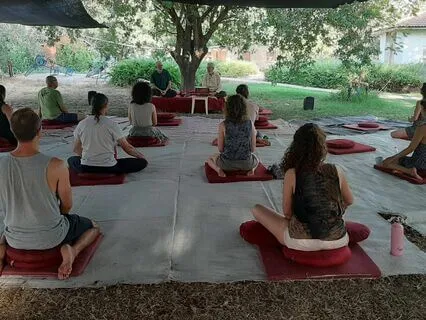
We're exploring the garden of mind and body,
Self and world.
Sometimes in the garden we just need to sit down,
On a rock,
And do nothing.
Thought arises and passes.
And we're just sitting there,
And we're just sitting there,
And the thought arises and passes.
The to-do lists,
The future,
Thoughts of the past,
Very strong sense of me in the middle of them,
What am I going to do tomorrow,
What I did yesterday,
What I have to do in the to-do list.
Now take a step out of the movie.
Saddakhora miyaseret.
This is classic Vipassana.
Iyi his dahut.
Thought coming and going,
And I'm the witness.
Haed.
I know the thought.
How does that affect the stepping out,
The Iyi his dahut?
Our ability to know thought is coming and going is already practice of Anatta.
But we can add to it a little another step.
Who's thinking?
Who's in charge?
Who's looking at thought?
Well maybe the witness is not very strong.
There's just awareness,
A space of awareness.
And thought arises and goes by itself.
No strong sense of self anywhere.
Check it out.
Thought just comes and goes by itself.
No one's doing it.
And there's a knowing,
Awareness.
Just knowing that it's happening.
Again,
Deeply relax.
Even when we look in the mind,
We need to feel softness,
Relaxation,
Ease.
From a relaxed,
Easy place of just being present and aware,
It's easier to know thought as coming and going by itself,
A bit like water passing in a river or clouds passing in the sky.
And we'll just take a few more moments,
Come back to the body,
The breath,
Body,
Sensations,
Life,
Ease,
Softness.
Nothing to do.
Nothing wrong.