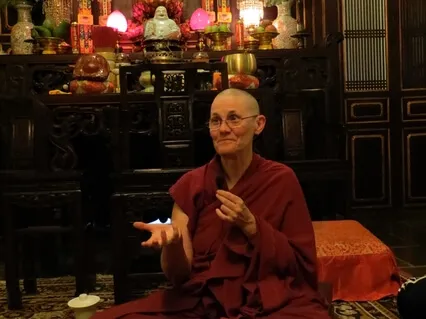
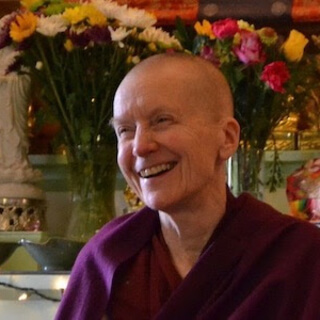
So we're starting a new theme at Daily Dharma Gathering on karma.
And I don't know how comfortable that topic is with a lot of people.
So I thought tonight we'd do a little bit of meditation to start as usual and think a little bit about hmm how this idea of karma fits and then how why it's important for us to actually think about it.
What's useful about it?
So let's just start with some meditation.
So wherever you are in your office chair,
Your couch at home,
In your bed,
Wherever get your spine straight.
If you're not on a cushion on the floor get your feet flat on the floor.
Yeah.
Lift your shoulders a couple of times and drop them up to your ears and then let them go completely.
Yeah.
Again up.
Inhale.
Hmm.
And so we take your meditation posture with your spine straight,
Feet flat on the floor.
In our tradition we practice with our hands in the lap with left hand on the bottom right on the top with thumbs touching like so.
But in your lap right up next to your belly button.
You know some teachers have your hands on the thighs so if that's more comfortable or familiar that's fine.
Shoulders level.
Lips closed but not but your teeth are not clenched.
Your jaws relaxed but your lips are closed and eyes lowered so that a little bit of light comes in.
Not some so much that it distracts you that you see images and so forth but enough that the light can help keep you awake.
So feel your presence in the chair,
Your connection with the floor.
Feel where you are in the room.
Note the temperature.
Notice any sights or sounds or smells but don't fix on them just let them pass through your awareness.
Slowly become aware of your body from the bottoms of your feet,
Up your legs to your knees,
Thighs to hips,
And if you find any tension there,
Breathe into it and just flex it let it out a little bit.
And then be aware of your back starting right at the tailbone being aware of any sensations moving up the spine,
Muscles in your back.
Again if you find any tightness breathe into it you can adjust as you need to.
Move your attention to the front of your body from the pelvis right up to your throat.
Slowly just checking in.
Note especially if there's tension in your belly or in your chest.
Be aware of any sensations in the organs in the body.
And if you find any discomfort or tension,
Breathe into it and let it soften.
Move your attention into your throat and neck being aware of any tightness or tension.
Adjusting as you need to to get into a more relaxed or more natural posture.
Breathe into that too.
And then move your attention into your jaw and face.
Let a little smile just a little little little not a big forced grin but just a little uplift of the corners of the mouth.
Softens the whole face,
Maybe softens the mind too.
And then move your attention to your breathing.
No need to change it just notice it moving in,
Moving out.
Being aware of the texture of your breath if you will.
Fast or slow,
Rough or smooth.
And again without really analyzing or catching on to it,
Just be aware,
Just notice.
Take a few minutes to let your attention rest either at your belly or at your burlet and nostrils,
Either place that you feel the breath.
We'll just spend a few minutes in silence allowing that breath to bring us present to this very moment now.
And then let's set a motivation for our time together.
And as we explore this topic of karma,
Intended action,
As we become more aware of our own actions and their results,
As we adopt a more conscious and conscientious move towards non-harming,
That has a huge effect on the people around us and in the world.
And so let's set the intention that as we explore this topic tonight that the virtue,
The goodness that we generate in our hearts and in our minds together will have this ripple effect that feeds the seeds of our own potential to grow and grow till we're fully awakened.
It also helps to bring about an awakening,
Greater compassion in the world and the people around us.
So all beings are liberated.
And before we end the meditation I want to just give this quote from the Buddha and let that rest in our space of reflection where he said,
Just as the shadows of birds in the sky move along with them,
Beings are followed by the right and wrong they have done.
So think about that a minute.
Birds in the sky,
The shadow on the ground follows the flight.
And just at that same way our actions,
The results of our actions,
The energy trace of our actions follow us and create causes for the future even as they ripen as results.
So I love talking about this topic of karma and it came up in a class I was teaching this week and I recognized that it's not always easy for people.
So I want to speak of it tonight really in terms of the very simple laws of cause and result.
Cause and result.
So according to the Buddha's teachings every single moment of pleasure that we experience comes not from the stimulus that we think but comes from a past virtuous action.
Everything.
Further every single pain,
Suffering,
Discomfort that we experience arises due to a past destructive action.
Cause and result.
It's a little bit hard to grasp isn't it?
Because of course we immediately think if I'm going to eat that ice cream sundae I experience that pleasure as soon as that ice cream hits my mouth.
And then if I have more than two bites personally I go into a lot of misery right away but for some of us it takes a little longer.
But still it's hard to relate that having that moment of pleasure comes from something I didn't cast.
Totally.
But you know even in a non-Buddhist sense we have this idea that what goes around comes around as you you shall reap what you have sown.
I mean we kind of all grew up with this.
So it's not so out of the ordinary to think about this and it's it's very useful to reflect not so much from the past although that's also useful.
But even more useful is looking at now what are the act what are the causes that I'm creating by my actions today.
So we can spend countless sleepless hours trying to decide should I buy this house should I not buy this house.
Should I offer more money should I not offer more money.
You know do I need to have it inspected again.
You know round and round and round about should I do this should I do this should I do that.
Looking for the result that will bring us the happiness of a new home in that case for example.
But in a much and that'll have a big effect on our whole life there's no question about that.
But much more of an effect and also more subtle.
This is this question of how what am I doing with my body,
Speech,
And mind today that will cause my future happiness.
It's not something we ever think about.
It doesn't come to mind.
It doesn't occur to us that what I'm doing today will bring about future happiness or future suffering.
So that's why it's very important to look at this Buddhist idea and go well does this make sense to me?
Does this really work?
So let's talk about it in terms of just cause and effect.
And the gardening analogy is the classic one that they teach in Buddhist texts and it's perfect.
I mean if you want vegetables this summer you have to plant seeds.
This is very clear.
And you know if you'd rather buy your food than grow it then you have to get a job or apply for food stamps or find some other way to do it.
But there but but an action has to be taken that has a result that will lead to the result that you want.
And it's not just that the spinach just rises spontaneously out of the ground.
We have to deliberately put in the seed.
We have to make sure that the soil is fertile.
We have to make sure that it's in a sunny enough spot that it gets enough light.
We have to remember to go out and water it every afternoon or every other afternoon.
We have to keep the slugs away.
We have to make sure the bowls don't come chew it up.
We have to keep the kids and the dog out of the garden.
I mean all these conditions have to come together to get this result of the spinach.
And if we weren't tracking it you know you could very easily somebody who hadn't planted the seed could very easily go out there.
What does it take about six weeks for spinach to come up?
Maybe four before you have something viable?
I don't remember.
But somebody could just go and go oh look miraculous there's spinach growing out of the ground.
Let's eat it.
Forgetting totally that we already planted this seed.
Being completely unaware that we watered this seed.
But in fact that's how the spinach got there.
We planted the seed and we watered it.
And the seed is essential.
We have to have that seed.
If we don't have the seed we just have a plot of nice dirt that we've been watering and whatever.
So we both need the seed and we need the conditions.
Clear?
That part's clear right?
So in the natural world cause and effect requires these three factors.
So first of all things can't and don't come from nothing.
Everything everything arises from a cause.
Everything that exists that is is produced arises from a cause.
It doesn't just come from nowhere.
The other factor is impermanence.
Without the ability to change nothing could produce results.
And then there has to be this potential that is that correlates with the result.
So it's obviously that a pepper seed does not make spinach grow.
Pepper seeds makes peppers grow.
Spinach seeds make spinach grow.
If the conditions are right.
So this logic applies to everything.
There's the physical world and then when we start to talking about karma and its effects we're talking about our mind.
We're talking about our internal world.
Our experience.
Our intentions.
Our motivations.
And then how these affect our experience.
So the main meaning of karma is volitional or intended action.
That's what it means.
Intended action.
And you know we're intending actions all day.
We're just not very mindful about it.
We're intending oh I have a full thirst.
I'm intending to pick up this cup.
That's a pretty neutral action.
I see you know in the mail somebody writes about the feeding the kids for the summer hungry kids for the summer program.
My intention to send a check to them comes from what?
A moment of compassion.
A moment of generosity.
I look at my checkbook.
I don't have much money.
Ten bucks is good.
I send the check.
I look at my checkbook.
Doesn't look so good.
I think I won't send them a check.
Both of those are intended actions.
They may even have a virtuous motivation behind them.
If I go ahead and send the check then this sends forth an energy of generosity that leaves a little bit of a trace on my mind stream.
Kind of like putting a seed there.
And when all the conditions come together that act of generosity reaps a result that is in that is somehow my own happiness.
And they say that in generosity the result is that you also get what you need.
So giving produces getting.
And in the same way if we refrain from speaking a snarky comment well this is actually an act of generosity.
It's an actually it's a virtuous action.
Oh I wanted to say something really smarty to that person and I didn't.
That planted a seed of goodness in my mind.
Whereas I just let it rip.
I say it.
I see their feelings.
Well I just planted a destructive seed in my mind.
That will result someday somehow in my own hearing such kind of harmful speech.
So it sounds like reward and punishment to our ears who are used to hearing reward and punishment.
Somebody says that you were bad.
You were going to either go to hell or to heaven if you weren't bad.
You know that's sort of the paradigm that we live in.
It's very important to separate our minds from from that.
And it's hard to do.
That's why I'm bringing it up.
So that we don't look at this cause and result that the Buddha described.
He didn't make this up.
But he described as a bit on the basis of his awakened mind.
So oh that's why people suffer.
People suffer because their negative action leaves this imprint in their mind and then they experience a result later on.
So when we begin to practice Buddhism or practice really new spiritual practice that says first do no harm.
We're not taking on this thing about do no harm because it's bad to be harmful.
We're not doing it even because we don't want to hurt the other person really.
Why should we refrain from harm?
Because when we harm others we experience a suffering result.
When we act in beneficial ways we experience a happy result.
Sometimes it's not immediate.
You know it's a they say this is so complex that even an enlightened mind only an enlightened mind can know the details of this cause and effect.
Like what exactly I did here that would result in that over there.
But the general trend of plant the spinach seed get the spinach.
Plant the generous act receive generosity.
It's quite logical if we think about it.
And if we look at our lives it's not out of the realm of possibility to see the trend.
If I spend my whole life in a habit of backbiting backbiting backbiting backbiting isn't any surprise that people talk about me behind my back?
None.
None.
If I start to curb my language just a little bit I can begin to see that my mind is different.
If I don't jump into that office bashing at the water cooler at the coffee pot it changes my mood right then.
And then from the law of cause and effect I'm changing the energy that I put forward.
Getting some sense there?
Yeah.
So it's useful it's really usable to think about this.
There it's a very detailed and large topic to look at in great detail.
Now we won't do that tonight obviously and that may not even be necessary but to start with these ideas there's four factors or characteristics of this volitional action karma that are good to remember.
One is that karma is definite in that virtuous actions result in happiness.
Non-virtuous actions result in suffering of some kind.
Which then makes a study well what is a virtuous action what is a non-virtuous action?
But that's another lesson.
But in some ways we also know right away.
We know if we're speaking out of anger.
We know if we're speaking out of love.
Simple.
The second characteristic is that karma is expandable and that simply means that a small action can lead to a large result.
The analogy most classically used is that a small acorn can lead to an enormous oak tree.
Maybe we've seen in our own lives that making a tiny little lie can lead to a huge fiasco.
Third we will not experience the effect of an action we haven't done.
So if we're wishing wishing wishing wishing wishing wishing wishing that we could I don't know have enough money to have dinner.
If we haven't created the causes if we haven't practiced generosity in our lives in the past.
We're talking multiple lives here too so that's a context.
But even this very life if generosity has not been our way of thinking then to expect that miraculously things are going to fall into our lap doesn't make sense.
And then the fourth one is actions that we do are never wasted.
Which means that whether if we do a strong negative action in this life sooner or later this life or a future life will experience a result from that action.
If we don't purify it it can be purified it can be purified so don't don't don't go into oh no what am I done?
Because why because we're talking about the mind we're talking about our experience.
When we look at when we talk about Karma so it's so easy to think it's all external actions and that doesn't make any sense.
But if we think that this is we're talking about our mind a seed we're planting in our own mind that results in the experience that we have in our own mind then it starts to make more sense.
You get what I mean?
So it's parallel to the spinach goes into the dirt and becomes a plant.
But we're not talking now about chemicals and elements we're talking about consciousness.
Same logic different medium.
So it's useful I want to go back to the we're all right at the end I want to go back to the verse from the very beginning as just guideposts to meditate on.
Something to reflect on it's a condensation of the Buddhist teaching here.
Just as the shadows of birds in the sky move along with them beings us are followed by the right and wrong they have done.
And then I will add not as punishment and reward but simply cause result.
Takes all the moral judgment out of it.
It's also the guilt and shame.
Simply cause result.
Very clean.
Very thinking.
Yeah it's big but in a month of karma why not start with the basics.