So I'll lead you through a short body scan to relax,
Let go of any tension there may be in the body.
And then we'll have some silent meditation for a while.
You can meditate on the breath or whatever practice you would like to do.
And then I'll lead a meditation,
A guided meditation.
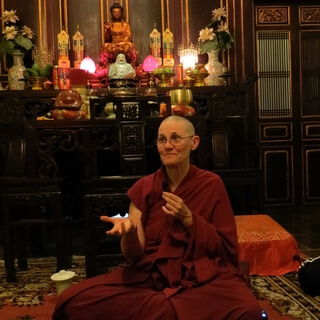
So you can imagine the Buddha in front of you or just think of the statue of the Buddha that's behind me and try to feel the presence of the Buddha.
So it's hard to really know what that would feel like,
But Buddha being somebody whose mind is completely pure,
Free of all negative thoughts and attitudes like anger,
Greed,
And ignorance about the way things exist.
So all such attitudes have been totally eliminated from the Buddha's mind.
But there's only positive qualities,
Universal,
Unconditional love and compassion for all living beings,
Each one of us.
So each and every one of us is the object of the Buddha's compassion and love.
And it's similar to love that parents,
Mothers,
And fathers feel for their children,
But millions of times stronger and more pure than that.
And it's always on.
I mean,
Buddha's compassion and love is always there for us.
He's always aware of us and ready to help us and completely dedicated to helping us.
So it's good to try to feel that,
To feel you're in the presence of somebody who has no negative attitudes like anger,
Greed,
Selfishness,
And only pure altruistic positive qualities for us and everybody else.
And he's there to help us.
So yeah,
If you can,
Imagine that,
Feel that.
So whenever we meditate or do other kinds of spiritual activities like listening to Dharma teachings,
Reading Dharma books,
And so on,
It's always ideal to have a positive altruistic motivation for the things that we're doing.
So some of you may have already generated such a motivation earlier today.
You can just refresh that,
Remind yourself of that positive motivation.
And if you haven't already done so,
Then just bring into your mind whatever positive thoughts you're able to have towards yourself and all other beings wishing to bring benefit,
To not harm,
To help in a long-term way,
In a spiritual way,
Helping yourself and others to reach higher states of mind,
Such as enlightenment or at least greater compassion and love and wisdom so that we in our lives and our actions do what's beneficial and meaningful and are able to avoid doing things that are harmful,
That just bring more suffering to ourselves and others.
So using your own thoughts,
Your own ideas,
Words,
Then generate a positive motivation for being here and doing the things that we're doing here today.
And then when we meditate,
It's helpful if we can be as relaxed as possible in our body and in our mind.
So let's just do a brief body scan to see if there's any tension anywhere in the body and to let go of that tension as much as possible.
So you can either start at the top of your head and go down or start at your feet,
Your toes and go up,
But just mentally scan your body with your awareness,
Go through your body and see if you notice any spots of tension,
Tightness.
If you do find any,
Then briefly focus at that place and let go of the tension.
Sometimes it's enough just to say to yourself,
Relax,
And then that place will relax.
Or another helpful technique is to imagine breathing into that place.
So as you're inhaling,
Imagine the breath going to that spot and releasing the tension.
So just do that on your own,
Just briefly,
Quickly going through your body,
Relaxing,
Any tension you may find.
Okay.
And to relax the mind,
Just let your mind,
Your awareness be in the present right here,
Right now.
Although that's difficult to do,
There's always thoughts popping up about things that happened earlier today,
Yesterday,
And so on in the past,
Or thoughts about the future plans you have for later today,
Tonight,
Tomorrow,
Next week.
It's hard to stop those thoughts from popping up in the mind.
But if they do come up,
Just be aware of them and realize that they are the past or the future and not the present.
So put them aside.
Always pick them up again later if you need to.
But for now,
Really do the best you can to keep your mind in the present,
Present moment,
And place,
And with your body and mind in the present situation.
So for the first part of this session,
Feel free to do whatever meditation you would like to do.
If you don't have one,
A preference,
You can be aware of the breath,
Being aware of your breathing coming in and going out.
So you can focus at whatever place you are able to feel the breath most clearly and easily,
Sometimes at the nostrils or in the abdomen or the chest.
And just let the breath be natural.
Don't control it,
Manipulate it in any way.
Just let your body breathe as it normally does.
And just try to be fully aware of each inhalation of the breath and each exhalation of the breath and any pause there may be in between.
And if the mind wanders away,
Which it probably will,
Get distracted by thoughts that come up in your mind or sounds that you hear in the room or outside or other feelings in your body.
So other things might take your attention away from your breathing.
That's normal.
Don't be surprised.
But when you notice that's happened,
Just gently and patiently let go of that other object that has distracted your attention and bring it back to the breath.
And even if you have to do this again and again,
Bringing your attention back to your breathing,
Remain patient with yourself and try not to get upset,
Discouraged.
That itself is meditation.
Coming back to the breath when the mind wanders away is itself meditation.
So don't get discouraged and think,
Oh,
This is too hard.
I can't do this.
It's not working.
Just feel that you are meditating.
You are doing something useful,
Something beneficial by noticing when your mind gets distracted and bringing it back to your object of meditation.
And you can count your breaths.
That's helpful.
You can count up to five or up to ten or whatever number you wish.
Just keep counting in rounds of five or ten.
That is a helpful way of staying with the breath and keeping track of your mind,
Where your mind is.
So do that for a while and then I'll ring the bell softly before we start the next part of the meditation,
Which will be a guided practice.
Okay.
Thank you.
Thank you.
Thank you.
Thank you.
Thank you.
Thank you.
Thank you.
Thank you.
Thank you.
Thank you.
Thank you.
Thank you.
Thank you.
See if you can imagine what it would be like to be free of those kinds of thoughts and feelings of non-forgiveness.
Is that something you would like to do,
A place you would like to get to?
It's helpful to recognize that holding on to anger and resentment and non-reliance is non-forgiveness.
It makes ourselves suffer.
So we're making ourselves suffer by not letting go of these thoughts and feelings.
It's a bit like holding on to something in our hands that's hot and painful and even though we're feeling the pain of this hot thing in our hands,
We just can't let it go.
But in fact,
We can let go of these painful thoughts and feelings.
We don't have to hold on to them.
We do have a choice.
One reason it can be hard to forgive is because we think,
But what that person did was wrong.
They shouldn't have done it.
And we may think that in order to forgive them,
We have to give up that idea.
We have to stop thinking that what they did was wrong.
But that's not true.
We can continue to maintain the view that the person's behavior was wrong,
Harmful,
Unethical or whatever,
And we can still forgive them.
Forgiving doesn't mean saying,
Well,
What you did was fine,
No problem.
Forgiving means deciding to stop being angry about it.
We realize that anger doesn't help anybody.
It only causes suffering for oneself and for other people who might be around when we're venting our anger.
So the great Indian master Chandrakirti wrote in one of his texts that being angry about something that already happened in the past will not undo what was done.
What was done already happened.
We can't go back and change it.
So continuing to be angry about that is quite useless.
So see if that makes sense to you and see if you can feel the wish to let go of anger.
So if you do feel that way,
Here's some suggested thoughts you could bring into your mind,
But feel free to change the words and the ideas to ones that are more comfortable for you.
So you can think,
That person did things that were wrong and harmful,
But I understand that all of us ordinary unenlightened beings have disturbing emotions in our mind that we can't always control.
Sometimes they arise in a really strong way and take over our mind and we do stupid things.
So this is something that happens to all of us because at this point in time we lack wisdom and mindfulness and have strong negative habits.
I myself have done stupid things.
So I know what that's like.
I've been there and done that.
So it is with this person.
They probably feel regret for what they did,
Even if they don't show it.
Deep in their mind they probably do have awareness that they did the wrong thing,
That they caused harm to others.
But maybe another afflictive emotion,
Pride,
Arrogance,
Is stopping them from showing it.
And I can't change anybody else.
I can't change other people's minds.
I can only change my own.
If I continue to be angry and hold on to resentment,
That doesn't help anyone and just makes things worse.
So I'll try my best to let go of these and learn to forgive.
And eventually I might even be able to feel compassion for this person and want to help them.
So even if you're not at the point right now where you're able to do that,
You might be able to feel the wish to reach that point at some time in the future,
To learn forgiveness.
And finally,
As a conclusion to the meditation,
Check how it felt to contemplate in this way.
And if it does seem like a wiser and more satisfying way of dealing with difficult people,
You get upset at including politicians and public figures,
Then make the resolution to try to adopt these kinds of thoughts and work towards forgiveness.
And let's mentally dedicate the positive energy of doing this meditation.
You can just think to yourself by the merit,
The positive energy from doing this meditation.
May it help myself and all other beings to overcome anger and other afflictive emotions and to increase positive emotions like compassion and love,
Wisdom and forgiveness.
That's mind.
.
.