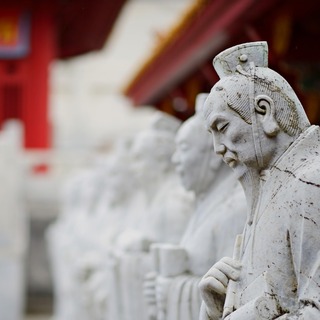
The ancient master Lao Tzu,
Who wrote his book the Dao De Qing 2,
500 years ago,
Says this in chapter 16,
Allow yourself to become empty.
Abide in stillness.
The ten thousand beings rise and flourish while the sage watches their return.
Though all beings exist in profusion,
They all end up returning to their source.
Returning to their source is called tranquility.
This is called returning to original nature.
Original nature is called constant renewal.
To understand constant renewal is called illumination.
To not understand constant renewal is to invite disaster.
To know the unchanging is to be enlightened.
To embrace the eternal is to be all-encompassing.
To be all-encompassing leads to nobility of spirit.
To be noble of spirit is to unite with heaven.
To unite with heaven leads to union with Tao.
To attain union with Tao leads to immortality,
Living eternally without fear.
So by abiding in stillness in both body and mind,
The practitioner is able to observe the world around them without being caught up in it.
Hsuan-Gong,
Another ancient Taoist master,
Says this step teaches us how to return to the root.
Because all things are born into being only to return to non-being or their source,
They quote,
Return to the root.
Lao Tzu calls this returning to source tranquility or jing,
As jing can also indicate peace or harmony.
This state describes how things return to their original nature so they can experience constant renewal.
To try to go against this constant renewal only invites disaster.
At the same time,
The sage identifies with the unchanging root of non-being,
Thereby becoming an enlightened being,
A jenren.
The goal of the self-cultivator is to experience this union with source or Tao and become one with everlasting life to attain immortality.
This reabsorption into the everlasting form of life is the ultimate destiny or ming of us all.
So this chapter refers to the practice of Tzu-Wang or stillness meditation,
The aim of which is to refine our thoughts.
Other definitions of Tzu-Wang are sitting in oblivion,
Sitting in forgetting,
And fasting of the heart-mind.
The ancient Taoist master Zhuangzi offers profound instructions for this practice.
You must center your heart-mind in perfect harmony.
Do not listen just with your ears,
But with your heart-mind.
Do not just listen with your heart-mind,
But with your spirit or Shen.
Hearing stops with the ears,
Thoughts and ideas stop with the heart-mind.
Your spirit,
Though,
Resides in stillness and is open and receptive to all things.
True knowledge or Tao resides in stillness and emptiness.
To attain this emptiness,
One must use the fasting of the heart-mind.
Tzu-Wang is a form of concentrated meditation in which the practitioner is said to achieve quote the mind within the mind.
We do this through seeing and listening with our spirit or Shen.
The insights that arise from this kind of practice are manifold.
We free ourselves from the hooks of the world and embark on what the ancient Taoists called free and easy wandering throughout the cosmos.
People new to stillness practice often have two problems.
One,
Too much thinking.
Two,
Feeling sluggish or even falling asleep.
If you want to get benefit from your meditation,
You need to address these problems.
Meditate when your energy is relaxed,
But not too sleepy.
If you begin to feel sleepy during meditation,
You can open your eyes more or rub your palms together and then rub your face.
Practice a moving meditation such as Tai Chi or Qi Gong.
Before you meditate,
This will give your energy a way to slow down without becoming sleepy.
During Tzu-Wang practice,
We are able to quote forget ourselves as a finite being and instead connect with ourselves as an infinite being where there are quote authentic self.
Our internal self emerges into the light of the external world.
Then by carrying that experience perspective into our daily lives,
We become free from the entanglements of dualistic mind that tends to run our world.
Instead we live our lives in a state that Drunk-Za calls free and easy wandering.
Or sometimes called free and easy roaming.
So the practice,
Sitting and forgetting.
As you have in other practices,
Put your mind's intent down into your lower Dan Tian.
This is a good way to quiet the mind,
Getting your focus out of your head and into your belly.
By paying attention to your breath moving in and out of your lower abdomen,
Expanding with each inhale,
Contracting with each exhale,
You give your mind something to do instead of running wildly with too many thoughts and thoughts about those thoughts.
Counting your breaths up to 9 or 36 but no more than that can also help focus the mind.
Pay close attention to your posture during meditation.
You need to sit up straight,
Either on the edge of a chair or on your cushion.
The more you slump,
The harder it is for the chi to travel through your body.
Your head should be pulled back a little so that your skull rests on top of your neck.
The tip of your tongue should be on the roof of your mouth.
Close your eyes halfway or all the way,
Which is called lowering the curtain in Taoist practice.
It is said that the eyes open to the heart or the Shen or spirit.
When you disengage your eyes from the outer world,
It is much easier to use inner vision to bring internal illumination to your being.
Sit in silence and quiescence,
Not thinking too much,
Yet not trying to force yourself not to think.
Sit with a spirit of lightness and groundedness,
With joy in your heart and peace in your mind.
Sit with inner and outer relaxation,
Not trying to accomplish anything,
Just relaxing into the present moment.
Do this for at least 20 minutes,
Following your breath as it enters and leaves your body.
Let your spirit or Shen become light and let your belly or Dantian become soft and open.
To finish your meditation,
Bring your palms together and rub them together briskly 36 times.
Then place your warm palms or your Lao-Gung points over your eyes.
Take a few deep breaths,
Breathing the warmth of your palm into your eyes,
Then all the way into your brain,
All the way to the center of your brain,
To your pineal gland.
Do not enter the world of action right away.
You will be very open and sensitive for a while,
So it's best not to immediately engage with the outer world.
Be gentle with yourself.
Be open with yourself.
Be at peace with yourself.
The insights and inner experience you receive with this kind of practice will change over time.
Don't be in a hurry and don't be disappointed if you don't get a lot of special effects from your practice.
Practice diligently and regularly and you will begin to experience the fruits of your practice.
Remember you have all the time you need.