Step through the frames of famous paintings in tonight's meditative sleep story.
Sleep and Sorcery is a folklore and fantasy inspired sleep series.
My name is Laurel and I'll be your guide on tonight's fantastical journey.
Sleep and Sorcery is one part bedtime story,
One part guided meditation,
And one part dreamy adventure.
Listen to my voice for as long as you like,
And whenever you're ready,
Feel free to let go of the story and make your way into sleep.
If you're still awake as the story concludes,
I'll guide you through a meditation for embracing the liminal.
In tonight's story,
You spend the evening in the Musée d'Orsay in Paris to prepare a new traveling exhibition.
You are captivated by the museum's masterpieces and the tranquility of solitude among them.
But soon,
You find you are not alone,
For the works themselves come to life all around you,
From the paintings of Toulouse Lautrec to the colorful and expressive landscapes of Van Gogh.
Color is all.
When color is right,
Form is right.
Color is everything.
Color is vibration like music.
Everything is vibration.
Marc Chagall.
It's a rapturous vista,
The lights of Paris through the window.
Her color collapses from the saturated daylight hues into a kaleidoscope of darkness.
Only glass separates you from the exhalation of night,
Having hues of intense violets,
Blues,
And greens upon the limestone city.
In the sparkling Seine below,
The diamond flickers of a thousand stars,
The bulbs that fringe the riverboats of diners and dancers,
Bridges lit with gas lamps,
A soft,
Romantic glow,
And the floodlights,
Lemon yellow,
Illuminating the Champs-Élysées,
The Eiffel Tower even,
Straight ahead,
And at the top of Montmartre,
The bone-white Basilica de Sacré-Cœur.
Ordinary glass,
Though it's no ordinary window through which you gaze.
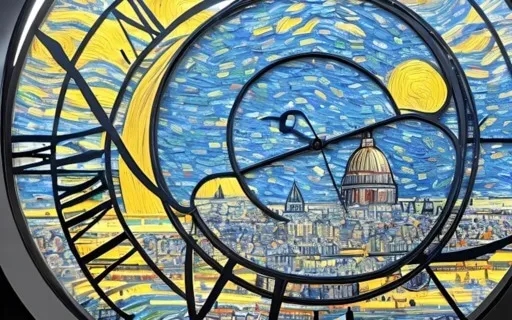
The glass is framed with gears and ironworks,
The makings of a great transparent clock,
So it's as if you peer through the very hands of time.
Paris,
City of love and legends,
Smiles back,
Ancient and forever the laughing youth,
Bright-eyed you drink in the alluring essence of Parisian evening,
Refracted through the clock's glass face till one of the hands obstructs your view,
And you're brought back to yourself.
There's work to do.
The Upper Galleries are hosting a temporary exhibition of the works of Marc Chagall.
It opens next week,
After months of planning and coordination.
After the museum closed for the day,
In the waning hours of early twilight,
You and the collection staff carefully installed the masterworks.
It's deliberate,
Exhausting labor,
Requiring precision and care,
With one-of-a-kind pieces.
Every artwork in its place,
Perfectly arranged according to the curator's plan.
A good exhibition tells a story through its selection and arrangement.
A great exhibition evokes a personal response.
This exhibition,
A retrospective of the renowned painter's works,
Is great.
Even after being present for the catalog selection,
All the meetings to determine the flow of the exhibition,
The transportation logistics,
And the installation process,
Now that you can see the paintings up on the walls,
It sends you on a powerful emotional journey.
You dismissed your staff only minutes ago,
And soon you'll be on your way as well.
There are some plaques yet to mount on the walls,
And some corners to tidy up.
It's all work you're comfortable doing on your own.
That's the excuse,
At least.
But really,
You're stalling,
If only to soak up a few minutes alone in the galleries.
It's a luxury afforded to so few.
So you savor moments like this,
When it's just you and the art,
And the art,
You and the color,
You and the artist.
You finish your menial tasks,
And stand back to behold the work.
Splashes of color,
Oil on canvas.
Chagall's paintings are charmingly surreal,
Inviting you into topsy-turvy worlds.
Fiddlers balancing on rooftops,
Lovers floating above the city.
Abstract forms that coalesce into moving tableaus of folk life.
Your favorite,
And the star of the exhibition,
Is titled Paris Through the Window.
Color dances within it like white sunlight,
Broken into rainbows through a prism.
In the foreground,
A windowsill,
Upon which sits a cat with strange,
Expressive eyes.
There's a figure within who has two faces,
Like the god Janus of Roman mythology.
He was a god of doorways,
Passages,
Portals,
The liminal spaces that mark the threshold between opposites or to other worlds.
And beyond the window,
The city,
Rendered in rudimentary,
Vaguely cubist style,
And flattened perspective,
Towered over by Monsieur Eiffel's iron gate.
A little man clings to a triangular parachute as he floats past the tower.
Two figures levitate near the ground,
Their bodies parallel to the streets.
The lyrical painting,
On Loan from the Guggenheim in New York,
Is so evocative,
Bringing to the surface all the associations you have with coming to Paris for the first time,
The feeling of time collapsing,
The spirit of the modern age coinciding with the city's long memory,
This vibrant,
Musical city,
Muse to her artists and writers,
A chosen home for so many amid worldwide unrest,
A place with its own dark past,
Now mostly reformed in limestone.
There's a tenderness in the painting as well,
A longing for what's lost,
For one's true home,
And all the memories that wait there,
Looking forward,
Out of the window,
And also looking back at what's behind.
You can understand that too.
It's easy to get lost in the artwork,
The delicate play of color,
Light,
And shadow.
The Chagall draws you in,
Spiraling toward its center,
Pulling your perspective lazily back and forth,
In and out of the window frame,
As your eyes swim across the lines and curves of the image.
You could swear you catch a hint of actual movement within the frame,
As if the tail of the cat perched in the windowsill had subtly twitched in the corner of your vision.
Your eyes dart to the cat,
Which now sits motionless in its place,
Just a long day,
You think,
The tired mind playing tricks.
Well,
It's time.
Best to get downstairs,
Sign out with the security guard,
And see if you can catch the metro.
You stroll past the massive,
Glass-faced clock once more,
Viewing time from the inside,
Smiling to think that clockwise,
To the outsider,
His witter shins to you,
And toward the grand atrium of the museum.
The building now occupied by the Musée d'Orsay's extraordinary collection of art from the 19th and 20th centuries was once a railway station,
Designed in the Beaux-Arts style for the 1900 Paris Exposition.
Many of the original features and relics,
Like the magnificent clock,
Remain.
Here the evolving technologies of the 19th century,
Once operated at full capacity,
Now it's a place not of locomotion,
But of stillness,
Sculpture,
Painting,
Decorative art.
It's a perfect place to exhibit the works of art that so defined a rapidly modernizing world,
This gateway between centuries,
This threshold between the old world and the new.
The galleries on the fifth level are your favorite,
So you take the long way to the left.
It's here that the highly recognizable works of Renoir,
Manet,
Gauguin,
Monet,
And Cézanne find their homes.
Millions of visitors flock to these galleries each year to behold the paintings of the Impressionists and Post-Impressionists.
The most popular gallery,
Of course,
Is the one featuring two dozen works by Vincent van Gogh.
By day,
The museum can be crowded and noisy,
Voices echoing across the grand halls of the old railway station.
By night,
Quiet,
And the stillness are thick,
Ringing almost like a resonant church bell.
What would be the harm of wandering through the galleries,
You think,
Just for a little bit before you head for home?
When you first endeavored to study the history of art,
You learned to look for invitations in every painting.
Usually,
You look for a human subject who invites you into the work of art,
Someone who might be staring out of the frame,
Their gaze falling not upon the other subjects,
But upon you,
The viewer.
By connecting with the gaze of the painted subject,
You've symbolically entered many a painting brought into the imaginative world within the frame.
One of your favorites in the museum's collection is famous for this.
Manet's Luncheon in the Grass features several subjects sharing a picnic in a pastoral setting,
At its center,
A woman,
Her face mysterious and lighthearted,
Barely draped in blue silk,
Stares outward beyond the frame.
Drawn in by her enthralling gaze,
You feel welcomed into the impressionistic landscape of shadowy trees and muddy waters.
You meander through the galleries to visit this masterpiece now.
There's the company of picnickers,
Engaged in conversation under the shade of trees.
Behind them,
Another woman bathes in the suggestion of a river.
You lock eyes with the woman in the foreground,
Regarding her like an old friend,
Just the hint of a smile,
Whispers on her lips,
Just as your eyes begin to slide out of focus.
You think you catch a hint of movement on the canvas,
Like you thought you had before,
When beholding the chagall,
You could swear.
Though it can't be so,
That the subject winks at you,
Snapping back to attention.
You can see that the image,
Of course,
Is motionless,
As always,
Only an illusion,
You suppose.
You decide to take a brief detour through the rooms housing the works of Toulouse-Lautrec,
A pop of color and decadence to send you off into the night.
Two monumental canvases frame a passageway between the spaces,
Each depicting an extravagant dance in the legendary Moulin Rouge.
The central figure of the pair is a dancing woman with auburn hair,
Voluminous green skirts,
And black tights.
This is,
You understand,
The famous cabaret dancer Louise Webber,
Better known as La Goulue,
Star of the Moulin Rouge and queen of Montmartre.
Around her,
The spectral figures of guests and other dancers revolve,
Their details more nebulous,
Less colorful,
And even apparently unfinished.
It's La Goulue who draws the viewer's attention,
And it's upon her that the gazes of all the other subjects are fixed.
The Moulin Rouge paintings never fail to make you smile with their frenzied activity and effortless luxury.
As your eyes flit between the two canvases,
Similar in material but entirely different in their framing of the subjects,
You create a kind of illusory motion,
Like alternating between frames of a film reel,
Or watching the stationary images in a zoetrope form a connected sequence before you.
It's as if you're part of the dance,
Moving in concert with the frozen images,
Bringing them slowly to life.
You feel a prickling sensation at the back of your neck,
A rush of goosebumps over the skin of your arms.
Great art can provoke a physical reaction as well as an emotional one.
You know this better than anyone,
But this feels different somehow.
Perhaps it's the unusual circumstances,
The almost mischievous quality of roaming the museum's empty galleries after dark.
Everything feels heightened when you're just one ordinary person,
Granted private audience with some of Western art's greatest masterpieces.
But it's more than that.
You've felt it all this evening,
A sense of standing on a threshold between known and unknown,
A wrestle of skirts and a twisting of bodies.
Now you can't even shake it away or deny it.
The subject of the painting to your left is moving,
Two-dimensional upon the canvas,
Flickering like unsteady animation.
She is dancing,
Kicking her legs and clapping her hands.
You glance to the right at the companion painting.
This too is marked by quivering motion.
The subject twists and kicks a leg upward,
Catching it in her hand in a supreme act of balance.
Her viewers,
Men in silk top hats and women in furs,
Are beholding her with eyes enwrapped.
You look back to the painting on the left,
Where La Goulue still dances her irreverent can-can and revelry commences all about her.
Your heart comes alive in your chest.
What wondrous magic is at work tonight?
Or have you fallen asleep at your labor and stepped into dreams of dancing girls and Parisian landscapes?
But now comes the moment that truly takes your breath away,
For the exuberant can-can dancer is turning to look upon you beyond her frame.
Out into space she gazes and finds you,
Her witness.
Her powdered face splits into a delighted grin,
Eyes wide and sparkling.
Then she reaches an arm out toward you.
At first it's foreshortened,
Flattened onto the plane of the canvas,
But she leans forward gracefully through the chaos of the painting's energy,
And you're awestruck to see her fingers break through the frame.
Her hand,
Though three-dimensional,
Is roughly outlined and filled in with painterly hues,
Like thick textured brushstrokes layered upon one another.
It makes you think of those amusing works of art that use the technique called trompe l'oeil,
An illusion that makes it look like subjects are climbing out of their frames,
Or turns a two-dimensional ceiling into an expansive celestial realm.
You hesitate for only a fraction of a moment before reaching out to take her hand.
Her grip is strong.
You feel weightless as she immediately tugs at your arm,
Pulling you headfirst over the threshold of the frame,
And you brace yourself,
Closing your eyes past the plane of the canvas.
Before you can bring yourself to open your eyes and find your footing,
You're met with the sounds of music and revelry,
The can-can,
Lively and floating over the echoes of laughter and cheers.
At last,
You blink your eyes open and the scene washes over you.
You're standing on the dance floor of the Moulin Rouge,
Indeed,
And clearly you've stepped back in time to la Belle Epoque,
The indulgent 1890s.
But more exhilarating than anything,
The dancers and guests that twirl around you are made not of flesh,
But of oil paint.
They are indistinct,
Impressionistic renderings of people,
Swept away in dance and the gesture of the brush.
The whole spectacle,
From the floors to the glowing lanterns on the ceiling,
Is composed of the feather-fine flourish of the artist's hand.
The flat world of the canvas unfolds into stereoscopic space through which you move,
Unencumbered.
And there is La Goulue,
The can-can dancer,
Louise Webber in her billowing skirts,
Red hair piled high atop her head,
With strands falling across her shining face.
She twirls across the dance floor,
Delighting the guests.
Brushstrokes and fuzzy outlines,
Blurred faces and meticulous details slide back and forth,
In and out of each other,
As the scene forms and reforms itself,
Almost like a stream of consciousness.
You watch the dancer halt before a table of gentlemen,
Her skirts still bounding even as she stops.
To melodic laughter and shouting,
She leans forward,
Scoops up one of the guests' drinks,
And holds it to her oil-paint lips,
Downing it in one gulp.
There's raucous applause as she places the empty glass before the patron,
Whose eyes glitter up at her.
Your eyes now float to the obscure masses that surround the elegant ballroom here and there.
In the indistinct puddles of paint emerge detailed figures and faces,
Which soon return to the crowd.
You feel a tender tug at your heartstrings when one form sharpens from the muddle of color and shade,
A small but stately man in a great coat and bowler hat bespectacled and clutching a cane.
He looks on at the dancer with a bemused expression.
The way he taps his foot,
Almost imperceptibly,
And the incline of his head suggest he might be humming along with the music.
You sense that he wants to dance along with La Goulue and her fellow cabaret stars,
But something is holding him back.
It's the artist himself,
Henri de Toulouse-Lautrec,
Painted almost as an afterthought into the blurred background,
Always a witness,
An observer,
An outsider within.
Something about the smiling self-portrait hidden among the masses is more captivating to you than La Goulue herself,
But soon he too fades into the layers of moving,
Dancing paint,
The twirl of the dance,
The shifting shine of the lights up above.
It's a whirlwind of elegance,
Pleasure,
And music,
The captivating sounds,
Sights,
And smells of La Belle Epoque twist around you like wind made solid,
The halls of the Moulin Rouge filtered through the artistic flourish of Toulouse-Lautrec.
You've always wondered what it would be like to live,
Even for a short while,
In the minds of the great artists,
And now you have a window into the sublime.
La Goulue continues to delight the guests of the Moulin Rouge,
But your eyes fall on another figure who haunts the oil paint cabaret.
She's well-dressed,
With a sizable black feathered hat atop her head and black satin gown.
This is Jane Avril,
You realize,
The next up-and-coming star of the Moulin Rouge,
Who will take the place of Louise Webber after her retirement.
You follow Avril with your gaze as she swishes across the ballroom floor,
Leaving splashes of paint in her wake which disappear into the scene or are swept up by dancing couples.
She's moving toward a door beyond the crowds.
You follow as she slips through the door into the Parisian night.
You can see the twinkle of the lights of Montmartre without.
Why not step outside and see what fresh air feels like in this artistic world?
So you too slip through the door,
But it's not out onto the hilly streets of Montmartre that you emerge.
Your feet land on tender green grass,
And instead of dark,
Sparkling night,
It's soft,
Wispy morning.
The sunlight streams in pinks and yellows,
Cascading like ripples in a clear pool.
Indeed,
Everything around you is bathed in this shifting,
Caressing light which alternates in its glimmer with shadow from beneath.
The whole scene thus seems to breathe before you,
Delicate and impermanent.
You step onto a sweet wooden bridge,
Its arc a gentle swell over a pond.
Willows weep into the pool,
Brushing its surface with the lightest of touches.
Reflected in the water are all shades of green and blue and white,
Undulating with breeze and the disturbance of water-skipping insects.
Oh,
And here and there,
Your heart flutters to see them.
Upon the surface of the pond are green lily pads,
From which bloom pink and white water lilies.
You've stepped from one painted spectacle to another,
It seems,
From the pleasurable underworld of the Moulin Rouge right into the garden of Claude Monet.
At Giverny,
Everything here is alive and in motion,
Quivering under the changing light of day,
And everything blends,
Assisted by the movement of the light and the breeze.
Into everything else,
There are no defined borders or outlines anywhere,
But an interconnected web of water,
Wind,
Blossom and leaf.
It's so hypnotic,
The interplay of rosy color and multifaceted light,
That you even feel yourself begin to melt into the landscape,
As if there's no place where you end,
And the living painting begins.
You are one,
Breathing with the essence of nature and her tendency toward eternal change.
You feel as if you could remain here forever,
Watching the water lilies twirl on the surface of the pond,
But you feel an urge to explore further beyond the bridge.
So you travel on,
Finding the bank on the other side,
Drawn toward a field of French tulips.
You part the tendrils of a willow tree,
Creating a doorway to step through,
But as you do,
With an audible gasp,
You realize that night is closing in again around you.
It's a different flavor of night than the one that surrounded the Moulin Rouge,
Or the night that settled over the Seine,
As you watched through the face of the museum's grand clock.
This night is astonishing,
And yet undeniably recognizable.
There's only one artist who ever captured a night so exalted.
Here upon the banks of a river,
Not the Seine,
But the Rhone,
It seems,
In the southwest of France.
Reflected in the running water are glistering streams from the gas lamps lining the opposite shore,
And in the sky,
The stars are not blinking white pinpricks on velvet darkness,
But bright burning orbs of pale yellow and green.
The night sky itself,
A tapestry of hue and stroke.
Intense azures and deep radiant violets kissed with tints of white and shades of black.
It's a starry night over the Rhone,
Through the eyes of Vincent van Gogh.
The river pulsates,
Its darkling ripples lapping at the banks,
Bobbing the dainty boats in the harbor,
And troubling the cascades of light that issue forth in beams.
The sky,
The stars,
Heave and oscillate,
A swirl of color and passion.
It's fragrant,
Too,
With a sense of Provencal urban life.
The wafts of red wine sauces and fresh pastry from restaurant patios,
Flowers freshly cut from the market.
A street performer somewhere sends visible ripples of music,
Light blue and deep crimson through the night.
There's a quiet ecstasy to it,
An otherwise ordinary night in an ordinary place expressed with passionate awe.
It's a sense of the glory of the universe few artists ever captured so well,
That even on a quiet night,
Strolling through a riverside town,
We all tarry beneath the unfathomably vast sky lit by those long-burning torches,
The stars.
It's enough to bring you to your knees,
What it must have been like to paint this marvel.
You pull your gaze from the flickering river and stars to behold your surroundings.
A familiar cafe sits behind you,
Its terrace bathed in a yellow-orange wash from the lanterns that hang in its eaves.
The light plays on the cobbled street,
Scarlet and sapphire,
Within the cafe through glass French doors.
There is a bustle of energy in the blur of oil paint.
One of the doors is open a crack,
The light spilling from within,
Beckoning.
You take the handle of the door in your hand,
But the interior of the cafe dissolves before you.
You find yourself standing right on the threshold,
Teetering there as if on the edge of a windowsill.
Beyond the portal is a vacant room marked by stillness that's almost bewildering after you've traipsed through the coruscating canvases of impressionist and post-impressionist painters.
It's the gallery once more,
With its slate gray walls and solid floors.
It's your world,
For better or worse.
You pause here,
Standing just on the edge of your frame,
Half inside the painting and half outside.
Behind you twist the blissful hues of Van Gogh.
Before you,
The still and silent halls of the Musée d'Orsay.
Then,
Finally and carefully,
You step down from the frame,
Glancing back to regard the painting of the starry night on the Rhone.
You watch its swirling sky seem to exhale,
Coming at last.
Back to stillness,
A moment in time,
Frozen in thickly layered brush strokes,
Yearning for motion.
You,
In turn,
Release a heavy sigh,
Overcome with emotion from the experience.
The floor feels steady underneath you,
Comforting.
You're not sure if you prefer it to the undulating worlds of the paintings or not.
But then again,
The earth is moving,
After all,
And everything is shifting all the time,
Even if we don't see it.
Now you take a long,
Deep breath in.
There's a ghost of perfume in the air still,
The musky fragrance of bodies whirling at the Moulin Rouge,
The flowery scent of lilies and tulips at the garden in Giverny,
The city night's fragrance over the Rhone.
If only you could hold it all with you a little longer.
But now it's gone,
Locked only in your sense memory,
Past the clock,
Where you gaze backward through time to the lift,
Lowering down to the ground floor,
Where you weave through the sculptural tableaus,
The works of Rodin,
Claudel,
And Degas.
In the corners of your eyes,
You think you catch subtle movements,
Breath and gesture between them.
But when you fix your gaze upon the sculptures,
They resume their stillness once more.
And at the desk,
The night guard greets you,
Asks how the installation went.
It went well,
You assure them.
The galleries look.
You search for an appropriate choice of words,
Dynamic.
You sign out,
Wondering in the back of your mind whether the guard stationed here in the dead of night ever visits Monet's garden or dances through the Moulin Rouge or dines at cafes on the banks of the Rhone.
You decide to walk the short way to your place in the Latin Quarter instead of taking the metro tonight.
You stroll along the Seine,
Glittering under the lights of Paris and the fiery stars overhead.
In the chilly Parisian night,
Rife with music and laughter from bustling cafe sidewalks,
You find an inner quietude in such calm and concentration.
You find that the most still and solid things,
The street,
The bridges,
The monuments,
Unfold into dazzling puzzles of light and shadow.
Notre Dame sparkles,
Brown and gray and gold and white,
Its rose window,
A darkened doorway to curiosity.
The sturdy bridge,
Ponce de Michel,
Flickers underneath radiant lamps which cast their streams on the river below.
You see Paris,
Not through the eyes of Van Gogh or Monet or Toulouse-Lautrec,
But through your own authentic impression,
Casting away the illusions of solidity and embracing the ever-changing,
Ever-shifting presence of the phenomenal world.
You move now through the masterpiece of the universe,
Conscious of its many contradictions,
And with blissful acceptance,
Toward your door and onto the threshold of dreams.
Bring your awareness to your breath,
Inhale deeply,
And exhale everything out.
Breathe in,
Letting the breath fill up the belly,
And breathe out,
Releasing everything.
Find a rhythm of deep,
Supportive breath that feels natural to you.
Feel how the breath massages the insides,
And how the exhale lets you relax deeper in your body.
Let it flow for a few breaths,
With minimal concentration,
Just finding that natural rhythm and relaxing as you go.
Let your mind be really soft here,
Acknowledging any thoughts or concerns that rise to the surface and letting them go without judgment or fixation,
Washing them out with the breath.
Now find in the flow of your breath little crests and troughs,
Like the pattern of a wave on the ocean,
Or ripples in a pool of water,
Instead of pausing at the top or bottom of the breath.
Feel how the inhale and exhale overlap and feed into one another,
Creating the energy wave that powers the next cycle,
In and out and down,
Like a wave.
Think of those transition spaces,
The crest and trough of your breath,
As a space of creative freedom,
Unhindered access,
And tender faith.
A space where you're more open to receive whatever comes your way.
A space where nothing is permanent,
All is flowing and changing all the time.
Feel how liberating that can be,
Having faith in only change as a constant.
The transitional space between your breath cycles is a curious,
Liminal space,
A threshold between one action and the next,
One world and the next.
Our world is full of spaces like this,
Doorways,
Windows,
Thresholds,
Choices.
Instead of being something to fear,
These spaces can be a place of comforting wildness and liberation.
As you near the edge of sleep,
The threshold between the waking world and dreams,
Embrace the liminal space in your breath and body,
In your mind and in your surroundings.
Cultivate your own spaces to be betwixt and between your own frame or doorway,
Because sometimes it's by standing in the liminal space that we discover who we truly are.
Good night.