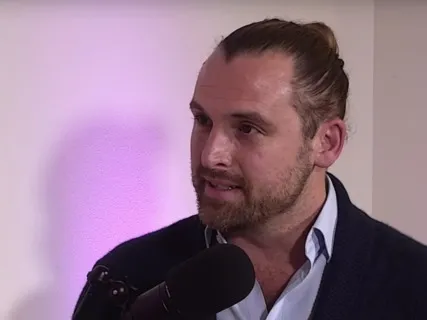
What's up everyone?
Welcome to Simulation.
I'm your host,
Alan Sakian.
Super pumped for this 600th episode.
We will be talking about timeless spiritual wisdom.
We have Dustin DiPerna joining us on the show.
Hi,
Dustin.
Alan.
Hi.
Thanks for coming on the program.
Such a joy to be here.
Thank you for having me.
It's such a joy for you to join us and I'm very grateful that we were able to meet thanks to the meditation retreat that was with Dan Brown and that Michael McCullough was an initiator of bringing me into that.
And I'm so grateful that those teachings are,
That we'll be talking about them throughout this conversation and that you yourself have become a teacher.
And I'm so pumped.
For those that don't know Dustin's background,
He is a visionary leader,
Author,
Meditation teacher,
Founder of Bright Alliance and a recognized expert in world religions who has committed his life to making timeless spiritual wisdom relevant and accessible for a rapidly changing global society.
You can find his main link in the bio below,
Dustindiperna.
Com and also his Amazon profile with all of his books.
Highly recommend checking those out.
Dustin,
Let's start things off with,
We have been so fascinated with understanding the nature of this reality.
What do you think is the nature of the reality?
Great.
Good question.
Let me start by saying congratulations.
600 episodes is a huge feat that takes a lot of will and courage and capacity.
So congratulations.
Really amazing.
600.
Thank you.
What do you think?
What's the nature of reality?
I certainly have some answers.
I'd love to say something about it.
What do you think?
What's the nature of reality?
We were mentioning this a little bit before we started these like four words,
A holographic fractal learning simulation.
It's just a funny way of describing it.
We all have different experiences of reality.
We enact reality moment by moment according to the particular views and perspectives that we take.
Those perspectives are influenced by the culture that we inherit.
They're influenced by our developmental level.
They're influenced by the spiritual orientation we take to life.
So we all have quite different views about the nature of reality.
But from my own practice and from the many amazing teachers that I've learned from,
Things tend to point towards a reality that is unbounded,
Meaning that there is no separation and no limits to that reality.
A reality that's ultimately deeply whole,
Meaning that we're not in a world where separation,
Division and suffering is something that's inevitable.
But there's perspectives that we can take where that limitless unbounded wholeness is one that becomes not only a temporary state that we experience,
But one that can be permanently established as part of our true nature.
So those are the teachings I'm really interested in.
Hopefully we can talk more about it today.
A timeless unbounded wholeness,
Making that the norm on a moment-to-moment basis.
Exactly.
So basically one of the things that I found so incredible is that many of us have had these peak experiences throughout our lives.
One of my dear friends and mentors,
Ken Wilber,
Often says,
Part of the task of spiritual practice is taking these temporary states and developing permanent traits.
And if we can over time train our mind and train the perspectives that we take in such a way that unbounded wholeness becomes the way that we experience day-to-day living,
Then it's more we become a master of our moment-to-moment experience rather than just an athlete who has temporary flow states or peak experiences.
So for me,
The stabilization of those types of recognition is what the game is all about,
Not just moment-to-moment experiences.
Oh man,
The game being so about the stabilization of these types of states of awareness,
I think is such a crucial part.
And we have all of these different options for feeling timeless unbounded wholeness.
All of these different options.
And we get to pick which ones we want to play with and experience these different options on a buffet for this recommuning with this one.
And for certain ones of us,
We'll like certain options on the buffet more than others.
And so it's like we all have different combinatorics of the options for what feels best for us to try to get to a moment-to-moment state of that timeless unbounded wholeness.
But there's dangers along the path.
There's dangers.
I have two main mentors,
Ken Wilber and Dan Brown,
I'm sure we'll talk about at certain points.
I remember being in a retreat with Dan Brown and he was teaching with a Tibetan teacher named Rahab Tokurampashe.
And on the retreat,
Rahab compared today's spiritual sort of buffet,
To use your language,
As this spiritual flea market.
And one of the troubles with the spiritual flea market,
One of the dangers,
Is that you go around and you sample everything,
But you don't actually take anything deep.
And it's been my experience that there's a lot of samplers and a lot of people who are picking sort of what feels good in the moment and what tastes good in the moment.
But there are very few people who are willing to make the sacrifice to take something all the way to its full culmination and completion.
So in my perspective,
I really agree with the Zen's thing,
Which is that if you chase two rabbits,
You don't catch any,
You don't catch either.
So the idea that you have to sort of pick something and go really deep into it,
Of course,
Along the way you can supplement and complement with different paths and perspectives,
But it's really important that you drill the well all the way to water.
Wow.
Chase two rabbits,
You don't catch any,
And also drill the well deep enough to get to one.
We've got to be careful,
There are too many metaphors.
Yeah,
Exactly.
Exactly.
And what I find today,
You know,
I have a lot of exposure,
Particularly here in Silicon Valley and in sort of the larger Bay Area,
And I find that a lot of people are really genuine about their spiritual seeking and their spiritual path.
Sometimes what happens is that people,
When things start to get difficult,
Or if they feel let down by a particular teacher,
Or there's things that happen,
That they sort of give up and they pick something else that feels good in the moment.
Certainly I see this with people who are state chasing around entheogens and other things,
That they have a lot of really positive experiences,
But there hasn't been a way in which they've made them part of their everyday life.
And certainly there are people working with those who have done that,
But there's a lot of people who haven't.
Wow.
So it's equally as important for when we are,
Find ourselves adventuring into consciousness in this world to both identify timeless spiritual wisdom and also make it the most common baseline of our moment-to-moment experience.
There's a very simple model that's been really influential in my life,
And that's a model that looks at spiritual intelligence.
Paul Tillich,
As a theologian a number of years ago,
A few decades ago,
He defined spirituality as that which is of ultimate concern.
His work developed in such a way where another theorist named James Fowler took his work and started to say,
Are there actually stages of faith development or stages of spiritual development that develop over time?
And to your point,
What we find is that spirituality and spiritual realization,
If we want to talk about something that's deeply experiential,
Has to be the underpinning or the fabric that we orient our whole life around.
I used to say the escape velocity of the ego is that you have to give everything to it.
So you have to actually want spirituality,
You have to want realization more than anything else or else we're taking refuge in rainbows,
As I say,
Which we can talk about.
Wow.
The ultimate focus of our adventure into consciousness is spirituality and making that a norm in our social fabric where it's fun and it's playful and it's on and it's happening.
Your flea market analogy,
I was going to say it's happening on the street corners just like our fast food is happening on the street corners.
But like you said,
Not chasing 7,
000 rabbits,
But maybe,
You know,
There is spiritual pluralism,
Namely important,
But also finding what works.
So after sampling,
Finding what's working and then kind of drilling down for water.
Exactly right.
So again,
Mixing metaphors,
But I think it'd be helpful if I said a little bit about the stages of spiritual development that James Fowler unpacked and other people.
It points to exactly what you're talking about.
So when we begin our spiritual journey,
We tend to inherit the beliefs that we've been given from culture,
Family,
Etc.
And that's where most people are.
They've just inherited beliefs and they haven't really reflected on them.
They haven't changed them or adjust them.
They just are doing what they inherited.
As people begin to mature,
They move out of a just inherited form of spirituality to one that's actually self reflexive,
Meaning they take a moment and they pause and they think about it and they say,
Well,
Is this really what I believe or is this just what I inherited?
Usually during that phase,
One of two things happens.
Either one,
People reject the spirituality altogether that they've inherited because they rebel against it.
Now that they realize they've inherited something they didn't do consciously or they just take a bit more critical view of it,
But still potentially embrace it.
Or I guess there's a third option.
People begin to explore other options.
So as you move into that third level where you start to explore other options,
It's what you describe where spirituality becomes pluralistic research to see,
Well,
There's something similar in this tradition and similar in this tradition.
You begin to look across multiple different traditions,
Seeing similarities,
And I think that's awesome.
Super helpful,
Super good.
And at the same time,
There are fundamental differences across different traditions and faiths and it's not necessarily the case that all paths actually lead to the same end or the same result.
That's something that many people say from a less informed perspective because it sounds really nice and the pluralistic orientation is that all paths do lead to the same place,
But paths actually are quite different and actually lead to different types of realizations.
Now that doesn't mean that that's a bad thing because what we found through research and my mentor Dan Brown at Harvard was one of the pioneers of this,
Is that even if the results of the past tend to be a little bit different based on the biasing perspectives of the traditions,
There is some deep structure to a spiritual path that actually is similar across traditions.
So then we need to make a distinction between the deep structure of spiritual awakening and the surface features,
How it actually presents and the realizations that unfold.
But I don't want to get ahead of myself because as we look at that pluralistic view,
What then starts to happen is that we say,
Oh,
There are enough similarities where I can take a path extremely deep and I can supplement and complement with the different aspects of the tradition that aren't supported as strongly within my tradition.
So we're not just looking at a buffet,
But we're looking at a path where we can go really deep in one and supplement.
And I think that actually is an extremely helpful orientation because it's not saying that we have to be exclusive.
We can actually be quite inclusive of other paths,
But it's to say that I'm willing to commit and go all the way in one path and supplement it across different paths and different traditions.
So I find that really useful.
That's James Fowler's work and I've written many books that incorporate those particular worldviews.
Okay,
So as we endeavor into consciousness,
We have initially these stages of development where culture,
Our family,
Act as primary forces on what we think spiritually.
Then there's a reflective process where we think of maybe happening later in our lives.
For me,
This is a very like 20s thing that happens.
Yeah,
Actually we start to gain that capacity between nine and 12,
That capacity for that type of reflective thinking.
So some people reflecting on their own experience,
Listening to this may find that like even in their early teens,
They started to reject the inherited spiritual systems that they received.
So yeah,
For other people it's older,
But we can happen at many different times in life because it's important to remember,
Alan,
We have different lines of development.
Meaning,
That we have a spiritual line of development,
We have moral lines of development,
Cognitive lines of development.
These things all can develop independently.
And so some people's spiritual development might not be as evolved as their cognitive development or might not be as evolved as their moral development or their ego development.
So we have to make sure we're looking at this in a sort of a broad and more sophisticated way.
Some people might do that in their 20s,
Other people earlier.
Some people in their 60s.
Yeah,
This is probably very commonly felt and experienced in our society with how we talk about something like someone with really high IQ and someone of really high social emotional intelligence,
EQ.
And so this is a very common way of now starting to see our world.
And so we talk a lot about being able to mix polymathy with empathy or EQ.
And when you can really mix those two together,
You can achieve great things.
But IQ can also be very deep depth in a specific field.
But just now when you say that,
Many of us now have an opportunity to kind of reflect and be like,
Well,
Where am I on my spiritual path versus my cognitive path versus my emotional path,
My physical path.
There's well,
You know,
All these different well-being social path.
There's all these different like well-beings or paths that can then we can see what stages of development we're at in them.
And to continue on that last point just a little bit more,
When you have the influences of the early stages of development,
When you start reflecting and seeing 9 to 12,
The teens,
The 20s,
When you have this time to like you said,
You may find something that is getting you into the drop merging with the ocean,
Your Greek communion with the one.
And as you do that process,
There's something that's getting you down in the well most for finding water and complementing other paths along the way to continue.
And I think you point to something really important here,
Which is that when people say all paths lead to the same place,
That there may be similar properties of the paths that are maybe around transcendence or around some sort of a communion with something that is transcendent.
But you also said that they don't point to the same place.
And so there are different places that point towards.
Yeah,
Can I give you an example?
I would love that.
So at some point it may be useful to make a distinction between what Wilbur would call stages of development or structures of development and states of spiritual realization.
So at some point you may want to talk about that because there was a bit of a conflation in how I heard you repeat things back.
Then let's do that now because I want to learn on that conflation.
And I think there's also really a lot of usefulness in articulating some of the things you just pointed to.
So when we talk about something like stages of cognitive development or stages of moral development or stages of spiritual development,
We're talking about structures of mind.
And these develop in a predictable unfolding pattern throughout the course of someone's life.
But it's important to realize that these structures of how we orient towards spirituality aren't actually the same thing as the sort of stages of realization or stages of spiritual awakening.
One could be at a fundamentalist or more what we'd call an orientation that thinks that their particular tradition,
The one they've inherited,
Is the only right tradition without reflecting on it.
And they can still have authentic spiritual realization.
So you have to think about two different vectors,
One vector horizontal and one vertical.
So you can be anywhere on that vertical spectrum of development,
But you can still wake up across that horizontal spectrum.
So one of the contributions of Wilbur's work and some of the work that I've tried to continue out is to show that spiritual awakening and spiritual development through these structures is actually are unique.
And the reason that's so vital is because someone could be,
Again,
A fundamentalist,
Meaning that they're not very high in their spiritual intelligence,
But still have authentic spiritual realization or spiritual experiences.
Someone could also be extremely high in their spiritual intelligence,
But maybe haven't had very many spiritual insights or aren't very spiritually awake.
So we need both of these.
One of the simplest ways that I describe this is that we need to be both woke,
Meaning that through our spiritual development,
We understand the plurality of existence.
We understand how systems interact with each other.
We understand social inequalities,
Et cetera.
And we need to be awake.
We need to be both woke and awake.
Woke meaning that we have a capacity to understand the complexity of our current systems and awake,
Meaning that we've come to know ourselves as this unbounded wholeness.
So you can be awake and not awake.
You can be woke,
But not awake and awake,
But not woke.
We need both of those.
Okay.
Okay.
This is helping.
So on a woke-ness is the realization of pluralism on paths.
And then a wake-ness is the experiential wisdom of timeless unbounded wholeness.
That's a good way to articulate it.
Yeah.
It's a bit more complex than that,
But I think for the simple purposes of what we're doing,
It's a great way to understand it.
Great.
Okay.
Interesting.
Interesting.
And I can totally now see where we may accidentally slip into only being one of those two.
And then – Many people are.
Yeah.
Yeah.
Okay.
Interesting.
So many people can understand the polarity of big spiritual traditions or understand the ways in which social context influence sort of inequality and things like this,
Sort of different forms of inequity or social injustice.
That's a very important definition of how we need to become more woke or more developed with our spiritual intelligence and our sort of broad intelligences in general.
But those people aren't necessarily awake to the fact that they are unbounded wholeness with no separation from everyone and everything.
And vice versa is also true.
We know many,
Many spiritual teachers who have authentic awakening but don't quite understand the dimensions of plurality that we're speaking about.
Both of those coexist.
We need both.
Excellent.
Thank you for helping me with that.
That's crucial for my understanding and hopefully for others as well.
And now let's do the examples.
So you were speaking a bit about the differences between how paths may unfold.
I want to give you one example.
One of the teachings that I learned from Ken Wilber early in my 20s was something called the three faces of God.
So I want to unpack that a little bit.
So in our basic language structure we have the orientations using first person,
Second person and third person language.
First person means I or following subjectivity.
Second person meaning thou or an I thou and third person meaning an it.
So different spiritual systems have developed with biases towards these various perspectives.
So for example,
A Buddhist tradition in the way that we've inherited in the West,
It's a little bit different in its native context,
Focuses on a first person perspective.
You trace your own awareness and you trace that subjectivity all the way back to its source which can be this type of unbounded open awareness.
The Christian tradition and the Jewish tradition and the Islamic tradition tend to take a second person relationship towards ultimate reality,
Meaning there's an I thou relationship.
Forms of prayer are often very common in these traditions where there's a relationship with reality.
It's not about tracing your own first person awareness back to its source.
It's about being in such close devotion and relationship with the divine that you actually find yourself merging.
Ultimately,
There's a third person perspective and I like to use Neil deGrasse Tyson as one of the examples of this.
Like someone who's so fascinated with the cosmos.
He's in awe constantly because of how the cosmos is such a miracle.
If we take that orientation,
The Carl Sagan approach or the Neil deGrasse Tyson approach,
We can actually feel the excitement and the awe and the surrender that's released in our being but there's no relationship and there's not a first person subjectivity that you're tracing back.
What you're doing is that you're relating to ultimate reality as a great it,
This amazing,
Amazing unfolding but it's objectified.
Now all those are very different perspectives and they lead to very different types of realization but underneath that sort of surface feature,
The deep structure is similar that it leads towards some sort of opening or some sort of liberation,
Some sort of freedom.
I think that's what's important that sometimes the perennialists who want to say everything leads to the same thing,
They sometimes miss that distinction that there are different perspectives,
What Dan Brown calls biasing perspectives that lead towards different types of realization but the fundamental underlying structure,
There's something,
There's a liberation that can unfold is actually the same across traditions.
Whoa,
Okay.
I feel like I used a transcendence and then you used liberation.
Yep,
You can use either one.
Okay,
Cool.
Interesting.
Often a transcendence of the separate self or transcendence of the individual relative self.
Yes,
Yes,
Yes.
But remember brother,
This is something that's so important for the readers,
Listeners to understand.
Transcendence is always a transcendent include.
What sometimes happens in people who are just being oriented towards spirituality is they start to identify with transcendence and they reject or deny their sense of relative self.
It's really,
Really important that we're a healthy relative self even as we transcend that self into a larger ultimate reality.
So spiritual realization is a process of transcending and including,
Including the relative self but also transcending it to establish your identity as something much whole or wide or larger.
And that reminds me of what Jack Engler says where Jack Linger says,
You have to be somebody before you can be nobody.
Right?
So it's really important to be somebody and then you can step into the fact that you're nobody,
But that nobody then lives through this relative sense of somebody.
And the two aren't separate.
The two are actually the part of an integrated whole.
And there's many people in the spiritual community who I've interacted with and who I've seen who make this air that they transcend and don't include.
So they're spaced out rather than spacious or they're disconnected,
Spiritually bypassing all of the relative experience rather than fully integrated and feeling how painful it is to be a human being.
We want to do both of those.
We want to feel and be totally human and we want to understand fully through our direct experience that we're also much more than that.
Yeah.
As though at the earliest parts of the adventure of consciousness there are feelings of self,
Then there is the exploration of all of the paths and the feelings of transcending self,
And then there's the process of including which is highly around us having a wise moment to moment experience with the self,
The unbounded timeless wholeness.
Also in this previous bit where you're taking us,
There's this layer of liberation that can be reached through myriad processes and we've been talking so much on the program about the beauty of the merging of science and spirituality in a harmony towards the architecting of a more prosperous world.
In a sense that is this,
I really appreciated your breakdown because I've sampled now those three that you listed where we take the perspective of the Buddhist awareness going to source through our awareness through the vehicle itself,
The I-thou relationship with the divine,
And then the being just profoundly awakened to divinity through understanding how a cell works or how quantum mechanics works or orbital dynamics or whatever aspect.
I think for me having felt these different structures has been paramount in my ability to be open and loving and compassionate to other people on their journeys and the way that they're finding their processes.
Yeah,
And how are you orienting now between those perspectives?
Which one is the most resonant for you?
Or maybe it's a combination of all of them.
Yes,
A drop merging with the ocean seems to be the most,
Which is likely the first the Buddhist through the eye.
It seems to be the most common through the eye to source.
Whenever my worldview becomes,
I get a eureka moment in my worldviews,
A lot of times from the drop merging with ocean,
But also from me crying at what are some of these source codes within creation,
Within source that have made this reality and unpacking those with the scientific method,
You see a lot of beauty in that process.
So I'm crying a lot from that as well.
What about you?
That's beautiful.
I'm just happy you shared.
Thank you.
I find that all these perspectives aren't mutually exclusive,
Like you're saying.
We can take that subjective first person view all the way to its end back to source and this sort of broad,
Open,
Lucid,
Unbounded awareness is here that's not separate from anything and at the same time we can be in a radical devotion from this relative self towards a divine or towards the beauty and fascination of the amazing way that the universe unfolds.
And I find that these perspectives enrich each other and that as we develop along the path that it's actually,
There's a fullness that comes from taking all three perspectives simultaneously.
Many people in my experience are impoverished because they've cut out one of these perspectives,
Particularly people in Western culture who were raised in an inherited way.
They inherited sort of a Judeo-Christian orientation and so very naturally as they began to question that they often reject that particular view and they lean towards something like science or something like Buddhism,
So either a third person or first person orientation.
And it's been my experience,
At least in my own life and the people that I've worked with,
Is that when we include that second person perspective,
There's an incredible richness that comes with that.
It allows us to actually be in a loving universe and in relationship with a loving universe,
Not just a magical universe that we're in awe about and not just a universe that is not separate from our own awareness,
But in relationship with the universe in a way that's incredibly nurturing.
And so I really encourage people to explore these,
Particularly if they've had some sort of break or rejection where they've moved into more of this atheistic view because they are scientific or rational.
These all can coexist.
It's really rich.
Ah,
Yes.
It seems as though that may be one of the most paramount things to happen around our world is for the hyper-rational technology builders,
Scientists to experience some of these spiritual paths that may give them a deeper ethical,
Moral or philosophical grounding that will help prevent issues that may come from developing said science and technologies into the world and ensure that they are built for maximizing prosperity and abundance and flourishing.
That seems to be something especially close to the hearts of areas that have such great influence like Hollywood and Silicon Valley to have these experiences that help with what we're actually architecting.
Absolutely.
I mean we have to have right motivation.
We have to have right motivation to create the world that is going to benefit everyone.
And sometimes these experiences that we're talking about can help encourage people to have good motivation because they start to understand the magnificence of reality and that they can be participants in that reality and contributors to it,
Not just people who are consuming and taking for their own sort of selfish desires and needs.
I think it's extremely important what you're saying,
What you're speaking about.
The word reciprocity has been a crucial pillar in my realization of that.
Every breath of air,
Every sip of water,
Every bite of food,
Every shower,
Every show using this equipment,
Every beautiful moments that I get with other people in their eyes,
That having deep reciprocity towards our planet that sustains us towards each other.
How do you keep that mind when you're breathing,
For example?
How do you keep that reciprocity in mind?
What do you do moment to moment or what kind of orientation do you have?
It would be useful for people to hear.
I appreciate the amount of tennis balls that you hit back.
My way… I think it's 600 shows,
You know.
Someone's got to ask you some good questions.
Whenever that does happen,
There's really good formulations on my end that help a lot.
In answer to this one,
I've passed a lot of feeling now on what has been a hydrological cycle or an air cycle that has been here since billions of years prior to me and that I am still today a recipient of phytoplankton and trees that are providing me with the oxygen that I breathe and that the same water that I drink today is what dinosaurs drank.
When I tie myself in like that and when I even sit here and breathe,
That we can melt into those breaths,
The sip of water we can melt into the sip of water.
I keep hearing this word so much,
Practice.
About practice.
Practice that moment to moment timeless unbounded wholeness and then you become that.
But like it's practice.
So that's probably my feeling is that I'm a work in progress towards that.
How about you?
I love those examples of you.
I think they're fantastic.
It's a way that you're bringing it into your everyday life moment by moment if you can remember to do it.
For me,
The key to practice,
To keep building on this term,
Is to remember to practice.
Many of us know what to do,
We just forget.
One of the basic fundamental.
.
.
The key to practice is to remember to practice.
It's true.
One of the fundamental poisons within the Tibetan world that I've been immersed in is ignorance.
It's that we forget.
We're deluded and we forget.
For me,
This is what mentors are all about.
My main mentor,
Dan Brown,
In the world of Tibetan Buddhism and meditation,
One of the first questions I asked him,
I said,
Dan,
You know,
I've had some of these experiences of being this open,
Unbounded awareness.
Is it possible to have that all the time?
He said to me,
That's the whole point.
The whole point is to actually have that moment by moment to not forget.
Because the tendency is to forget over and over again.
There's all kinds of ways that we can build out structures in our life to support that.
But one of the most basic ways to start building it out is through a meditation practice.
If you think about a meditation practice,
You can think of it from the neuroscientific lens,
You can think of it through a peak performance lens,
We are developing concentration,
You're really making your mind fit for flow states,
You can use all that language.
I think for me,
A more profound and a deeper way is that you're actually going to take time to remember.
You're going to take time to not forget.
Because so much of our life is based on forgetting what we know intuitively.
That part of our own awareness,
You know,
It's said many of us have tasted awakening many times before,
But we've just forgotten.
So take time to remember this root of religion,
This root meaning like to rejoin,
To remember.
All of us are just so forgetful.
And so for me,
Practice is simply about remembering and developing the structures in our life and the relationships in our life that help us remember moment to moment.
Then if we remember,
We're in a much better position to help others and to create the world that we want to create.
But if we forget,
And we're acting from all of our unconscious motivations,
Then we're going to create more of the world that we've seen so far.
We have to remind each other.
Yeah.
Moment by moment,
And remind ourselves.
It's true sangha.
Sangha is a word in the Buddhist community means,
You know,
A group of practitioners who are committed to each other's realization and practice.
And sangha,
We're here to remind each other,
Hey,
Don't forget.
My wife tugs on her ear,
And everywhere in public,
And she sees that I've totally forgotten.
She just goes,
Hey,
Wow,
She reminds me,
She helps me remember.
What a cool sign.
Yeah,
We can do it for each other.
Right?
Yeah.
So during the interview,
I might do a little tug or something.
Yeah.
Wow,
For those that are open to taking a similar ear tug for remembering,
Please,
That's a really fun one.
For those also that are open to that,
This is maybe a good question to ask is,
What,
For sangha,
We surround ourselves usually with people that are committed to the practice of remembering on a moment-to-moment basis,
Yet we usually,
As the great quote goes,
If you think you are enlightened,
Spend a month with your family.
What do we do about our parents that we love so dearly,
Yet that don't necessarily want to play the.
.
.
Yeah,
Maybe there's some,
You know,
Maybe there's folks being born,
At least in the last generation,
Who actually had parents who did remember.
Yes.
Who were in good shape,
You know?
Yes,
Yes.
And this is how the evolution of spiritual teachings actually really take root,
Is that you do have parents who remember.
But many of us didn't have parents who remembered.
So I think one of the best ways is to first understand that it's understandable that we forget in the presence of family,
In the presence of teachers,
Or the presence of parents,
Because our relative sense of self was formed in the presence,
In the cauldron of our family structure.
And our relative sense of self being pulled back into that sort of smaller self is often what happens when we're in family.
It's totally understandable.
Wow.
That's how it was formed.
We can have compassion for ourselves.
But as we deepen our practice and we can be hyper-aware and vigilant as we go into those situations,
Then it's natural that we remember more and more in those situations.
It no longer has that kind of pull.
And then we naturally butterfly effect our timeless unbounded wholeness to our… But often it doesn't show up as a transmission of that timeless boundless awareness,
It shows up as a transmission of kindness or something else that's beneficial.
I think there might be people who are fortunate enough to have parents who are open to that.
My parents have both expressed interest in their own ways and that type of thing.
My father sat on retreat with Dan Brown.
He did,
Wow!
Such a special thing for me.
Wow!
That is so neat.
And we've had friends that have said that they've had really strong butterfly effects where their parents have then… there's been a catalyzation of some sort of inquiry from them about the… what's this bliss state that you're… Best thing we do is be an example.
I'm quoting Dan so much just because I've learned so much from him and he's had such a profound impact on me.
He often says,
Better to be a Buddha than a Buddhist.
So it's better to actually be a living example of what's possible rather than try to convince people through your words or language.
We have to really embody it.
We know deep practice and remembrance through conduct and how we show up in the world.
So showing up and being the teachings is the best thing we can possibly do.
Yeah,
That's it.
I love that.
Yeah.
Okay.
Another question that is of great inquiry to me right now,
We've been playing with a lot is,
Is this reality a perfect harmonization or flux of good and evil?
In Tibetan teachings there's a perspective or deity called samantabhadra.
And this perspective is that what it means or sometimes how it's translated is everything good.
And from that particular perspective,
The idea that there's something wrong or there's something evil that you're in harmony with is it's sort of a moot question.
So from that perspective,
Everything is good.
Everything's here to show us our way back onto the path.
But reality itself is constantly trying everything it can to reveal itself to itself.
And if we take that perspective,
Then everything is a gift along the path.
Everything is a gesture of compassion to show us our way home.
So from that perspective,
I don't think that we're in some sort of dualistic battle between good and evil and there's a perfect harmony and these kinds of things.
I think everything from the right view is a orientation to bring us back more deeply and more fully to our own true nature,
To our own realization.
That perspective resonates with me much more and it tends to be a very effective way to live and to practice.
Wow.
So could it be then that this is a perfect pressure cooker,
Reality of perfect pressure cooker for the spiritual path?
Yeah.
The reality is here for the benefit of its own realization through all of us as we experience more and more of its unfolding.
That is the process that's unfolding is that we're in the pressure cooker of realization.
And that if we actually allow ourselves to align as fully as we possibly can with that intention,
That motivation,
Not just to awaken for our own benefit,
But to waken so that we can participate in the fullness of this glorify experience and for the benefit of others,
Then it's a pretty magical universe to live in.
It's hard to live in that perspective all the time,
But that's what remembering is all about.
And when we're not in that perspective,
It's okay.
We forget from time to time and we suffer deeply as a result.
And my dear friend of mine often says,
Pain is inevitable and suffering is optional.
So the ways in which we're hurt and that reality is actually deeply traumatic moment to moment,
It doesn't go away even as we develop deeper on the path,
But our perspectives change.
And there is a point where we no longer suffering when pain arises,
But it actually allows us to feel more fully.
And as we feel experienced more fully,
Our heart opens to feel others experience more fully and becomes this amazing virtuous cycle of feeling and orienting towards a tenderness of what it's like to be human.
While we're also simultaneously recognizing that we're in the pressure cooker of reality revealing itself to itself,
Which is also awesome.
Yes,
Yes,
Yes.
Now,
How does one being born in Columbus,
Ohio and then pursuing Cornell and pursuing Harvard studies of religion,
Getting involved with Ken for 15 years,
Dan for 12 years,
How have you been on the process of navigating to identify and then you yourself,
How do you parse for the things that are working for you?
When I was in my early 20s,
I had spent time living in Paris after Cornell,
I'd moved to India to be a monk.
I'd lived this sort of very dualistic lifestyle,
Eventually settled in Denver,
Colorado,
Where I met Ken Wilber.
And I'd written him a letter and I said,
I really want to come work with you.
I've done all these different things,
But I want to find a middle way.
And his integral Institute at the time was something that really resonated with me.
As I found my way deeper into relationship with Ken,
What I found in him was a theoretical model of how all these pieces that seemed to be separate from me could all fit together into a comprehensive whole.
This what he's called integral theory,
Sort of an integrated worldview was so helpful for me because up until that point,
I had all these different areas of interest,
But I didn't quite see how the pieces of the puzzle fit together.
What integral theory does is it allows you to put all the pieces on the table across all different cultures and throughout time and different epics of time.
And we can then say,
Oh,
There are these patterns that emerge.
This is what it means to be human.
This is what we've inherited through history.
This is what we've inherited as a great human civilization.
Let's build a map and let's build actual practices that act it.
So that's what I learned from Ken on one side.
What I also learned from Ken was that Ken and the way he showed up his loving presence and the way that he was like unbrokenly caring when I'd interact with him,
It showed me an example of what it means to love.
So I have to say from Ken,
I learned two things.
One is I learned how everything fits together,
Which was really useful,
But I also learned how to love.
I didn't know how to love until I met someone like him.
So Ken was what sort of brought me on to a deeper like practice based path,
Meaning that like right now in the moment,
This matters and how I'm relating to you matters.
A few years later I met Dan Brown and Dan was really who like put the rocket fuel in my personal practice because the Tibetan teachings that he's trained in for 40 years and then his clinical practice that he sat at Harvard for also around 35,
40 years.
It was like I had stumbled upon this gold mine of wealth and information,
Both in the clinical side and the Tibetan side.
And I often say Tibet is like the Silicon Valley of the mind.
So Tibetan culture is isolated on this plateau for hundreds and hundreds of years.
And it just became this incubator for transformative practice because the invaders couldn't get in.
It was amazing.
So we have all these practices.
When China came into Tibet and the reorientation happened,
The Tibetans all became refugees and that Dharma spread throughout the world.
It's been this amazing gift.
And so from Dan,
What I learned was like,
Wow,
People have actually come to understand what are the practices step by step that we can do to take somebody from ordinary everyday suffering into a level of practice and realization where they actually experience themselves as this drop merging with the ocean.
They experience themselves as the ocean.
And how do we stabilize that moment to moment?
How do we take that into dreaming?
How do we take that into deep sleep?
How do we allow ourselves to unfold on a path where all of the time we're remembering?
The Tibetans have figured this stuff out.
We don't have to reinvent the wheel.
It's amazing what's built into this tradition that I've been able to learn from Dan and that I'm sharing with others.
So I found my way onto the path somewhat through accident,
But also through just incredible good fortune,
Good fortune that I've met people like Ken and Dan.
This might have been the first time that I heard that the traumas of Tibet,
That Dharma is spreading around the world are actually being viewed as one of the greatest treasures of it being spread.
I'm not sure that's a popular view.
It's the first time I'm here.
Actually one of the most common themes of the different guests that we have on the program is that they've seen their greatest traumas as their greatest treasures.
It's a very common theme.
So we can look at globally great traumas that are great treasures.
Exactly.
Which is very hard to also think about given the great deal of trauma from a transatlantic slave trade to see treasures from like a scramble for Africa or from all the different genocides that have happened across the planet.
It's really hard,
But it's also really important to heal on both an individual level seeing treasures and also on a collective level from these bigger traumas seeing treasures.
That was very interesting what you mentioned and also Ken in many ways reminds me of what it feels like my next chapter that Source is channeling through is meant to be.
There's a lot that is coming into our daily reality as unstructured data and anyone worth their salt in the field of deep learning will tell you that structured data is extremely important and that if you want to make models,
Make fine patterns,
Structuring data like this reality being filled with so much what feels like noise and signal at the same time and being able to structure all the different pockets of signal into a cohesive map or canon of all of the different signals and what people can go and we remove the fog of war,
We remove the veil and we give people ability to see the signals,
Experience the signals,
Find what works for them and go find the water.
You're very fortunate because you've got two that I would say are at the absolute cutting edge Ken and Dan and that's really important for you passing along.
Now you have a great responsibility to continue passing this along and you do.
How many meditation retreats have you co-led?
How many have you done now?
With Dan or just in general?
In general and with Dan.
Many,
Many retreats.
One of the biggest gifts of studying with Dan has been an apprenticeship model,
A model where there is a learning by doing where I sit with him on retreat.
He's right next to me.
We're teaching together.
He obviously has 40 years more experience than me so I'm a baby when it comes to this but he sits me in the seat to actually start learning how to do it.
I'll make a comment.
He'll whisper something in my ear,
A little tweak or correction I could do.
This type of relational based practice and mentorship that I've received is absolutely incredible and I'd say the same thing with Ken and that Ken and I now have a course on Insight Timer for example where we talk about the importance of what we call wake up,
Grow up,
Clean up,
Show up which we can talk about at some point in time.
This whole idea of teaching with somebody and preserving the wisdom that they've been able to come to is something I feel so passionate about.
So for example,
Dan for 40 years has taught with the Tibetans side by side and has helped to preserve these teachings in a way that makes them living and alive in the West not just through book form but through real life sitting next to each other and sharing.
For the past six years of training,
Dan's given me this opportunity to sit with him and to train and to learn and to share that with students.
My hope with all of this is that there's an ongoing preservation of what's come and what we've all inherited.
After that,
It's just like nothing but an unbelievably heartfelt gratitude.
Like you were saying,
The water you drink,
If you can take that orientation,
The dinosaurs drink the same water.
As you drink it,
There's no other experience you can have other than gratitude.
It's like,
Oh,
I'm so grateful you can savor it.
So there's an aspect of my experience that's just so grateful for everything that I've received and how I can express it.
And always what happens with spiritual teachings is that they have to meet the current time and the different dynamics that are present in the current situation.
So in addition to preservation,
There's always innovation.
So it's this dance between preserving the essence and innovating in the most relevant and potent way for this particular moment in time.
So preservation,
Innovation,
And it's that dialectical tension between those two.
Sometimes people lean too far on the innovation side.
When they lean too far on the innovation side,
They forget the preservation.
Sometimes people lean too far on the preservation side and they aren't present with the current context of what's most helpful now in these circumstances.
So of course we need both of those.
I like other people in my generation are in these positions where we're trying to hold that balance and imperfectly as we're doing it,
There's a lot of us who are very earnest in trying to do it well.
Like Tibetan Buddhism meeting TikTok.
Yeah.
What does that look like?
What does that look like?
I don't know what that looks like.
I'm sure we'll find out in some ways.
But there's also this danger in the innovation side that we dilute things.
And so it's always about preserving the essence in the way that doesn't dilute anything.
And so,
You know,
Can we do something on TikTok that won't dilute it?
I don't know.
Yeah.
Yeah.
That's well said.
There have been a couple of those very short videos that I've seen that are trying to communicate some sort of timeless spiritual wisdom in one of the short TikTok videos.
And I think it works more for those that are already somewhere along the path because it kind of causes them to reflect for that little 15 second period.
But one of the things is that then the scroll goes to just the next video,
Which is usually something around like entertainment,
Which can sometimes take us out of that state.
So I'm not even sure how those things harmonize a 15 second like attention video generation organizing with what requires a very,
Very serious focused practice of uncovering the nature of reality through awareness and through breath to source.
It seems to be lots of incompatibilities with the 15 second video scrolling app.
And so that's just something to consider,
But also to try and find.
I really,
Okay.
Let's hit this from where you initially started it,
Which is that you are now responsible for the preservation and innovation simultaneously of what you've been gifted.
And likewise,
I am as well with what we've been gifted on the program,
The preservation and innovation of all of these different things that we've been taught.
And so there's something here that has now come up over and over and over again,
Which is that we're going through an ethnographic condensation where you have 7,
000 languages currently spoken that are half are not being taught to children.
So it's already dropping to 3,
500 and there's just a greater and greater push for people to solely be learning English or learning Mandarin or et cetera.
And so we have also a responsibility to preserve culture around the planet because there's pockets of great timeless spiritual wisdom that occur in many of the first nations in Canada or in the Native Americans in the US or in the plethora of indigenous cultures in Latin America and Africa.
There's just so many pockets that exist like that and that basically indigeneity has been like this is such a common thing on the program,
Curious to hear how you feel about it.
Ninety-nine point nine percent of human time has been in indigeneity and then agrarian society 10,
000 years and then especially enlightenment and industrial revolution 500.
And so to and that's only point one percent of time of being human.
And so to think that all of our wisdom is concentrated in modernity is hubristic,
It's myopic and it needs a humility check.
Not only in sort of the modern era but also in sort of mostly the Western modern era.
I mean there's a,
I used to always give this teaching and it's very imperfect but it's sometimes useful.
So as a sort of a teaching tool,
Pedagogical tool,
Is that what I really aspire to is a deep integration of North,
South,
East and West.
And let me just say a bit about sort of what I see as some of the gifts of these different broad swaths and it's imperfect because none of these communities are homogeneous and they're not monolithic and there's so much diversity within them but just for the sake of broader orientation.
So the Western world has really offered us an incredible,
A few incredible tools,
Many incredible tools but this idea of sort of a rational scientific lens that allows us to actually have a hypothesis to test it out and to check the results that are reliable and repeatable.
This is really,
This is cool.
And this capacity to understand some of the broader unfolding and sort of a process oriented or an evolutionary context.
You just laid out sort of some of the epics of humanity from sort of early indigenous to agrarian to industrial to maybe information to maybe something more integrative,
Etc.
So that's really valuable to sort of see things in these broad strokes.
I think that's useful.
It's one of the gifts of the Western mind.
At the same time,
Some of the gifts that come from say like the Tibetan culture or some of these more Eastern embedded cultures are that the,
If we actually examine our own subjective experience and we actually notice that moment to moment there is an awareness,
Even though things seem to be unfolding in this evolutionary way,
There's an aspect of our experience that's always here.
That's interesting.
Now it's a new moment,
But like there's an aspect of experience that's still right now.
That's aspect of experience that's still right now is here.
When we were a child,
It's here now.
It's now a few seconds later than I first said it,
But there's this aspect of experience that's here now.
You start to understand there's an aspect of our own experience or awareness that's beyond the coming and going of time.
We take that even further,
We start to explore,
We begin to realize,
Wow,
That awareness isn't separate.
It actually is huge.
It's beyond our physical body.
It's unbounded.
It's timeless.
It's unbounded.
It's whole.
We integrate these two perspectives.
We get this timeless unbounded awareness that's also seeing itself show up and evolving within time.
That's very cool.
East and West integration.
From the North and the South,
What I find is that there's these rich traditions,
These rich indigenous traditions that actually are holding wisdom around how we actually come into a deeper harmony with the natural world.
A deeper harmony with the natural world through the way that we eat food,
The way that we build community,
The way that we interact with each other.
Also,
Because of that deep harmony with the natural world,
There's an incredible understanding around medicines and healing,
But also around the ways in which plants and entheogens can actually transform the way we experience reality.
There is this amazing capacity for these indigenous cultures and tribes to teach us about how we be in relationship with each other,
How we're in relationship with the earth,
And how we're in relationship with these amazing kingdoms of plants and animals and minerals.
If there's something about this trans kingdom harmony that comes from the North and the South,
When we combine that view with this evolutionary view and this unbounded wholeness view,
We get a bit more sophisticated orientation to how we might live both in right relationship,
But also with right realization,
And also in the right unfolding of evolutionary time in process.
To me,
That's a much fuller realization.
These are some of the things that I've learned through my study with Wober is that these perspectives can all fit together,
And they're all holding a piece of the puzzle.
One of the things that Wober says I love,
He says,
No one is smart enough to be 100% wrong.
What that means is that everybody is holding some piece of the truth,
And they're also partial.
Everything is true but partial.
When we begin to look at the world with a hermeneutic of generosity,
We interpret the world with a generous spirit.
We begin to say,
Oh,
Well,
There must be some truth in that.
Even if there's a lot of it that might be partial,
There's something true there.
We begin to look at the world with this generous spirit.
We see,
Oh,
Everything actually has something to offer,
Something to contribute.
That to me is the gift of an integral theory is that we begin to see a much more real,
Robust,
And rich,
And pluralistic experience of reality that also is unfolding throughout time in a really incredible way that can benefit all of us and the planet and beyond.
To me,
That's super exciting.
So North,
South,
East,
West,
This is the global wisdom tradition that's unfolding as an integration of all these streams into one great human tradition.
Yes.
Wow,
I really like that.
Yeah,
The North,
South,
East,
West.
What's your experience with some of these indigenous cultures and ways in which we can learn from our,
You know,
The Kogi and the Andes,
The older brothers and sisters of humanity?
Yeah.
There's probably some truth to that.
What's your relationship with some of these different groups of people and whether we look at cultural systems or just your own experience with some of these things?
I really like the way that you framed it.
I think that's a really strong analogy that seems like it's actually very much so on a compass.
They're just so integral to one another and to this new world that we're all part of the evolutionary process of.
My relationships with that North,
South,
East,
And West are,
As you described,
As we've been describing throughout,
That I love the paths in those and that my sampling of the paths of those have been instrumental to my own spiritual path but also my hopefully ability to help empathize with people that are on their paths,
Sampling their processes of awakening,
Relating with them,
Getting into dialectic with them about them,
And then also on the program as well,
Trying to take these great analogies and hopefully have them be a centerpiece of discourse in society because this spiritual path is the path and it is being the fundamental layer in our social fabric would be transformative.
You mentioned this throughout and I think it's so important to point it out.
We talk about this so much that having sitting there with like Dan Brown or Ken Wilber and having a mentor,
A one-on-one mentorship,
Which has so many studies through Bloom Two Sigma and all these other studies showing that you perform just exceptionally as an outlier beyond an average when you have one-on-one mentorship.
And so in this case,
I and other viewers get one-on-one mentorship from all of the guests that come onto the program,
You have the one-on-one mentorship of Dan and Ken in their states of communicating what they hope to inspire other people to awaken with and it's a very common theme for people that come on the program as well to say things like if you want to get involved in a field or an industry or on the spiritual path,
What better way than to tell,
Than to reach out to the people that are at the cutting edge of those fields,
Industries,
Paths and say,
Hey,
I would like to get involved and I'm willing to work for free and no one's going to do a better job than me.
I'm dedicated to succeeding for you,
For the edge that you're pushing and learning from you directly as a mentor one-on-one.
And that young person is going to set themselves drastically apart from their peers because they're willing to go into the edge for one-on-one mentorship for free and do work that is for on behalf of that edge pushing that is hopefully a really good,
Great quality and maybe even leads them to an actual paid position within that afterward.
Can I comment on that for a second?
I think it's really important here to mention privilege.
I hear like I need to become so much more woke and I recognize that I'm not very woke.
And I want to say that I just recognize that the position and the articulation that was just outlined,
It comes from extreme privilege perspective,
Even the idea of working for free and all these things.
That's not necessary.
I want to just be really clear that this mentorship relationship isn't necessary to enter in and start this journey of your own transformation and spiritual path.
One of the groups that I'm so excited about working with is called crediblemind.
Com.
And Credible Mind has assimilated all these different practices for mental health and spiritual growth.
And we've taken a whole panel of experts and given all these resources ratings and we have user ratings.
It basically is like the substitute mentor because one of the things that I got from Dan and Ken is they said,
Oh,
Try this,
Read this book,
Check this out.
But if we look at the swath of spiritual texts today and texts about mental health and wellbeing,
There is information overload where we're content obese with this type of information.
This may be we're speaking to with like unstructured information.
There's so much of it.
And so what we try to do with Credible Mind is say,
Okay,
Let's start sorting through some of these things.
Let's start positioning things with saying,
Oh,
This is actually expert rated.
This has five stars written,
You know,
Rated by experts,
All the best mentors.
So I just want to say that that privilege perspective is now being supplemented with a totally free resource of people to say,
Here are the best things that help you along your spiritual path.
Here's the things that are evidence based.
Here are the things that really work for your mental health and for your flourishing in life.
And so I just wanted to mention that because this sort of democratization of some of this information is so vital that it's not just called this act into communities of privilege and to the elite.
So there is something available.
CredibleMind.
Com is one and there's many,
Many others.
Credible Mind.
Credible Mind.
Credible Mind.
CredibleMind.
Com.
Awesome.
Oh,
We'll also,
That link we'll put in the bio as well for people.
CredibleMind.
Com.
The democratization of awakening is incredible and it is also different to read or watch about it than it is to have a one-on-one with Dustin that helps me on the path.
There's a friend of mine named Bruce Lyon and he once told me a metaphor that I think is useful in this context.
I hear a lot today about people talking about the democratization of enlightenment,
Democratization of spiritual awakening.
They say the age of the guru or the spiritual teacher is kind of over and we now have access to all this information.
So what I said before still stands.
You can enter onto the spiritual path and you can develop a huge robust set of practices and teachings that are really,
Really helpful and that is true and that remains true.
At the same time,
It's really important at some point if you can to find someone who's actually taken a few steps further than you.
It doesn't have to be the people at the cutting edge and the best and the brightest,
But someone who's just a little bit further along from the news so you can have a direct relationship.
So I want to share with you a metaphor.
Bruce said to me,
We're moving from an era in which we have isolated suns with planets revolving around them.
This is like the solar model of the spiritual teacher and the students who are the planets.
So it's like the orbit of the sun is the people who are sort of finding themselves in the orbit of the teacher.
Moving from that type of model to more of a galactic model.
And in a galactic model,
We start to actually realize ourselves as suns and we look around and we say,
Oh,
There's another sun.
There's a sun.
There are all these aluminum beings who start to recognize and notice each other.
But those suns are actually centered around this amazing event horizon of a black hole and that black hole,
Nobody's in the center of that.
It's actually an infinite well of potential.
So we can actually see ourselves in different constellations as suns and we can stand around that event horizon of a black hole of that infinite potential emerging between us and through us.
That's a really cool model.
But the reason I like that model isn't just for the amazing metaphor of the black hole,
But it's because that's a transcend and include model.
Even those suns who are standing in formation together around the black hole may still have planets in their orbit because there is a point in time in a soul's evolution or individual's development where they actually need the nourishment of a sun in order to actually light up themselves.
Like we as earth need the nourishment of the sun.
It's really vital to our existence and to our survival.
And so we can stand in that light and we can actually be nourished by that light until we ourselves become a sun.
So I use that model because it's a transcend and include model.
The age of the spiritual teacher,
The age of the sun with planets isn't over.
It's just been transcended into a much larger collective understanding that we can stand as suns in orbit around a black hole.
Those suns may still have their own planets that they're lighting up to become suns.
Yes.
We need both.
Yes.
And that there may be suns that burn brighter and that we can also learn from,
Which is kind of like that what you were saying earlier about finding someone that's a little bit more bright.
Exactly.
And that we begin to understand that the galaxy isn't flat,
But it's actually three dimensional.
So there are some suns that are more developed in different areas than others.
And so those suns continue to learn from each other and to evolve as they stand in that orbit together.
So absolutely.
I want to touch on the food preservation and innovation of what the path is like and what the path is like.
How does Bright Alliance do such work?
Great.
Thank you.
So Bright Alliance comes from this model of suns standing together.
In the English language,
This word bright is interesting.
It means full of light.
We also use it to mean intelligent.
And the word alliance has this quality of being together,
But also moving in a direction.
So what does it mean for bright suns to stand together,
Actually moving in a direction?
Bright alliance of the sun metaphor is actually the perfect setup for it.
So Bright Alliance is in its sort of,
You know,
It's been around for a few years now and mainly it's on publishing.
And so publishing is something that I never thought that I would get into,
But it turns to be a really great way to preserve things.
So Bright Alliance has recently published five different volumes of translations from the Tibetan canon,
The Bon Zogchen,
It's called canon,
That Dan Brown has translated with someone named Geshe Sonam from the Bompo tradition in Tibet.
And this is the only time these books have been translated into English and they've been preserved through this publishing house.
That's one example is,
You know,
Someone like Dan and some of these other,
These Tibetan teachers publishing work and preserving work through Bright Alliance.
But in the past,
Bright Alliance has done other things like Bright Alliance has helped to facilitate and explore what does it mean for different people who are looking for spiritual practice 2.
0.
So people have done a lot of their own individual work.
They've done their own sort of shadow work and integration.
They've been studying on a path for a while.
They have some sense of this remembering in their lives.
But then they come together and what are the practices that we can do together to enrich each other?
That practice 2.
0,
Or we used to call relational spiritual practice was something that Bright Alliance was doing for quite a few years.
It's been on break for a while,
But I sense that that's coming back.
Another thing that I'm really interested in doing is pulling together different teachers across multiple different lineages and exploring the gifts of each of those lineages and seeing how they might contribute to a more global spirituality or a spirituality that's based on sort of the best of what we know about being human historically,
And also what's emerging now.
My sense is that we're reaching a time in our evolution as a human species where the individual spiritual teacher will begin to unify into groups of spiritual teachers together across lineages and cultures.
I often say that the individual spiritual teacher or lineage holder or realizer will sort of always be pushed to the side and the fringes of culture and society.
But when we reach a point in the arc of our evolution as a human species,
Where people can come to enough of an understanding of the deeper spiritual path they're standing on,
Even as the surface features remain different,
When we get a group of people who can stand together across traditions,
Across cultures,
Across lineages,
And can actually share in teaching and sharing humanity's wisdom all at once,
There's a way in which that impulse won't be denied.
It won't be able to be ignored on the world stage.
So for me,
Bright Alliance is a seed for the eventual coming together of a group of spiritual realizers,
Teachers,
Practitioners,
To share what's more of a universal inheritance of human wisdom with the world in a really positive way.
So who knows?
I mean,
That could just be a pipe dream,
And I'm okay with that too.
But it seems like something aspirational,
At the very least,
That we might stand together and have benefit for others.
If something like that doesn't unfold,
My wife is so good at teaching me that the moment-to-moment experiences that we have,
Every interaction we have,
The way that we interact with the clerk,
And the way that we interact with the drivers on the road,
The way that we interact with ourself,
That's really where the rubber meets the road.
That's the most important thing.
If in addition to that,
Other things unfold,
I think that's really positive,
But they're not necessary.
That's Bright Alliance.
The moment-to-moment practice of spiritual awakening being the greatest test and achievement.
And the conduct that emerges from that moment-to-moment practice.
Conduct that emerges from it.
Yes.
Yes.
By their fruits,
Ye shall know them.
There's this phrase that's in both the New Testament and that William James often quotes and that my teacher Dan Brown often quotes.
It's by the fruits you'll know true realizers,
By the fruits and the path that they leave behind them.
So I often say to people who are interested in beginning to study with somebody or they want to test someone's practice,
They should look at their history and notice all of their relationships and everything that they've left behind them.
People of authentic awakening leave a wake of goodness in their past,
No matter where they've gone.
There's like,
I visualize it like flowers floating behind somebody on their path.
And someone who is,
Anybody can be fooled in the moment by someone's charisma and these things,
And you have to look at their history.
So this idea of conduct being the true sign of someone's practice,
I think is a really good one to live by.
Look at where someone's been,
How they've showed up,
How they're showing up now and how they continue to show up and to go slow with your relationships with others and your relationships with teachers in general.
And also keeping in mind the evolution of people,
The evolution of ethics,
The evolution of our spiritual paths,
Because we also have a phenomenon that's happening where people are digging like five or ten years in the past and trying to… So happy you're saying that.
It actually is so un-compassionate to go into someone's history in such a way that you're not actually seeing them fresh.
So there's a balance between seeing history and being totally open to who somebody is in this moment,
Seeing them with fresh eyes and new eyes.
That's I think the other pole of knowing someone's conduct and tracing it back,
It's knowing that you're open to them showing up in a new way for you in this moment to who they might have been five minutes ago.
And when we balance a fresh perspective with examining conduct,
I think then we have a really good integration of two views.
Yeah.
I like that and I also like Bright Alliance's understanding that this timeless spiritual wisdom has been collectively… you can look at the big,
Huge planetary level of timeless spiritual wisdom that's been evolving with us over time and to be able to both preserve it and innovate with it in the sense of meeting the information technology age but also in the sense of making novel connections between timeless spiritual wisdoms that have yet to be explored is really interesting to me too.
Yeah.
It feels like a very ripe moment in human evolution for us to be able to do that.
Yeah.
It's basically again what I'm going into the next chapter to do is that process of seeing the timeless collective wisdoms of us and then finding patterns across them,
Trying to find novel connections across them and then further disseminate those in novel metaphors and stories that then can be further built upon or critiqued or made new connections with etc.
To kind of evolve us further.
Okay.
And I would like to ask you… This is probably useful for me and for others because you referenced this earlier and this kind of happens a lot when we say words like indigeneity or when we say a word like Buddhism or Tibetan Buddhism even.
There's still Mahamudra Dzogchen.
What are those breakdowns and then yeah,
Give us a little insight into that.
Sure.
As someone who studied religion,
One of the first things I learned was that all these categories are inventions.
Basically invented categories for convenience of study and the real lived experience of any of these different traditions and lineage is so much more rich and dynamic than any of that.
So even the North,
South,
East,
West,
I mean it's useful for a moment and then it becomes totally irrelevant because it's so oversimplified.
It's not even useful.
So same thing when we talk about these different religious and spiritual traditions.
They're complex living organisms that are constantly changing and evolving.
With that caveat in place,
I'll say a little bit about how I've come to understand at least Mahamudra and Dzogchen.
So within the Tibetan tradition,
There are several different main lineages of practice.
The highest teaching in some of those lineages,
So one lineage is called the Kagyu tradition.
The highest teaching in that particular tradition is called Mahamudra.
Maha means great and mudra means seal or gesture.
So great seal or great gesture.
What Mahamudra is really excellent at is articulating a step by step process by which one moves from ordinary consciousness to this unbounded wholeness or to awaken consciousness.
It's extremely effective in doing that.
As I've studied with Dan and the teachings that he's learned from his own teachers like Gishuangyo and others,
I'm learning and training to teach that.
I don't have full permission to teach it,
So I want to be very clear that I'm still training,
I'm still in apprenticeship.
But Mahamudra is excellent at that step by step path.
So it's that path that we see with the.
.
.
That's different.
That's called the elephant path,
Which is a path of concentration specifically,
Not a path of insight,
Which leads towards awakening.
Mahamudra in particular is useful at that step by step path.
What Dzogchen is really useful for is once you have a taste of that opening or taste of that awakening,
Dzogchen is excellent at detailed instructions about how to stabilize that awakening from moment to moment,
How to remember consistently over time.
Dzogchen teachings come from the nigma lineage,
Which is like the ancient lineage,
The oldest lineage of the Tibetan teachings.
So Dzogchen is very simple in certain ways in its articulations,
But it's not as good at the step by step unfolding.
So what Dan's been able to do in the way he's learned these teachings is to synthesize both Mahamudra and Dzogchen in a really effective way.
Some of the more advanced Dzogchen teachings that we've been learning lately come from the Bon tradition.
So the nigma tradition is the tradition of Tibet.
The Bompo tradition is a tradition that comes actually from much further east,
Has different origins and a different civilization.
And so the Dzogchen teachings we've been learning are really about stabilizing and completing the path.
So if anybody wants the most basic breakdown,
The way that I've learned it is that Mahamudra is good at step by step,
From ordinary awareness to your first taste of awakening,
And Dzogchen is good at how do you stabilize that awakening and complete the path to full enlightenment.
Yeah,
Whoa.
Yeah,
It makes sense to draw on both of them as well.
Dan,
In a lot of ways,
Is one of these integralists where he's looking at the traditions and he's saying from a practitioner's perspective,
What does this path do more effective than this path and how do you actually bring them all together?
In Tibet,
That was a tradition called Re-mei,
Which means non-sectarian.
There's a non-sectarian or a trans-lineage perspective that's really useful.
So the practice that I've learned from Dan and the practice that Dan's taught and the different lamas and teachers we bring in are all part of that orientation,
Re-mei or non-sectarian.
Yeah,
Whoa.
So we're moving now into an era of global Re-mei or non-sectarian or trans-lineage practice as a human species,
Not just within Tibetan culture,
What practices work best for what aspects of the path,
But as a human species,
What aspects of different lineages work best for different aspects of our own unfolding.
That's what Adi Da called the great tradition of humankind.
We're actually entering into an era where we actually can stand in one single human lineage.
The great inheritance of wisdom is now here and available to us,
No longer divided into these different branches,
But actually we have it all here and we can integrate that into a true trans-lineage path.
It seems like part of your interest and your destiny.
Totally.
Whoa.
Whoa.
Given our moments now where there's such abundance in the internet age and the computational renaissance that we can now take timeless spiritual wisdom lineages and we can see how for every one of us is a unique combination and also,
Like you said,
Trans-lineage but also getting down to water.
That's why it's trans-lineage.
It means that you take one really,
Really deep,
But you also can move beyond it.
You have to stand in something with depth before you can move beyond it.
You can't just sample,
As we said earlier.
Okay.
Interesting.
Oh,
Interesting.
Part of the buffet is that one bite isn't a really good representation.
You take the full meal in,
Which takes time to take the full meal in.
You can taste the buffet until you decide which meal is the best fit for your particular orientation.
Then you have to eat the whole meal.
Once you've eaten the whole meal,
You can then explore other flavors.
You've eaten the whole meal.
Your belly's already full.
You're not exploring to see something that's missing.
You're already full in your own practice,
Your path,
Your realization.
Yet,
You might supplement so that you can fill out different aspects of the realization or the practice that you might not have otherwise been able to fill out within your single meal,
The flavors that weren't in your single meal.
You need both.
Exactly.
May I also eat another meal and go down that so I can maybe eat many meals?
Your motivation might be different.
When you eat your first meal,
It's because you're hungry and you need food and you need to fill up your belly with realization.
If you eat a second meal,
It's not because you're hungry,
But you might eat the second meal out of deep care because you want more tools to be able to help other beings.
You might want to eat the second meal because the meal you ate might not be right for everybody.
You want to eat a second and a third and a fourth and a fifth meal so that when someone comes to you and they're hungry,
You have the right flavor for them to fill their belly.
That would be the motivation to eat more than one meal.
That's it.
Ah,
Ooh.
All right.
Couple of the last questions that we like asking,
I want to hit this one on the way.
You've had this process that you've done now with Mikey Siegel where you guys host sessions where you listen to other people's heartbeats while you look at them in the eyes.
Mikey is such a pioneer.
I hope he comes on the show.
Mikey,
He hates it when I say this,
But it's true.
Mikey is going to be written into the textbooks about the evolution of consciousness when it comes to how technology and consciousness interface.
Mikey has designed something called the group flow process where we hook 24 people up to a central brain.
That central brain is all coordinated by a consciousness jockey like a DJ,
Like a CJ.
That CJ can actually play with the different ways in which different biometrics are playing out into the real time,
Into the space.
We can play people's heartbeat through speakers.
We can play people's heartbeat through headphones.
We can swap heartbeats.
We sometimes use breath sensors to breathe together,
To harmonize breathing as collectives and to listen to each other's breath.
It's all translated into sound,
Into light.
One of the things that we do,
Because you mentioned it,
Is that we have this amazing practice where we sit together,
We listen to our own heartbeats,
Which in and of itself can be a profound experience.
Many of us never heard our own heartbeats.
We realize,
Wow,
It's such an intimate relationship with ourselves.
Then what we do is we actually make eye contact with another person.
We really ritualize the process of trading hearts.
You take a light with your heart pulsing on it.
You hand it to somebody else gently and delicately as you look at them in the eyes.
We have our CJ,
Our consciousness jockey,
Shift their heartbeat into your ears.
You're holding a person's heart in your hands as it's glowing with light.
You're looking at them in the eyes and you're hearing their heartbeat.
Talk about an incredible way to connect as human beings.
One of Mikey's theses is that if technology is currently being used to create massive division,
Separation,
And isolation in the human species,
Well,
Technology is neutral.
How can we use technology to actually bring us into deeper connection,
Into deeper awakening,
Into deeper intimacy with each other?
Anybody who's not familiar with Mikey Siegel's work or Konstantin Saki's doing amazing work,
I've had such a fun time teaching with him at retreats every year at Esalen and elsewhere.
That's worth checking out if other people aren't familiar with that.
Consciousness hacking,
Cohack.
Com.
It's a great place to check out Mikey's work.
You can find our playlist also with Consciousness Hacking's Awakened Future Summit.
We did partnership interviews with them.
You guys can find that playlist on our channel where we talk to many of these leaders that are doing pioneering work.
You say technology can be used in malevolent ways.
It can also be used in all these benevolent ways and for us to find the benevolent ways like this exercise is gorgeous.
Listening to your heart,
Again,
Get a $30 or $40 stethoscope on Amazon or any of the other platforms and listen to your own heartbeat and listen to your gut and it changes your life.
And then if you partake in one of those activities where you can receive someone's light lit up heart and hear their heartbeat.
I love the design of experiences like that because it's an option on the buffet that is very new to the technology age that can enrich people to want to care more about the spiritual path.
Technology can be super conducive to people desiring to get onto that spiritual path.
One of the things that I found,
I teach a class at Stanford that actually Mikey first started called Technology and Meditation and we always do a survey at the beginning of class like who meditates and obviously it's a self-selective group but like 95% of the people have a meditation practice.
We ask like who's meditating using an app and again it's like 80 to 90% of people are meditating because of an app.
So technology can bring people onto the path.
The coolest thing about that class is that we give them all this technology,
They try it out and at the end we say who's going to continue their meditation practice because we also give them instruction in class and 100% of the people say they're going to continue and we say who's going to continue with the apps and by that point we've given them enough instruction but they don't even need to use the apps anymore.
So I see apps and technology as such a positive on-ramp to get people interested and hooked for things they might not have otherwise been interested in.
So I'm all for technology and apps as long as they create an on-ramp for deeper practice.
And how do you see the way that we have in the harmonic interconnectedness of our natural environment we see things like larger trees sequestering carbon in excess amounts and redistributing that through their roots and fungal networks to smaller trees and seedlings that don't get so much.
Meanwhile in our wealth inequality we don't see similar inclusive stakeholder frameworks.
So how do you see spiritual evolution playing a part in the redesign of the social contract for inclusive stakeholder to have a deeper amount of love and compassion for the rest of us on the planet not seeing as an other but seeing as a brother sister as another part of this human.
Yeah,
You know for most of human history not for most human history there's been a huge segment of people who are interested in inner work and for a long time let's just look at the United States from the 1960s.
There's a big group of people who are really interested in inner work and they sort of went on meditation retreats they saw the Beatles studying with Maharishi Mahash Yogi and they said oh maybe if I go inward I can find a way to transform my own mind and a lot of those people did have a lot of success going inward and they actually discovered some things about their own mind and their own awareness but often that group of people was not very impactful in the world.
Also in the 1960s there was this birth of people who actually said whoa look at what's happening in the world like we have civil rights movement women's movement environmental movements beginning they said we really need to have impact in the world we need to actually look at the social inequalities and what's happening we need to do something to actually make an impact and change but often that group would see so many struggles and problems in front of them that they would end up finding they would get burn out.
So what I see happening right now is this amazing opportunity for integration where the people who have spent time going inward have actually gained some source of inexhaustible energy and on the external the people of actually doing the impact in the world have an opportunity to go inward and when these two come together it seems like we have an opportunity for people to go into the world with extreme positive impact and a reservoir of inexhaustible energy for real change to happen.
So I'm really hopeful I think it's happening now.
My wife works for a foundation and the interest that's sprouting around inner work and development is like going you know off the charts and same thing I'm working now with Evolve Foundation which is an organization started by Bo Shao and the inner work that people are interested in now is just it's amazing.
So I think that we're coming to a place in our own evolution at least in western American culture and western culture where we actually see these two streams that were born in the 1960s of inner work and outer transformation coming together into a West single river and so I'm really hopeful.
I don't know exactly how it's going to unfold but I do know that with that inner resource of spiritual awakening and a transcendence and inclusion of the self so self compassion but also a much broader source of social good combined with like the tried and true methods of social change that have been born through 40 or 50 or now 60 years of social change and social entrepreneurship I think that we have the opportunity to see the real impact that we all want to see.
So I don't know how it'll play out but I certainly hope to be a part of it and to play a role in it and I'm hopeful that these streams can come together into a really huge impactful river in the coming years.
Thank you.
Does it feel like humanity is a biological bootloader for digital super intelligence?
What do you mean by bootloader?
And then I'll answer your question.
I like the question.
What do you mean by bootloader?
Are we a stepping stone?
No.
No way.
I mean my thing is my experience is that there's something incredibly precious about human beings and there's something incredibly precious about life itself and as we start to really take seriously the spiritual path itself I think that what we start to find is that these fears of some super intelligence taking over,
AI taking over,
To me they're externalized anxieties.
We're actually worried about our own aspects of self so taking over in ways that we aren't able to control.
And so what I think is that we start to actually see the sacredness of life in such a way that no part of reality is ever instrumentalized or utilized in a way that has some sort of negative or malicious intent behind it.
As I said earlier,
We can actually start to see that we're living in a sacred world and that the intention behind the world is actually to reveal itself to itself.
When that orientation is present,
I don't think that we see ourselves through this perspective that you're saying.
I could have totally not understood the question too.
What do you think?
I go between these a lot.
Can you say the question again?
Is humanity a biological bootloader for digital super intelligence?
Yeah,
No way.
No way.
Digital super intelligence doesn't have an interior.
My basic understanding is that I've learned through integral theories that we have an exterior and an interior.
And although no matter how much a super intelligence might be able to externally exhibit the behaviors of empathy and care and massive intelligence,
There's no actually in there there.
And do I think we may have the capacity to actually integrate our particular interior with a super intelligent,
Bio-created super intelligence?
Embed consciousness in digital super intelligence.
We might learn how to project our consciousness outside of our bodies as many people can do now and live in different subtle realms and states and dream states.
We might be able to learn how to do that and inject it into a super consciousness,
But we would be the interior that we're injecting.
So I see a much more harmonious future than somewhere we're being used or taken over for some sort of super intelligence.
Not unless we integrate with it,
Which we may.
Is Source giving us free will so that it can dance with uncertainty and that we can be artists of the symphony that's unfolding?
I think this is a good question for the users and the viewers to contemplate for themselves.
I don't want to give an answer to it.
This question around free will and determinism is one that goes so deep and there's probably ways in which both sides are true.
I find just the inquiry itself to be extremely,
Extremely,
Uh,
Uh,
Tentilating.
That's a really cool question,
But I'm not going to go there on this one.
I don't want to give an answer to that.
Another interesting point along it is that the more spiritually awake and woke we are,
That the less spiritually fragmented we are and the more spiritually fragmented we are,
It seems like the less free will we have because we can have other forces be at play.
From the Tibetan point of view that I've learned,
There's always intention and that there's intention and that intention of individual intention begins to just become more and more transparent to a universal intention and that universal intention is to awaken itself to itself.
From that perspective,
Do we say that it's free will or determinism?
I do come down on this side of the universe is trying to reveal itself to itself every moment,
Like even this one.
Everybody listening between you and I is trying to reveal itself saying,
Hey,
Do you recognize that we're actually the exact same awareness looking at each other?
So who knows?
Yes.
Is this,
Are we on the Tao?
Are we on the path?
Have we veered off and we need to come back on?
How do you view that?
Yeah,
Each individual is finding their way more and more fully onto the path.
But it's not that they veered off the path,
It's that they're recognizing more and more clearly that they've always been on the path.
So there's a difference between sort of,
You know,
In the early Christian tradition,
Is there such a thing as off path then?
From the perspective of the individual who is actually living and forgetting,
They feel like they're off path.
Yes.
They feel like they're off path,
But they're actually on path towards becoming more on path.
Yes.
Because that's the nature of reality is that it's actually bringing us all onto a deeper realization that we're all on path already.
There's something primordial about being on the path.
Yes.
And it certainly feels a lot of the time,
You know,
For many people that they're not on the path.
You know,
I want to offer something and that's that in the early interpretations of the word Sen in the Christian tradition,
The early Greek,
Maybe you've had other guests to say this to you,
But the idea of Sen was to miss the mark.
Right?
It's like you were shooting an arrow and it was just a bit off.
But that means you can redirect.
So I really like about this idea of being on the path,
It's just like,
Can you remember moment to moment?
The moment you remember you're right back on path.
You haven't missed the mark,
But you miss the mark every time you forget.
Every time you forget that there actually is a goodness underlying all of reality that's bringing things forth for you.
There's a much larger discussion,
Which maybe you've even have with Jordan Peterson and others about sort of the nature of evil and these kinds of things.
But I think there's a perspective we can take where it can be totally inclusive of both the relative nature of good and evil and simultaneously this perspective that everything is actually unfolding in a beautiful way of the great perfection or suction.
And then what do you feel is most beautiful?
I want to give a personal answer and a bit more of a philosophical answer.
I was so moved when I first read Plato's Symposium.
In the Symposium,
Socrates gives this amazing articulation of what's sometimes been called the ladder of love.
And he says,
You know,
I've been a paraphrase and,
You know,
Butchered a bit,
But basically the idea is that we begin by appreciating beauty in like another human being.
And we see that beauty in another human being,
Maybe it's in their like naked form,
And we're just in awe about beauty.
And then what happens is that we see another form.
And we actually say,
Well,
There's something beautiful about that,
Too.
So we begin to realize there must be some transcendent principle of beauty that exists both in this form and in this form.
So something higher.
And then we begin to say,
Well,
It's not only bodies that are beautiful,
There's something about like the way in which we can come up with,
You know,
Mathematical formations and philosophy and like,
Wow,
That's beauty.
That's beautiful,
Too.
And then it's not just that,
But it's the ways that we can build philosophical systems that govern society.
And,
You know,
That's beautiful,
Too.
And we just move along this ladder of beauty or this ladder of love,
Ladder of lust after beauty until we finally reach this culmination of coming face to face with beauty itself.
And in the realization of beauty itself,
It's like we begin to see that like reality itself is so unbelievably beautiful.
And that ladder of realization,
That ladder of love is one that's been so deeply close to my heart.
And just to bring it into the micro,
Like the process of being a father and having children and watching my wife for like 60 hours just like give everything she had,
Like give life to another human being.
I mean,
That's beautiful.
That's really beautiful.
So the whole is beautiful.
And the smallest,
Most minute particular experience is beautiful.
We find beauty through and through.
Thank you,
Brother.
Thank you for the time and the questions and your care.
Thanks for coming onto the show,
For sharing with us.
It's been beautiful.
Such a joy.
True pleasure.
Thank you.
Thanks,
Leslie.
Thank you.
Thank you.
Thank you.
Thanks everyone for tuning in.
We greatly appreciate it.
We'd love to hear your thoughts in the comments below on the conversation that we had today.
Let us know what you're thinking.
Have more conversations with your friends,
Families,
Coworkers,
People online about the subjects that Dustin covered in the show about all things timeless spiritual wisdom.
Have more conversations about that.
Have more practices about that.
Check out the links in the bio below.
Again,
Dustin's website,
Also his book links.
Check those out.
Also the crediblemind.
Com as well.
And support the artists,
The entrepreneurs,
The spiritual leaders in your communities around the world.
Support them,
Help them grow and support us.
Simulation.
Our links are below to our show.
PayPal,
Patreon,
Cryptocurrency.
Support us and go and architect that future social fabric for prosperity.
We love you very much.
Thank you for tuning in.
We will see you soon.
Meditation on the way out?
That's okay.
Yeah,
Okay,
Sure.
Short one?
Sure.
Sure.
Short meditation on the way out as well.
Great.
So just take a moment to sit up straight no matter where you are.
Take a deep breath in,
Filling your belly.
Exhale out.
Feel your hands.
Take your hands and place them against your thighs or your knees.
Just begin to explore the boundaries between where your hands end and your thighs begin.
Can you find the boundary or the edge between your hands and your thighs?
And then bringing your attention now to your whole body.
Feeling your whole body all at once from the inside out.
Rather than jumping around from different parts of your body like your head,
Your foot,
Your knee,
Just feeling your body as a whole.
Begin to feel the air against your skin and your clothing against your skin.
Where does your body end and the air begin?
Can you find the edges or the boundaries between your body and the air?
Just allowing your body to glow up,
Down,
Right,
Left,
Forward and back.
Just the glowing body opening with feeling.
No edges,
No boundaries.
Just rest in this open awareness.
Totally present with everything as each moment unfolds.
Just radiating with awareness.
Okay,
Maintain this feeling and just go about your day or your night.
Thank you,
Brother.
Yeah.
Moment to moment that.
Thank you.
Thank you.