Just adjusting our position so that we may be in a place of comfort,
A place of ease to enjoy the second part.
That being the mindfulness talk this morning.
Though hopefully some mindfulness is thrown in for good measure.
I should have offered a small disclaimer at the beginning.
I do have a four-legged Dharma companion here with me.
For his size he does snore quite loudly even though he's only about that big.
So if there is any background noise I can possibly see that some would enjoy and I apologize for those that don't enjoy.
Let us begin.
As mentioned I'm offering this in a slightly structured manner so I shall invite the structured questions before moving into the following part of the talk itself.
So let us begin.
This is background.
A small insight into my path leading up to connect with Buddhism,
Venerable Thich Nhat Hanh and Plum Village.
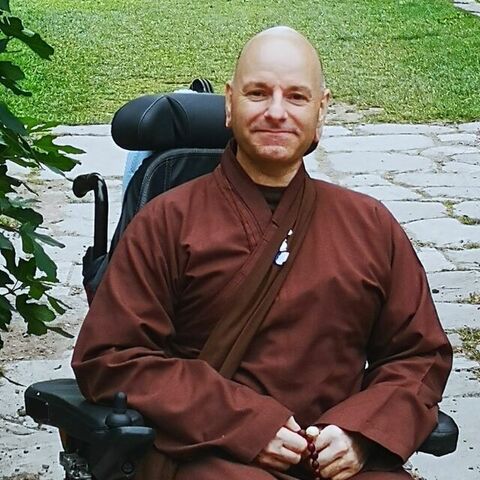
I have a background in engineering both civilian and in military life for which I served over nine years in the infantry and Royal Engineers.
Upon leaving the army I experienced some challenges which were later diagnosed and discovered to be PTSD or post-traumatic stress disorder,
A result of operations in Northern Ireland and the Bosnian conflicts.
The challenges I faced through PTSD brought about my introduction to Buddhism.
A friend wanting support healing gifted me a ticket to enjoy teaching by His Holiness the 14th Dalai Lama on mind training or Lu Zhong in the UK in the late 90s.
The experience of the Dalai Lama's teaching helped me tremendously in learning the possibility of healing using the mind.
However my interest took a back burner when I moved to Glastonbury UK where I explored other spiritual paths.
I became a Reiki master teacher also connected with my Pictish roots through studying pagan healing and craft and enjoying practicing as a pagan priest for some years.
But there was still something missing for me spiritually.
My life and ability to practice changed though when I broke my back in January 2008 fracturing my L1 and L2 vertebrae and prolapsing three discs.
During my recovery I became depressed and struggled spiritually and after a deep and challenging and upsetting conversation initiated by my then wife we examined how the disability I shared a body with had taken away our marital relationship and had slowly debilitated my physical abilities and mental health.
I could not be touched even to hug and she felt her role was more of a carer than a wife.
She asked me what direction I would have taken in my life if we have not met.
I replied that I would have liked to have ordained as a Buddhist monk which I had made some moves towards previously before we met.
She replied by asking me well why don't you?
She offered to divorce me and remain as my carer and support my spiritual path.
This act and expression of deep compassion from her rocked me to my core that brought such gratitude through my tears and as I see it now an offering of accessibility.
As a result of researching the possibility of ordaining I found holding on to this aspiration as a disabled person held its own challenges possibly food for another talk.
Despite this I undertook a three-year home study course offered jointly by Kaju Samye Ling monastery in Scotland and Dharmachara Ken Holmes who which reopened me up to Buddhist teachings.
This led me to taking my first trip up to Samye Ling in 2010 but more on that later.
How this affects me daily.
So coming back to the catalyst of the disability that I share a body with.
After approximately three months into my recovery the spine healed and I went back to work in heavy industry at that time.
However I was experiencing difficulties with manual dexterity,
Pain,
Seizures and standing and after 18 months I was finally diagnosed as having degenerative central pain syndrome,
CPS for short.
This was due to the trauma that accident caused my central nervous system to which as of yet there is no cure and very minimal treatment available.
Consequently due to dealing with chronic pain on a daily level and seizures which may have been impacted on some mental difficulties too.
I had to leave work as my body had its own agenda.
How the practice supports me.
After a few years through the support of the Dharma,
Friends,
Family I came to a good understanding of how I could respond to the disability and pain.
This I find is better accomplished by focusing on simple practices when enduring a spike in symptoms.
For example coming back to the breath thereby reducing the focus away from the pain.
I find this supports me both physically and mentally.
This practice from Thay's teachings made accessible by having the choice to study online via teachings,
Meditations,
Youtube,
Books and a couple of apps.
The practice of impermanence is present in all dharmas,
Even pain.
So practicing the understanding that the pain will only last for a day,
An hour,
A moment dependent on severity has been a great support.
I also find the teaching on the five remembrances enriching and a wonderful Dharma practice.
There's also the three doors of liberation,
Emptiness,
Sinlessness and aimlessness that I can enjoy at times to help with pain spikes or bouts of seizures etc.
But all this is done by not creating a battlefield in myself or in any part of my life as Thay offers also this can create more and more problems.
So this finally brings me to the title of this talk accessibility and inclusiveness of the Buddhist path from a disabled,
This one,
Person's point of view.
Though upon reflection when I put this title out into the ether I initially experienced feelings of anxiety about the enormity of the subject and my ability to cover it in its entirety given the fact that I was not able to give it all the attention that it deserves.
Over the next few days I began to reflect on these themes and see the complexity within them that could be spoken about especially if there was as there are many communities practitioners perspective practitioners that could and should receive inclusiveness and could prosper in the Dharma if accessibility is increased for them.
I say subjects but it's apparent to me that accessibility and inclusiveness do not mean the same thing but they are inter are.
Ideally ensuring that all 84,
000 Dharma doors spoken of in classic Buddhism are unlocked for all beings and on a personal note if we could install a few more mobility ramps to these doors that would be wonderful.
When I invited my anxiety concerning this subject forward to view it clearly I recognized that some seeds of its propagation residing in my store consciousness,
Alaya Vrijana in Sanskrit,
Seeds of neurodiversity,
Mental health.
I was tested first in the 70s for ASD which is autistic spectrum disorder and also members of my family,
A son,
Daughter,
Grandson and ex-wife are also on the ASD spectrum.
So I recognized my reflection in them coupled with PTSD from military experiences and the trauma of the accident.
All of which reinforced my reluctance to speak publicly.
Even though in the military I was a very proficient instructor but I feel that was a result of the disciplined framework that is laid out for you for communicating a teaching or an instruction session.
Recognizing these seeds brought me to a point of my inner Te to come forward and offer support in the practice through his teachings.
Te often reiterated about keeping the practice simple.
I may say accessible.
Unfortunately in fact though I've witnessed this perceived simplicity being spoken of in a derogatory way online.
But for me the beauty is there in the simple way these practices are communicated.
To coin a phrase if only we have the eyes to see.
They hold so much depth of insight and understanding.
The simplicity that Te offers the teachings and reflections brought me to the understanding that I should bring this simplicity to the talk and subjects.
I need to start with recognizing and offering myself inclusiveness and engaging with personal accessibility too.
Mahatma Gandhi is often quoted as saying be the change you want to see in the world.
But this is a misquote.
I find the origin of this paraphrasing holds more meaning for me.
He's quoted as saying we but mirror the world.
All the tendencies present in the outer world are to be found in the world of our body and mind.
If we could change ourselves the tendencies in the world would change also.
As a person changes their own nature so does the attitude of the world change towards them.
This is the divine mystery supreme.
A wonderful thing is a source of our happiness.
We need not wait to see what others do.
We'll enjoy a sound of the bell.
When I looked for the word inclusiveness in Buddhist texts and books I found it a challenge to find the world overtly offered.
But I came across it in Teyas commentary within teachings of the six parameters.
The third of the six parameters is generally described or known as patience or forbearance in the kaju teachings and other teachings in other traditions.
However Tey translates it as and describes it as inclusiveness kishanti in his book Heart of the Buddhist teachings.
As the capacity to receive bear and transform pain inflicted upon you by your enemies and also by those who love you.
This I have added to by including illness and disability.
This path of offering inclusiveness begins by extending and experiencing inclusiveness to or for oneself.
In the same vein Tey conveyed to offer peace you need to be peace and I paraphrased by saying to offer inclusiveness you need to know inclusiveness.
The same is true for accessibility all of which to me are a work in progress I find.
I feel this can be explained moment by moment as internal inclusivity challenges arise and gently pass.
As with many of the Buddha's teachings the parameters are interwoven into our with the other five offered from the Buddha's instruction those being dana parameter that of giving offering generosity shila parameter precept or mindfulness trainings kashanti parameter the inclusiveness patience and forbearance varaya current parameter diligence energy perseverance dhyana parameter meditation concentration and prajna parameter that of wisdom insight and understanding this interbeing interwovenness I find especially connects to dana parameter prajna parameter and varaya parameter but I'm not a dharma teacher so I will not expand on them but invite you to explore them for yourselves these teachings hold such beauty and are a path in themselves experiences of inclusiveness and accessibility so this leads me to a brief insight of my experiences of inclusiveness and accessibility within the buddhist community initially this came about by the opportunity to enjoy the home study course offered by samueling and ken homes and from my first trip to kaju samueling in esto mule scotland over the next few years and a few more trips up the road to scotland i had the opportunity to take refuge and the bodhisattva vows with chojai lama yeshe loso rinpoche in 2014 so from 2010 up until 2019 I had the opportunity to enjoy one or two retreat visits per year at all times I've been given wonderful support both physically and spiritually from the monastic and the lace sangha there with ramps to accommodation the temple lifts and stair lifts but I did have problems accessing the teachings and transmissions when not there this was due to distance funds additionally my chosen and additionally my chosen kaju lineage is mainly an oral tradition so with some research to further my buddhist learning and practice I came across the youtube channel of the venerable tiknadham and plum village which I found to be open and nourishing like a fresh breeze of dharma air and accessibility in early 2017 I wrote to thai and the brothers and sisters and siblings of plum village explaining my physical situation plus my aspiration to ordain including some background of my previous life subsequently on november the 30th 2017 I enjoyed self-ordination supported by a dear tired books stepping into freedom and freedom wherever we go this happened at home in front of my altar with the support of my dearest friend to bear witness and to give me my three robes and arms bowl I vowed to live the rest of my life as a buddhist monastic living my life by the vinaya and pratimoksha I did not receive any direct response to the letter but I did enjoy a mention in brother fapu's new year's dharma talk which was so encouraging for me and so nurturing for a couple of years I practiced the life of a solitary monastic however in early 2020 I replied to an advert requesting for volunteers by plum village uk to which I was successful and became a volunteer in march 2020 into the comms team which involves helping produce a weekly e-dharma mail out and being part of the social media team and small part of tech advice on the side of that the inclusivity that plum village uk and plum village has encouraged me to extend my offerings into the community via online meditations every friday and through supporting a ptsd charity as a graphic designer which was another interest I built as part of an art therapy I helped facilitate various facebook groups in the buddhist virtual world and offered support in a 90-day lay sangha rains retreat I'm about to hold meditation sessions within a local homeless rehabilitation center and with young people on the autistic spectrum I'm also fortunate to be part of the lgbtqia plus community enjoying connection to the plum village rainbow sangas and beyond having had the good fortune and support to enjoy a few online retreats with plum village and being received by the brothers sisters and siblings with open arms and open hearts they have offered gracious support and inclusion in all aspects of the retreats to ensure I'm able to enjoy them as physically possible for which I am wholeheartedly grateful and humbled wholeheartedly grateful and humbled we should invite a bell so timings are eluding me I apologize I do have a slight habit of trying to extend time envelopes so ableism I cannot and do not propose to speak for all disabled practitioners in plum village and buddhism as the umbrella term disabled holds so many forms and ways of being through research I've discovered some friends have enjoyed wholesome and some experienced unwholesome challenges regarding disabledism or ableism within buddhist communities the main ableism challenge I've come across is that of a seemingly closed door to practitioners with disabilities who wish to become monastics and have that aspiration I had the opportunity to broach these issues regarding disabled monastic inclusion in a one-to-one conversation with lama yeshi one of my root teachers he expressed that it can be an issue traditionally however personally he felt that if the mind is sharp then that's all that matters sammy ling is a very supportive with disability however my issue was the inability across all traditions to ordain as a monk or a nun or sibling I've researched some of my own work and I've been working on a series of interviews with my fellow Bugdha class and working on some of my own work with him i've researched some other buddhist traditions as much as possible online but seem to all seem to have a closed door to disabled practitioners ordaining although there have been some instances of terminally old practitioners being able to which is wonderful to hear monastics with disabilities being disrobed.
Consequently I investigated the possibility of self-ordination as previously discussed as I had no other options open to me.
Even this I have found is controversial and a discouraged route.
However a good friend reminded me that Buddha was all compassionate and accepted all.
Asking him would be the way.
Therefore I meditated and focused on what Buddha would truly want from me.
How I adapt practices for me and my situation.
These are just short points really.
Be diligent,
Don't push yourself to where pain and harm may be caused.
So if you're not able to sit then lay down to practice.
Perhaps inclusivity of disabled practitioners being given spaces within practice rooms,
Halls and temples.
Allowing them the option to lie down if needed would be a good thing to explore.
I'm usually awake from 2am onwards unless sleep is elusive which I experience regularly a few times a month and days at a time.
So I'm able to enjoy sitting,
Rolling,
Walking meditations and practice sessions only throughout the mornings.
I find it difficult to practice in the afternoons but will attend Dharma sharings and retreats etc.
Lying in bed I'm able to offer my presence and support the Sangha.
I spoke about this possibility with brother Pham Hanh on a retreat last year before the Dharma sharing and was unsure it was appropriate for me to do so.
He opened the door of inclusiveness to me,
Invited me to join in whichever way is comfortable for me to do so.
As I write this I recognise the self-ableism or self-restricting I was experiencing but I also recognise my limits interacting when I'm feeling well enough.
Do not overstress the body,
Mind or heart.
The positives of practicing my situation in my situation.
I consider myself to be so fortunate to have received the practice from our spiritual ancestors which have given me clarity in the darkest of times.
Allowing me to clearly see there is a path which when practiced diligently can offer more and more wholesomeness to life.
Before the accident I did not possess the skills to communicate with loved ones,
Friends or most anyone in a compassionate manner.
But through Buddha,
Thay and my spiritual ancestors teachings I'm learning the attributes that bring about right speech,
View,
Thinking and understanding etc.
All of which have opened my life and heart to embrace opportunities when offered as much as possible.
All practices help me with pain reduction and mental health.
Because of the teachings offered I can see and enjoy the small beauties throughout the day.
Most times with concentration being able to cultivate a heart and mind of happiness.
This has opened my horizons in so many ways not least igniting the feeling of being useful again.
So that I may be of service in some small way to my loved ones,
Friends and Sangha.
This sense of lack of constructive use is quite common I feel.
A means of enabling the disabled to experience feeling abled.
So it's just a couple more points.
This is titled Global Points for the Sangha to Consider.
According to a report from the World Health Organization in 2011 and the World Bank,
1 billion people around the world live with some form of disability.
Making up around 15% of the global population.
So with my rudimentary math skills there are approximately 5 million Buddhists globally.
And so 15% of this means that there is approximately 75 million disabled practitioners.
So how can we increase accessibility,
Inclusion and interbeing nature for all?
What barriers cause practitioners who suffer differences to feel physically and mentally excluded within Buddhism?
And what can be done to remove them?
Are the practice spaces inclusive?
Is the use of language inclusive?
Have you ever experienced barriers to practice?
So instead of working through a lengthy conclusion,
After a short break we shall be opening up to the space for some questions if there are any.
And maybe during the dhyara's dharma sharing if you find difficulty to come forward you may like to reflect on one of those previous points.
So we shall now just enjoy two sounds of the large bell and then pass over to the ledger to Terri.
Thank you dear friends for giving me this space and time in your day and I shall now pass over to Terry.
Dear,
Dear brother,
Such a moving talk and I believe you're a true jewel in the UK Sanga lotus flower.
Thank you so much.
So we can now enjoy a short break,
Let's say come back at ten past eleven.
Please,
If you can,
Maintain a sense of peacefulness and mindfulness with whatever you're doing.
And if you would prefer to put a question in the chat,
You might like to do it during the break.
And then when we come back,
There'll be an opportunity to ask live questions of brother.
So thank you for your presence and your Sanga presence.
That's all I can say.
I'm left quite speechless with your beautiful talk brother.
And I'm so glad to have invited you to do