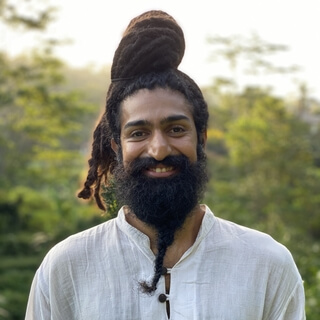
Namaste dear friends,
Today I am going to be speaking about some Ayurvedic recommendations and tips for our sleep cycles or circadian rhythms.
Our internal biological clock or circadian rhythms are linked to the proper functioning of the organs.
When we sleep at the proper time and so on,
Our organs function at its optimal and we thus feel vital and good.
Of course these recommendations might not apply to everyone across the board,
Especially people that might have night shifts or have other lifestyles that are incompatible with these recommendations.
However I am just listing them out so you can try as much as possible to implement these into your life.
So our circadian rhythms are first and foremost governed by light.
Our retinas in the eye are sensitive to specific wavelengths of light that set our internal biological clock.
For optimal health,
One should wake up approximately 90 minutes before sunrise.
The time of sunrise may vary considerably from season to season and location to location.
In these cases,
We can adjust the 90 minute rule by about an hour or so either way.
The 2 hour period just before sunrise is known as Brahma Muhurta,
The time of the divine.
It is the time where the mind and nervous system is the most relaxed.
The best time to meditate,
Set intention,
Practice breathing and so on.
Due to the angle of the sun at this time,
It is highly recommended to be outdoors even if just for 10-15 minutes around sunrise.
Doing this for 4-5 days will automatically adjust one's circadian rhythms so that it will become easier to wake up early.
One does not have to gaze directly into the rising sun to gain these benefits and it works perfectly well even on a cloudy day.
The lumens of light entering our retina on an overcast day is about 10,
000 lumens as compared to the typical 500 lumens in a 40 watt bulb.
In case you have a window facing the sunrise,
It is still advisable to get outdoors or open the window as only 30% of sunlight enters through glass and that is when the sunlight is directly falling on the windows.
Additionally it is not recommended to sleep in a completely dark room with thick curtains.
Sleeping in pitch dark might help you sleep deeper but it will make you feel groggy upon waking up.
We are meant to wake up for about 30-90 minutes as light slowly starts to enter the room so our waking up period is happening progressively.
If we sleep in complete darkness and set an alarm to wake up,
We are forcing our bodies to wake up instantly when it should have been gradually exposed to the morning light.
If you have ambient light like a street light right outside your window then it obviously doesn't work to keep the shades open.
In these situations,
I would advise an alarm clock with an attached light.
These alarm clocks will beam a light 30 minutes to 1 hour before ringing,
Mimicking the light before sunrise from a warm red to orange and to bright yellow at the time of the alarm.
Ideally when our circadian rhythms are balanced,
We will automatically wake up an hour or two before sunrise without the need for an alarm clock.
Moving on,
The period just before sunrise is the time of the bladder and we should ideally eliminate our waste at this time.
Just after sunrise is the time of the lungs according to Ayurveda and this is a great time to do some light or moderate exercise or breathing practice.
The lungs also hold the emotion of sadness so those that are experiencing sadness should definitely do some movement right at or immediately after sunrise.
Sunset is also almost as important as sunrise.
It is recommended to be outdoors for at least 15 minutes during sunset to allow the evening light to enter our retinas as well.
Thereafter it is recommended not to have overhead light indoors.
Having warm light,
More towards the red wavelengths of light and placed at eye level or below are ideal for the evening time.
This will help the body begin to produce melatonin,
Preparing us for a good night's sleep.
Avoiding blue wavelength of light from screens post sunset is also highly recommended.
If you are looking to dive deeper into the circadian rhythms and what Ayurveda has to say about them,
Do check out my course on Insight Timer,
Ayurveda the Science of Self-Healing.
Thank you so much and I hope to see you soon.
Namaste.