Welcome back to the Ordinary Mind Meditation Course.
Before we start,
Please sit comfortably and breathe deeply in.
As you exhale,
Release all the accumulated pressure in the body,
Mind and heart.
In this series,
We will be using meditation to investigate the reality of our life.
Our very own mind,
Heart and body.
As you listen,
Don't try to forcefully follow what I'm saying.
Simply listen to the words as you would to the sound of nature or a piece of music.
As the mind immediately begins to make judgments and comments,
Acknowledge these thoughts and softly let them go and bring your attention back to the sound of my voice.
Breathe deeply in.
Here we go.
Last time,
We spoke about the general purpose of meditation,
A practice for becoming ever more familiar with our very own minds,
Or to put it differently,
Getting to know the reality of our life.
But why is this such a challenge?
Why is seeing reality as it is not the default mode of being for most of us?
This is a subtle question.
The short version is that we filter every experience through the lens of the so-called self.
In Buddhist thought,
We are said to be composed of five aggregates or heaps.
These are form,
The physical aspect,
Feeling,
All physical and mental experiences that we experience as pleasant,
Unpleasant or neutral.
Perception,
Which is the process of labeling or identifying objects,
Fabrication,
Which are all our different thinking processes,
And consciousness,
Which is the faculty of cognizing all of the input to our senses.
The way,
For example,
How light waves,
Which encounter our sense of seeing,
Can become a rainbow in our minds.
The use of the term heaps or aggregates for these lets us know that we're talking of phenomena composed of many different things and therefore cannot constitute a single self.
Usually,
We confuse all these various experiences for ourselves,
As if there is a little magical driver sitting between our eyes and controlling everything.
But the fact of the matter is,
There are only these processes going on,
With us perceiving them rather than controlling them.
And this basic fear of having no control over the situation is what makes us take experiences and concepts and try to solidify them into solid objects or selves.
But fear not,
If the river of life is carrying us along,
We can only take responsibility and learn to swim with the stream.
How enjoyable such swimming can be!
At a later point in our sessions,
We will be learning how to check for ourselves whether there is no self,
Rather than just take someone else's word for it.
But first,
We are going to need to slow down the mental rush hour in our minds,
And rather than pushing and pulling constantly,
Allow ourselves to be fully in this uncertain and vulnerable situation.
And so today's practice will be a step toward giving up the need for control.
We will practice identifying our aggregates for what they are without identifying WITH them.
The Healing Breath Like the last time,
Let's start with the Healing Breath technique.
But this time,
We can use a more advanced proportion of 1-4-2.
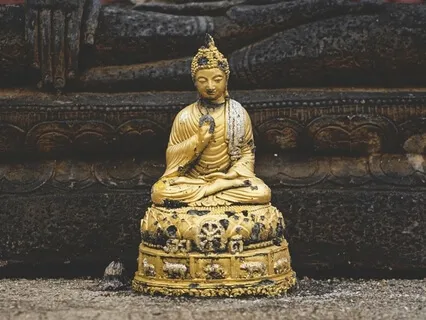
Since it is common and beneficial to recite Buddha Amitabha's name as a wonderful way of centering the mind,
We can use it as a way to keep count in this exercise.
Amitabha is a Buddhist archetype which represents infinite light,
The cognizant aspect of our own experience.
I will be using the Chinese pronunciation of his name,
Which is Amitofo.
So we inhale for the duration of one Amitofo,
Hold the air in for the duration of four Amitofo,
And exhale for the duration of two Amitofo.
Let's try it.
Breathe deeply in.
A-mi-to-fo Hold-mi-to-fo A-mi-to-fo A-mi-to-fo A-mi-to-fo And out.
Mi-to-fo A-mi-to-fo Once again,
In.
Mi-to-fo Hold-mi-to-fo A-mi-to-fo A-mi-to-fo A-mi-to-fo And out.
Mi-to-fo A-mi-to-fo A few more times.
In.
Mi-to-fo Hold.
A-mi-to-fo A-mi-to-fo A-mi-to-fo Out.
In.
In.
Hold.
And out.
Let yourself slowly come back.
For our main practice today,
We will be continuing to train in single-pointed concentration,
As this is instrumental for achieving effortlessness and restfulness,
Which we need in order to have a chance to see things as they really are.
However,
Since we want to start to see the truth of no control behind our thoughts,
We need to learn to recognize them so that we are not carried away by them,
Or attached to them,
Or as scientists today call it,
Cognitive fusion.
So we will be using our thoughts as our object of focus of today's practice.
We begin with an exercise I call Outer Sound-Inner Sound.
Thoughts are vague representations of sensory experiences,
And so very often we think by talking to ourselves internally,
So to speak.
As you now sit comfortably with the back relatively straight,
But free of tension,
Become aware of the experience of hearing.
Let all the sounds you hear go,
In one ear and out the other,
As they say.
Don't fixate on any sound.
Don't measure whether it's near or far,
Loud or soft.
Don't make any judgments at all.
Listen to all of it,
Like you would to a CD for example.
Just listen to the sounds.
There is no such thing as failing at meditation.
If you get distracted,
Simply become aware of the distraction,
Acknowledge it,
And gently let it go.
Open the hand of thought,
Release it,
And come back to the task at hand.
The recognition of distraction and returning to the practice is the success in meditation.
This is called training the letting go muscle.
Just give it up.
Now as you were listening to the sounds in the environment,
Let us turn the attention to any internal dialogue that might be there.
Maybe the inner voice is saying,
How pleasant.
Perhaps it's saying,
What on earth does this guy want from me?
Or maybe even thinking about lunch options.
Whatever it might be,
Focus on the sound of the inner voice the same as you did on the sounds around you earlier.
If there is no inner dialogue going on,
That's also great.
Just return to listening to the sounds around you.
Often we also experience thoughts as mental images,
As if vague pictures are showing on a sort of mental screen.
If any such images arise,
Focus on them gently,
Without falling into them.
Simply observe them without making any judgements,
As you did before with the sounds outside of you and the sounds of the internal dialogue.
Maybe you are experiencing some feelings together with these various forms of thought.
The sum total of these feelings and thoughts and the interplay between them is what we call emotions.
These can color a whole period of time and then we might call them moods.
If you are noticing any of these,
Pay attention,
Again without any judgements,
Opinions or labels.
If your attention strays,
Acknowledge that and then gently bring it back.
Look to see where it is that you experience these various experiences.
Is it in the body somewhere?
Is it in the mind?
Keep resting your attention in the various experiences that come up,
Flowing like a river from one experience to another.
Arising and passing,
Coming and going.
Just rest in all of it.
Bring yourself gently back,
Stretch a bit and take this calm,
Aware state with you into the rest of your day.
Repeat this practice daily and once you feel comfortable and effortless with this practice you may move on to session 3.
May you be content and at peace.
Amitofo.