Good morning.
Nice to see everyone.
Nice to be back in North Carolina.
Been traveling the last week or so.
I gather it's been pretty hot here.
I've been in the cool,
Wet rains of Northern Indiana.
So,
Back in the humidity,
Back in the heat.
It's all good.
So,
I'd like to make a second in a series of a few short talks.
We'll be here a pretty short amount of time,
About our practice here in the Zendayog.
About a month or so ago,
A month and a half ago,
We talked about the idea of merit and our practice of dedicating merit.
And today I'd like to talk about bowing or making prostrations.
The idea of bowing cuts across Buddhist traditions.
Really,
All schools of Buddhism practice bowing in one form or another.
And it's been part of the Buddhist practice since Buddha's time in Northern India,
2,
600 years ago.
Back then,
In the monastic community,
People would do dozens,
If not hundreds,
Of prostrations every day.
On special ceremony days,
I understand,
They do up to 10,
000 prostrations in a day,
If you can imagine that.
But I also know there can be a misunderstanding of what bowing is really about,
Especially here in America,
I think,
Where people sometimes see bowing,
You know,
And they don't like it.
They come in here and they see this bowing and it can make them feel like they're putting themselves into a subservient position or somehow engaging in an act of worship.
And I've known a lot of people who have come into Buddhist settings,
You know,
They're recovering Catholics or whatever they are,
And that's not what they're looking for.
And the good news is that's not what our practice of bowing is about.
Bowing in our tradition is not an act of reverence.
It's not an act of deference either.
To really understand why we bow,
We have to look outside of that box.
So the first things I consider that bowing does is simply to provide an opportunity for stopping and contemplating one's presence in the moment.
Bowing provides an opportunity for mindfulness,
To use our body and our breath and the action of a bow as a conscious point of engagement with the present moment.
Now over the years,
I've come in here at different odd hours,
Early in the morning,
Late at night,
I come in with Zendo.
I come to the bowing mat here and I make prostrations,
I recite the refuges,
The four great vows,
The pure precepts,
And I intersperse prostrations between all of them.
And I was giving a talk about bowing to a different group here in this room,
In fact,
A Refuge Recovery retreat.
And someone came to me afterward and said,
You know,
I told them what I just told you and someone came to me afterwards,
So why do you do that?
Why do you bow?
What calls you to that?
And part of the answer is as simple as what I said just a minute ago.
To bow is to practice a point of engagement with the present moment.
It's a time when I feel like I can see my attachments,
Discriminations that I make,
My aversions and the crowd around me,
You know,
In my bow.
It's also a time when I can learn to use each bow or prostration that I make to put myself into a place where I can envelop these things into awareness.
I can open my clinging hands and I can let those things rise and then fall.
Teshan likes to say that to bow is to put oneself into a place of receptivity,
Where we can see clearly,
We can respond skillfully to the content of each moment.
And it's important to have moments like this.
It's important to create moments like this.
You know,
It's difficult to be disingenuous when you're bowing.
It's difficult really to be anything other than honest with yourself in the moment of a bow.
I've often felt that making prostrations is like a haiku almost.
It emerges in mindfulness.
It's a reflection of the moment.
And it makes space for awareness,
For a sense of contact with our Buddha nature,
That thing which is empty,
Not one,
Not two,
Interdependent with all sentient beings.
And this is the second way to consider the bow as a recognition,
Really as an expression of interdependence.
Norman Fisher,
Who I read a lot,
He's a teacher in the San Francisco Zen Center tradition,
He tells the story of his teacher,
Dainen Kategiri Roshi,
Who would mumble softly in Japanese as he bowed.
And Norman Fisher,
Who is his attendant,
Essentially,
Asked Kategiri one day to translate this.
What is it you're saying when you bow?
The translation was something like this.
The one who bows and what is bowed to are one by nature.
The bodies of oneself and another are not two.
I bow with all beings to attain liberation,
To manifest the unsurpassed mind,
And return to boundless truth.
There's a metaphor in Buddhism that I like.
It speaks of the gift,
The giver,
And the receiver as a way of demonstrating the idea of interdependence,
The not separate nature of things.
That in the moment of offering a gift,
Receiving a gift,
And the gift transferring from one hand to another,
It's all one thing.
There's not really a separation in that moment of action between the gift,
The giver,
And the receiver.
It's infinitely interdependent.
So when we bow,
When we make prostrations,
It's not divinity that we're acknowledging.
I mean,
We know that Buddha was just a person like us.
Rather,
When we bow,
It's our own capacity to awake,
To experience the Buddha nature that we share with others,
The reality of non-duality,
The oneness of existence.
That's what we're paying homage to when we bow.
That's what we're honoring with our bow,
Our own capacity for awakening.
We recognize the Buddha as someone who's reached awakening,
As someone who's gifted us with teaching,
With an example.
So it does have a certain amount of respect to it,
But it's not this power imbalance that people can sometimes perceive,
Because the bower and the one who is bowed to are not separate.
Does that have some sense to it?
It's like an exchange in which we recognize the importance of each being in the universe and the interconnection that we share in the inherent field of Buddha nature.
Some of you will remember the image of Indra's net.
It's another good metaphor for interdependence.
If you picture a hammock netting,
That kind of square netting with the knots at each corner,
And now imagine that fabric stretching just endlessly through space and time.
And in each knot is a jewel.
And in each jewel is a reflection of each and every other jewel.
Interdependence.
There just is no separation.
A third way that we can consider bowing is as part of our bodhisattva practice,
That which calls us to work for the awakening and well-being of everyone,
Really,
Of all beings.
The many bows are numberless,
The first great vow says.
And our response is,
I vow to save them.
In this light,
Norman Fisher tells us that a unique quality of bowing is its internal function.
He writes,
Bowing is a mental training that helps us to cultivate an attitude of love and an appreciation for the Buddha nature within ourselves,
And to appreciate that same nature in others.
Not their Buddha nature as opposed to our Buddha nature,
But Buddha nature itself.
That which we all share in common,
And which the energy of bodhichitta calls us to honor.
Now I'm going to give a talk on bodhichitta and the three refuges next week while Teshan is recovering.
So I won't go far into that here,
But suffice to say,
If you're not familiar with the term bodhichitta,
It's the energy of our wish and our hope to attain enlightenment and its motivation in our compassion for others.
There is a psychologist and Zen priest named Seth Siegel who said,
The beauty of bowing practice is that it's bodhichitta in motion.
When we make prostrations,
We offer the spirit of aiding the enlightenment of others,
Of finding our own way toward awakening by supporting the awakening of others.
Bowing is the spirit of bodhichitta in motion,
Siegel said.
And he goes on to say,
In bowing,
We bow to ourselves as part of everything.
We see the smallness of our own egos,
The vastness of being,
And the way of awakening.
So bowing is a mental training.
In the bowing,
We open our body and our mind to the reality of interdependence and the compassionate engenders.
We open ourselves in the bowing to letting go of everything but that quality of compassion,
Bringing our compassion out,
Making it big,
Fashioning it day by day,
Bow by bow,
Walking the bodhisattva path.
It's lofty stuff.
It's inspirational.
It's aspirational.
It's the practice of a lifetime.
But do we think about all of this each and every time we bow?
Maybe.
Indirectly.
In a telegraphic sort of way.
But I think that all of this is better held in feeling rather than in thought,
In presence rather than a projection in time.
In bowing,
We just consider his manifestation of now,
Manifestation and engagement with the present moment,
The interdependence of life,
The promise of compassion.
So for me,
Prostrations,
Even simple bows,
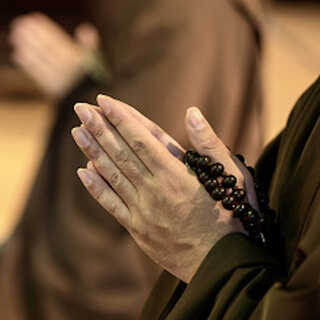
Just with my hands on gassho,
For me,
They are near to the heart of practice.
Something very simple.
When we bow to someone,
They just return the bow.
Bowing is mutual,
Category said.
Just one bow.
Bowing back and forth.