Good morning.
Good morning.
Everybody doing all right?
Glad to see the sunshine?
Yes.
Glad for the rain.
Glad for the sun.
Tashin asked me if I might not speak of something related to Easter.
And so I've been thinking about it.
And I'm not going to talk very long,
Which is probably best,
Because I'm going to go out on a little bit of a economical limb here.
It is Easter morning,
And Easter,
As a remembrance of Jesus's resurrection,
When you think of it in that light,
It's easy to consider new life,
New beginnings.
We certainly see this in the natural world around us.
The flowers that have been around us these last couple of weeks have just been amazing.
And it's not a coincidence,
I don't think.
I don't think it's an accident that the timing of Easter falls in the calendar at springtime.
It's a time of new beginnings.
In fact,
I went on my porch just last night,
And I could hear the spring peepers out there in the pond near my house.
I mean,
It's just everywhere.
It's around us.
The living world,
Beginning again,
Emerging from cold and darkness and out into warmth and into light.
Now,
In our Zen practice,
We have opportunities and chances to begin again.
Each time we sit,
Each time we find awareness and presence in the moment.
Each time we lose that awareness,
Each time our presence falters,
Each time we come back,
Each time we return to our breath,
Each time we return to our koan,
We return to our practice.
We begin again,
Breathing easily.
And of course,
Our real chance that practice offers for new beginning,
To begin again,
Is when we begin to experience that sense of unity,
To experience that sense of oneness with the world and those around us,
An experience of non-separation that we talk about so much.
And we can grasp that idea intellectually.
But as we practice more and more,
We can begin to experience that in our bodies.
And it's there that we begin to experience a different kind of mind.
And we grow into lives lived in the Dharma,
Beginner's mind,
Every day.
I have a friend named Brian.
He's a lot younger than me.
And he's kind of a hippie rebel,
If ever there was one.
And we were talking recently about spiritual technologies,
To use a phrase.
Now,
He practices Kundalini yoga,
Which,
As I understand it,
Is all about specific postures,
Meditations,
Breath work,
Leading toward specific ends.
And he calls this a technology,
A spiritual technology.
And he asked me,
What did I think was the technology of Zen?
And we talked about Zazen as our technology,
As our tool,
Which can lead us into opening experiences,
Which can lead us into awakening.
So Zazen,
Yes,
Certainly,
Where we experience renewal and growth.
Because,
You know,
Like I said earlier,
We know our practice and meditation is not measured by how often we lose our attention.
Our practice and meditation is in how we return,
Over and over,
With honesty,
Humility,
Commitment,
Over and over,
Beginning again in our practice,
Moment after moment.
So later,
After Brian and I had had this conversation,
Though,
I was still kind of intrigued by this idea of spiritual technology.
And I got to thinking,
What else might be these tools of Zen?
What else do we have at our disposal?
Other things which both deepen and reflect our practice of concentration and our growing sense of union.
What are the tools in that sense of union that help us to relate with others with gentleness,
Kindness,
Care,
Help,
Comfort?
We don't have to look a lot farther than the four noble truths.
The fourth noble truth,
The Eightfold Path,
Wise thought,
Wise speech,
Wise action.
Learning what these mean for us in the lives that we live in relation with others.
And then the three pure precepts,
Which we've talked about in the precept class in the last couple of weeks.
Avoid all evil,
Do all that is good,
Save the many beings.
These say so much,
Especially when we understand that word evil in this context,
To mean separation,
Disunion,
Living in a sense of self and other.
And instead,
We avoid actions that are born of separation.
We do that which is good in a shared reality.
We save the many beings.
And then the precepts themselves,
The grave precepts,
Some call them,
The clear mind precepts,
Some call them,
Preserving life,
Taking only what is freely given,
Being truthful,
Being supportive of others,
Being responsible with our anger,
And what are known as the paramitas,
The practice of generosity,
Patience,
Commitment,
And energy in practice.
And a favorite of mine,
The four immeasurable minds,
Sometimes called the Brahma Baharas,
Loving kindness,
Compassion,
Shared joy,
Equanimity,
All of these things are tools that we can use to live our lives with kindness,
Compassion,
Responsibility,
And care.
As a practical example,
For a lot of years,
Most of you know as a schoolteacher,
And for a lot of years,
I used these four immeasurable minds,
Loving kindness,
Compassion,
Et cetera,
To gauge my own actions and my interactions with the many children who have filled my life.
Was I practicing loving kindness?
Was I being compassionate in my presence with these young people?
And this was a daily reflection.
And it helped me to work with my students more skillfully,
And that made their experience more positive.
Buddhism offers us practices which build our hearts in the doing,
And build the hearts of others in the receiving.
Spiritual tools that we use in the expression of love.
And as we do,
These practices become gradually qualities of our hearts,
Tools we use to uphold our vow.
All beings without number,
I vow to save them.
So Easter morning.
I'm not a Christian,
Though I was raised one in the relatively comfortable context of the Episcopal Church.
I'm not a big fan of Christianity as a religion,
I have to be honest.
But I am a big fan of Jesus,
And I always have been.
Now,
My friend Brian,
He's going to get married in the next year or so.
And his partner's parents are deeply Christian,
Conservative people.
And Brian,
At their request,
Has engaged with them in some conversations about the Bible,
And about their faith.
And I think he finds it interesting,
And a chance to sort of explore something that he's long forgotten.
So when Brian and I were talking about spiritual technologies,
We also speculated on what tools are part of a Christian practice.
Now,
The idea of prayer leapt to mind,
But for me,
That's not it.
My personal nature and my Buddhist practice take me to a different aspect of this story.
Less toward a relationship with God through prayer,
And more toward the idea of a life lived in the image of Jesus.
Now,
You may notice I'm not using the word Christ here.
That word comes from the Greek word Christos.
It means anointed,
The anointed one of God.
Just leaving that aside.
I'm less connected to Christ than I am to Jesus,
Who in his teachings placed forbearance,
Compassion,
Love at the center of human life.
So I really have thought about it since Teshun asked me to give this talk.
What might I say on a thankfully sunny but chilly Easter morning in a Zen temple here in Arizona?
I've been watching a really great television program called The Chosen.
I don't know if any of you have heard of it.
It is the story of Jesus,
And it's the most human portrayal of the story that I have ever seen.
It's not dogmatic.
It's not moralizing.
It's just grounded in the spiritual palette of that story.
And the last episode I saw was the Sermon on the Mount,
The Beatitudes,
Which are its opening.
I wanted to read this.
Blessed are the poor in spirit,
For theirs is the kingdom of heaven.
Blessed are those who mourn,
For they will be comforted.
Blessed are the meek,
For they will inherit the earth.
Blessed are those who hunger and thirst for righteousness,
For they will be satisfied.
Blessed are the merciful,
For they will be shown mercy.
Blessed are the pure in heart,
For they will see God.
Blessed are the peacemakers,
For they will be called the children of God.
In their spirit,
Most of these are statements of hardship and offering,
Of sadness and comfort,
Of need and provision,
The cry of the downtrodden,
And the promise of renewal.
Need and offering,
Spiritual tools of forbearance,
Compassion,
And love.
And perhaps not so far off from the tools that we use on our paths of Buddhist practice.
For in our experience,
In our understanding of non-separation,
In our practice of precepts,
In our practice of things like loving kindness and compassion,
Do we not also look to help the poor in spirit?
Those who mourn,
Do we not aspire to be pure in heart,
Merciful?
We have tools of practice on our Buddhist path,
Which help us to relate with others with gentleness,
Help,
Comfort,
With grace.
And it struck me that when we live in dharma,
In a sense,
We live in the beatitudes,
With a heart which is beatific,
Truly blessed,
As we offer ourselves in service to others through a mindful,
Precept-led life.
Loving kindness,
Compassion,
Responsibility,
Care,
The fruits of these practices build our hearts in the doing and build the hearts of others in the receiving.
But this is Zen,
And it's never quite that simple,
Because there's that dual language again.
Our hearts,
The hearts of others.
What about that unity?
What about that non-separation?
So let's see if we can put it another way.
There is a metaphor.
I want you to consider the idea of a gift,
The giver and the receiver of the gift.
And in Zen,
These are not three,
But rather,
In the moment of action,
They are simply one.
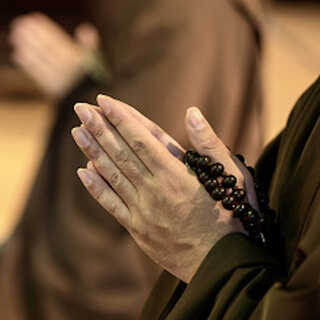
A proffered hand,
A hand to receive,
And both touching the gift at the moment of transmission.
One moment,
One action,
One presence to reach to the poor in spirit,
To offer a compassionate presence and to be reached toward in grateful response.
One moment,
One action,
One presence.
No separation,
In a moment of unity,
Avoiding all evil,
Doing all that is good,
Saving the many beings.
So blessings,
Compassionate action.
I think that Jesus meant for people to find in prayer the grace of the Beatitudes.
And I think that Buddha meant for people to reveal in Zazen the grace required to save all beings.
And maybe they're not that different.
I said I wasn't going to talk long,
And I'm not.
But I do want to leave you with this quote.
It's from one of the scrolls that was found in the Dead Sea Scrolls.
I'm talking about the Gnostic gospels and all of that.
From the teaching of Sylvanus,
And I think this kind of summons how our practice of Zen relates to all of this.
Knock upon yourself as upon a door,
And walk upon yourself as on a straight road.
For if you walk on that path,
You cannot go astray.
And when you knock on that door,
What you open for yourself shall open.