Welcome to Day 7 of Breathing to Thrive,
Our final session in this 7 session course.
Hope you've started to appreciate how the breath can influence the nervous system,
How we can play around with oxygen,
Carbon dioxide and nitric oxide to really genuinely oxygenate our body.
Move away from our body being in stress mode,
Only being able to oxygenate certain areas that are associated with our survival,
Our preparation for stress.
And using these techniques to find a sense of calm and increasing the power and strength of your respiratory system.
Today focuses on bringing all those practices together,
So you have a daily practice that you can use at the start,
Middle or end of your day whenever you find time,
Just to ensure you're well oxygenated,
You're balancing your carbon dioxide ratios and you can come down from any feelings of stress,
Anxiety and tension in quite a quick,
Efficient manner.
We'll begin like we usually do with some breath awareness,
And that's placing one hand on our chest and the other hand on the belly.
Putting a bit of resistance into that lower hand to encourage your deeper breathing muscles,
The abdominal wall,
To rise and fall with the breath and your chest remaining relatively still.
Starting to inhale for four seconds,
Exhaling for six and bringing the Ujjayi noise,
The ocean sound to your exhale.
Exhale.
Exhale.
Exhale.
Exhale.
And bringing this four six breathing to a close,
Feeling that calming sensation now that you've started to engage your parasympathetic nervous system.
And from this place of calm,
We're going to move into our box breathing to keep enhancing our CO2 tolerance.
Beginning with a four second box breath,
Remembering the four equal parts,
Inhaling for four seconds,
Pausing for four seconds,
Exhaling for four,
Pausing for four.
And repeating this for the next two minutes.
Exhale.
Exhale.
Exhale.
Exhale.
And if you wish to increase by a second,
Moving up from four to five seconds and continuing for just another minute.
Exhale.
After your next exhale,
Letting go of your box breathing pattern.
Letting your breath return back to its natural rhythm.
And we'll prepare now for three phase yogic breath,
Using this to gain space,
Stretch out the abdomen,
The rib cage,
And enjoy a long calming exhale.
Begin by inhaling for two seconds into the belly,
Two into the chest,
A one second top up to fully expand the lungs,
And a long slow steady exhale,
Continuing this on your own for the next few moments.
Exhale.
Exhale.
Exhale.
And after your next exhale,
Bringing the three phase yogic breath to a close.
Breathing into the sensations in your body,
How you're feeling.
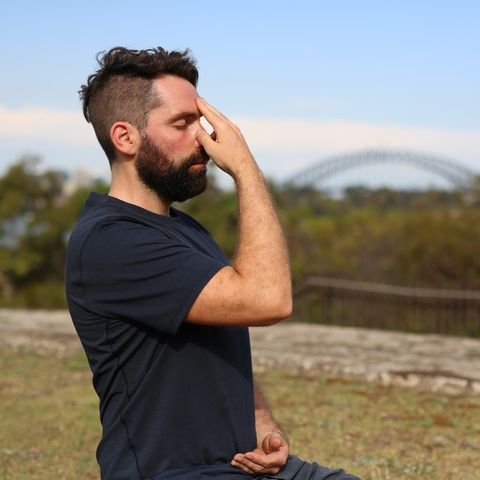
Prepare now for alternate nostril breathing.
For this alternate nostril breathing,
We're going to inhale for four seconds,
Exhale for eight seconds.
Beginning when you're ready,
And I'll let you know when to come in.
And after your next exhale,
Keeping your eyes closed,
Relaxing your hands on your lap.
Noticing any sensation around the nose,
The forehead,
Or inside of the head.
And now we'll prepare for our next round of alternate nostril breathing.
This time we'll layer a few techniques on top of each other.
So we're going to do the alternate nostril breathing in the box breathing pattern.
We'll inhale for four,
Pause for four,
Exhale for four,
Pause for four.
While moving and alternating the nostrils,
And I want you to add in your Ujjayi sound as well.
So we're getting three techniques in one here which will be very powerful,
Increasing resistance,
Finding a state of calm,
And enhancing the function of your heart and lungs.
Beginning when you're ready,
Taking your first inhale to the left nostril for four seconds.
And now we'll do the opposite.
And relaxing your hands after your next exhale,
Leaning into the feelings,
The sensations created by these techniques combined.
And now we'll prepare for our Brahmari breathing.
Remembering the humming noise that increases the nitric oxide,
But also has a really calming effect on the vagus nerve,
A lot of very gentle stimulation,
So the parasympathetic nervous system understands that you're safe,
Healthy,
And well.
I want you to do ten of these whenever you're ready,
Remembering to cover over the tragus on the ear canal to create an increased resonance.
And now we'll do the opposite.
And now we'll do the opposite.
And after your next exhale,
Relaxing your hands,
Absorbing some of the sensations,
The feeling around your ears,
The resonance in your head.
And now we'll do the opposite.
And we'll bring today's session to a close using the coherent breathing,
The six second inhale,
Six second exhale that helps optimize the function of our heart and lungs.
And now we'll do the opposite,
Feeling that if six seconds in and out is impossible,
Settling for five or four.
And now we'll do the opposite,
Feeling the system,
Gaining the space,
The six second inhale and exhale will be achievable,
Beginning whenever you're ready.
And now we'll do the opposite.
Gently letting go of the coherent breathing,
Returning back to your natural breath.
Just spending a few moments bringing your awareness around your body and how it connects with the breath.
Noticing any sensation at the tip of your nose,
Through your nostrils,
In your throat,
Your chest,
Your belly.
And feeling a warm sense of gratitude for taking the time to connect with your breath and influence your nervous system in a very positive way,
Keeping you adaptable and resilient in the face of the stresses and strains of modern life.
Thanks for your time and effort and enjoy breathing better,
Stronger and less frequently.
.