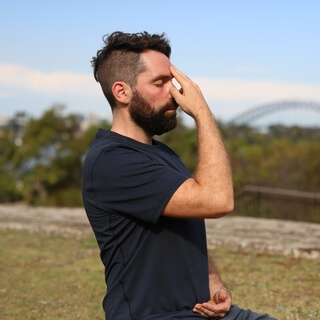
Welcome to day 2 of Breathing to Thrive.
For today's session you can practice sitting up comfortably or even lying down.
So getting comfortable in whichever position you choose,
Relaxing your eyelids,
Gently closing the eyes and starting to observe your breath without trying to change it in any way.
Then taking a little more control of your breath,
Breathing deep into the belly,
Expanding the belly on the inhale,
Tightening it on the exhale.
And counting for how many seconds your inhale lasts and how many seconds your exhale lasts.
Breathing in and out through the nostrils and starting to lengthen your exhale.
Now breathing in for 4 seconds and out for 6 seconds for the next few moments.
Nice deep belly breaths.
In a few moments we'll move into Box Breathing.
Box Breathing has 4 equal parts,
We have an inhale,
A pause,
An exhale and a pause all of the same duration.
We use this practice to enhance our tolerance of carbon dioxide.
If we've had trauma in our lives or even just sensitivities or are anxious or tense,
Our nervous system will have become sensitive to carbon dioxide and as a result we could be over breathing.
Over breathing tends to perpetuate stress and anxiety in people so we want to recondition our relationship with carbon dioxide and we do this through box breathing.
The pauses give us a chance to tell our nervous system that even though there's an extra build up of carbon dioxide that this is not dangerous in any way.
We've simply become more sensitive to it over the years.
Begin by inhaling for 3 seconds,
Pausing for 3 seconds,
Exhaling for 3 seconds,
Pausing for 3 seconds.
If any discomfort,
Irritation or agitation arises during the pauses that's completely normal we are retraining our nervous system to be less sensitive to carbon dioxide knowing that the urge to breathe arises from a build up of carbon dioxide and not from a lack of oxygen.
If you feel comfortable at the 3 second box breath feeling free to move up to a 4 second box breath,
Remembering the 4 equal parts and using the belly to draw air into the body and to gently push it out again.
Slow and steady during your inhale deep in your belly,
Relaxing into your pauses,
Maybe even bringing a smile to your face.
Slow and steady exhale,
Again relaxing into the pause before starting again.
Many people breathe about 15 to 20 times per minute.
When you're practicing this 4 second box breath you are breathing less than 4 times per minute which is taking a load off your nervous system,
You're engaging in neuroplasticity,
Changing your relationship with CO2 and enhancing your respiratory system.
After your next exhale letting go of your box breathing pattern and allowing your breath to return back to its natural rhythm.
Acknowledging yourself for engaging in neuroplasticity today and with practice your CO2 tolerance will increase from box breathing on a regular basis and you'll be less susceptible to anxiety and tension because your nervous system will react less to any build ups.
Having 5 more slow and steady breaths as a pathway to guide yourself out of the practice.
Thanks for practicing day 2 and I look forward to taking you through day 3.