Hello,
Thank you for joining me.
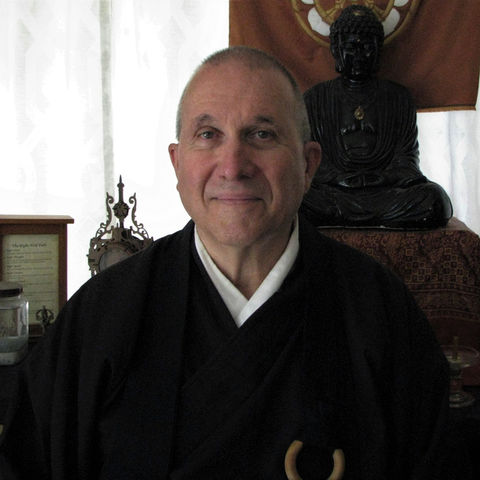
I'm Sensei Morris Sullivan,
And this is the first part of a series on Buddhist practices that you can apply in your everyday life.
Well,
For the last couple of decades,
I've been talking about Buddhism to several different groups,
Including small groups that meet at places like UU churches and city libraries,
One that meets at a large Buddhist monastery,
Even a group of incarcerated men who meet in the chapel of a state correctional institution.
Some of the people who come to these services are lifelong Buddhists,
And they grew up in Buddhist cultures.
Many more,
Though,
Grew up in the U.
S.
And were either raised in one of the majority religions where they lived or were spiritually unaffiliated.
And some of those people now identify as Buddhist,
But many,
Maybe even most,
Of the people who come to our Buddhist meetings and services aren't really looking to join a religion when they show up.
They've read something or heard something about Buddhism,
And something resonated.
And so they begin to wonder if the teachings laid out by Sakyamuni Buddha more than 2,
500 years ago might help make their lives less stressful,
More joyful,
More meaningful.
So in this series of talks,
I'm going to go over some of the principles of Buddhism that can do that.
I'll explain some related contemplative practices,
And I think you'll learn how some of these spiritual tools can help you transform your own life in positive ways.
So I'm going to talk broadly about the idea of contemplative practice.
You've probably been doing some sitting meditation or yoga or something like that,
And these are contemplative practices.
They're activities that have the primary purpose of training us to use our attention more skillfully.
To a large degree,
Our experience of life has relatively little to do with our circumstances.
Instead,
It has a great deal to do with how well we use our minds,
Where we put our attention,
What focuses our concentration,
How well we pay attention,
And things like that.
I'll be going into some specifics about this,
But if you look at contemplative practices from a Buddhist perspective,
You find three main areas of activity,
What the Buddha called right effort,
Right mindfulness,
And right concentration.
Right effort means letting go of harmful or unhelpful mental phenomena and cultivating skillful helpful ones.
Right mindfulness means paying attention in a deliberate,
Nonjudgmental way,
But in a diligent way.
And right concentration means to exercise control over our mental responses to things that enter our awareness.
So right effort,
Right mindfulness,
And right concentration,
These are the haos of contemplation for mental development.
These are the tools that we use to develop an awakened mind.
Most people think of contemplative practice in terms of sitting on a cushion with your eyes closed,
But really it can involve using one's attention in deliberate ways while doing something we all do,
Eating for instance.
So we can use walking meditation,
Things like qigong,
Or archery,
Or flower arranging,
Or making tea,
If we do those things in a deliberately contemplative way.
Let's look at the why of this.
If I ask people who come to one of our meetings why they come the first time,
A lot say they want peace of mind.
Well,
Life can be very stressful,
And stress reduction is a good reason to develop a contemplative practice.
The second why is to increase happiness.
We don't just want less stress,
We want to feel good,
Enjoy our relationships,
Things like that.
So that would be the next mental skill set one might hope to develop.
And finally,
People are looking for a way to connect with the sacred.
This is the third why of contemplative practice,
To discover a greater sense of purpose and meaning in life.
All three of these,
To one extent or another,
Will incorporate all three ways of developing the mind,
Effort,
Mindfulness,
And concentration.
So let's look at contemplative practice more from the standpoint of why than how.
I want to focus on the first one for now,
Reducing stress.
If you think in terms of daily life,
This is kind of the low-hanging fruit.
It's the easiest one,
Which is good because it's hard to develop happiness or an intimate relationship with the sacred if you're caught up in a bunch of stress.
You can learn to incorporate useful practices to lower stress levels fairly easily and quickly.
There's a whole field of clinical practice now that applies Buddhist mindfulness practice,
For example,
To reducing stress.
Some of these programs get really good results,
Even in an eight or 12-week training.
You'll get the basics of that in these talks,
But a few weeks of practice does tend to show results if you approach it with the right attitude.
In fact,
Meditating 15 minutes a day is actually pretty beneficial.
The results are not instantaneous,
And they may not be hugely dramatic.
Benefits appear over time,
And they're often more subtle than you might expect.
So some meditation teachers I know,
When people ask,
What am I going to get from meditation,
Will say nothing.
I don't do that because people don't invest time in something that is pointless.
And it's only partially true.
The results of meditation have more to do with letting things go than with acquiring something.
You can't acquire inner peace.
That's kind of a difficult concept for people to grasp sometimes.
The benefits come more from dropping stressful mental patterns than some sort of mental gain.
However,
You know that if you make healthy changes in your lifestyle,
Your physical health will improve over time.
And contemplative practices over time yield similar mental and spiritual benefits.
Just this week,
I had a conversation with one of my students,
A physician that I started teaching to meditate seven or eight years ago.
I asked him how his practice was going,
And he practices every day.
And I asked him,
Why do you do that?
Why do you keep practicing every day?
He mentioned things like being able to handle difficulties more calmly,
But also having a greater sense of meaning and purpose in life,
Beyond just this physical form.
He felt that he had undergone a dramatic transformation.
It was a really nice conversation,
But it's hard to quantify that kind of benefit.
When medical science developed things like the fMRI,
We became able to see the effects of meditation on the brain.
We've learned that if you focus attention on your breathing for a while with some regularity,
Your prefrontal cortex becomes stronger.
That's the part of the brain that has to do with executive thinking and decision making.
So this suggests that developing that area of the brain might give us more ability to regulate things like anger and feelings of powerlessness.
Other studies show that when you learn to do a body scan,
The insula becomes more active.
That's the part of the brain associated with things like empathy,
Moral intuition,
Even the ability to enjoy music.
So consequently,
If you practice mindfulness of the body,
You may become emotionally more self-aware.
Well,
For now,
I want us to focus on the idea of deliberately paying attention.
In the three forms of mind training the Buddha taught,
He used the term sati,
Which is usually translated mindfulness.
There are several aspects of this and there are related concepts,
But I want to simplify it just a little bit.
Mindfulness is a meditation technique and it's also a way of being attentive to the way the mind is engaging with life moment to moment.
In both cases,
We're deliberately paying attention with purpose.
When you're not paying attention to anything in particular,
When you're grocery shopping and letting your mind wander,
For instance,
Awareness often tends to gravitate towards the grocers.
Think about how annoyed you might get if you're standing in line at the grocery store and the person in front of you is trying to pay for their groceries with 40 bucks worth of pennies and nickels.
You could just as easily be pleased with how efficiently the cashier is trying to deal with this,
But the tendency is to look for trouble.
Well,
I'm not a neurologist.
My understanding of this is minimal,
But I gather that this has to do with the network of brain regions that are active when your mind is wandering.
That particular network is the seed of what we consider the self.
So when we think about ourselves or judge others relative to ourselves and things like that,
That network is active and that's a big source of stress.
Some meditation tends to change the way this network activates and affects the parts of the brain in that network.
So paying attention deliberately takes us out of that and into a more positive network that engages with experience in more pleasant ways.
So to reduce stress,
You learn how to train your attention.
That makes the mind calmer and clearer.
Then we can get some space between what comes into our awareness and our response to it.
So let's do an exercise together.
I'll ring a bell and for 60 seconds afterward,
I want you to just sit and try not to think about anything.
Just be aware of whatever comes up in your mind or rises into your consciousness.
Okay,
So we've all been in a fairly good space together.
You're probably pretty relaxed.
But let's see,
Did you notice any desire,
Clinging,
Or craving of any kind?
How about animosity,
Anger,
Ill will,
Annoyance,
Restlessness,
Anxiety,
Impatience,
Sleepiness,
Boredom,
Torpor,
Doubt,
Emotional resistance?
So those five states,
Desire,
Animosity,
Restlessness,
Sleepiness,
And doubt,
Those are all stressors.
Notice as you meditate in the coming days if any of those things appear.
If you're observing them in your meditation,
They probably appear as stress in your life.
Everyone experiences these.
So you've just taken the first step toward reducing them.
So let's try another exercise.
I'll ring the bell again.
This time I want you to just focus your attention on your hand.
Either hand,
It doesn't matter.
Just notice what's going on.
Where is it resting?
How does it feel there?
Is it hot or cold?
Is there tension in the muscles?
Notice if there's any air moving over your skin.
Just try to see very clearly whatever there is to experience in that hand.
Well,
How was it different when you focused your awareness deliberately?
Did you still feel the same stressors?
Was there any stress at all?
When you rested your attention on something,
You shifted neural networks to one that is less associated with stress.
It's fairly easy to pay attention for one minute with me telling you what to do.
It's a little harder to do it on your own.
But that's okay.
That's why we call this a practice.
When your attention wanders,
Just bring it back.
You're learning to let go of whatever your mind is hooking onto and go back to directed,
Focused attention.
I've said this before and I will almost certainly repeat it.
Your experience of life,
Whether it's good or bad,
Has almost nothing to do with what happens to you and almost everything to do with where you put your attention.
This doesn't mean that you should try to be okay with it when really bad things happen or that stress is all in your mind or anything like that.
But what we pay attention to is going to grow.
So if your attention goes to stress,
To anger,
Restlessness,
Hopelessness,
Cravings,
Etc.
And you focus on that,
Those things will dominate your experience.
It also doesn't mean that if you meditate you won't get angry or doubtful or covetous or any of those things.
If you have a tendency to experience those things in life,
They will arise.
But it means that you get better at letting go of them and shifting your attention in a more skillful direction.
And with practice,
If something like anger has been a problem,
It will eventually arise less often because it's not growing.
Since you're not giving it your attention,
It starts to diminish.
So let me give you an example,
A personal thing.
So I have this neurological anomaly.
It's called misophonia,
Selective sound sensitivity syndrome.
Sounds complicated,
But basically what it means is that when I hear certain sounds,
I have an extremely negative emotional reaction.
So I'm not going to tell you what sounds because if I meet you in person,
Sometimes I don't want you to be worrying about this.
But when I first started experiencing it,
It tends to appear in late childhood,
I would get really angry about some of the sounds people make.
The syndrome was identified fairly recently and scientists only started to study it a few years ago.
There's really not a heck of a lot you can do about it.
I can't prevent these feelings from arising and sometimes I'm not where I can avoid the sounds.
But I can be extra aware of my feelings as they arise and put some space between what arises and my response to it.
You can develop that skill too.
So I want to give you some things you can practice so you can put this to use.
First remember,
You're not going to learn some technique that's going to make this easy.
You can expect some difficulty and that's okay.
If you're struggling,
That just means you're working.
At one of my meetings one time,
A woman was complaining that she didn't think she was meditating properly because she was feeling pain and her mind was jumping around a lot.
But actually that was a good thing.
When she sat,
She was able to notice what was going on in her mind and body.
That's the first step.
And then the next step is to learn how to deal with that.
So we'll keep this simple.
I just want you to meditate on your breath.
Breath meditation is a great place to start because it gives you a chance to train both mindfulness and concentration.
I'll give you a couple of ways you can use breath as a method of stress reduction.
So let go of immediate stress.
Just breathe in and out.
Breathe in on a four count.
Hold that for a second.
If it's comfortable for you,
If you're feeling anxious,
It may not be and that's okay.
Just let it go.
And then breathe out for an eight count.
This count doesn't need to be exact.
You just want the out breath to be longer than the in breath.
And do that for three to ten breaths and see what happens.
If you want a longer term practice,
Then use that above to center attention on the breath.
And then find where it feels comfortable to stay with the breath.
And rest your concentration lightly on the breath for however long you intend to meditate.
I suggest a minimum of five minutes.
You can go up to half hour,
Whatever you want to do.
Mindfulness by the way,
Leads to greater understanding.
Concentration tends to lead to calmness.
So when you let your mind rest on the rise and fall of the breath,
All that stuff floating around in your awareness can start to settle down and your mind become calmer.
Concentration and mindfulness are connected.
You need a certain degree of calm in order to see the subtleties of what arises.
And you need mindfulness to remain in focus.
Notice how your attention has settled or wavering.
Mindfulness involves being fully aware and fully in the present.
But it's more than just that.
You're paying attention to what you're paying attention to.
And we can use that to work with stressful emotions when they arise.
Observe what has arisen.
Accept ourselves with that emotion.
In other words,
We don't judge ourself for having a particular feeling.
Feelings are not ours to control,
Really.
We simply note what arises.
And then we observe how we have continued to generate thoughts that maintain that feeling or create other stressful emotions.
If we're angry,
Maybe we're reacting to a memory and an angry feeling that arises by compounding that memory.
Or if we're anxious,
We might compound that with perfectionistic thoughts about how we must not be anxious or by imagining that other people think less of us because of it.
And then third,
We let go of those thoughts that compound our stress.
We don't try to force away an emotion that has arisen.
We just shift our attention away from it.
Fourth,
We coexist with our unpleasant feelings.
Start to relax into the gaps between stressful thoughts.
We release those thoughts and feelings that we can.
We accept those that we can't.
Finally,
We look at the values reflected in the thoughts that led to our unhappiness.
And we begin to cultivate values that will lead us toward fuller,
Freer lives.
Well,
I hope that this was helpful to you,
That it gave you some ideas about how to focus your exploration of contemplative practices.
As I said,
This is one of a few talks on this subject that I'll give,
So I hope that you'll work with this one for a while and then move on to others to see how Buddhist practices can lead to more joy and greater meaning and purpose.
Thank you for your attention.
Until next time.