Hello,
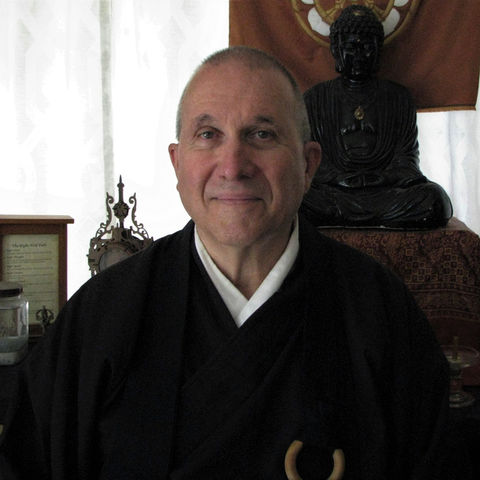
I'm Sensei Morris Sullivan,
And this is the second in my series of talks on Buddhist practices you can apply to your daily life.
In the first talk,
I explained that I would discuss the concept of contemplative practice as it exists in Buddhism,
And look at that from three different perspectives.
And I mentioned that people tend to tell me they come to Buddhist meetings for three main reasons.
They want peace of mind,
So to reduce stress.
Or they want increased happiness.
Having fewer stressful emotions is a great thing,
But we also want to feel good about life.
And finally,
People are looking for a way to connect with the sacred.
They may not use that word,
But once we have reduced our stress and started feeling happier,
We tend to want to sustain that,
In part through seeking a greater sense of purpose and meaning in life,
And even perhaps in ways that transcend this lifetime.
So there's a continuum of practice here.
One of the steps in stress reduction through practices like meditation and mindfulness is to let go of thoughts and value systems that lead to stress.
The next step is to start developing good replacements,
Thoughts and value systems that lead us toward fuller,
Freer lives.
And we'll look at a few of those in this talk.
But before we talk about how to be happy,
Let's talk about why it's good to be happy.
Once in a while someone will tell me they have a hard time wanting happiness for themselves.
It seems selfish,
Maybe,
To want happiness.
However,
If you can't find the resources for your own happiness,
It's very difficult to help others be happy.
It's also important for our spiritual progress.
If we can't be joyful,
We'll have a tough time appreciating the value of the sacred.
The Buddha recognized this.
There's a discourse in which he was talking about enlightenment and what that entails.
He said,
These seven factors of enlightenment,
When cultivated and developed,
Are conducive of full realization,
Mindfulness,
Investigation of the Dhamma,
Energy,
Happiness,
Calm,
Concentration,
And equanimity.
So,
Happiness.
Now,
You may not be thinking in terms of full realization,
But happiness has some very practical benefits in the here and now.
For instance,
Research shows that cultivating positive emotions actually reverses some of the physical effects of stress,
Resulting in a longer,
Healthier life.
Also,
In the process of developing happiness,
We create some emotional resilience.
So when bad things happen,
We suffer less.
And when people feel good emotionally,
They tend to be more creative and find more meaning in life.
The healthy pursuit of happiness is not a selfish endeavor.
When we develop the mental states that are most associated with happiness,
We tend to feel more connected to other people.
When we feel more connected to others,
We have more empathy.
So we tend to treat people better.
In fact,
The qualities that lead to true happiness,
Besides mindfulness and concentration and things like that,
Largely have to do with the way we see ourselves and the context of our relationships and our world.
So what do we mean when we use this word happiness?
In Buddhism,
We often talk about true happiness as something in terms of total liberation,
Something maybe presented as mainly experienced by monastics or people who really focus all their attention on the spiritual life.
But the Buddha said there were legitimate states of happiness that we could all see,
The kind of happiness experienced by someone with family,
With a career,
Those kinds of things.
So I like to think of happiness as a state of mental being that is generally pleasant with a preponderance of positive emotions that is sustainable,
Renewable,
And even self-perpetuating.
In other words,
Happiness should feel good much of the time.
It should be resilient enough that when something unpleasant happens,
Something bad happens,
We can feel appropriately badly about it.
And then we can return to feeling good,
Feeling happy,
Within a reasonable time.
And true happiness should lead to more happiness.
It shouldn't disappear entirely when circumstances become challenging.
Think about it like being in good health.
You might still get the flu or have an accident,
But because you're in good health,
You recover and return to good health quickly.
So happiness should make it possible to endure periods of unhappiness.
And it should lead to more happiness over time.
It should feel good emotionally and physically,
But it should also be good for us,
Not just individually,
But it should be healthy for the circumstances in which we live.
So you know,
Things like drugs and drinking can produce feelings of pleasure,
Even what we might consider positive emotions.
But happiness would generally support our family life,
Our social life,
And even our community,
Because this is the context in which we either thrive or we don't thrive.
So let's try a little exercise.
I want you to practice something that most people say leads to an improved overall sense of well-being.
Happiness is associated with positive emotions,
And we can create many of those emotions.
For instance,
Let's start with gratitude.
If you have a pencil and paper handy,
You can do this on paper.
Write down three gifts that you have received so far today.
In other words,
Name three things that others have made possible for you,
Or things that you have made use of in life that make your life more pleasant.
Like you can be grateful for your coffee maker,
Or for the plumbing that brings water to you,
Things like that.
So if you don't have paper and pencil around or don't want to write it down,
You can just reflect on this,
And I'll give you a minute.
So let me tell you what I put on my list.
I'm recording this early in the morning,
So I haven't interacted with any people yet,
But I think I can still come up with some causes for gratitude.
And as I mentioned,
Coffee makers,
That was important to me.
My coffee maker brewed me very good coffee this morning.
The street in front of my house is being paved right now,
But the crews are taking the morning off,
So I have a smoother street to walk the dog on today,
But I also have some quiet time to use for recording.
And third,
Insight Timer,
Which means a whole bunch of staff and people like you who subscribe and that sort of thing,
Have given me a platform for sharing the Dharma with people,
Which is pretty much my favorite thing to do.
So there are three of my reasons to be grateful.
I hope you came up with three of your own.
You may already be keeping a gratitude journal.
If not,
I encourage you to start.
Back in the late 90s,
I think it was,
There was a group of researchers who noticed that each of the world's religions encouraged gratitude.
And they decided to research this,
And they found that just writing down three reasons to be grateful each day over a fairly short period of time increased people's overall sense of well-being.
So there's a simple practice you can try and see how that works for you.
Here's another related practice I'd like for you to try.
You can do this during the course of your regular daily life.
It's called Mindful Thank You.
So pick a day,
And for that day,
Whenever you thank someone,
Specify what they did for you.
Why are you thanking them?
For instance,
If someone holds the door open for you,
Don't just go through it and say thanks.
Say,
Thank you for holding the door for me.
Try to do that a dozen or more times in that one day.
My colleague Greg Creech assigns that exercise in courses in Japanese psychology.
It relates to a practice called nai-kan,
Which derives from Jodo Shinshu Buddhism.
Nai-kan is very powerful.
I encourage you to work with it someday if you get the chance.
I talk about it on Insight Timer now and then.
And that particular practice,
Mindful Thank You,
Is surprisingly powerful.
We don't often think of contemplative practice in terms of something active like that.
It seems fairly passive,
Sitting still,
Contemplating your navel,
Whatever.
But really,
Contemplation is an active process.
It's a way of journaling an action.
When you're doing something and being aware of how your mind is involved with that thing you're doing,
That is contemplation.
Let me take this in a little different direction.
Have you ever considered the difference between thought and thinking?
Most of us probably think something isn't really harmful unless we do it physically.
But the Buddha said there were actions of body,
Speech,
And mind,
And those actions could be helpful or harmful.
There is a difference between a thought,
Which is a mental phenomenon that arises unbidden.
You don't have to do anything to have a thought.
And there's thinking,
Which is an action that produces more mental phenomena,
And also potentially actions of speech and body.
So thoughts arise.
One of the great Japanese Zen masters referred to thoughts as secretions of the mind.
It's not a bad way of looking at it.
A thought might arise in response to a stimulus the way a sniffle arises in response to pollen.
We can't really control what arises in our awareness any more than we can control who steps into a crosswalk while we're sitting at a traffic light.
But suppose you're sitting in your car waiting for the light to change and someone you really don't like,
The guy giving you trouble at work,
For instance,
Steps into a crosswalk.
That's not your doing.
But suppose you hit the gas and give him a little bump.
Well,
That's yours.
You own that.
All kinds of thoughts arise in our minds,
And that's not our doing.
Whether we keep our foot on our mental brake or let our minds run amok,
That's our doing.
So we want to focus on what we can actively do.
If you want a happier mind,
Practice happier actions.
What we nurture grows.
So when stressful thoughts arise,
We let them go.
If on top of that we deliberately practice good actions,
Then happy ways of thinking grow.
So to cultivate gratitude,
As we just did,
Increases our overall sense of well-being and thus our happiness.
In the past,
Psychologists tended to view positive emotions as symptoms of happiness.
If you were joyful,
It's because you were happy.
But in the last few decades,
Scientists started to understand something the Buddha pointed out over 2,
500 years ago.
Positive emotions cause happiness.
They're not so much a consequence of it.
Among the actions of mind that create happiness is a tough one for a lot of people.
Forgiveness.
That's worth a talk on its own.
In fact,
If you look at the audio that I've posted,
You'll find a talk on practicing forgiveness.
But after gratitude,
Kindness is probably the next most powerful happiness-producing practice.
So let's do another exercise.
So first,
Recall a kindness that has been done for you in the recent past.
Just think about that.
Focus on it for a moment.
Now notice how you feel.
How does it feel in your body,
In your mind,
In your heart,
Having recalled that kindness?
Now develop a heartfelt wish for someone else in your life to receive a similar kindness.
You can even visualize them being treated kindly in this way.
Notice how that feels.
How does it feel to wish well someone in your life?
So when I do that practice with groups,
People will often notice that when they recall a kindness they received,
It makes them want to be kind.
We also see that witnessing a kindness makes us want to act kindly too.
If you want to work more with this idea of developing kindness,
Try this exercise.
Do five kind things.
Things you wouldn't normally do for others in a single day.
Maximize the effects of that.
Make them all different.
Take time later to write down what you did and how you felt.
A person doesn't even have to know you.
I had a friend who had paid the toll on the expressway for the driver behind him.
I guess it's harder to do that these days because those things are usually automatic.
But you can find some way to help out a stranger.
Forgiveness and kindness both operate on the basis of compassion.
In Buddhism,
This is one of the most important principles.
The Dalai Lama often talks about the importance of compassion.
He once said in a famous speech,
The greatest happiness comes from the development of love and compassion.
Not only higher forms of life,
But also many of the smallest insects are social beings,
He said,
Who without any religion,
Law,
Or education survive by mutual cooperation based on an innate recognition of their interdependence.
I'll talk more about things like interdependence and meaning in the next talk,
But I want to leave you with one more thing to try.
In our services,
We always include some verses intended to help us be kind and compassionate.
People tell me that after they started doing this,
They began feeling more compassionate,
Having calmer,
Kinder responses to difficult people,
Things like that.
It surprised me a little,
To be honest,
That just reciting some verses might cause a change that way.
But actions of body,
Speech,
And mind are closely related,
And practicing one affects the others.
So,
There is something powerful about saying powerful words.
They resonate in our awareness,
And they can transform us.
So I'm going to say a phrase,
And then I'd like you to repeat it out loud if you're where you can do that.
Maybe if you're surrounded by other people right now,
You could come back and do this again later.
Repeat after me.
May I be happy and well.
May no harm come to me.
May I learn compassion.
May all my friends,
Family,
And those I love be happy and well.
May no harm come to them.
May they learn compassion.
May all those troubled in body,
Mind,
And spirit be happy and well.
May no harm come to them.
May they learn compassion.
May all those who have hurt me in body,
Mind,
Or spirit be happy and well.
May no harm come to them.
May they learn compassion.
May all those I have hurt in body,
Mind,
Or spirit be happy and well.
May no harm come to them.
May they learn compassion.
May all my adversaries be happy and well.
May no harm come to them.
May they learn compassion.
May all living beings be happy and well.
May no harm come to them.
May they learn compassion.
I hope this was helpful to you and that it gave you some ideas about how to focus your own exploration of contemplative practices.
As I said,
This is one of three talks in this series,
So I hope you'll work with this one for a while and then come back and learn how Buddhist practices can lead to a greater sense of meaning and purpose in life.
Thank you for your attention.