Namo tassa bhagavato arhato sammasambuddhassa Namo tassa bhagavato arhato sammasambuddhassa Namo tassa bhagavato arhato sammasambuddhassa I'm going to talk about meditation again.
Last week we talked a bit about formal meditation practice as a kind of self-care.
A dancer activist friend of mine wrote to me after I sent out the little newsletter saying,
Hey,
Let's talk about the history of self-care.
We had a little email exchange that was talking about this term self-care and how in its modern history it really begins in the civil rights movement.
Some of the earliest references are with the Black Panthers in Oakland doing community care and what it means for folks to come together doing what we now call mutual aid,
Really supporting each other.
It wove through feminist writing that was influenced by Marxism and queer liberation writing in the 70s.
That beautiful quote by Audre Lorde,
Caring for myself is an act of self-preservation and is thus political and radical.
It weaves through the feminist understanding of the interweave between the intimate,
The personal,
The relational,
And the social political.
The term has really emerged in the activist discourse on the left,
Understanding that we don't need to fall into a conceptual separation or a division between action,
Action engaged in the community or cultural level,
Political level,
And action engaged with the intimate,
The personal,
The relational,
And even the internal.
The caring for ourselves in this most intimate way,
When we come into meditation and we give ourselves the gift of time to set down the dramas,
To set down the work and the worry,
That this is not a retreat from the political,
But that in this classic radical way,
It is a political act because we are never not in relationship with the culture and with the forces of power and those who are moving power in the world.
And so to think about meditation as really moving through several channels of experience at once,
There is a way that meditation,
It is a kind of renunciation.
We set down being engaged with our work or our family or our social or political engagements or with the culture more broadly,
With entertainment.
We put all of that down and we do this thing that is strange in its simplicity.
We bring the body into stillness,
Already that can feel strange and uncomfortable even if we're used to constantly being in motion.
That's the hindrance of restlessness.
We bring the body into stillness without falling asleep.
That's strange.
Often when we bring the body into stillness,
There's too quick a slide into unconsciousness because we're exhausted.
So that's the hindrance of sloth and torpor particularly,
The dullness of the energetic system.
Then we bring the heart and mind,
The thought and emotional processing system where we make sense of the world and figure out what we want to approach and what we want to avoid.
We bring that system toward stillness.
The body is the easier thing to bring to stillness,
But the mind that it's just going and going.
We talked last week about what it's like to set the body into stillness and to turn attention to the mind and be flooded sometimes with all of the work and the worry and everything that's going on.
But the work to just let that flow through,
Not knock us over.
The work of setting down the fixations of the energetic,
Emotional,
And mental worlds is the work of the first two hindrances,
Setting down sensual desire.
All of the ideas we have and the emotions where we really want some kind of experience.
We want contact with some body or we want a certain experience of pleasure or satisfaction.
All of these things that we could get through sensory engagement.
I want to see certain things,
Hear certain things,
Touch certain things,
Taste certain things,
Smell certain things,
Even feel emotionally certain things.
All of that is essential in a way,
Moving through the senses.
How do we set down those very,
Very primal,
Deep ancient urges?
The urges for taste and for sexuality and for entertainment and for non-boredom,
For contact.
It's not so much an ethical proposal that says,
Oh,
The right way to live throughout your entire life is to not want or need anything.
This is specific to meditation where the question is really,
Can I take a break from that?
Do I get any respite from the force of wanting that courses through my being?
Even if I'm a relatively groovy individual and the things I want are healthy,
I want to see people being happy and safe.
That's a good thing to want.
I want to feel the pleasures of wholesome connection with good people.
That's a good thing to want.
But even those,
I can want them so intensely and then look around the world and realize that I can never really have them.
I can't stabilize those things.
Those lovely people,
Those conditions of safety are unstable.
They don't last.
They come and go like everything.
It doesn't help the appreciation of beauty at all.
When you see the beautiful wildflowers blooming to get all of a clumped about like,
Oh my God,
But they're going to die.
It's going to pass away.
The wildflowers will be gone.
They only bloom for a week or whatever.
Why waste your time doing that?
It's almost more ecstatic to see and be with and really feel viscerally that their temporality is in a way part of their beauty.
If the hills were just constantly covered in purple and orange,
It'd be a very different world.
It would be in a certain way toxic.
That's just not how ecosystems work.
Something would be wrong.
At the very least,
It wouldn't be special,
But nothing is like that.
Part of what's extraordinary about,
There's that phase of baby toddlerhood where they're sort of perfect and adorable.
You just want them to be like that for a long time.
Then basically five minutes later,
They're throwing nerf balls at the back of your head.
They change so fast.
You're like,
What happened to the little baby?
I remember the phase where our kid had moved out of the,
Oh my God,
Chewy baby kind of phase and had become a differently gorgeous,
Fun,
Marvelous toddler.
Then we started to have the,
Oh,
I missed the baby.
Maybe we should make another one.
Just to have more babies around.
I was like,
This is not the right motivation.
To make more people.
You can have that pristine six-month phase where they're just like a cinnamon bun.
Then they change.
The work of setting down wanting is the work of dealing with the first hindrance,
Essential desire.
Then the terrible second hindrance of ill will or hatred,
The work of setting down hatred.
I'm coming to meditation and the world is what it is.
You've all been reading the news or avoiding it or being in some relationship to it,
Or you've got relationship issues or whatever.
If you're paying attention,
Like what was that old bumper sticker?
If you're not outraged,
You're not paying attention.
Yes,
But it's not that useful to just live outraged.
At the very least,
It's not fun,
Sustainable,
All of that.
The second hindrance of ill will,
Can we sit down in meditation and set down the hatred that we may be carrying for anybody,
For the evil people,
For the terrible men in the world?
Can we set down the hatred for the terrible people?
Whatever words you use for them,
That's hard work.
Of course,
The fifth doubt,
Can we sit down in meditation and set aside doubt?
Formal meditation,
Sitting in meditation and stillness is sometimes traditionally characterized by the setting down of these five hindrances or the diminishing of them.
Classically,
They are contained and then diminished through concentration and they are uprooted by it through insight.
You can concentrate on your breath or something and set aside the hindrances for a while.
Then when you soften up on the rains,
They sometimes come flooding back in,
Sometimes they don't.
It's so good to take a break from them.
It's nourishing to take a break from them.
The more we do,
The more we learn that it feels really good to not be driven around by the hindrances.
And so they get weaker and less frequent.
But they finally get uprooted really through seeing with wisdom.
You can suppress grasping with relaxation and concentration and being absorbed in something good.
But you only really uproot it when you understand impermanence very,
Very deeply.
When you come into a mature relationship to the blooming flower or the blooming human or the beauties of the world,
All of the things worth grasping at for a few moments.
But then we grow up a bit and we understand that nothing is worth suffering over.
And there's such a paradox here because we have been talking about social action.
And even when I say it,
Nothing is worth suffering over.
There's a way that I want to say,
No,
Some things are worth suffering over because they're important and people are being harmed.
So then we have to understand what suffering here means.
So in our meditation,
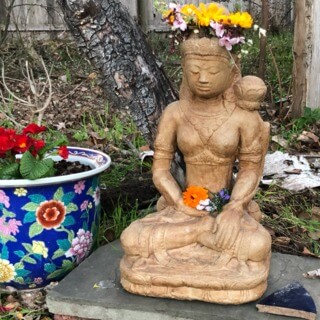
We invoked the form of Quan Shui Yin,
The one who hears the cries of the world while resting at ease.
Quan Yin's meditation is a meditation grounded in listening.
There's a hearing is the action,
Hearing the cries of the world.
That's the object.
So there's a hearing and that's directed toward the suffering of the world that encompasses or enfolds or listens to,
Bears witness to the suffering in the world.
And there's that mysterious third phrase,
While resting at ease.
Quan Yin clearly is not suffering the way we suffer.
But this image or archetype or figure is clearly described as being oriented toward suffering.
To be the avatar,
The embodiment of compassion is not just to be resting in emptiness.
That's not exactly Quan Yin's meditation,
But it's resting in compassion.
Which is the,
They say,
The quivering of the heart in response to pain,
To suffering of others or of ourselves.
If we can manage the beautiful,
Bearing witness to our own suffering in self-compassion.
But compassion orients toward suffering.
And the heart responds with this kind of softening,
That kind of tenderness.
Oh,
This is real.
The heart doesn't turn away.
And at the same time,
She's resting at ease,
Resting at ease.
Part of what this tradition,
I think,
Understands beautifully about freedom,
About the heart when it's unconstricted.
Is that the activity of contact coming into connection with another or with another's experience.
That this is not incompatible with the experience of emptiness,
Vastness,
Equanimity,
Release.
I think the thing that gets confusing for us who are immersed in the world of liking and disliking,
Hoping and fearing,
Grasping and pushing away.
Is that it feels like contact with anything automatically implies reactivity.
We either want it or we want more of it or we want less of it.
Or we can't really,
Or we're not really connecting.
If we're really connecting,
There's some kind of passionate response.
Either to make deeper contact or to push away contact.
And that we praise this state that we call sometimes equanimity.
But it can be difficult sometimes to really feel,
What's that really like?
Equanimity as a state is considered to be very,
Very close to liberation itself.
In that way,
It has a lot of near enemies.
For a lot of these wholesome qualities in the Dharma,
There's the far enemy,
Which is its kind of obvious opposite.
For loving kindness,
The far enemy is hatred or ill will.
That's clear.
But there's also a near enemy,
Which is the thing that looks like it,
But isn't really.
For compassion,
This tenderness or poignancy in the heart,
In the presence of another's suffering,
The near enemy is pity.
It has a little bit of superiority in it.
It's kind of like,
I look down upon.
And if Kuan Yin practice is infected by this quality of pity,
It means that there's something unhealed there in the self or the relational body.
Pity is not the only near enemy.
Others are like,
There can be other forms,
Other kinds of spiritual bypass.
Like too quickly washing away suffering that I see in the world by calling upon karma or all things being right or mysterious.
Sometimes these things religiously can be comforting.
You're losing everything and someone says,
Well,
God must have a plan.
That's a way of calling on a kind of higher power to say,
I have no idea why I or you or we are suffering so terribly,
But maybe there's a greater wisdom at play that I'm not in contact with.
But all of those justifications in a way,
Or intellectual type justifications,
Like I'll catch myself doing this.
I'll be looking at the news and I'll see something kind of geopolitical,
Something having to do with borders or this or that is going on in a part of the world that's heavily contested.
Parts of Central Africa right now are inflamed in this way.
The Middle East,
Of course,
Is inflamed in this way.
But the border between California and Mexico is inflamed in this way.
And I can look at any of these kinds of situations and wash it away with a kind of like,
Yeah,
The long tail of colonialism.
You know,
Still here.
And that's true.
But I could totally do a kind of like,
Yeah,
Postcolonial analysis.
Here's how we got here when the British Empire divided up the Middle East without asking anybody who lived there what they needed.
They did the same.
The British created the partition in India.
The person who drew the line between India and what's now Pakistan just drew a line on a map without ever even visiting,
Without knowing anything about the people that lived there.
And that line is a battle zone right now.
How many decades later?
Like the height of delusion and ignorance in doing that.
So I can know that.
But sometimes knowing that,
Like drawing on history in that way or whatever,
Can also be a way of not feeling the pain that's there.
I can say,
Oh,
Yeah,
You know,
Arg the British.
And that's kind of a way,
You know,
I get a little distance from it.
And so then,
You know,
That's not Kuan Yin practice either.
Kuan Yin knows the history.
Yeah,
That's not the thing.
But that's not what she's doing.
Kuan Yin is listening to the cries of the world while resting at ease.
And so there's listening and hearing and listening actively to the world,
The suffering without turning away,
But also without falling into this mistake that contact always has to mean having a visceral or forceful emotional response.
I have to feel it strongly.
Compassion feels it strongly,
But in a very spacious way.
Right.
She's resting at ease.
So,
Of course,
She wants people to be well,
You know,
You tune into the war zone and you want the people to be safe.
Can you do that while resting at ease?
Is this very difficult?
I'm not even sure it means that we don't take sides because I think there's times when,
You know,
You can say,
Oh,
You know,
The harm being caused here is not,
You know,
You don't do a false equivalence.
You're like,
Yeah,
It's clear that these people are causing most of the harm.
You can see it.
You say,
Oh,
Look at this situation.
Here's where the harm is flowing from.
Right.
It's not just that it's not that harm is always a sort of.
You know,
Just an equally spread out quality in the landscape,
You know,
So you can you can beat you want.
You should be discerning,
I think,
Really understand the world.
And still right while resting at ease.
So in meditations,
Come back to meditation for a minute here.
We come into sitting meditation,
Formal meditation.
There's the practice of setting it all down,
Which is its own bit of work.
And then there's this mystery of what it means to embrace and even delight in stillness.
To lean into this third phrase,
Right,
To not just be like,
I'm listening,
I'm listening to the cries of the world,
But to be like,
OK,
You actually are pretty good at that.
What you need to practice is that third while resting at ease.
So we come into the body,
We say,
OK.
Meditation is the resting at ease.
The body comes to stillness.
Wash the body with breath energy.
Clear out some stuck places,
Bring the body into the more of a feeling of openness.
Set down the stories,
The obsessions,
The reactivities,
The hindrances as much as we're able in this moment.
As soon as we set down the stories of what's going on out there.
We can listen in a different way.
I think there's a kind of Kuan Yin listening where we're not actually bringing up the stories,
The images.
Even though that is a kind of listening,
You can do that.
And if the heart can't feel the world,
Then give it some more fuel.
Think about the images,
Bombed buildings,
Hungry children,
Angry people.
Totally,
The images are in there anyway.
You can bring it to mind,
But don't churn on the story.
It's more like you bring it up so that we stay in a meditation on compassion.
It's not we're not just doing a breath meditation,
But we're staying with the world.
But then as much as possible,
Set the story down as long as the heart can still feel it.
And there can be a listening.
You can do regular physical listening.
So for me,
I'm hearing the frogs right now.
And hearing gives rise to a sense of space.
Or if we're with the breath,
It can give rise to a sense of the body as being spacious.
Sometimes the body feels like it expands or softens,
Gets big.
It's flowing with energy.
And this becomes its own kind of self-care,
Not just the stopping,
But the stopping and opening.
And there's a kind of nourishment that comes as the breath and spaciousness meet the body,
Relaxing,
Staying awake.
Sometimes when we're beginning this,
It doesn't feel restful.
It feels like I'm having to really work to set down the thoughts to keep coming back again and again,
Focus the mind.
It is a certain kind of work.
But you might feel into what your state is like when you're not doing that.
And when the mind is flooded with stories,
Ideas,
News,
Conversations,
People,
Images,
You might feel how that actually is also work.
It's unconscious work because you've been taught to do it all the time.
But it's effortful in a certain way.
It's not restful.
It's not restful.
And again,
Often it's the right thing to do because you're working in the world to be in service of well-being.
But in meditation,
You can really feel how there's a part of you that's hungry for,
Almost wild for the heart at rest,
The mind at rest.
So you get a glimpse of that.
It takes a bit to stabilize it.
But as you do,
You can open into a space that is profoundly nourishing.
Sometimes when we emphasize daily meditation,
That it's really good to be in meditation and stillness a little bit every day,
That every day is more important than big chunks every once in a while.
It can seem like what we're saying is,
It's a kind of training or practice,
Right?
Keep practicing.
And the more often you practice,
The better you get at it.
That's true.
But there's this other piece in the self-care direction that resting into the spacious,
Silent,
Or at least softer,
Blossoming energy that comes in this kind of meditative stillness.
Dropping into that state a little every day is just,
For most of our nervous systems,
Just profoundly healthy.
In a life filled with doing,
Doing,
Doing,
That this other kind of doing,
I'm not going to call it non-doing,
Because it takes work to settle.
In the same way that it takes work to put the phone down and go to bed at a reasonable hour,
It takes work to set the stories down and,
As they say,
Get your tush on the cush and stop for a little while.
And I think the agenda that we meditation teachers have for y'all,
Anyone listening to this,
Anytime,
Is not so much that you do your meditation every day or get really good at it or whatever.
The main thing I want you to do is fall in love with it.
Because if you enjoy it,
Then all the rest will come.
But I want you to have,
And I want all of us to have,
These moments of respite,
These minutes of resting at ease,
That are mysteriously,
Completely at the same time,
They are totally for you and also for the whole world.
And that's Kuenyan magic.
Resting at ease,
She hears the cries of the world.
So may we each,
And may the world be at peace.
Flossing there.
Good.
Her mantra is namo kwan-shir yin-pu-sa,
Namo kwan-shir yin-pu-sa.
So,
If you're not quite sure what to do,
Say that a whole bunch of times.