Begin the meditation by taking as comfortable a sitting posture as you can.
Given the state of your body in this moment today,
Sitting in a chair or on a cushion or bench,
You can also meditate standing up or lying down,
And in movement,
Of course.
For this meditation,
We'll focus on sitting posture as a foundation for stability of attention,
Growing the quality of mindfulness immersed in the body,
Intimate with the body.
For those sitting in a chair,
It can be helpful to have both feet flat on the floor or supported by cushions so that they can rest flat,
And for the back to be either supported so that it can be tall and upright,
Or unsupported,
Settling into its tall upright midline.
It can be helpful to sit on the front edge of a chair so that you can tip the bowl of the pelvis forward,
Inviting the low back into its natural curve,
Relaxing through the belly,
And finding,
Often through some experimentation,
A posture in the spine and the upper body that feels balanced,
Relaxed,
And most importantly that you're not using force through the musculature,
Particularly through the abdominal muscles and the postural muscles around the spine,
To stay upright.
The sitting posture,
At best,
Is relaxed,
Effortless,
And aligned.
And you'll choose how to sit,
Floor or cushion or bench or chair or standing,
Based on what is most useful for your body.
All of our bodies are different and find ease in different ways.
If you're sitting on a cushion or a bench,
Again,
Finding as comfortable a posture as you can and enough elevation under the sit bones,
Again,
To allow the hips to tilt forward slightly or to rest balanced on the sit bones so you can feel the two bones at the base of the body.
Depending on the structure of your hips and legs and lower body,
This can look very different body to body.
Again,
What's most important is comfort,
Ease,
In whatever way we can find it.
If it's difficult to relax the low back or the upper back or the belly while sitting on the floor,
Sitting up higher can help on two cushions or more or on a bench if the cushion is difficult.
Sitting right on the sit bones and tipping the hips forward slightly is an invitation for the belly to soften.
So in whatever posture you're sitting,
Finding that softness as best you can and then resting into it.
You might rock forward and back just a little or side to side or even find little circles like a dog turning circles to settle into its napping spot.
And we're feeling for a place where the belly,
The chest,
The head and shoulders,
The whole bright column of the upper body relaxes,
Softens the effort of sitting upright,
Of pulling ourselves upright and settles into center,
Midline,
Balance.
You can feel for the midline of the body as if at the center of the top of the head there were an opening or a hook and the body were strung on a string hanging from the center of the dome of the sky as if the body were the weight at the bottom of a plumb line,
Naturally orienting towards center or that the body were like a bead on a string where the earth itself is the bottom of the plumb line and the body a tiny bead strung on the string resting on the surface of the giant bead of the earth and the string going further all the way out.
We sit as my teacher Jack says again and again,
Halfway between heaven and earth.
And throughout the Buddhist tradition,
The image of a tree again and again appears as it does in so many cultures around the world.
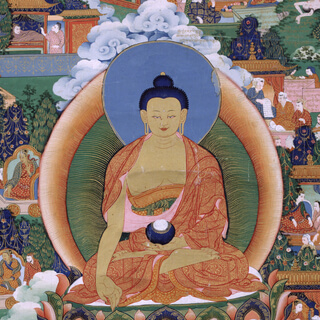
The tree under which Gautama sat growing in clarity and wisdom and stillness until with the morning star he was finished,
Fully awakened at peace.
The tree becomes the metaphor for that which is rooted into the earth and rises up into the sky,
The tall clear trunk.
Early in the Zen tradition,
The metaphor was offered quite literally.
This body is the Bodhi tree.
This body is the tree rooted into the earth rising up.
Feel the lower body as the roots,
Pelvis broad and spreading,
Legs at ease,
Relaxing,
Resting,
Curling down into the soil,
Spreading out,
Stable,
Broad,
Rooted.
And like a sapling initially,
The thread of the spine and the center of the body rising up.
As we begin our practice,
Sometimes this feels just like a sapling collapsing,
Falling into patterns of slouch,
Slump,
Collapse,
Or the patterns of strain,
Lift,
Present,
Hold it together.
Can we feel our postural practice as a middle way between collapse and strain,
A soft,
Bright buoyancy through the upper body,
Shoulders falling open,
Invited to fall open,
Not pulling against the tensions of habitual posture,
Not trying to force the body into any imagined form or imagined perfection.
We feel for balance.
We feel for center.