So taking a moment to settle into our posture.
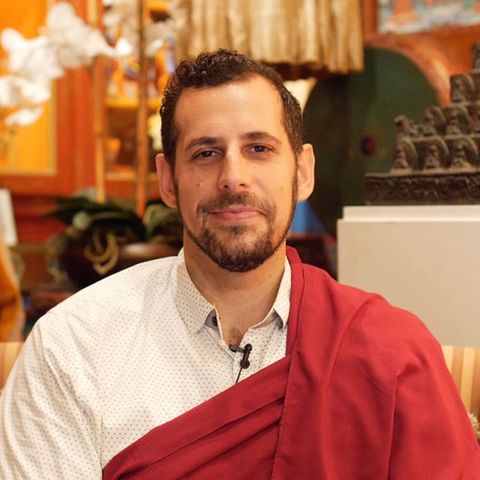
We'll just come into a relaxed yet alert posture with our back straight,
Our shoulders back and down,
Our chin slightly tucked.
And if you'd like,
You can start with your eyes closed.
Just taking a moment to come into our intention for practice,
Remembering our compassionate motivation,
That we're exploring our own minds in order to find awakening not just for ourselves but in connection with all other sentient beings,
That we may become of service to them through getting to know our own human experience,
Human mind,
And finding more and more freedom and awakening through the practice of the dharma.
And more specifically,
Generating an intention for calm abiding or shamatha practice that we are going to train in stabilizing our awareness in the present moment in order to find more freedom,
In order to eventually see clearly into the nature of mind,
Into the nature of experience.
So in order to do that,
We need a calm and stable presence,
An awareness that doesn't just run everywhere.
So forming that intention,
We'll start by just briefly coming into a practice of shamatha with support or shamatha with the breath.
Just starting to notice our breathing in the abdomen as we inhale and exhale,
Noticing the expansion and contraction of the end of the abdomen,
Bringing our attention and awareness to just knowing the breath and the body.
Breathing in and out through our nose,
Just letting our awareness find the breath and the body,
And the awareness notice when we're carried away by a thought,
Carried away into distraction and letting the breath bring our attention back in to the moment like a magnet.
So here as we meditate with the breath,
Just notice that there's a sense of presence with the breath,
A sense of awareness,
A sense of bearing witness to that experience.
So this sense of presence is available to us not just with the breath,
But also without a set object to focus that presence on.
So now coming into contact with that presence,
We're going to gently open our eyes,
Coming into 180 degree vision with our peripheral vision open.
Here the gaze is just open and relaxed.
We're not focusing on anything in particular.
One tip is just to focus out into space and rest the gaze in space,
Not in an object.
Now with all of our senses wide open without blocking any of our sense perceptions,
We're going to let go of the breathing and just attempt to stay with this presence,
To stay with the awareness.
Here we're just trying to preserve that present moment awareness or that presence without getting lost.
There's no particular focus,
Just the present moment.
Letting the awareness rest on the present and sustaining that.
So this present moment awareness is not a thought,
It's not a sound,
It's not a sight,
Not a smell,
Taste or taste,
But it's a thought.
So we're going to let go of this present moment awareness,
So this present moment awareness is not a thought,
It's not a sound,
It's not a sight,
Not a smell,
Taste or touch.
It's a quality of mind that can know when we're knowing and just this quality of mind that can be aware and present.
So just remain with that presence,
Letting that stabilize from moment to moment and when distraction comes,
When you wander from that presence,
Just notice and rest or relax back into that presence.
So rest here means just let that awareness come and relax a bit,
But don't lose the presence.
When you've lost that presence,
Too much relaxation.
So just stay open,
Fresh.
It's like a child's mind here.
Present but without anything in particular to pinpoint.
We rest the mind with itself.
So just for a moment,
We'll refresh the practice.
You can feel free to break that presence.
Move around,
Let the eyes move around if you need to.
Take a gentle stretch,
Deliberately don't try to focus on the present.
So again,
Finding our posture now.
Just rest the gaze,
Rest in the body and find that presence.
It's neither a sense perception or a thought.
Just rest in that presence once more.
When you become spaced out from that,
Just refresh the presence again.
It's really nothing to come back to because there's no object,
There's just a presence.
Just an awareness to come into contact with and try to sustain these very short moments.
You may feel un newer or less,
You may feel worse,
You may feel better,
You may feel worse.
Okay,
So again,
We'll just take a momentary break from the practice.
Feel free to take a gentle stretch,
Deliberately break the practice,
If you need to blink your eyes,
Do something.
And now return to your meditation posture.
Gently settle into the body once again,
And just settle into that presence,
That present fresh awareness.
Don't try to focus on anything in particular,
Just be aware and rest in that awareness or on that awareness.
Sustain that in a relaxed,
Peaceful way,
From moment to moment.
Okay,
Feel free again to gently break the meditation.
So now,
Hopefully you have a taste of this present fresh awareness,
This shamatha without support or open awareness practice.
So now you can continue on your own or in sessions throughout the day,
Just in these short moments many times,
Practicing one or two minutes at a time of just resting in presence,
Resting in awareness,
Trying to sustain that.
If we do it in this way,
Not trying to sustain it for too long,
It stays quite fresh,
It stays quite alive.
Sometimes when we try to do it for too long,
We become kind of like a zombie or kind of spaced out.
So just keep it short,
Keep it fresh.
Of course,
If you're able to go longer,
Try to go longer.
And you can also alternate between with support and without.
If you want to come back to the breath sometimes,
Then drop the breath and just remain in presence itself.
That can be very useful.
So experiment,
Have fun and enjoy the practice.
Thanks so much.