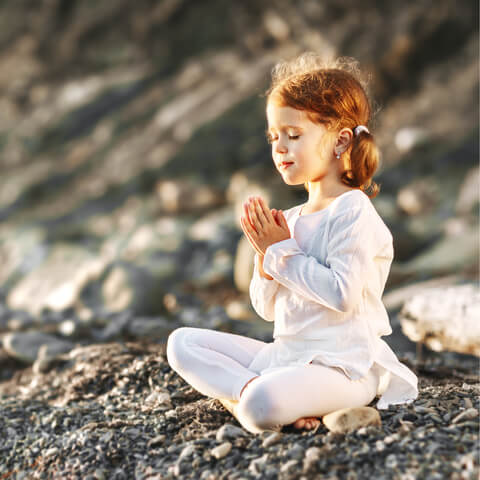
Ps Hello and welcome to this brief discussion about different anchors we can use when following a mindfulness practice.
So this isn't so much a guided meditation as it is a review of some techniques that you can use in your own meditations to help you stay focused and stay grounded in the present moment.
So we'll begin by getting into a comfortable position.
This can be lying down,
Sitting on a sofa,
Sitting on a chair.
It's preferable to be grounded,
To have our feet firmly placed on the ground and if possible sat upright in what I like to think of as a position of dignity.
I'm going to begin with what is the most common anchor for mindfulness practice which is the breath.
We use the breath as an anchor because it's always with us and because it's not a process that we need to control,
Therefore it's always happening.
So when we're sitting,
Approaching a mindfulness practice,
We focus on our in-breath,
Feeling where it draws in through the nostrils.
We focus on the effect that it has in our body,
Be that the expansion of the chest,
Swelling of the belly or on the out-breath,
Softening of the body and the relaxing of the body with each out-breath.
Now another way to use the breath consciously as an anchor is simply to count and what we do is count one on an in-breath and then let go in an exhalation and count two on the next in-breath and release again,
Three,
Four.
What the process of counting does is maintains our attention on each breath.
It makes it harder to become distracted by our thoughts and feelings.
If you realize that you have become distracted and you've lost count,
Simply begin again at one and if you successfully reach ten without distraction,
Then again return to the number one on your next in-breath.
I'd like to leave you for a minute or two to practice using counting as an anchor in the present moment and I'll tell you when those two minutes are up.
Travis talking.
You you Remember if you lose count You feel you've been distracted and followed a train of thought Simply return to one with your next in-breath you Okay,
And you can let go your concentration on counting now simply allow your breath to return to rhythm and we're going to look at another This is to pay attention to sensations in your body And actually to play a little with where you feel sensations You may be familiar with the concept of a body scan Where you focus on different body parts?
Consciously relax consciously note how they're feeling And this is similar although.
It's a little bit more specific What I would like you to do on your in-breath Is to concentrate your attention on the little finger of your right hand And as you breathe in See if you can recognize the sensations Just in that little finger one breath in Focusing all of your attention on the little finger of your right hand And we then go through each finger so in-breath the ring finger In-breath the middle finger In-breath the index finger And in-breath the thumb And then we would repeat that procedure on the left hand In a moment I'm going to leave you again two minutes of silence to practice this For the more adventurous we can also try to focus attention into our toes Many people find this harder But it certainly is possible to focus our attention so acutely We can feel sensations for example in our little toe on our left foot or our middle toe on our right foot You may find focusing attention on your big toe is easier Let's just try that one moment As you breathe in focus all of your attention on the left foot and the big toe Can you feel the tingling sensation,
The warmth?
And then you can shift the attention as we did before to the next toe And the next And so on It's important to note that when you do this exercise you don't try to move the finger or toe that you are concentrating on in order to provide the sensation This is very much a mix of pure awareness and possibly some visualisation of the finger or the toe To arrive at a point where you really can identify the sensations that you are feeling And again I'm going to leave you for a couple of minutes to practice that I would suggest that you start with the left hand and the little finger and move systematically across to the little finger on your right hand and then repeat the same with your toes So I'm going to leave you to that I'll tell you when the two minutes hit up So So So Okay so we're approaching two minutes now Before we move on from focusing awareness on fingers and toes I'd like to simply try a brief experiment to play a little with the idea and see if you can shift your attention from one finger or toe to another So let's try first of all for the thumb on the right hand See if you can focus your attention purely on the thumb on your right hand Find the tingling sensation,
Find the warmth,
Find the sensation of touch if it's against your leg or against fabric And now shift to the little finger on your left hand And now can you find the middle toe on your left foot And the big toe on your right foot This is a technique you can definitely play with on your own when you are sitting mindfully and simply moving attention from fingers to toes and back and other body parts if you like Can you find the sensation with your nose or your left ear And this maintains your attention in the here and now The last anchor that I'd like to explore with you is perhaps a little surprising because we often think of sounds during mindfulness practice as a distraction Very few of us have a place where we can go in absolute silence for any lengthy period of time We're going to be hearing birds,
Family members,
Doors closing,
Cars the sounds of life moving around us and at times these sounds can appear as distractions,
Can appear as unwanted and can seem to wreck the session of mindfulness However if you consciously use sound as your anchor then you'll find that each sound that you hear is something that you can really focus on and be aware of and actually the sounds around you can become the anchor to the present moment and if you find your mind wandering and following the chatter then the slightest sound in your immediate environment can be an anchor and can bring you back So what I'd like us to start with is the sounds that you can hear that are very very close to you and the sounds that you can identify in your immediate environment And now move your attention a little further out Are there sounds perhaps just outside the room or the space where you are that you can identify?
Are they persistent sounds?
Are they intermittent sounds?
Are you now identifying sounds that previously,
Focusing on sounds within the area where you are,
You weren't aware of?
And now I'd like you to take your attention even further and see if you're able to identify the sounds that are coming from furthest away Perhaps the rumble of traffic,
Perhaps an overhead airplane,
Perhaps a bird Which sounds can you now identify that previously you weren't aware of?
And you can also play with this awareness of sound by moving from immediate sounds perhaps sounds of your own body or breathing to distant sounds and to sounds coming from just outside the space where you are And in this way again,
We're focusing our attention on what is happening in the here and now and using the environment around us to provide us with an anchor to the present moment Let's try that for a minute or so Practicing moving our attention from sounds closest to us,
Furthest away from us and then in the mid-range Okay,
I'd like you now to let go of that focus on sounds I'm going to look at one more method of anchoring in the present moment This is a little more conceptual and it does involve also paying attention to the general breath But it's a way of dealing with distractions arising from our thinking or from our emotions And on the surface it sounds very simple The practice is one of noting So,
Become aware of your breathing Follow the breath in Follow the breath out And as soon as you become aware of the thought simply note that was thought and return to your breathing And when you become aware that you felt an emotion simply note the emotion Let it go and return to your breathing It's not necessary to name the thought You don't need to engage with it and follow it It's not necessary to name the emotion Whether it's anxiety or joy or anticipation,
It doesn't need a name We can simply note the emotion Let it go and return to our breathing This idea of noting is certainly worth practicing for longer and longer periods But let's just explore that for a minute or so now So beginning with a focus on your breathing,
Awareness,
The in-breath and the out-breath Perhaps choosing where in your body you feel that most And if you need to,
You can place a hand on the belly so that you can physically feel the in and the out-breath And then as and when thoughts or feelings occur simply note and let go Okay,
So just to recap We've covered four different techniques of anchoring to the present moment The first was counting our breaths The next was sensations in the body Then we used environmental sound as an anchor to what is happening in the present moment And finally we looked at the slightly more conceptual idea of noting thoughts and emotions as they occur I'm going to end this talk and meditative practice for now But of course,
You're free to sit for longer and to choose one or more of these techniques And experiment with it a little longer Thank you for sharing your mindfulness practice with me today Thank you for watching