The world has changed in an unprecedented way within a matter of weeks.
We're being shaken up and thrown into some very uncomfortable places.
Our familiar structures and patterns,
Including places of work,
Meetings and the schooling for our children,
Will all come back,
Even if we don't know when.
But for now,
They're no longer here.
And we could be forgiven for feeling disorientated,
Especially when normal life is so typically centred on familiar routine,
Busyness and autopilot.
I'm definitely not in a position to tell you what to feel or how to think,
But in this series of weekly podcasts,
I'd like to share a few reflections and some simple,
Practical ways of transforming how we relate to what's happening in our life.
My aim is to offer you some simple ways to experience more peace and have greater freedom during this period of uncertainty.
And each podcast will include a 10-minute meditation practice at the end.
A few days ago,
I read some wise words by Rabbi Moss from Sydney,
Australia,
On the topic of uncertainty.
Someone said to him,
This coronavirus thing has really thrown me.
I feel like I've lost all sense of certainty.
No one knows what will happen next.
How do we stay sane when we don't know what's lurking around the corner?
The Rabbi replied,
It's not that we have lost our sense of certainty.
We have lost our illusion of certainty.
We never had it to begin with.
This could be majorly unsettling or amazingly liberating.
Earlier this month,
I spoke at Exeter Diocese annual School Leaders Conference on meditation as a way of building community,
Enhancing wellbeing,
And learning to lead,
Work and live more collaboratively and compassionately.
Needless to say,
People were very worried about the impact of coronavirus and school closures,
So I dropped a lot of what I'd planned to say and tried to make the session as helpful,
Straightforward and practical as possible.
I began by writing problem in large letters on a flipboard and asked for a volunteer to stand just a few inches in front of it.
When I asked what she could see,
She replied,
Problem.
I then asked her to step back and tell us what she could see.
And this time she replied,
Problem and a small bit of the room.
Each time she stepped back,
She could see more of the room.
The problem wasn't going away.
It was there,
Real,
In big black letters.
And she wasn't allowed to look the other way.
Life happens and it needs to be faced.
But her relationship to the problem changed with every step she took.
As her field of vision opened,
She was encountering the problem in an ever-expanding and more spacious context.
And this is just what we do in meditation.
During our period of practice,
The problem we learn to step back from is whatever thought or feeling happens to be flowing through our mind.
We don't try to suppress thoughts and feelings or run away or hide from them.
We just note them without comment and return to our practice.
It's that simple.
Most of us spend a great deal of time simply reacting to what's going on around us.
We react to life's events on a sort of autopilot,
Running along well-worn tracks of habit or fear.
Meditation can help us become more aware of our fears and reactive habits,
Learn how to skilfully acknowledge and pause them,
So we can create a space of greater peace and opportunity,
In which we have more freedom to decide how we want to relate to all that life offers us,
Or in the case of coronavirus,
Throws at us.
Richard Rall,
Who runs the Centre for Action and Contemplation in the US,
Recently wrote,
We are in the midst of a highly teachable moment.
There's no doubt that this period will be referred to for the rest of our lifetimes.
We have a chance to go deep and to go broad.
Globally,
We're in this together.
Depth is being forced on us by great suffering,
Which,
As I like to say,
Always leads to great love.
The simple meditation I practice and teach centres on focusing our attention on the inflow and outflow of our breath.
When we notice that we've been distracted from our practice by a thought or feeling,
We simply turn our attention back to our practice,
However many times we need to do so during our time of practice.
Each time we turn back to our practice,
We are gently confronting our previously largely unconscious habit of just reacting to thoughts and feelings with yet more thoughts and feelings.
We learn to meet thoughts and feelings quietly and without comment.
We watch them come.
We watch them go.
It's that simple,
That subtle,
But we have to work at this.
All we need to do is to commit ourselves to the practice and begin.
And each time we are distracted,
We just begin again.
It's a little bit like taking your head to the gym.
Repeatedly turning back to our practice is like mental resistance training.
Being distracted is going to happen.
We should expect it.
But we don't need to mind distractions or struggle with them.
We can just welcome and patiently work through them.
What we're doing is learning to pay attention to what we choose to pay attention to,
Not just letting our attention,
Our ego,
Chase whatever it finds attractive or run away from whatever it fears.
And it's precisely through repeatedly turning back to our practice over and over and over that we gently learn to note,
Step back from,
And change our relationship with what's going on in our surface mind.
And we do this so we can look out from a more solid foothold and meet life,
However it is,
From moment to moment,
With ever greater peace and freedom as our field of vision opens.
All we need to do is make the decision to set out on the journey and keep making it.
Here are some simple guidelines to help you meditate.
Firstly,
Make sure you're sitting comfortably with your back as straight as you can,
With your body still and relaxed but alert.
Take a few slow,
Deep breaths to gather your attention and help still yourself.
Focus your attention on your breath and follow it as it flows in and out through your nose.
This will help you bring body and mind together and lead you into stillness.
And when distractions come,
Which they will,
Don't fight them and don't be discouraged.
This is entirely natural and in fact it's a good and necessary thing.
We're not trying to have a blank mind.
We don't want to be mindless.
So whenever you notice your attention has followed a thought or feeling and you're busy chatting to yourself about it,
As soon as you notice,
Just gently take your attention back to following the breath.
And very importantly,
Do not place any demands or expectations on yourself.
You cannot judge or evaluate your meditation or anyone else's.
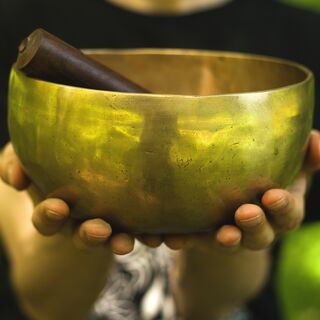
I'll ring a bell in a moment to signal the beginning of meditation and again when it's time to finish.
The following period of meditation is for ten minutes.
The following period of meditation is for ten minutes.
The following period of meditation is for ten minutes.
The following period of meditation is for ten minutes.
The following period of meditation is for ten minutes.
The following period of meditation is for ten minutes.
The following period of meditation is for ten minutes.
The following period of meditation is for ten minutes.
The following period of meditation is for ten minutes.