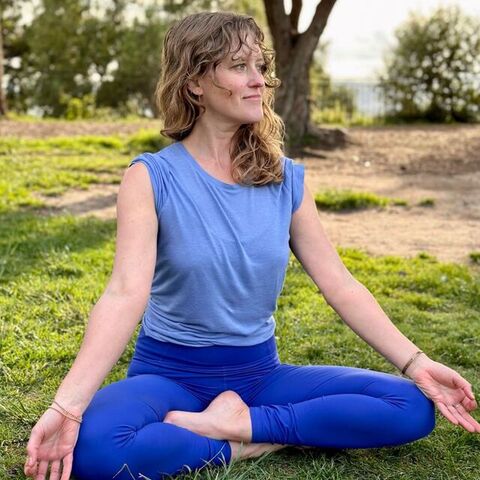
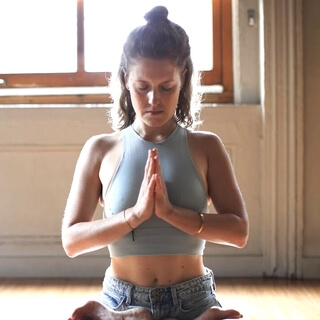
I invite you to take a tall and comfortable seat.
You can also lie down or stand up and either pick a gazing point in front of you or close the eyes gently from top to bottom and breathe calmly in and out of the nose,
Relaxing any obvious tension with each exhalation.
Let your breath be natural here.
It might also naturally deepen simply by slowing down and arriving in a place of stillness and ease.
Notice if your attention starts to wander on thoughts or to-do lists or the sounds around you.
Knowing that it's very natural for the mind to wander,
This practice is not about stopping the fluctuations of the mind but rather calming them,
Being aware of them.
And maybe by default,
Because of that practice,
They might start to cease gently,
Naturally,
And easefully.
But in either case,
You can always continue to return your attention to the breath here and now,
Moment after moment,
As an anchor for your awareness.
So that if you do have thoughts,
If you are distracted by sounds,
Sensations,
You can always invite your awareness back to the present moment using the breath as this gentle anchor.
If it's helpful,
You can name the breath as inhale and exhale as it happens,
Continuing to allow the breath to release any tension as it flows in and out of the lungs like waves.
You might notice where in the body you feel your breath.
It might be the belly or the ribs or the chest,
Most common places.
It might shift in intensity or length or the space,
The place in which you feel the breath move physically.
Not trying to push the breath to be anything different than what it is.
Just letting it be,
Letting it do what it naturally does.
We'll start to explore a breath work practice involving your own physical touch.
So I invite you to place your hands gently onto your belly,
Just one on top of the other.
Let the belly be soft and see if you can allow your breath to flow easefully into this space and just let the hands move with the waves of the breath.
Don't try and force it.
You might not feel this area move and that's okay too.
Just let your hands be here and let your breath move naturally in and out.
But if it's possible,
You might also direct the breath gently into this space underneath the hands.
Continue to sit up tall and once you've finished your exhale here,
You can start to slide the hands to the side of the ribs,
Each side,
One hand on each side,
The side of the rib cage above the belly button on either side of the torso underneath the armpits.
And notice how your breath moves in this place.
You might notice quite a bit of movement,
Expansion and contraction naturally without having to force the movement but allowing the breath to do what it does naturally.
Notice how the body responds physically.
It might feel nice just to have the warmth of the hands,
The weight of the hands here.
Not pushing,
Not trying to do anything differently than what you're doing.
Just letting the hands rest and letting your breath breathe.
As you finish the exhale there,
Placing the hands one on top of the other on the chest.
And the center of the chest.
Continue to sit up tall.
There might not be as much movement here as there was in the belly or the ribs.
Or you might feel a gentle ebb and flow underneath the hands.
But literally placing the hands over this energetic heart space can be incredibly calming,
Can help to calm the breath in and of itself just by placing the hands here.
Can help to calm the mind.
Again you don't have to force the breath into this area,
Just notice.
Use it as an anchor,
Label the inhale and exhale as inhale and exhale if that's helpful for you.
And we'll just repeat this about three times with one cycle of breath on each area.
So you can finish the exhale in and out of the nose,
Nostril breathing is calming for the nervous system and brings oxygen into the lungs.
And then you can slide your hands down to the belly and inhale and exhale here.
You can slide the hands up to the ribs and inhale and exhale there.
Take your time,
No rush,
And you know what's next.
Hands at the center of the chest,
Inhaling and exhaling there.
If you're not on my breath,
Don't worry,
Just keep breathing on your own.
And again they go down to the belly,
Inhale and exhale.
They slide up to the ribs,
Inhale and exhale.
Doesn't matter if the breath is moving in that space,
Don't force it,
But it might naturally go there.
Into the chest,
Inhale and exhale.
One more time at your own pace,
First the belly,
Then the sides of the ribs,
Then the chest.
And maybe see if the breath might fill that space underneath the hands as gently as possible.
I'm not trying to force or make anything too strict,
Too tense,
Allowing this to be as fluid as possible.
Once you finish the hands on the chest,
You can either leave them there or just place the hands back down onto the thighs or the lap and breathe normally.
Noticing if you feel an imprint of the hands on one or all of these areas.
If that warmth of your own touch might help you to cultivate a sense of calm,
To help the breath slow,
To help it deepen.
Feel your breath to be natural,
Remembering that this is the anchor for the present moment if the mind goes elsewhere.
Perhaps you still feel the imprint where the hands were.
Continuing to sit up tall and allowing the exhale to release any areas of obvious tension.
Just being with yourself as you are right now.
There's no right or wrong to this practice,
Good or bad.
It's just a practice of being with yourself,
Your body,
Your experience.
And if something comes up for you that's challenging or doesn't feel quite right,
You can invite the breath to support that dis-ease or that discomfort.
Letting all of the sensations,
Emotions,
Thoughts,
Feelings,
Sounds flow like the waves of the breath.
We'll explore now some of the deep or same breath,
Equal breath.
We'll just equalize the inhale and the exhale to be relatively the same length.
It doesn't have to be perfect,
It doesn't have to be incredibly slow.
You can choose a different length if it doesn't match with my own.
If you haven't done so already,
You can let your exhale happen naturally.
Maybe a little bit longer.
Once you're ready to inhale,
Inhale for three,
Two,
One.
Keep the eyes and draw calm.
Inhaling three,
Two,
One.
A few more times,
Maybe you'll go a little slower or you need to increase the speed.
Allowing your body to inform what's best for you now.
Doing your best to keep the eyes relaxed,
The muscles of the face and the neck and the jaw.
Keeping the shoulders soft,
Not trying to force the breath anyway in or out.
If you're interested,
You might take a pause at the top of the inhale,
Holding the breath for just a moment.
Taking a little sip of inhale before you exhale completely for the same amount of time.
And similarly pausing at the bottom of the exhale.
Exhaling a little bit more and then one or two more cycles.
Either like that or just equal breathing.
Allowing the breath to anchor you into the present moment.
And once you finish one or two more cycles after your exhale,
Breathe normally,
Calmly.
It might be a little bit deeper.
Allowing the breath to naturally return to its own rhythm.
In the same way you return to yourself in your own rhythm.
It's like a gentle invitation to come back home.
You might notice how you're feeling now.
If something's come up for you or if you've been able to release any tension that might have felt stuck.
Just being aware of yourself and your experience and continuing to invite the attention back to the breath.
Inhale,
Exhale on your own time.
And finally we'll kind of combine these last two practices for Viloma or three part breath.
And we'll breathe into the belly and the ribs and the chest in one inhale and then in one exhale each separately.
So you can listen first or breathe with me.
Let your exhale happen completely and naturally.
Inhale just partly into the belly and pause.
Then inhale partly into the rib cage and pause.
Inhale partly into the chest and pause.
And breathe calmly out the nose.
Maybe it comes out of belly,
Ribs and chest in a more fluid way.
Breathe normally for one cycle of breath.
Keep the eyes relaxed.
As you finish your exhale again we'll repeat.
Inhaling a third of the way into the belly and pause.
Inhaling a third of the way into the ribs and pause.
Often expands out to the sides.
Inhaling a third of the way into the chest and pause.
Keep the shoulders calm.
Inhaling calmly out of the nose.
It might naturally also come out by way of belly,
Ribs and chest.
Breathe normally for a cycle of breath.
And if you like you might consider this same practice on the exhalation.
By gently blocking the breath a third of the way as you exhale out of belly,
Ribs,
Chest.
So we'll start again.
Exhale completely.
Inhale into the belly and pause.
Inhale into the ribs and pause.
Inhale into the chest and pause.
Take your time if you're not with me that's okay.
Exhale out of the belly and pause.
Out of the ribs and pause.
Out of the chest and pause.
Breathe in and out normally.
You can also reverse this and take a gentle inhale and then do the exhale and pause.
Explore this practice for yourself for one or two more cycles.
Do your best to keep the eyes relaxed,
The shoulders soft,
The spine tall.
You might imagine where the hands were earlier.
If you get dizzy or short of breath you can always just pause and return to the anchor of inhale and exhale naturally.
Once you're finished inhale and exhale normally calmly.
Letting the breath be an anchor for the attention,
An invitation to return back to yourself and your experience,
Whatever your experience includes today.
Whether it's sounds around you,
Sensations,
Emotions,
Thoughts,
Feelings.
Everything is transient,
Fluid.
Just like the breath.
Nothing is permanent or stuck or static.
And if the breath does feel stuck or static we can return to a meditative state such as this and practice bringing our attention to the breath.
Whether it's just the label of inhale and exhale over and over again or one of these practices.
Perhaps the more and more that we practice this the more natural it will be to guide the attention to the breath,
To calm the breath and to allow the breath to cultivate a sense of calm in our body and in our mind.
This is a quote from Pema Chodron.
She writes,
When you are waking up in the morning and you aren't even out of bed yet,
Even if you are running late,
You could just look out and drop the storyline and take three conscious breaths.
Just be where you are.
When you're washing up or making your coffee or tea or brushing your teeth just create a gap in your discursive mind.
Take three conscious breaths.
Just pause.
Let it be a contrast to being all caught up.
Let it be like popping a bubble.
Let it be just a moment in time and then go on.
Before we end take a moment to notice how you're feeling now.
There's no right or wrong answer.
Letting it all be part of your experience.
Set up a little bit taller and if it feels comfortable for you,
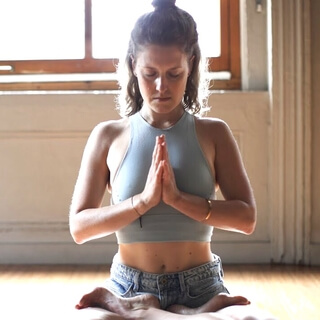
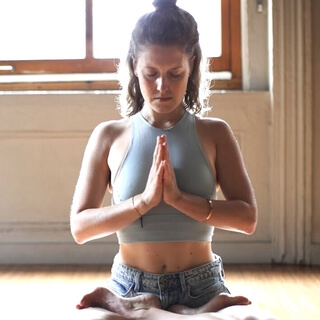
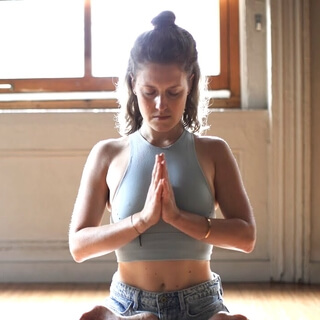
I invite you to bring the hands together in the center of the chest as a symbol of gratitude toward yourselves for being curious to learn about yourself in this way,
For taking the time to explore new practices that help you to cultivate calm in body and mind,
Which might even act as a ripple effect towards those around you.
If you'd like to repeat the word Namaste after me,
A general rough translation is I bow to you.
It's a way of honoring ourselves and each other,
The light that exists within ourselves and within each other.
Namaste.