Whoever you are,
Wherever you are,
If you're still looking outside for happiness,
Just know it's guaranteed that whatever you get,
You will lose it.
And it will never satisfy.
It will never transform.
You'll never find contentment or fulfillment or meaning.
And if this is what we most deeply desire,
Is meaning fulfillment,
Look in the right direction.
Look into your mind and begin the greatest adventure of your life.
Hello.
Welcome to the Samadhi Podcast.
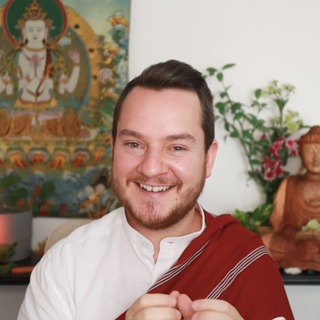
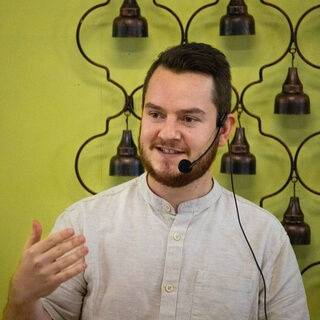
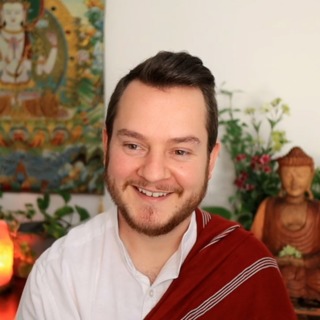
I'm delighted to welcome to the podcast,
Alan Wallace,
Who many of you listening will either know directly through his work,
Books,
Retreats,
And so on,
Or from my frequent mentioning of Lamala and his teachings.
So this is a wonderful opportunity to hear from and learn from a very accomplished scholar,
Contemplative teacher,
And spiritual friend.
Salaam Ala.
Welcome.
Thank you for joining us today.
My pleasure David.
So to give a brief background by way of introduction,
Lama Alan left his college studies in the early seventies and moved to Dharamsala in India to study Tibetan Buddhism,
Medicine and language.
And after some time immersing himself in the culture,
He was ordained by His Holiness the Dalai Lama.
And he devoted over 14 years training as a monk while he studied with and learned and translated for many wonderful and skilled lamas and spent time in retreat as well.
And after that,
He returned to Western education,
Completing his undergraduate study in physics and the philosophy of science,
Then onto his PhD exploring the interface between Buddhism and Western science and philosophy,
These two worlds,
Which those who know him will know continues to be a passion and a driving force.
And since then,
When not in retreat,
Lama Alan has been a frequent translator,
Writer,
Teacher,
He's written and translated more than 40 books,
And he's been a leading voice in the dialogues and research between Buddhists and scientists.
He's the founder and director of the Santa Barbara Institute for Consciousness Studies.
And he's the founder of the emerging network of centers for contemplative research,
Which are appearing all over the world.
So Lama,
You've very kindly agreed to explore a couple of topics with me today surrounding the nature and potential of consciousness,
The importance of shamatha and contemplative inquiry,
And your vision for the centers for contemplative research.
And as I started to put some thoughts together for this interview,
I realized that there's enough here to fill actually months of retreat.
These are big topics.
So I'll try my best to a couple of pointed questions.
Let's give this topic justice in the time we have.
So first of all,
Let's just jump straight in.
The nature and potentials of consciousness.
This has of course been an interest of yours for a long time.
Can you tell us a little bit about where that interest came from?
What sparked your exploration of Tibetan Buddhism?
Sure,
The topics we'll address today could fill maybe multiple volumes.
I could say on the other hand,
They have filled the last 50 years of my life.
I've done very little during these 50 years other than explore the topics that we will address here.
So the nature and potentials of consciousness.
I can't quite remember really when those specific topics came to mind as something of central interest.
What I do know is by the time I was 20 years old,
Having been really focused on pursuing a career in environmentalism,
Ecology,
Wildlife biology,
For the last seven years since I was 13,
By the time I was 20,
It was clear to me that we as a human species will not avert catastrophe of our human created violations and degradation of the environment.
Simply with more science and technology,
With more legislation,
With more better business practice.
Already back then,
I know about global climate change,
Although it was known as specialists in the area,
They already saw it coming back in the 1960s.
But I knew about Rachel Carson and the population bomb,
Paul Ehrlich,
And the many ways that humanity back in the 60s was already violently degrading the environment.
So by the time I got to 20,
I said,
This is still as important as ever.
Now it's all the more important.
But I just felt that we'll need something more.
Science and technology,
Legislation,
Business practices,
So forth won't be enough.
We'll be too little and too late.
So looking outwardly,
I felt we need something more.
And looking inwardly as well,
It's been a passion of mine since I was very young,
Since I was an adolescent,
To want to live the most meaningful life I can,
By my own criteria.
Not somebody else's schtick,
But by my own criteria.
And I felt that if I devoted the rest of my adult life,
Professional life,
Outwardly,
You know,
Spreading the word,
Doing studies,
Ecological studies,
And so forth and so on,
That there would be something missing within,
That I wouldn't be finding the inner fulfillment that I was seeking,
The inner enhancement of a sense of meaning in my own life.
So I saw it's too little out there and not nearly enough in here.
And it was just about the time that I felt that's not going to be enough,
Inwardly or outwardly,
That I encountered Buddhism.
And then specifically,
The first book I picked up on Buddhism that was really inspiring,
That hooked me,
So to speak,
Was when I was hitchhiking around Norway in 1970.
And actually just before then,
I was in Switzerland,
Hitchhiking,
And picked up a book on the school of Indo-Tibetan Buddhism known as Dzogchen,
Or the Great Perfection.
This was 1970,
So that might've been the only book in English at that time on that topic.
One of the,
I think,
Four volumes of Evans-Wentz,
Where Mark was calling.
I read that,
Didn't understand much,
But intuitively I found this is really it.
This is where I want to go.
Because I'd been trained from adolescence to become a scientist,
And yet I was raised in a very religious home.
My father is a Christian theologian.
Went to church every Sunday until I went off to college.
And so I wasn't willing to abandon either one,
Throw away science,
Evolution,
And so forth because of religious beliefs.
But nor was I willing to throw away religion lock,
Stock,
And barrel,
As if it's just a bunch of nonsense,
Because science has shown the way.
Science will provide all the answers for us.
It was clear it doesn't.
And one area in particular where science,
Even back then,
Was kind of drawing a blank,
And it's still drawing a blank,
Is what's the actual nature of the mind?
Not your beliefs that is simply what the brain does.
That's just a metaphysical belief.
It's like believing in angels or God,
There's no evidence for that.
They don't know,
Neuroscientists,
Psychologists don't know the relationship between the mind and the brain.
They pretend as if they do,
Many of them.
Oh,
It's solved,
The mind is simply the brain,
Or the mind is what the brain does.
But in fact,
The reality is anybody who looks into it carefully,
It's quite clear to this day that the actual nature of the correlations between brain activity and mind remains as unknown now as it was 150 years ago.
There's been in fact no progress at all.
So what is the nature of the mind?
That which is nearest and dearest actually to us?
And what makes the mind mind?
How are we different from robots or computers or algorithms?
And I think the simple point is we are conscious,
We experience.
We experience.
I'm experiencing the image of your face on the screen.
I hear your voice.
I understand the meaning of your words.
And so consciousness,
What's that?
And throughout the,
Oh,
Especially the latter half of the 20th century,
Neuroscientists,
Physicists,
Psychologists would just shirk it.
They would avoid it.
They wouldn't talk about it.
Because the dominant paradigm was scientific materialism,
And they couldn't see any way to come to grips with consciousness within that metaphysical context.
Now,
Many people have taken the cheap way out.
Well,
What the heck,
Let's just say it.
Consciousness doesn't exist.
Or it's just the brain.
Or it's just evolution.
It's just this.
But this is just hand waving.
Lots of speculations,
No way of testing any of these hypotheses that aren't even scientific hypotheses because scientific hypotheses by nature can be tested.
But I think I've looked at the whole range of current philosophical scientific theories about consciousness,
And all of those rooted materialism cannot be tested empirically.
So they're not even scientific theories.
They're just untested ideas.
So the more I looked into this,
And then when I was in Dharamshala during the early 70s,
Studying,
Meditating,
And so forth,
The role of the mind in nature became more and more clear to me.
And within the mind,
What is the nature of consciousness?
What are the potentials of consciousness?
These issues are very explicitly raised in Buddhism.
And they are tackled head on.
And not just with belief or dogma,
But with viable theories that can be put to the test of experience.
And they have been.
So where does consciousness come from?
You're perhaps 40 years old or so.
Where did your consciousness come from?
Did it come from your dad's sperm,
Your mother's egg?
Did it come from,
Where did it come from?
And the scientific answer is they don't have a clue.
They really don't have a clue.
They can't define it.
They can't measure it.
They know almost nothing about it.
And then,
Sooner or later,
You and I,
We're going to be no longer here.
Our bodies will be moldering,
Or they'll be incinerated.
They'll be whatever,
Decomposing.
What happens to the mind?
Something happens.
It's not just a matter of a vote,
Or just group think,
Or opinion,
Or preference.
That would be kind of nice.
Whatever you want,
Well,
That would be happened.
But that's a fairy tale.
That's a cartoon.
Something happens.
Just like if you,
Like Galileo,
If you take a rock,
A big rock and a little rock,
And drop them from the Tower of Pisa,
Something happens.
And it doesn't really matter what you believe happens.
You believe the big rock will hit the ground sooner.
You may believe that,
But you just have to open your eyes and see it doesn't.
And some things are just true,
And it doesn't matter what you think about them.
And I'm utterly convinced that what happens to consciousness is that it doesn't matter what you believe.
Materialists simply believe.
They have no evidence of their beliefs.
It's just a belief,
Like believing in angels,
Or Santa Claus or the Tooth Fairy.
So what does happen?
And is this the only life?
If so,
That's easy to deal with.
I mean,
What's easier?
You die,
You fall asleep,
You become oblivious.
Big deal.
Life is kind of cheap.
No big deal.
Do what you can.
Have a good time.
You have only one life to live.
And many people take this as if it's just the truth,
And it's just a belief.
So I saw how much was unknown,
Is unknown,
About everything pertaining to consciousness,
Its origins,
Its nature,
What happens to it,
Death,
What are its potentials.
We draw a blank in the West,
Scientifically,
And the philosophers don't agree on anything.
They have a bunch of very interesting ideas,
Some of them very cunning and clever,
And some of them really quite idiotic.
But they don't agree on anything,
So why should we look to them?
And so does anybody know about the nature of the mind?
And then bring it a bit closer to home.
My search for meaning,
How many people experience that?
How do you find meaning?
How do you find genuine well-being,
What the Greeks call eudaimonia?
What are the causes of that?
Does it exist?
Is there anything more than simply material pleasures,
You know?
And so I saw it just,
It was drawing a blank in Western civilization.
I saw almost nothing there.
So when I bought my one-way ticket to India at the age of 71,
Age of 21,
1971,
I wasn't looking back.
What I was looking for,
I didn't see any answers,
Not empirical ones,
Rational ones that can be put to the test.
So it was a one-way ticket and I kind of never came back,
Frankly.
I am now on that journey,
I've continued on that journey for now 50 years.
And it becomes only more thrilling,
Satisfying,
More fulfilling with every step of the way.
So I'm not very good at short answers,
David,
But there's for a start.
That's a wonderful answer and actually brings me straight to my next question,
Which just as you've drawn on,
You know,
There is that common assumption that consciousness or mind is either equivalent to the brain or a function of the brain.
And in fact,
These words brain and mind are often used interchangeably or even head,
You know,
My head's muddled,
My brain says this,
My so,
You know,
You've talked a little bit about the implications of that view,
You know,
That it does lead to a materialistic sort of way of interacting with the world.
But so when you came into Buddhism,
You found this sort of introspective approach,
What you've what you thought was a more scientific approach to the mind.
Could you talk a little bit about that introspective approach and what makes that unique from what Western science is doing?
Sure.
I will,
And I'll first address a point I think you've just made that is very important and I've watched it.
And that is during the 20th century,
Then there were many,
Many references in the popular media to the mind,
The mind,
You need to train your mind,
The mind,
The mind,
The mind,
Very common.
And then something happened during the first couple of decades of this century,
Where wherever we would otherwise say mind,
Journalists,
People in the media,
In scientific community and academia just started slipping it in using the brain instead of mind.
That shows their science somehow.
I mean,
It's preposterous.
It's like,
You know,
It's tomfoolery to think that just by saying brain instead of mind,
That's somehow more scientific because you can study the brain scientifically.
But scientists study the mind only indirectly.
By in way of behaviorism,
Starting in around 1910,
Studying the mind by way of behavior.
Well,
Okay,
Something can be learned,
But then to reduce the mind as the behaviors did,
Many of them to mere predispositions for behavior is poppycock.
And then in the 1960s,
We have this another bold and very daring discipline come up of neuroscience.
And I've read the very early literature and the founders of neuroscience,
Frankly,
They kind of pulled a fast one.
They really did.
They acted as if the mind-body problem had been solved.
It hadn't been.
Nobody got a Nobel Prize.
Nobody discovered it.
Nobody knows the origins of the mind or a relationship with the brain.
Nobody knows what happens if that,
But they just said,
We will now develop this discipline of neuroscience in order to demonstrate or to find a purely physical explanation or biological explanation for the mind.
We will do this.
This is what we're aiming to do.
This is like starting a whole branch of science saying our job is to prove that God exists,
To prove a metaphysical belief.
And so,
You know,
Do you have the phrase in Scotland or in England or Wales for you?
Because I'm going to be giving a talk for an institute in Edinburgh soon.
Do you have the phrase slipping a Mickey into somebody's drink?
You know that phrase?
Yes.
You do?
Yeah.
Okay.
So it's not just American.
You know of it.
You know of it.
Well,
Slipping.
So I give you a nice,
I say,
David,
Here's a glass of punch.
You'll enjoy it.
Drink up.
And I've slipped some LSD into it.
I've slipped some,
Or maybe,
You know,
Whatever,
Any kind of drug,
But just slip it into the ring and they're like,
Oh,
That tastes good.
This is what the media has done to us for the last 20 years.
They slipped a Mickey into the drink.
I'm just,
Well,
Let's just use brain and mind and see if anybody notices.
And if they don't do it,
Then we'll get away with it.
This was materialist ploy.
It was very cunning,
But it's fundamentally dishonest.
And so that's the first point.
And then your question was,
Because that really caught my attention,
But I really want,
You know,
If they're equivalent,
Then demonstrate it.
Nobody's demonstrated.
If they're not equivalent,
Then stop using the two words equivalent because it's duplicitous.
It's misleading.
It's a scam.
It's a scandal.
And yet it's ubiquitous in the British press,
The American press,
Let alone in communist countries where scientific materialism is the state religion.
So then to your question,
Which is to reiterate.
So then going into the,
Into Buddhist thought,
You saw this introspective approach.
So what's the,
What's the difference?
What does introspection bring?
Sure.
So to this day,
Overwhelmingly,
The primary scientific approaches to study mind are by studying behavior,
Including facial expressions and so on,
Studying brain correlates,
Which is very good,
Giving people questionnaires,
But introspection plays virtually no role in the modern scientific study of the mind.
But this would be like starting a branch of astronomy in which you say,
Well,
We know there's stars and planets up there,
But don't look.
And for heaven's sake,
Don't even think about telescopes because whatever,
And this was a complaint to Galileo.
If you direct your Callisto up at the sky and you look at Jupiter,
Its moons and so forth and so on,
You're not actually seeing Jupiter.
You're not seeing its moons.
You're not seeing spots on the sun or craters on the moon.
You're not seeing what's really out there.
All you're seeing are images generated by your brain.
Those images,
They're not out there.
So Galileo,
If you're discovering things that are contrary to the Bible,
Well,
You're not telling,
You're not seeing what's really out there.
You're just seeing things conjured up independence by your visual cortex.
They wouldn't use that terminology,
But that's exactly what they were saying.
These are illusions,
But they're not out there.
Those images are not out there.
And therefore it's totally unreliable to rely upon a telescope to tell us what's really out there because all you ever see are images generated independent on human brains.
So all the images you're going to see are anthropocentric.
And Galileo just said,
Every dude and carried right on and we have 400 years of successful astronomy.
But this is what the behaviorists did.
The very early psychologists,
Wilhelm Wundt in Germany,
Tichenor from England,
But taught at Cornell University in New York,
My favorite William James.
These were brilliant minds,
Pioneers of modern psychology.
And they suggested that we take a scientific approach to the study of the mind like astronomy and biology and chemistry and physics.
And that is,
If you want to understand something,
Then look at that phenomenon you're seeking to understand with all the precision and rigor and sophistication and replicability that you can.
And then you'll have science and not simply more philosophy.
But when it came to the mind,
The introspectionists from about 1875 until about 1910,
They said,
That's our approach.
And we know that we have to refine attention because it's unreliable.
And so they just began.
But then,
But they're having problems,
Of course,
It was a science in its infancy.
And they're having problems,
But of course having problems.
It was a young science.
But then John Watson and other pioneers of behaviorism came along and just basically cleared the table of introspection and said,
Let's not talk about subjective experience.
And for heaven's sake,
Don't talk about consciousness.
Let's be scientific and we'll only talk about and examine what is objective,
Physical and quantifiable.
And now that's scientific.
Well,
That's a scientific study of behaviorism,
But it leaves you in the dark about the nature of mind because you're refusing to look at it and even refusing to talk about it.
And so then during these early years studying in Dharamzala,
Well,
I studied for a year or two prior to becoming a monk.
And then I became a monk and entered into a very rigorous discipline.
And it was at the Institute of Buddhist Dialectics in Dharamzala,
India directly on the supervision of Dalai Lama,
At that time he was my personal mentor.
And so in our training,
And this is their academia,
This is their,
When you're going to higher education,
This is where you go.
The first thing you learn was logic and reasoning and how to take a position and defend it rationally,
How to critique a position and critique it rationally.
And then on that basis,
Really learning how to use your intellect,
Logic,
Reasoning,
The very first topic we studied and everybody studied in that curriculum was the mind.
Different modes of cognition,
Nature of consciousness,
Nature of mind,
Nature of afflicted mind,
Nature of wholesome minds and so forth,
That was primary.
And everything else came after that.
And I looked and it was radically empirical.
There were no leaps of faith here.
Believe it because the Buddha said so or some other great,
You know,
Great bodhisattva or what have you.
I thought,
Now this is the kind of science of the mind I've been looking for.
And I can join that before long with a brilliant methodologies that you find,
Especially in the Theravāda tradition of Buddhism,
Specifically Sattvatthana or the close application of mindfulness to,
Number one,
The body.
We are embodied here.
Let's look at it,
But from the inside out.
Feelings,
Pleasure,
Pain or suffering and neutral feelings,
But not just study the neurocorrelists actually observe feelings rather than simply identify with them.
Examine them,
Investigate them,
But the only way you can investigate feelings directly is by looking at them.
You learn very little about just knowing what kind of,
What parts of the brain are activated when you're feeling this or feeling that.
And many people are good at hiding their emotions.
So if you want to understand emotions like any natural phenomenon,
Look at them,
But with precision.
And then there was an ingredient here that I'd never encountered before and nor has modern psychology.
And that is if you're going to observe the mind rigorously with sophistication and so on,
Then what's the tool with which you are going to observe it?
Well,
Your own mind,
Mental events,
But our minds,
As we know,
We focus our minds with attention,
But our attention spans,
Especially in this 21st century tend to be very,
Very short.
And so the analogy I like giving is imagine if Galileo had mounted his telescope,
He began with a three power telescope,
Then ate them eventually up to 30 power.
Imagine if he lived in North Africa and he mounted his telescope on the back of a camel out in the desert in a sandstorm and then had it gallop.
But whatever observations he might make,
Looking up there would be pretty darn unreliable because it has no stable platform.
It's not clear.
It's covered with dust.
And he would,
So if that's how all these astronomers proceeded by the only way to use a telescope mounted on the back of camel,
Because they're sacred animals or whatever,
Then astronomy would have been a joke.
You know,
They just know a lot about dust and not much about stars or planets and so forth.
And so when we try to observe our minds,
The first thing we find out is,
Gosh,
It's hard for me to even keep focused on whatever I'm observing,
Whether it's feelings or observed body feelings.
And then the Buddha said,
And then the mind,
And that's a whole array of mental events arise with a special emphasis on what are those mental processes that give rise to unhappiness and distress and conflict.
And what are those that give rise to wellbeing and harmony and virtue?
And then finally applying mindfulness to the whole range of phenomena,
Inner and outer,
But especially with the orientation to can we identify what are those tendencies that lead to misery,
Conflict,
Suffering,
The first noble truth,
The reality of suffering,
And what are those tendencies,
Behavioral,
Mental,
Verbal,
Which give rise to peace,
Harmony,
Wellbeing,
Bliss and joy and so on.
So taking those two,
The Buddha's foundational teachings on authentic vipassana,
Insight meditation,
Not just mindfulness,
That's watered down to homeopathic doses.
All you're doing is practicing bare attention.
Well,
That's sweet,
But rodents can do that.
And Buddha was teaching something rodents can't do with sophistication,
Rigor,
Theoretical sophistication,
Examining the body,
One's own and others feelings,
One owns another mind phenomena,
And then conjoining that with a quite brilliant theory of Buddhist psychology that we find in India,
In the Abhidhamma,
In the Pali Canon and the Sanskrit and going into Tibet,
The Abhidhamma nature of mind,
Phenomenological nature of mind,
Put the theory and practice together and you have a system that works.
So a lot of people nowadays,
Including myself,
Have a great admiration for science and a great appreciation of technology.
We would not be having this conversation right now,
Of course.
I can't shout that loud.
Your hearing is not good.
And so it's only the having this clairvoyance of the video and the clear audience of the audio here that we,
You and I can speak and we can share this with other people.
So I really appreciate technology and medicine and communication and travel,
Transportation and so forth.
So very good for all of that.
And why do people believe in science?
Many many people believe in science.
Because it brings practical benefit and because it makes sense.
But it brings practical benefit.
Those physicists studied this,
They found quantum mechanics and it sounds very esoteric and weird,
But look,
This cell phone works because of quantum mechanics.
This wristwatch,
Digital,
It works because of quantum mechanics.
The internet works because of quantum mechanics.
And so,
Wow,
Well quantum mechanics must really add something to it because the technology comes out as fantastic.
Is there any technology that comes out of the rigorous contemplative inquiry that we find,
For example,
In Buddhism?
And the answer is yes,
But you can't see it.
That is,
You can't see it like you can see a cell phone or internet or a jet or a car.
But I have lived with Tibetans for many many years,
Starting in 1971.
I lived with them for four years,
Then back to India several years later.
I have lived with Tibetans for many years,
Over the last 50 years.
But when I first moved into this refugee community,
The cloud gunge,
Just above Varnassala,
India,
It's a poor community,
It's a refugee community.
Everybody was poor,
It was simply how poor are you,
But nobody is rich.
And they're refugees and virtually all of them have been traumatized by living in a country that was perpetrated with the most ferocious genocide by the Chinese communist government and the Cultural Revolution,
Which was a catastrophe for the Chinese and all minorities.
And I was living with the happiest people I'd ever met.
Whatever these people,
Whatever worldview they've embraced,
The lifestyle they're highlighting,
It really has something to do with because it got them through tremendous trauma.
And they weren't always looking for more and more and more and more materialistically.
I wanted to pick up on a point you made there.
So you mentioned this,
Obviously the benefit of actually observing that which you wish to understand,
The body,
Feelings,
Phenomena and so on.
And you mentioned,
Of course,
This sort of like jumping on the camel's back.
And that's what we,
The experience we tend to have,
You know,
We try to observe the mind,
The body,
And we find that this mind is just unfit for the job.
It's completely overwhelmed all over the place.
And when it's not,
It's asleep and it's dull.
So there's a piece here,
Isn't there,
Of the puzzle.
This is shamata.
Shamata is a practice that you've been passionately emphasizing to your students for many years.
And as I understand it,
That's because it was always one that was emphasized to you by your teachers.
So could you give us an overview of what shamata is,
Why you see it as something we should be focusing on,
Whether we're Buddhist or non-Buddhist,
And how it relates to understanding consciousness?
Sure.
So you picked up just where I left off.
I said there was a missing piece.
And that is how do we,
If we use the telescope analogy,
How do we find a firm mount for the telescope,
So it's firmly stable and then clearly focused and the lens is clean so that whatever we observe,
We can observe with continuity and with clarity and precision and high focus.
So we now have the James Webb Space Telescope,
The next generation,
And they're just getting better and better and better over the last 400 years.
But inwardly,
All of that technology doesn't help at all because our thoughts,
Our feelings,
Mental states,
Dreams,
Consciousness itself,
They're not physical.
If they were physical,
They'd have physical attributes.
They could be measured.
They can't be.
They haven't been.
And when you observe them,
You see they have no physical attributes.
They don't exist in physical space,
But they can be observed.
And this has been a point which has been astonishingly ignored by the modern mind science.
It's the fact that mental events can be observed and rigorously in replicable ways.
So shamatha,
I often characterize shamatha as an array of methods designed to refine our attention skills so that whatever we wish to attend to,
We can do so with stability,
With continuity and with increasing clarity,
Vividness,
Acuity,
Focus,
Including meditating for hours on end.
This morning was fairly average to me.
I began my meditation at three o'clock,
Had a four hour session,
And then I got on to breakfast and doing other things.
So I've been meditating for a while.
So then you enter into your practice and you can continue for one,
Two,
Three,
Four hours,
Maybe longer for really advanced yogis.
And so it's the technology as the telescope is the technology for empirically observing celestial events.
Likewise,
Samadhi is the telescope for observing mental events,
Which cannot be observed using any of the instruments of technology.
And you certainly don't observe them when you look at the brain.
You look at the brain,
You don't see a single mental event,
Observe mental events,
And you don't see a single neuron synapse,
Dendrite or anything else.
So that's the contempt of technology,
Shamatha.
The word literally,
As you know,
Means quiescence,
Tranquility,
Calm,
Which means that what's calmed is both the tendencies,
Both of excitation,
Distraction,
Agitation,
That's calmed.
But the other extreme of attention deficit disorder or laxity and dullness,
That's calmed.
And so the calming of attentional hyperactivity and attention deficit,
What remains is attention that is stable,
It's focused,
And it's sustainable in the sense that you're not getting tighter and tighter and tighter the longer you meditate.
So there are many skills like being a jet fighter pilot or professional chess player or air traffic controller where you must maintain a high level of attention.
Otherwise it's a catastrophe.
You'll lose the chess game,
That's not a catastrophe,
But maybe that's the end of your career.
But you know air traffic controllers,
Of course people die,
Jet fighter pilot,
He dies.
And so,
But what's been found is without training,
People that simply have to really be focused,
The longer the focused,
The more exhausted and stressed out they become.
And they're yogis,
And I know some of them,
That will meditate as much as 16 hours a day for years and years and years as they're going into the deep space of the mind.
And they're not getting stressed out,
Not getting drained,
Not getting uptight.
And so Shamat is the technology that can be used then for anything.
You can apply it.
When I was studying physics at Amherst College,
I had already been a monk for,
Oh gosh,
About 10 years.
And so when I was studying physics and calculus,
I mean Sanskrit,
History and philosophy of science and so on,
But especially physics itself and doing the hard work.
My training in Shamata really helped me to focus and calm the mind and open up reservoirs of creativity,
Of intuition,
Seeing connections that are not otherwise obvious.
So I found my training in Shamata very helpful for studying physics.
I found it eventually quite helpful,
Quite interesting that it opened up reservoirs for creativity as in music.
I could improvise on the piano for the first time,
Not brilliantly because I'm not terribly gifted,
But there was something there that wasn't there before.
So Shamata for balancing the mind,
For finding equal equilibrium and inner stability and calm to enable and to explore the mind is the technology and then vipassana,
Authentic vipassana,
Not just mindfulness,
Authentic vipassana by definition in the Theravada tradition,
The Indian tradition always entails a spirit of inquiry.
If there's no inquiry,
If you're just sitting there being present or being mindful or just watching your breath,
Well that's fine,
It could be nice,
But it's not vipassana,
Not authentic vipassana.
By definition that entails inquiry and anybody who wants to know whether that's true or not,
Just read the Buddhist discourse on the four applications of mindfulness and it's perfectly clear one closely reviews,
Examines,
Investigates the factors of origination and how are phenomena present whether they're mental or somatic and so on,
How did it dissolve?
Are they permanent,
Impermanent?
Are they satisfying,
Unsatisfying?
Are they really I or mine or are they not?
This is contemplative science and in Buddhism it starts with the four applications of mindfulness,
But then it goes on from there as we go to the Mahayana tradition,
We go into Mahamudra and Dzogchen in the inter-dietan tradition and then you say my goodness,
This is a highly developed,
Ancient and extremely sophisticated matrix of methods for exploring the mind all the way up and all the way down and discoveries have been made,
They have been replicated by contemplatives,
But if you're not a contemplative you make it either believe what they say or not believe what you say,
But you won't know for yourself.
So I think Buddhism really has a paradigm of authentic mind science which is based like all the other branches of the natural sciences on carefully observing the phenomena you're trying to understand,
Whereas above all is materialism,
The metaphysical and ideological and methodological constraints of materialism that if completely hogtied and gagged and put into a straitjacket,
Modern mind sciences because they refuse to allow people to practice introspection because actually that would challenge their metaphysical beliefs of materialism.
So it's trying to throw off these shackles,
It's just an ideological dogmatism just as bad as medieval scholasticism saying if it's not in the Bible it's not true,
You know,
That kind of malarkey and it's the same malarkey we see in America,
It's the same rubbish,
It's the same bloody rubbish to say well if you can't study it scientifically then it doesn't exist,
Well by job that's complete rubbish.
If it's the same dogmatism as religious or political or philosophical dogmatism it's just flat out,
Pardon me,
It's just flat out stupid.
So I think to pick up on just some of these points,
One of the things that we see happening in our world,
You know,
As we've said is emerging from that view of materialism is a rise in hedonism,
Consumerism,
A devastating way of treating our planet and other sentient beings.
Do you think that shamatha practice,
Perhaps not the achievement of shamatha by everybody because it's quite an incredible achievement to make,
But just the practice of shamatha which entails that inward development,
That cultivation of genuine well-being,
Do you think that that could have an impact on this,
This sort of shift of priorities?
Yeah,
Well to engage in shamatha practice of any,
And there's a wide variety,
The Buddha himself taught 40 different methods,
But one of the most helpful for many many people is mindfulness of breathing.
There are many other techniques.
Anybody can engage in practice of mindfulness,
Whether a religious fundamentalist or an atheist or a theist or whoever,
So it's open to anybody.
There's no metaphysical strings attached and for that matter likewise vipassana.
You don't have to believe something first and now you can start.
Galileo just observes,
He didn't bring a whole bunch of beliefs that cordoned off what he was allowed and was not allowed to see.
So the answer is yes and for a very simple reason.
A practice like mindfulness of breathing,
For example,
It's very helpful.
It can be taught with various nuances and so forth,
But it can be helpful to illuminate a simple fact and that is by and large in our modern world.
When people think of the pursuit of happiness,
I want to be happy and as Adalallamah said,
Human beings were characterized by the wish to find something more.
You want something more.
If you're a little bit happy,
You'd like to be happier.
If you have a little bit of wealth,
You'd like to be wealthier.
If you're a little bit well known,
You'd like to be better well known.
If you have a bit of influence,
You'd like to have more influence.
This is something quite interesting that we're looking for more and if one is locked into the materialistic syndrome of thinking the only things that are real are material and you want something more,
Then you're going to want more wealth,
More sensual pleasures,
More power,
More reputation,
Better looks and so forth and that's hedonism.
And then to pursue hedonism,
Just any kind of pleasure you get from the world,
Then the primary way of pursuing that is with consumerism.
And now we have 7.
8 billion people by and large embracing consumerism as a way of life and wanting more and more and more.
And right now we are writing the script for the collapse of human civilization and we're not slowing down.
And why?
Because everybody wants more and we want it soon.
We want it fast and never mind children,
Grandchildren,
Well they'll work it out.
And graduate turn-bed tells us,
Well maybe we won't because you're completely shafting us.
So there's a distinction here that I'm really quite dumbfounded that it's not in the media,
It's not in our face every single day because it's something that actually could save humanity.
And I'm not talking about a religion or belief in reincarnation or karma or God.
But a simple distinction between hedonia as any type of sensory driven pleasure from the senses of course,
Enjoying good food,
Music and so forth and so on,
But also enjoying power,
Enjoying fame,
Notoriety and so forth.
These are all sensory driven.
Enjoying drinking a pint or a gallon,
You know,
A beer or what have you,
Or taking drugs,
Legal and illegal drugs.
People are taking these wine because they want something more if they're taking them for pleasure.
And so that's hedonia,
All of that including drug aroused pleasure.
It's all hedonia and it doesn't last,
It doesn't transform and it never satisfies.
And everybody should know that.
Stalin had maybe more power than any man in the history of humanity,
Stalin.
He basically owned everything in the Soviet Union.
He could take anything he wanted.
But look at any photo of him.
Does he look like a happy camper?
Does he look like a guy who's got a great sense of humor and a lot of warmth and kindness and love and just love the joie de vie?
Not exactly.
And yet he was wealthy as Midas,
He was powerful.
People were terrified of him.
And yet happiness,
Forget about it.
And we know other political figures that are very prominent,
Very famous and so forth.
But do they have any real joy?
Rich people,
But where's the joy?
Powerful people,
Where's the joy?
Famous people,
I've met some very famous people.
Where is the joy and fame alone?
And seeing,
You know,
It's really not there.
And then people get depressed.
Whereas the Greek,
Socrates,
Aristotle,
Buddha,
Jesus,
St.
Augustine,
Zhuangzi,
Shankara,
The great sages of history,
They appointed from all over the world that there's another whole dimension of well-being.
I'll just use the Greek term,
You know it well,
Eudaimonia,
Genuine well-being.
And this is a type of well-being that is not contingent on stimulation.
It's not what we get from the world,
It's what we bring to the world.
By cultivating a way of life that is harmonious.
By cultivating qualities of mind that are balanced and peaceful and satisfying.
And so shamita opens the door to that.
In practicing mindfulness of breathing,
For example,
Temporarily we withdraw from all of the allures of the environment.
Good food and smells and beautiful music and tactile sensations and so on.
We withdraw from that and attend to something quite neutral and that is simply the in and out flow of the breath.
It doesn't make you happy,
Doesn't make you sad.
But it calms the mind.
It relaxes the mind.
It gives peace of mind.
No drug can give you peace of mind in any sustainable fashion.
It just dopes you up for a while and then it doesn't.
Whereas calm the mind with mindfulness of breathing,
And your mind settles the turbulence of conceptualization calms a bit.
You find a sense of peace of mind and money can't buy that.
Wealth power,
Prestige can't buy that.
But you find this is sustainable and this is satisfying.
But it's not just peace of mind.
Go deeper into that practice.
Not necessarily practicing 14,
16 hours a day,
But maybe an hour,
Maybe two hours a day.
Practice it.
Cultivate it.
Cultivate your mind like a farmer cultivates a field.
And then reap your own harvest.
Udomini is cultivated,
Hidoni is pursued.
And you find not only peace of mind,
But as your whole system becomes into a state of equilibrium like tuning an engine so it's finally tuned,
Your body,
Mind,
Your nervous system they get tuned and a sense of well-being arises in the body and especially in the mind.
And go deeper still and then there's a big surprise.
And I've been teaching meditation now for more than 40 years.
So I've heard many,
Many reports.
Of course,
Not only from my students,
Countless of them.
And that is go deep enough and you actually discover bliss.
I mean real bliss,
Really strong joy.
But there's nothing,
No pleasurable stimulus.
You're not thinking about something happy or not experiencing delicious tactical sensations or hearing something beautiful.
It's bliss arising right out of the nature of your mind that is now brought to a state of balance.
It's tuned.
And you're playing your mind and the melody of your mind is beautiful.
And there's bliss arising as a symptom of a mind that's brought into equilibrium,
A mind that has been made serviceable.
So an untuned engine,
It doesn't work well.
It starts to smell badly because it's burning up and it's undependable and it just breaks down.
And an untuned mind,
Whether you're rich or poor,
Famous or infamous,
Powerful or disempowered,
If you have an untuned mind,
You're facing a breakdown and you'll keep propping yourself up by just one luxury,
One entertainment,
One drug,
One way of losing your mind in work or booze or whatever.
But you're basically just in an ongoing breakdown stage.
And then for the materialist,
They say,
Well,
Okay,
Life may be difficult,
But at least when you're dead,
It's over.
At least you only have one life to live.
So many people take that,
Well,
At least one thing we're sure of,
You have only one life to live.
So life may really be pretty awful and it gets worse as you get older.
And then you're facing old age and maybe illness and severe illness,
But then you have something to look forward to.
The materialist,
If he thinks they do.
Well,
Okay,
But then at least I'll be dead and all my problems will be over.
And that's like believing in the tooth fairy or Santa Claus.
All I have to do is wait until Christmas and then Santa Claus will come and give me peace.
Peace will be delivered on a dish because it's rest in peace,
Dude.
And I would say dream on,
Because I would say with enormous confidence,
People believe that and think,
Oh,
When I die,
Then it will just be lights out.
You've got a big surprise coming for you.
And it may not be all that welcome,
But there's a conservation of consciousness,
Which is a natural phenomenon.
You can't make it out of nothing.
It never turns into nothing.
It never turns into something else like matter or molecules or electrical energy.
That doesn't happen.
That's preposterous,
But it doesn't become nothing.
It's not just a function of something else.
It was never generated by the brain.
Therefore,
The brain malfunction doesn't make it turn into nothing.
And so people run for a big surprise.
Many,
Many people,
They think finally when they breathe their last and the brain goes flat line,
OK,
Curtains closed,
Lights out,
Whew,
The deep sleep.
And then the fans are going to be in for this big surprise like,
Aye,
Caramba,
If they spoke Spanish.
I thought it was supposed to be over.
And what's going to happen now?
And they're totally unprepared.
They're totally unprepared because everybody told them,
All their friends,
All their buddies,
Their drinking buddies,
And so forth,
You've got only one life to live.
Make the best of it.
Make the best of it.
Live a good life,
A colorful life.
And now you have no color at all,
And your life is over,
But the show isn't over.
And now you have no idea where you're going,
No plan,
No preparation.
And I think it's very sad that these people have been hoodwinked,
Scammed into thinking we know that death is the end.
You know no such thing because you don't know how the mind began.
You don't know how consciousness began.
You don't know anything relevant at all,
And science has not helped out at all.
Helped us out for a lot of things,
But not for this.
And so one might want to check one's working hypotheses.
For people,
If you believe death means termination,
On the basis of what?
Because I've just been asking a couple of top-notch neuroscientists that I know,
Have they found the neural correlates for mental consciousness?
Not visual,
Visual cortex.
Not auditory,
Auditory cortices.
Good,
They found the correlates there.
What's the brain correlate of mental consciousness?
They don't know.
They don't know.
They can't measure it.
And so then neuroscientifically,
We know basically nothing at all about consciousness.
All we have is a bunch of hand-waving and idle speculations that don't even lend themselves to scientific repudiation or validation.
So I want to just encourage people,
They might take a second look and not simply assume what is easy and very comfortable to assume as well,
And I'll just be gone.
And I'll live on another people's memories.
We start telling ourselves these lovely stories with a complete rubbish.
Hodgepodge,
Mumbo jumbo,
Clap-clap.
Really powerfully said.
Absolutely.
And I think just to remind everyone,
All of this is to be discovered ourselves and can be discovered ourselves.
All of this can be realized ourselves.
And I think even just from,
You said about your experience of when you first started to cultivate the mind with Sramatha,
Having access to creativity and problem solving.
And I remember from just my very first experience of Sramatha retreat with yourself and just noticing a difference in the mind and a shift in my priorities.
And there came the option to either let's watch a film or actually that doesn't sound very pleasant right now.
But really,
I think I just want to go sit and meditate because I think that's actually going to be more enjoyable.
And I think that that's something worth mentioning sometimes because for a lot of people,
Meditation feels difficult to begin with.
Of course,
There's a lot of work to be done.
And there are enjoyable times,
Not so enjoyable times,
But it's one of those things that when you really get a taste,
It starts to be something that you want to do more and more.
Before we stop,
David,
I'd like to add one more point in this regard.
It's very easy to take a reductionistic approach,
And I'm not suggesting you do,
But it's very easy to do that happens an awful lot.
Well,
What is meditation?
Well,
Meditation now we know it's mindfulness.
Or before then,
What's meditation?
Well,
It's TM,
It's reciting a mantra.
Or what's meditation?
Well,
It's reciting the Jesus prayer.
To collapse it all down into a technique or it's vipassana,
That's what meditation really is,
Vipassana.
Or it's reciting om mani peme hum.
I mean,
Reductionism is rife where people hardly know anything about meditation,
Then they collapse into something very simple and simple-minded.
Whereas in the Buddhist tradition,
There are literally thousands of modes of meditation because the word meditation means to cultivate the mind.
And there are thousands of ways of cultivating the mind.
So developing attention skills,
Undoubtedly very important,
And it's important for everybody.
To get a good education,
To be a scientist,
A mother,
A father,
Anything you need to have to develop your attention skills,
It will go better.
It's very easy to think of spiritual practice in general and meditation in particular that is well all for self-improvement.
I'm doing this for myself.
I go to work,
Okay,
That's for serving humanity.
But now,
Okay,
Now I'm done enough there.
Now I'll not watch a movie and I'll meditate.
But if we balance out the emphasis on refining attention skills,
Introspection,
Mindfulness,
Samadhi,
Concentration,
Balance this out with another way of cultivating sharmat,
In fact,
By cultivating the heart.
And so as you're very well aware,
There are four sublime virtues of the heart.
They're called the four immeasurables in Buddhism.
They're not unique to Buddhism,
For sure,
We know that.
But it's the cultivation of loving kindness,
Of genuinely caring for others,
Wishing for each one,
Every person you encounter,
Every creature you encounter,
Human,
Animal,
That each one can find happiness in the causes of happiness.
Cultivating compassion,
Not simply a feeling of empathy or sympathy or feeling sorrow for others,
But the aspiration may we all find freedom from suffering and its causes.
Empathetic joy,
Taking delight in our own and others.
Their successes,
Their joys,
Their virtues,
Delighting with them.
And then finally,
Impartiality.
And that is some people treat us nicely,
Some people don't treat us nicely,
And many people don't treat us at all.
But caring equally with an equally open heart to people who are pleasant and unpleasant,
Rich and poor,
Virtuous and non-virtuous and so on,
And caring equally for everyone around us,
That each one,
Like ourselves,
Wishes to be free of suffering,
Wishes to find happiness.
And as we wish for ourselves,
Then equally,
In all directions equally,
May we all find that which we most deeply seek,
Find the happiness we seek,
And not the cheap imitations,
Find freedom from suffering and not merely a suppression of misery with drugs and so forth.
Find genuine well-being.
And so these are also meditations cultivating.
And so through shamatha,
By quieting the mind and developing greater clarity and greater focus and continuity of attention,
When we're engaging with another person,
That person becomes the object of asamati.
As one old friend of mine,
A Benedictine monk,
He said,
The greatest gift we can give to another person is our attention.
And so the cultivation of the mind of attention,
The cultivation of the heart,
It does bring about inner transformation,
But also is not encapsulated within just this body-mind here,
Because we exist in interdependence with everyone and everything around us.
So we open our hearts to everyone around.
And so the quieting of the mind,
The enhanced clarity,
Stability,
Focus,
Continuity of attention.
When we're attending to others,
They become very real for us.
William James again,
For the moment what we attend to is reality.
And if we're really attending to others,
Attending to,
Going back to the Latin root means to tend to,
To look after,
To watch over and to care for,
That's attention.
When we're giving others our attention,
Then empathy naturally arises.
They become real for us because we're attending to them.
And if we see they want happiness,
Then we want happiness for them,
And that's called loving kindness.
We say they want to be free of suffering.
We want them to be free of suffering and that's called compassion.
They take delight in their joys and successes.
We do too,
Well,
Empathetic joy.
And whoever we encounter,
Each one fundamentally is just as deserving of finding freedom from suffering and the inner causes of suffering as anyone else,
Including the great villains of history and the great villains,
And they're not so great,
But they're very big villains of the modern era.
People are really bringing about a lot of misery in the world.
Why are they doing that?
Why are they behaving so despicably?
Don't they get it?
Why are they so awful?
Why are they doing this?
And it's because they don't understand.
They'd understand what would really bring them happiness.
They don't understand what brings them unhappiness.
They don't understand how to live a meaningful life.
They have very limited imaginations and to behave in deplorable ways because they don't know any better.
And because their minds are dominated by ignorance,
By delusion,
By hatred,
By greed,
By ego.
And so they're the first victims of their own mental afflictions.
And therefore,
From a Buddhist perspective,
We would say they are the most worthy of compassion.
Because they're first of all bringing misery to themselves and then bringing misery to other people and bringing misery to other people sooner or later.
It doesn't turn out well for you,
Let alone to anybody else.
So such people really deserve our compassion.
And that's what meditation is for in a nutshell.
I'd like to ask you about the Centers for Contemplative Research.
If you could tell us what is a Center for Contemplative Research or Contemplative Research Observatory as I've also heard it called.
And what the vision is.
Yeah,
The first thing would be to give you the URL.
Because I can pick only very briefly now,
Whereas the website we've created for this I think is really quite wonderful.
It's beautifully done.
And it's CenterforContemplativeResearch.
Org.
CenterforContemplativeResearch.
Org is very easy to remember.
So we've already created one that's up and running in Questone,
Colorado in the United States.
We purchased property that we're just about to develop in Tuscany.
Right now it's called Castellina.
And we've acquired quite a large property,
Almost 600 acres of property on the South Island of New Zealand.
Also in the early phases.
And so what's the point here?
On the one hand they are meditation retreat centers.
That's true.
With individual cabins where people can go into weeks,
Months or even years of intensive,
Rigorous contemplative training.
They're not just going for a weekend to get a bit of peace of mind.
But professionally trained,
Like becoming a professional neuroscientist or a doctor or,
You know,
An economist.
These centers are created to provide professional full-time training for individuals who have a strong motivation,
Will and so forth.
And so they come under expert guidance to practice above all shamata to start with,
Cultivate these qualities of the heart,
Venture into vipassana to explore the nature of the mind,
Its relation,
Its role in nature and so on.
But it's contemplative science in the sense that while the contemplatives themselves through their training and the following that are using contemplative practices to investigate nature of reality,
These centers are designed from the outset to create a forum or facilities for collaborative research between modern scientists,
As in psychologists,
Neuroscientists,
Even physicists,
But especially mind scientists,
Psychologists,
Neuroscientists,
To study what happens in meditation from the outside while the contemplatives of what happened was studying meditation from the inside.
And the scientists will know some things the meditators don't know about,
Like what's happening in the brain.
The meditators know a lot of things that the scientists don't know about because they're in the front row,
They're actually seeing the mind.
And so for the first time in history,
Setting up facilities for collaborative,
Mutually respected,
Respectful research by mind scientists and highly trained contemplatives so they can learn from each other and in so doing,
Address fundamental issues about the nature of mind,
Its origins,
What happens at death,
Its potentials.
One can say,
Yeah,
But this has already been done for 25,
3000 years,
2500,
300,
3000 years.
It's true.
But from the outside,
It doesn't look like science.
It looked like religion,
Or Hinduism or Buddhism.
It doesn't look like religion.
Oh,
No,
That's just Buddhist belief.
That's people because people don't know what they're talking about.
They don't know that these are not just beliefs.
And in fact,
The Buddha himself made his many of his discoveries,
Actually his culminating discoveries on the night of his enlightenment.
And then when he came out and taught,
He said something that I don't know any other religious leader or founder of a so-called religion has ever said,
Do not accept my words based on your reverence for me.
Do not accept it on the basis of authority.
Do not accept it because it's in scriptural or text or it's ancient,
But test for yourself.
And if you see for yourself that these teachings,
These statements are true and they are beneficial,
Then practice them.
And if you don't,
Then don't.
That sounds more like a founder of a discipline of science than a religion to me.
And it's not philosophy because it's filled with empirical methods investigation.
And by definition,
Philosophy isn't.
And so the centers of contemplative research are designed to create the environment for scientific and contemplative inquiry to come together and find out definitively in a consensual way that is validated.
Where does the mind come from?
Why should that remain a mystery?
It is a mystery for scientists,
But not for Buddhists,
Not for many,
Many Buddhists.
What happens at death?
Mystery science for science,
But not for highly advanced Hindu yogis,
Buddhist yogis,
Taoist yogis,
Sufi yogis.
And so we need to open up channels of communication,
Not just persuade the scientists to become religious,
Not at all,
But collaboratively to ask these questions and get some answers.
Because although there's been mind science for about 150 years now,
The fundamental issues have not been tackled.
They have not been answered.
And there has been no revolution in the mind sciences.
But two in physics,
One with Galileo,
The second one with quantum mechanics and relativity theory.
One revolution in the life sciences,
Darwin,
Magnificent.
But 150 years of scientific study of the mind has given rise to no revolution at all,
Because it's been hogtied,
Ganked and bound by materialism.
So I'm really encouraging you to throw off these shackles.
They're not getting us anywhere except for maintaining the status quo,
Keeping the powerful powerful,
The rich,
The rich,
And the influential influential.
But they're blinding us to the actual nature of the mind by sidelighting the notion you can actually observe it and observe it rigorously and make replicable discovery.
So the centers are creative to that,
To tackle the big issues,
To tackle the nature of eudaimonia and its sources,
And then to apply those insights into the modern fields of mental health,
Education,
Business,
Government,
Environmental activism.
And although it's not terribly important to me,
It's very important for a lot of people,
But athletics,
Athletics,
It's huge for many people,
It's like their religion.
What about bringing greater attention skills and emotional balance and ethics,
Good sportsmanship into athletics?
Well,
That would influence millions of people.
So that's what it's for.
And so we have three going and more and more are germinating right now as we speak.
Yes.
Yeah.
Wonderful.
Starting,
Catalyzing,
Playing a part in the next revolution that will change the world.
Absolutely.
Now,
You've given us a lot to consider and think about.
And I think just to round off our conversation,
I wanted to ask you something that I've been asking every guest who comes onto the podcast.
And so it's a hypothetical and it's if you had for just a few minutes,
The attention of every human being on the planet,
They were listening,
They were attentively listening with an open mind and you could tell them just one thing,
One thing that would change their life,
Make a difference.
The one message,
The one thing you want everybody to know,
What would it be?
Look within to find the true causes of happiness and cultivate it.
Beautiful.
So we'll beam that message out.
Okie dokie.
Get it to everyone.
There's no us and them.
There's no insiders and outsiders.
There's no divisions there.
Wherever you are,
Wherever you are,
If you're still looking outside for happiness,
Just know it guaranteed that whatever you get,
You will lose it.
And it will never satisfy.
It will never transform.
You'll never find contentment or fulfillment or meaning.
And if this is what we most deeply desire is meaning fulfillment,
Look in the right direction.
Look into your mind and begin the greatest adventure of your life.
Thank you.
That's wonderful.
Thank you once again for spending this time with me discussing these topics of enormous importance in our world.
Yeah,
Much gratitude to you.
Thank you.
You're welcome.
And I will add this final point and that is we are facing the environmental catastrophes and if humanity as a whole,
All of us with all of our different worldviews and belief systems,
Religion and no religion,
If we would shift our priorities to the cultivation of inner well-being and be content with what is efficient for outer,
For consumption,
Acquisition and so forth,
We could actually save human civilization with a wide variety of belief systems.
But whatever our belief system is,
If we're following this trajectory of hiddenism and consumerism and whether we're Buddhists or atheists or anything else,
We are dooming ourselves and so this has enormous ramifications.
If we shift our priorities and quit depleting the earth and take care of the earth for ourselves and other species,
Then there's hope for us to actually enter a new phase of human evolution that is better than anything that's gone before.
We have large aspirations here and thank you for this time,
David.
Thank you.
Thank you very much.
I wanted to thank you for listening to this week's podcast and I hope it brings some benefit to you.
If you would like to learn more about meditation or join us for our free weekly online meditation sessions,
Then please join our Samadhi community on Facebook.
Just go to our website samadhi.
Org.
Uk,
Click on support and click on join our Samadhi Sangha and you can find out all the information there.
Please don't forget to subscribe and share and I hope to see you again soon.