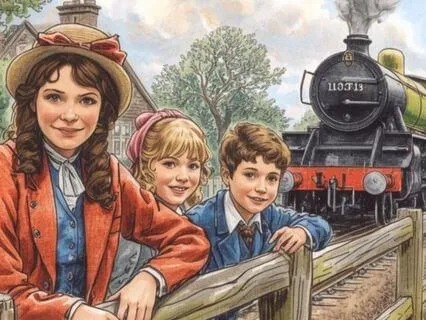
Hello dear ones and welcome to today's reading of The Railway Children by Edith Nesbitt.
Today's reading is chapter 14,
The final part of our story.
So taking a few moments to get yourself comfortable,
Coming into your body,
Becoming aware of your breath and your surroundings.
If you're in bed snuggling down and getting ready to be transported to the English countryside and the three railway children.
Chapter 14,
The end.
Life at Three Chimneys was never quite the same again after the old gentleman came to see his grandson.
Although they now knew his name,
Children never spoke of him by it at any rate when they were by themselves.
To them,
He was always the old gentleman and I think he had better be the old gentleman to us too.
It wouldn't make him seem any more real to you,
Would it,
If I were to tell you that his name was Snooks or Jenkins,
Which it wasn't,
By the way.
And after all,
I must be allowed to keep one secret.
It's the only one.
I have told you everything else,
Except what I am going to tell you in this chapter,
Which is our last.
At least,
Of course,
I haven't told you everything.
If I were to do that,
This book would never come to an end and that would be a pity,
Wouldn't it?
Well,
As I was saying,
Life at Three Chimneys was never quite the same again.
The cook and the housemaid were very nice.
I don't mind telling you their names.
They were Clara and Ethelwyn.
But they told Mother they did not want Mrs Vinnie and that she was an old muddler.
So Mrs Vinnie came only two days a week to do the washing and the ironing.
Then Clara and Ethelwyn said they could do the work all right if they weren't interfered with.
And that meant that the children no longer got the tea and cleared it away and washed up the tea things and dusted the rooms.
This would have left quite a blank in their lives,
Although they had often pretended to themselves and to each other how they hated housework.
But now that Mother had no writing and no housework to do,
She had time for lessons and lessons the children had to do.
However nice the person is who is teaching you,
Lessons are lessons all over the world and at their best are worse fun than peeling potatoes or lighting a fire.
On the other hand,
If Mother now had time for lessons,
She also had time for play and to make up little rhymes for the children,
Just like she used to.
She had not had much time for rhymes since she came to Three Chimneys.
There was one very odd thing about these lessons.
Whatever the children were doing,
They always wanted to be doing something else.
When Peter was doing his Latin,
He thought it would be nice to be learning history like Bobby and Bobby would have preferred arithmetic,
Which was what Phyllis happened to be doing.
And Phyllis,
Of course,
Thought Latin much the most interesting kind of lesson and so on and so forth.
So,
One day when they sat down to lessons,
Each of them found a little rhyme at its place.
I put the rhymes in to show you that their Mother really did understand a little how children feel about things and also the kind of words they use,
Which is the case with very few grown-up people.
I suppose most grown-ups have very bad memories and have forgotten how they felt when they were little.
Of course,
The verses are supposed to be spoken by the children.
Peter.
I once thought Caesar easy pap,
How very soft I must have been.
When they start Caesar with a chap,
He little knows what that will mean.
Oh,
Verbs are silly,
Stupid things.
I'd rather learn the dates of kings.
Bobby.
The worst of all my lesson things is learning who succeeded who,
In all the rows of queens and kings,
With dates to everything that they do.
With dates enough to make you sick,
I wish it was arithmetic.
Phyllis.
Such pounds and pounds of apples fill.
My slate,
What is the price you'd spend?
You scratch the figures out until,
You cry upon the dividend.
I'd break the slate and scream for joy,
If I did Latin like a boy.
This kind of thing,
Of course,
Made lessons much jollier.
It is something to know that the person who is teaching you sees that it is not all plain sailing for you and does not think that it is just your stupidness that makes you not know your lessons till you've learned them.
Then,
As Jim's leg got better,
It was very pleasant to go up and sit with him and hear tales about his school life and the other boys.
There was one boy named Pa,
Of whom Jim seemed to have formed the lowest possible opinion,
And another boy named Wigsby Minor,
For whose views Jim had great respect.
Also,
There were three brothers named Paley,
And the youngest was called Paley Turts and was much given to fighting.
Peter drank all this in with deep joy,
And Mother seemed to have listened with some interest,
For one day she gave Jim a sheet of paper on which she had written a rhyme about Pa,
Bringing in Paley and Wigsby by name in a most wonderful way,
As well as all the reasons Jim had for not liking Pa.
Jim was immensely pleased.
He had never had a rhyme written expressly for him before.
He read it till he knew it by heart,
And then he sent it to Wigsby,
Who liked it almost as much as Jim did.
Perhaps you may like it too.
The new boy.
His name is Pa.
He says that he Is given bread and milk for tea.
He says his father killed a bear.
He says his mother cuts his hair.
He wears galoshes when it's wet.
I've heard his people call him a bear.
I've heard his people call him pet.
He has no proper sense of shame.
He told the chaps his Christian name.
He cannot wicket-keep at all.
He's frightened of a cricket ball.
He reads indoors for hours and hours.
He knows the names of beastly flowers.
A beastly stuck-up thing to do.
He won't keep cave,
Shirks his turn and says he came to school to learn.
He won't play football,
Says it hurts.
He wouldn't fight with paley turds.
He couldn't whistle if he tried,
And when we laughed at him he cried.
He says that pa is only like all new boys are.
I know when I first came to school I wasn't such a jolly fool.
Jim could never understand how mother could have been clever enough to do it.
To the others it seemed nice,
But natural.
You see,
They had always been used to having a mother who could write verses just like the way people talk,
Even to the shocking expression at the end of the rhyme,
Which was Jim's very own.
Jim taught Peter to play chess,
And drafts,
And dominoes,
And altogether it was quite a nice time.
Only Jim's leg got better and better,
And a general feeling began to spring up among Bobby,
Peter and Phyllis,
That something ought to be done to amuse him.
Not just games but something really handsome.
But it was difficult to think of anything.
It's no good said Peter,
When all of them had thought and thought until their heads felt quite heavy and swollen.
If we can't think of anything to amuse him we just can't,
And that's the end to it.
Perhaps something will just happen,
Of its own accord,
That he'll like.
Things do happen by themselves sometimes,
Without you making them,
Said Phyllis,
Rather as though,
Usually,
Everything that happened in the world was her doing.
I wish something would happen,
Said Bobby,
Dreamily,
Something wonderful.
And something wonderful did happen,
Exactly four days after Bobby said this.
I wish I could say it was three days after,
Because in fairy tales it is always three days after that things happen.
But this is not a fairy story,
And besides it really was four,
And not three,
And I am nothing if not strictly truthful.
They seemed to be hardly railway children at all in those days.
And as the days went on each had an uneasy feeling about this,
Which Phyllis expressed one day.
I wonder if the railway misses us,
She said,
Plaintatively.
We never go to see it now.
It seems very ungrateful,
Said Bobby.
We loved it so when we hadn't anyone to play with.
Perks is always coming up to ask after Jim,
Said Peter,
And the signalman's little boy is better,
He told me so.
I didn't mean the people,
Explained Phyllis.
I meant the dear railway itself.
The thing I don't like,
Said Bobby,
On this fourth day,
Which was a Tuesday,
Is our having stopped waving to the 9.
15,
And sending our love to father by it.
So,
Let's begin again,
Said Phyllis.
And they did.
Somehow the change of everything that was made by having servants in the house,
And father not doing any writing,
Made the time seem extremely long,
Since that strange morning at the beginning of things,
When they had got up so early and burnt the bottom out of the kettle,
And had apple pie for breakfast,
And first seen the railway.
It was September now,
And the turf on the slope to the railway was dry and crisp.
Little long grass spikes stood up like bits of gold wire.
Frail blue hair bells trembled on their tough,
Slender stalks.
Gypsy roses opened wide and flat their lilac-coloured disks.
And the golden stars of St.
John's Wart shone at the edges of the pool that lay halfway to the railway.
Bobby gathered a generous handful of the flowers and thought how pretty they would look lying on the green and pink blanket of silk waist that now covered Jim's poor,
Broken leg.
Hurry up,
Said Peter,
Or we shall miss the 9.
15.
I can't hurry more than I am doing,
Said Phyllis.
Oh,
Bother it,
My bootlace has come undone again.
When you're married,
Said Peter,
Your bootlace will come undone going up the church aisle,
And your man that you're going to get married to will tumble over it and smash his nose on the ornamented pavement,
And then you'll say you won't marry him,
And you'll have to be an old maid,
Phil.
I shan't,
Said Phyllis.
I'd much rather marry a man with his nose smashed in than not marry anybody.
It would be horrid to marry a man with a smashed nose,
Went Bobby.
He wouldn't be able to smell the flowers at the wedding.
Wouldn't that be awful?
Bother the flowers at the wedding,
Cried Peter.
Look,
The signal's down.
We must run.
And they ran,
And once more they waved their handkerchiefs,
Without at all minding whether the handkerchiefs were clean or not.
Take our love to Father,
Cried Bobby.
And the others too shouted,
Take our love to Father.
The old gentleman waved from his first-class carriage window.
Quite violently,
He waved.
And there was nothing odd in that,
For he had always waved.
But what was really remarkable was that from every window,
Handkerchiefs fluttered,
Newspapers signalled,
And hands waved wildly.
The train swept by with a rustle and roar.
The little pebbles jumped and danced under it as it passed.
And the children were left looking at each other.
Well,
Said Peter.
Well,
Said Bobby.
Well,
Said Phyllis.
Whatever on earth does that mean?
Asked Peter.
But he did not expect any answer.
I don't know,
Said Bobby.
Perhaps the old gentleman told the people at his station to look out for us and to wave.
He probably knew we should like it.
Now,
Curiously enough,
This was just what had happened.
The old gentleman,
Who was very well known and respected at this particular station,
Had got there early this morning,
And he had waited at the door where the young man stands holding the interesting machine that clips the tickets.
And he had said something to every single passenger who passed through that door.
And after nodding to what the old gentleman had said,
And the nods expressed every shade of surprise,
Interest,
Doubt,
Cheerful pleasure,
And grumpy agreement,
Each passenger had gone onto the platform and read one certain part of his newspaper.
And when the passengers got into the train,
They had told the other passengers,
Who were already there,
What the old gentleman had said.
And then the other passengers had also looked at their newspapers and seemed very astonished and mostly pleased.
Then,
When the train passed the fence where the three children were,
Newspapers and hands and handkerchiefs were waved madly,
Till all that side of the train was fluttery with white,
Like pictures of the king's coronation.
To the children,
It almost seemed as though the train itself was alive,
And was at last responding to the love that they had given it so freely and for so long.
It is most extraordinary,
Said Peter.
Most stronnery,
Echoed Phyllis.
But Bobby said,
Don't you think the old gentleman's waves seemed more significant than usual?
No,
Said the others.
I do,
Said Bobby.
I thought he was trying to explain something to us with his newspaper.
Explain what?
Asked Peter.
I don't know,
Bobby answered.
But I do feel most awfully funny.
I feel just exactly as if something was going to happen.
What is going to happen,
Said Peter,
Is that Phyllis's stocking is going to come down.
This was but too true.
The suspender had given way in the agitation of the waves to the 9.
15.
Bobby's handkerchief served as first aid to the injured,
And they all went home.
Lessons were more difficult to Bobby that day.
Indeed,
She disgraced herself so deeply over a quite simple sum about the division of 48 pounds of meat and 36 pounds of bread among 144 hungry children,
That Mother looked at her quite anxiously.
Don't you feel well,
Bobby,
Dear?
She asked.
I don't know,
Was Bobby's unexpected answer.
I don't know how I feel.
It isn't that I'm lazy,
Mother.
But will you let me off lessons today?
I feel as if I wanted to be quite alone,
By myself.
I won't let you off,
Said Mother.
Bobby dropped her slate.
It cracked just across the little green mark that is so useful for drawing patterns round,
And it was never the same slate again.
Without waiting to pick it up,
She bolted.
Mother caught her in the hall,
Feeling blindly among the waterproofs and umbrellas for her garden hat.
What is it,
My sweet heart?
Said Mother.
You don't feel ill,
Do you?
I don't know,
Bobby answered,
A little breathlessly.
But I want to be by myself and see if my head really is all silly and my inside all squirmy-twisty.
Hadn't you better lie down,
Dear?
Mother said,
Stroking her hair back from her forehead.
I'd be more alive in the garden,
I think,
Mother,
Said Bobby.
But she could not stay in the garden.
The hollyhocks and the asters and the late roses all seemed to be waiting for something to happen.
It was one of those still,
Shiny autumn days,
When everything does seem to be waiting.
Bobby could not wait.
I know.
I'll go down to the station,
She said,
And talk to Perks and ask about the signalman's little boy.
So she went down.
On the way she passed the old lady from the post office,
Who gave her a kiss and a hug.
But rather,
To Bobby's surprise,
No words,
Except,
God bless you,
Love.
And,
After a pause,
Run along,
Do.
The draper's boy,
Who had sometimes been a little less than civil and a little more than contemptuous,
Now touched his cap to her and uttered the remarkable words,
Morning,
Miss.
The blacksmith,
Coming along with an open newspaper in his hand,
Was even more strange in his manner.
He grinned broadly,
Though,
As a rule,
He was a man not given to smiles.
And he waved the newspaper long before he came up to her.
And as he passed her,
He said,
In answer to her good morning,
Good morning to you,
Missus,
And many of them.
I wish you joy that I do.
Oh,
Bobby said to herself,
And her heart quickened its beats.
Something is going to happen.
I know it is.
Everyone is so odd,
Like people are in a dream.
The station master wrung her hand warmly.
In fact,
He worked it up and down like a pump handle.
But he gave her no reason for this unusually enthusiastic greeting.
He only said,
The 11.
54's a bit late,
Miss.
The extra luggage this holiday time,
And went away very quickly into that inner temple of his,
Into which even Bobby dared not follow him.
Perks was not to be seen,
And Bobby shared the solitude of the platform with the station cat.
This tortoise shell lady,
Usually of a retiring disposition,
Came today to rub herself against the brown stockings of Bobby with arched back,
Waving tail,
And reverberating purrs.
Dear me,
Said Bobby,
Stooping to stroke her.
How very kind everybody is today,
Even you,
Pussy.
Perks did not appear until the 11.
54 was signalled,
And then he,
Like everybody else that morning,
Had a newspaper in his hand.
Hello,
He said.
Here you are.
Well,
If this is the train,
It'll be smart work.
Well,
God bless you,
My dear.
I see it in the paper,
And I don't think I was ever glad of anything in all my born days.
He looked at Bobby a moment,
And then he said,
One,
I must have miss,
And no offence,
I know,
On a day like this.
And with that,
He kissed her,
First on one cheek,
And then on the other.
You ain't offended,
Are you?
He asked,
Anxiously.
I ain't took too great a liberty.
On a day like this,
You know.
No,
No,
Said Bobby.
Of course it's not a liberty,
Dear Mr.
Perks.
We love you quite as much as if you were an uncle of ours.
But,
On a day like what?
Like this,
Here.
Don't I tell you I see it in paper.
But see what in the paper,
Perks?
Asked Bobby.
But already,
The 11.
54 was steaming into the station,
And the station master was looking at all the places where Perks was not and ought to have been.
Bobby was left standing alone,
The station cat watching her from under the bench with friendly golden eyes.
Of course,
You know already exactly what was going to happen.
But Bobby was not so clever.
She had the vague,
Confused expectant feeling that comes to one's heart in dreams.
What her heart expected,
I can't tell.
Perhaps the very thing that you and I know was going to happen.
But her mind expected nothing.
It was almost blank and felt nothing but tiredness and stupidness and an empty feeling like your body has when you have been on a long walk and it is very far indeed past your proper dinner time.
Only three people got out of the 11.
54.
The first was a country woman with two basket-y boxes full of live chickens who stuck their russet heads out anxiously through the wicker bars.
The second was Miss Pickett,
The grocer's wife's cousin,
With a tin box and three brown paper parcels.
And the third.
Oh,
Daddy!
Daddy!
That scream went like a knife into the heart of everyone in the train and people put their heads out of the windows to see a tall,
Pale man with lips set in a thin,
Close line and a little girl clinging to him with arms and legs while his arms went tightly round her.
I knew something wonderful was going to happen,
Said Bobby as they went up the road.
But I didn't think it was going to be this.
Oh,
My Daddy!
Daddy!
And didn't Mother get my letter?
Father asked.
There weren't any letters this morning.
Oh,
Daddy!
It is really you,
Isn't it?
The clasp of a hand she had forgotten assured her that it was.
You must go in by yourself,
Bobby and tell Mother quite quietly that it's all right.
They've caught the man who did it.
Everyone knows now that it wasn't your Daddy.
I always knew it wasn't,
Said Bobby.
Me and Mother and our old gentlemen.
Yes,
He said.
It's all his doing.
Mother wrote and told me you had found out and she told me what you'd been to her.
My own little girl.
They stopped for a minute then.
And now I see them crossing the field.
Bobby goes into the house,
Trying to keep her eyes from speaking before her lips have found the right words to tell Mother quite quietly that the sorrow and the struggle and the parting are over and done and that Father has come home.
I see Father walking in the garden,
Waiting,
Waiting.
He is looking at the flowers and each flower is a miracle to eyes that all these months of spring and summer have seen only flagstones and gravel and a little grudging grass.
But his eyes keep turning toward the house and presently he leaves the garden and goes to stand outside the nearest door.
It is the back door and across the yard the swallows are circling.
They are getting ready to fly away from cold winds and keen frost to the land where it is always summer.
They are the same swallows that the children built little clay nests for.
Now the door opens.
Bobby's voice calls Come in Daddy,
Come in!
Bobby goes in and the door is shut.
I think we will not open the door to follow him.
I think that just now we are not wanted there.
I think it will be best for us to go quickly and quietly away.
At the end of the field,
Among the thin red spikes of grass and the hairbells and gypsy roses and St.
John's wart,
We may just take one last look over our shoulders at the white house where neither we nor anyone else is wanted now.