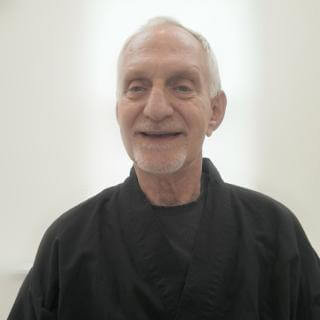
For those of us who are new to the Sangha tonight,
Our tradition with Dharma Talks is that we sit in our meditation posture and keep the eyes down and simply let my words flow over you,
Through you.
No need to do anything else,
And then we'll sit more comfortably afterwards and we'll have a Dharma dialogue.
So tonight I'm speaking from a place of struggling with my own helplessness.
Many of us are finding ourselves in the midst of upheavals that we've never seen in our lifetimes.
Wars around the world,
Political turmoil,
So much suffering.
And my question to myself is,
How do I work with this?
I hear the news and I literally feel a chest that's likely to explode,
I'm afraid,
And this quandary of what to do.
And many people talk to me about not knowing how to practice with this sense of having nothing to do.
Now of course in Zen we prize having nothing to do.
Doing nothing is the radical nature of Zazen,
Where we sit and are present for everything that arises.
As the teaching goes,
Without the slightest meddling.
And that of course is transformative,
It's incredibly powerful.
And so in Zen we teach practice that includes being with the breath,
Or simply choiceless awareness,
Sitting with whatever arises.
So is there then any place for something else?
And the other thing we caution each other about in Zen is all the strategies we use.
Often we do this instinctively.
You might have a particularly good meditation session,
Whatever that is for you.
And you might say,
Oh I was doing this during that session so I'm gonna keep doing that thing.
And then a strategy develops.
And of course before long we find that our strategies fall apart.
And so Zen teaches us to notice ourselves developing strategies and then let them go when we see through them.
However there is a long tradition in Buddhism of active practice,
Particularly practice with suffering.
Practice that helps develop compassion.
Compassion for ourselves,
Compassion for others,
Compassion for the world.
But that's a doing.
Is that even allowed in Zen?
Well,
Many of our esteemed Zen teachers have found these practices helpful.
Some of you may be familiar with Norman Fisher,
Who among other books has written a book called Training in Compassion,
In which he takes teaching from the Tibetan tradition,
The Lojong,
And he puts it into language that is much more familiar to us as Zen practitioners.
And he talks about these as very powerful ways to train the heart and mind.
And in Zen we do talk about skillful means.
We do talk about doing that is more or less skillful.
So what I'm finding is that when I feel I am about to explode,
And I have felt that in recent weeks,
That there is a practice called Tonglen that has given me great comfort and relief,
And that I've found powerful.
And what I wanted to do tonight is something I haven't done before.
I wanted to share a practice with you,
To offer something that might be of use to you as you struggle with these difficult times.
This practice,
Tonglen,
Literally means sending and receiving.
And we read a section from Norman Fisher tonight entitled Sending and Receiving.
And it originated in India in the 9th century,
But it was adopted by the Tibetan Buddhist tradition,
And they've become masters at teaching it.
And actually Tonglen is thought to be a powerful way of transforming suffering into peace and light and ease.
And the symbol that's used in the ancient traditions for this practice is the peacock.
And there's a story behind that.
The peacock was believed to be a bird that could eat things that were poisonous to other animals,
But transform it into nourishment.
And that's what Tonglen practice aims to do.
That the practice involves imagining taking suffering in with each breath and transforming it into love and light and compassion.
And it's meant to help both develop compassion for others and to loosen the attachment to self and the attachment to the suffering that feels like I,
Me,
And mine.
There are two main intentions.
One is to train ourselves to be more open-hearted by training our hearts to go toward the suffering rather than pulling away.
And then to realize that our suffering and the suffering of the world is not separate.
So what I would like to do tonight is to ask you to practice Tonglen with me.
And then if it doesn't speak to you,
You set it aside.
You put it down as soon as this is finished.
But if it feels like something that might be of use,
Consider it as something to sprinkle into your regular practice.
So you're already sitting in Zazen posture.
So with me,
As you listen to the sound of my voice,
Simply focus on the breath.
Let yourself notice every bit of the inhale and then that little space at the top where there's no movement.
And then notice every bit of the exhale and again that space at the bottom.
And then the inhale again.
And just let yourself be present for the breath for a few moments.
And once you've settled into that easeful awareness of the breath,
Then think of some way that you have been suffering.
It could be a feeling of sadness or anger that you're struggling with.
It could be the pain or rage that comes with seeing the injustice in the world.
It could be a physical ailment.
It could be an argument with a loved one or a friend.
And let yourself feel the pain.
Let the thoughts come.
Let the feelings be there.
Notice where you feel it in your body.
And now visualize that pain as a kind of dark smoke that's out there swirling around you.
And now as you breathe in,
Visualize yourself breathing in all that dark smoke,
All that pain.
Coming in not just through the nostrils,
But through every pore of your skin.
You've breathed it all in so there's no black smoke on the outside.
It's all in you.
And then something miraculous happens.
We picture our bodies transforming this blackness into lightness and ease.
And as we exhale,
That's what we breathe out into the world.
And again,
Just become aware of that darkness,
That feeling,
That sensation,
That suffering.
Really let yourself feel it.
And now picture yourself breathing all that blackness in until it's all inside of you.
And then the transformation.
Until you see a glow inside.
No more blackness,
But light and peace.
And let yourself breathe that out into the world.
Now spend a few moments with this practice.
So this is where we begin.
We begin with our own suffering and transforming that suffering as we breathe in and out,
Using our bodies as vehicles of transformation.
And then after you have done this practice,
Perhaps for a while,
Then focus on someone you care about,
Someone who's suffering,
Someone in pain,
Someone who is the victim of trauma or war or is afraid.
And do this practice taking in their suffering,
Transforming it,
Breathing it out.
And then,
Eventually,
The teaching is that we move on to someone we dislike and we do this practice with them.
That's the harder one.
Perhaps someone who has wronged you.
Perhaps someone who you feel is harming the world.
And you do this for them.
So the practice is that we start with ourselves,
We extend toward others who we care about,
And then for someone we really have trouble with.
And ultimately,
We do this practice taking in the suffering of the entire world,
Transforming it,
And breathing it out.
We set our intention to transform the suffering and pain of all beings.
The goal is to be a transformational force in the world.
And one of the things that I find so helpful is that traditional Metta,
Or loving-kindness practice,
Uses words.
May I be peaceful,
May I be happy,
May you be free from harm.
But for me,
This visualization is without words,
And that is more akin to our practice of Zazen.
This is the practice of Tonglen.
When someone once asked the Dalai Lama about this practice and asked,
Does it really work?
Does it help others?
Does it lessen their suffering?
The Dalai Lama said,
I don't know for sure,
But I know it works to transform me.
So my hope is that you think of this as one possible tool in a time of great suffering.
And I just want to close with words again from Norman Fisher,
Who says,
Our body never fails us.
It is on its own as it is love itself,
Nature itself flowing on in profound sanity and appreciation despite our human confusion.
And this practice invites us to harness the profound sanity of our bodies to transform our own suffering and the suffering of the world.
Thank you,
And I am eager to hear your thoughts about this.