Tonight,
I'd like to talk with you about the Bodhisattva Precept.
Many of you have received an email about study sessions that we'll be having starting in January,
And it seemed like a time,
Particularly now,
When talking about these ethical principles might have a lot of resonance with all of us.
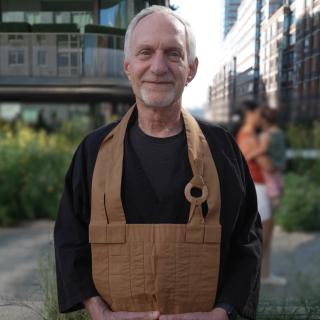
Many of you know that some of us sit here with these rakus,
These little garments that look like bibs,
And what they signify in our Zen tradition is that we have formally adopted the Bodhisattva Precepts,
That we have said that we would like to orient ourselves toward living our lives according to these ancient principles.
What I'd like us to do to begin is to read the precepts together,
And so Tom will share his screen,
And let's simply read these together and then go on and talk about them.
So we put our hands in Gassho,
We put our hands together,
And we recite,
I take refuge in the Buddha,
In oneness,
The awakened nature of all beings.
I take refuge in the Dharma,
In diversity,
The ocean of wisdom and compassion.
I take refuge in the Sangha,
In harmony,
The interdependence of all,
Not knowing,
Thereby giving up fixed ideas about myself and the universe.
I vow to cease from evil,
Bearing witness to the joy and suffering of the world.
I vow to practice good,
Honoring wholeness in myself and others.
I vow to save all beings,
Recognizing that I am not separate from all that is I vow to take up the way of not killing.
Being satisfied with what I have,
I vow to take up the way of not stealing.
Honoring mutuality and respecting commitment,
I vow to take up the way of not misusing sex.
Listening and speaking from the heart,
I vow to take up the way of not speaking falsely.
Cultivating a mind that sees clearly,
I vow to take up the way of not intoxicating mind and body.
Unconditionally accepting what each moment has to offer,
I vow to take up the way of not finding fault with others.
Meeting others on equal ground,
I vow to take up the way of not elevating myself at the expense of others.
Using all the ingredients of my life,
I vow to take up the way of not sparing the Dharma assets.
Transforming suffering into wisdom,
I vow to take up the way of not harboring ill will.
Honoring my life as an instrument of the great way,
I vow to take up the way of not defaming the three treasures.
Wonderful noble principles.
And when I first encountered them many years ago,
I think Carolyn and I took the precepts together.
I thought,
Eh,
Why do I need these?
I know what ethical behavior is.
I'm a good person.
Most of the people I know are good people.
Why do we need these?
And now I have come to understand how absolutely fundamental they are to this practice,
To our spiritual practice.
Some of you may share my experience of falling into despair at times when I read the news,
When I listen to what's going on in our world,
And when I find myself railing at what's going on,
I've come to realize that what I'm particularly disheartened by is the behaviors that violate these precepts.
These precepts like not killing,
Not stealing,
Not speaking falsely,
Not finding fault with others,
Not elevating myself at the expense of others,
Not harboring ill will.
And of course what we see now in our public life is that so much behavior violates these principles,
And in that process causes so much harm,
So much destruction.
And so this idea that we know what good behavior is and we're all good people?
No.
I read a quote recently from Jack Kornfield,
The Vipassana teacher.
He wrote,
It's really clear that no amount of technology,
No amount of computers and biotechnology and nanotechnology is going to stop continuing warfare and racism and environmental destruction.
What's called for on the earth at this time is really a change of heart.
We are a nation,
As one of the great generals said,
Of nuclear giants and ethical infants.
And I think our status as ethical infants is what we want to look at really closely and what it means to orient ourselves toward principles that are a corrective,
Principles that aim at fostering a change of heart.
Because as Jack Kornfield says,
The place we always have to start is with what's right here now.
There are so many rituals in Zen,
There are so many principles,
So much to learn.
And we are cultivating concentration,
We are cultivating equanimity,
We cultivate so many things on the cushion.
But one of the most startling realizations that I've had is that without the bodhisattva precepts,
Without a moral compass,
All of this work could be not just for naught,
But for evil.
I mean,
Think about cultivating deep concentration.
We could become really mindful,
Safe crackers.
We could become really skillful pickpockets.
Why don't we do that?
And I know I'm making an argument that sounds trivializing,
But it's not.
Because this orientation toward the fundamentals of good and evil,
Promising to do good,
To cease from evil,
To save all beings,
That orientation is the only thing that keeps our practice from deviating into what is harmful.
My initial aversion to the precepts,
I think,
Came from my Judeo-Christian heritage.
I learned the Ten Commandments,
And they were commandments.
Well,
Isn't that what these are?
Not killing,
Not stealing,
Not bearing false witness,
Has a familiar ring to it.
But these are not commandments from on high.
These were developed,
According to the ancient teachers,
In Buddhist communities,
In sanghas,
In communities of monks and nuns who were trying to live together in harmony.
And what they found was that certain actions contributed to harmony,
And certain actions did not.
And so,
What these precepts are is a distillation of skillful means of living.
It would be very difficult to have to make all this up from scratch,
To have to make all the mistakes we would have to make in order to learn these principles for ourselves from the ground up.
And so,
What we are asked to do in the Zen tradition,
In the Buddhist tradition,
Is to trust that these are tried and true,
That they have been developed over centuries because they work,
And because the alternatives don't work.
One way to think about these precepts is through three different lenses.
One is the literal lens,
The literal injunction not to steal,
Not to lie,
Not to kill.
Those really are like the Ten Commandments,
And those are important guideposts,
North Stars,
If you will.
But how do we eat if we never kill?
How do we save lives if we never lie in order to protect someone hiding from an oppressor?
So many ways,
So many complex ways that these precepts,
If kept absolutely literally,
Can cause harm.
And so,
We temper the literal perspective with the compassionate perspective,
A perspective that says we are all doing the best we can to live as ethically as we can,
And sometimes we violate one precept in order to uphold another.
That nothing is absolute,
And so in fact,
As we read,
Not knowing,
Thereby giving up fixed ideas about myself and the universe,
Absolute moral certainty often leads to harm and great sorrow.
And so the compassionate perspective says we temper the literal with compassion for ourselves and our fellow beings.
And the third perspective is the perspective of oneness,
Of emptiness.
And in that perspective,
All of this is simply the unfolding of the universe.
Killing happens.
People take from each other.
Animals take from each other.
And that all of this from the perspective of oneness is simply the unfolding of the universe.
And that is an important part of our tradition,
But that perspective can become the excuse for complacency,
The excuse for tolerating harm and injustice,
And sitting still for violation of each other's rights.
And so all of these perspectives are interwoven,
And we play with all of them as we try to cultivate the wisdom that comes from the bodhisattva precept.
And all of it is about investigating the experience of being human.
So how do we work with them?
Well,
Let's take,
For example,
The precept of not stealing.
In many translations,
This precept is translated as I vow to refrain from taking that which is not freely given.
A much broader and more subtle precept than simply not stealing.
Because it asks us to investigate all the ways,
All the subtle subliminal ways that we may coerce one another to give up things that we don't feel free to hold on to.
And so we work with it.
We work with our own behavior.
We work with how we encounter others in the Sangha,
In our communities,
In our world.
And so as we start in this new season of inviting those who would like to come to precepts study sessions,
What we're really asking is for all of us to turn again toward these precepts and to talk about them,
To play with them in all their complexity.
Not with the idea that everyone is going to sew a raksu and go through the jukai ceremony and formally take the precepts.
Some people will.
But with the idea that having these discussions and pointing ourselves again and again toward the ethical foundations of Zen practice is essential if we are going to be real students of the way.
So let me end with a quote from Robert Aitken,
Who wrote the book The Mind of Clover,
Which we will be reading as part of this study group.
He writes,
Over time we realize that the precepts are not really rules.
They are a definition of the life of a Buddha,
Of how a Buddha functions in the world.
They are how enlightened beings live their lives,
Relate to other human beings and this planet,
And make moral and ethical decisions while manifesting wisdom and compassion in everyday life.