We're very glad to have people joining us for the first time tonight.
And our tradition when we have a Dharma talk is that we sit in meditation posture,
If you like,
With the eyes down,
And simply let the talk wash over you and see what arises for you,
What resonates.
And then we'll sit comfortably and have a Dharma dialogue afterwards.
One of our Sangha mates posed a question to me,
And I wanted to pose it to all of us.
She said,
I was brought up to believe that there is one God who created the universe,
And I still believe this to be true.
So how do I reconcile this with what I'm learning in Zen,
In Buddhism,
And in preparing to take the precepts?
This is a question that comes up so often.
Many of us in the West were raised in traditions where belief in God was central.
And many of us still love those traditions,
Adhere to those traditions,
And some of us believe in God.
But then the question arises,
Is our Zen practice compatible with believing in God?
Or if I believe in God,
Am I not able to do this practice?
Or am I not supposed to be a Buddhist or a Zen practitioner?
One of the classic ways that people talk about this is to turn to a story that is attributed to the Buddha.
Many of you have heard it,
But it's worth repeating.
The Buddha is said to have told his disciples suppose a man were wounded by an arrow thickly smeared with poison,
And his friends and companions brought a surgeon to treat him.
The man would say,
I will not let the surgeon pull out the arrow until I know the name and clan of the man who wounded me,
Whether the bow that wounded me was a longbow or a crossbow,
Whether the arrow that wounded me was hoof-tipped or curved or barbed.
All this would still not be known to that man,
And meanwhile he would die.
So too,
If anyone should say,
I will not lead the noble life under the Buddha until the Buddha declares to me whether the world is eternal or not eternal,
Finite or infinite,
Whether the soul is the same as or different from the body,
Whether or not an awakened one continues or ceases to exist after death,
That would still remain undeclared by the Buddha,
And meanwhile that person would die.
Quite a stark example.
And of course the story is referring to these big questions.
Who made the universe?
What happens after I die?
The biggest questions that humans have struggled with probably since they have been conscious beings.
And the Buddha was a person of his time,
And these questions were central,
And they were the subject of enormous debate,
Heated debate,
Among the various religions practiced in India at that time.
And he was offering something radical.
He said,
I don't know who made the arrow.
I don't know if the soul is immortal.
These are questions that I do not presume to answer.
These are questions that I do not presume to address.
This was radical.
He said,
I teach anguish and the ending of anguish.
And that word anguish is the translation actually of the teacher Stephen Batchelor.
He says that this more accurately reflects what the Buddha intended than the familiar statement,
I teach suffering and the end of suffering.
Because he argues that in fact,
Suffering is an inevitable part of our lives,
But that the anguish,
The added suffering,
Is something that we work with to relieve in this practice.
So the Buddha was saying,
I will not concern myself with the big questions of the origin of the universe and the immortality of the soul.
So one could expect that the Buddha was atheist,
That he did not believe in God,
But in fact,
He was profoundly agnostic.
He said,
This is not where I turn my attention.
I will be entirely focused on the relief of anguish.
But some of us,
Some of us find these questions essential to our way of life.
For some of us,
The question of why I'm here on earth,
What it means to be alive,
Whether there's life after death,
For some of us,
Those questions have to be answered.
So for some of us,
Believing in a higher power is like the air we breathe.
But if we think about our practice of zazen,
Our practice of Zen,
Believing in God or not believing in God is all the same.
It leaves us in the same place when it comes to our practice.
The Dharma is not something to believe in.
The Dharma is something that we do.
The Dharma is an action.
The Dharma is knowing through our zazen and through our experience of the present moment,
The taste of tea,
The feeling of the air on my skin,
The experience of pain in my knee.
It is a doing rather than a believing in.
And Zen emphasizes this doing,
This experience.
You know,
As we know,
If we become the greatest Buddhist scholars ever,
But we don't practice,
We don't train the mind in zazen,
We have left out the heart of this spiritual tradition.
If we think about koan practice,
Some of you have been working with koans.
If we simply take an intellectual approach to koans,
We go completely astray.
And in fact,
One author published a book called Secrets of Zen Koans in which he gave all the answers that he had gotten from somewhere.
All the official answers to the koans.
And they are useless because koan practice is a doing.
It is an experiencing.
And Zen emphasizes action.
In fact,
There's a wonderful koan about Master Yun Men.
A monk asks Yun Men,
What are the teachings of a whole lifetime of Zen?
And Yun Men answers,
An appropriate response.
That may sound confusing at first,
But what he means is that the core and the essence of our practice is what we do to act with greater and greater appropriateness,
Which means relieving suffering,
Which means acting with greater compassion.
And so,
The bodhisattva precepts,
Which some of you have taken,
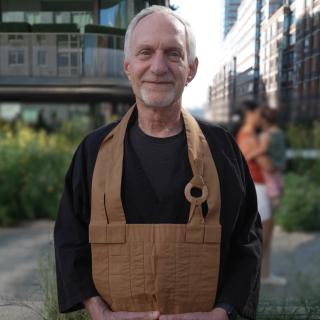
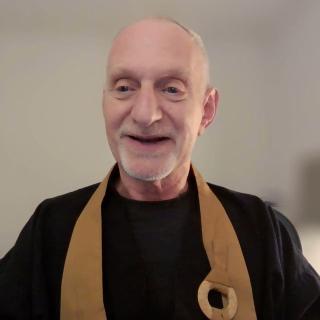
And so you're wearing these raksus,
And some of you are about to take,
And so you're sewing raksus,
These bodhisattva precepts are about actions.
They're about not taking life,
Not speaking falsely,
All the things that we think about as doing.
And this is important because one of the criticisms of meditation traditions in general,
Including Zen,
Is that we are about contemplating our navels.
And that is absolutely the opposite of what the aim of this practice is,
Which is to cultivate discernment that leads to compassionate action.
So,
Buddhism and Zen are not atheistic,
And they're not theistic.
That our Zen practice is founded on the passionate recognition of the truth of not knowing,
Of the truth that we will never fully describe reality,
Life as it is,
With the limitations of our thinking minds.
And you know,
Of course,
There are these wonderful stories that point this out.
The story of the blind man and the elephant.
This is sometimes attributed to the Buddha,
But no doubt came from many other traditions as well,
Where blind men are asked to describe an elephant,
And one man takes the tail and says,
Oh,
The elephant is a rope,
And another holds the leg and says,
Oh,
The elephant is a pillar,
And so on.
And of course,
It's a way to remember,
As we were reminded in our reading tonight,
That we can never fully apprehend reality,
That we are always those blind men and women,
And that not knowing is the only stance that really reflects the truth of our situation.
But many of our Buddhist thinkers approach all of this quite rationally.
And in fact,
The example of the Buddha and the arrow is a very rational example.
It's saying,
I am not going to concern myself with the ultimate questions of the meaning of life and the origin of the universe.
But there is a knowing of the heart that happens for many of us that is not rational,
And that for some of us includes faith,
And faith in a supreme being.
And what our tradition asks is that we embrace all of these knowings as other ways of understanding ourselves in the world.
We talk a lot about the stories we tell ourselves.
The mind is constantly creating stories.
I create them about myself.
I create them about other people.
I create them about life.
And so we will never be without stories.
We could argue that believing in a supreme being is a story,
And yes,
It probably is,
But it is not different from the other stories we tell ourselves all day long.
Zen emphasizes experience and the limitations of thought.
And our experience,
For some of us,
Includes this deep knowing of the presence of a supreme being.
What Zen encourages us to do is hold all of our stories lightly.
So for many of us,
It's not this or that belief that concerns us.
It's when those beliefs are held so tightly that they cause suffering.
And so belief in a god is completely compatible with our practice and our tradition.
What we really aim toward is looking at what we do as beings out there in the world.
And if those beliefs help us to act with greater compassion and greater wisdom,
How could we not welcome those beliefs in our midst?
If those beliefs held too tightly cause suffering and pain and division,
Those actions are what we do not embrace.
So to go back to the teaching from Kōnyamada,
The realization born of Zazen is merely a fact,
An experienced fact in the same way that the taste of tea is a fact.
A cup of tea has no thought,
No idea,
No philosophy.
It tastes the same to Buddhists as it does to Christians.
So let's all enjoy our many varieties of tea.
Thank you.
So now,
Please sit comfortably.