Tonight,
I'd like to talk about something that seems to be everywhere these days.
I picked up the latest issue of Lion's Roar magazine,
Which many of you know is a widely circulated Buddhist magazine,
And the lead article was Artificial Intelligence and the Dharma.
And the subtitle was,
AI can articulate the sum total of human knowledge,
But can it help us cultivate wisdom and compassion?
And I thought,
Oh no,
It's everywhere.
What could this possibly have to do with our practice?
But the article got me hooked.
It was interesting,
And the story that it told was of the abbot of Green Gulch Zen Center,
Mark Rutschman Beiler.
He was the Dharma heir of Suzuki Roshi,
And as many of you know,
Suzuki Roshi was a very important Zen teacher who brought Zen to the United States from Japan and was a major force in our way in the United States.
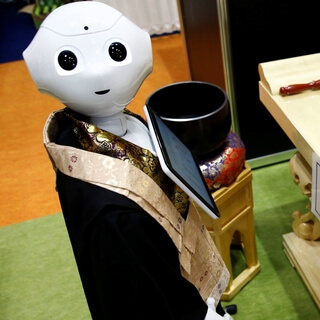
And what he did was to take all of the Dharma talks that Suzuki Roshi had recorded many years ago and all of Suzuki's writings,
And he fed it to a bot,
An artificial intelligence bot that he named Suzuki Roshi Bot.
And then he asked the bot complicated questions about Zen and the Dharma.
The bot could write poems,
The bot could give answers that sounded just like Suzuki Roshi,
Including his little idiosyncrasies of speech.
And then another Sangha member at Green Gulch found a way to get the bot to say unexpected things,
Things that he said were vile and egregious.
And they had to take Suzuki Roshi Bot offline.
Now we are finding this in many,
Many domains of our lives.
I recently had to explore it in the world of mental health.
But what it made me think about was the tools that we use for awakening.
How exactly do we do this great engineering project,
If you will,
Of waking up?
And what are the means that we use?
And can artificial intelligence become one of those means?
We use many skillful means.
We've used them tonight,
Chanting,
Reading the Dharma,
This Dharma talk,
Hopefully a somewhat skillful mean,
Koan study.
We have dialogues with each other about our practice and about what the Dharma really is and how we can express it and live it.
But of course,
What we come back to over and over again in our Zen way is the fundamental core of this practice,
Which is practice,
Sitting,
Walking.
As they say,
Knowing whether the water is hot or cold for ourselves.
And so there is an experiential core of practice that cannot be replaced by reading,
By koans,
Certainly not by artificial intelligence.
And it got me to thinking about the fact that we have teachers in our way.
And these are not simply people who we relate to,
To download the content of their minds.
In fact,
What Zen teaches us is that we cannot transmit the content of our minds to each other.
That is not what transmission involves.
That there's a core of being in relationship,
Teachers with students,
Sangha mates with Sangha mates.
It is another way of knowing for ourselves whether the water is warm or cold.
And some of us take on Shokan relationships with teachers in order to have one person as a guide.
But it is not,
Again,
To download information,
But much more a heart-to-heart connection that lasts often many years,
And sometimes most of a lifetime.
And what went wrong with Suzuki Roshi Bot is their ability to make this artificial intelligence creation say terrible things,
Say ridiculous things.
Brought me back to the teachings of Zen Master Thich Nhat Hanh.
He talked about nourishing healthy seeds.
He talked about how vital it is to pay attention to what we put into our minds.
At one point,
He said,
When we watch television and movies,
We consume.
When we browse the internet,
We consume.
When we listen to music or have a conversation,
We consume.
And then he said something which always stays with me.
He said,
Our mind is made of what we feed it.
So we need to know how to nourish and protect it.
And I came to realize that we do this with all of these tools of awakening,
With all of these skillful means.
We don't just chant anything.
We chant selections that have come to us sometimes over many centuries,
But always tested.
And what they're tested for is their ability to convey the truths of the Dharma,
The truths of just this,
And of the process of waking up.
Mike Felicky and I,
With some of our Sangha mates,
Have been working on revising the Sutra Book for Living Vows in,
And it's been wonderful.
We particularly want to include more women's voices,
More voices from people who are not normally included in the white male-centric lineages of Zen,
And that's been wonderful.
But what we also find is that it's important to be very careful about what we choose,
About what we choose to consume as a Sangha in terms of our chants,
Our readings.
Similarly,
The koans are chosen because they convey particular things that are of vital importance to waking up.
So we are careful,
We try to be careful,
All of us with each other.
And what I've come to understand is that it is a way of making a safe space for work that is,
By its nature,
Unsafe.
It's the work of turning toward everything,
Including this mind,
This body,
And holding each other with care as we do it.
And what's so wonderful and frightening about artificial intelligence is that if we instruct it to do this,
It will reach everywhere.
It will reach everywhere and see every place that Suzuki Rochi is mentioned.
And if he's mentioned along with a crazy or a hateful idea,
Artificial intelligence will consume that and will offer it to us.
And so we take care,
And the goal is to take care with artificial intelligence just as we take care with everything else that we bring into this space of Sangha,
This space of the practice of awakening,
So that we do our best to ease suffering and to do as little harm as we possibly can.
And what it leaves me with is the understanding that artificial intelligence is not inherently good or bad.
It's not inherently enlightened.
It is simply a very useful and vigorous search engine,
Another of those means that can be used skillfully,
But that can be used without skill.
And so just as Thich Nhat Hanh urges us to nourish our healthy seeds and to feed our minds the things that we want to feed it in order to create nourished and protected beings,
We need to be very careful about what any artificial intelligence consumes and then offers back to us as something that it calls the Dharma.
We need first and foremost to use our good judgment and to trust each other,
And then to discern whether artificial intelligence has consumed what is trustworthy and can be included as one of these skillful means.
Our mind is made of what we feed it,
So we need to know how to nourish and protect it.
And that will never change regardless of the technological advances that come our way.
Thank you.
So please sit.