Welcome to the mindfulness meditation podcast presented by the Rubin Museum of Art.
We are a museum in Chelsea,
New York City that connects visitors to the art and ideas of the Himalayas and serves as a space for reflection and personal transformation.
I'm your host,
Dawn Eshelman.
Every Monday we present a meditation session inspired by a different artwork from the Rubin Museum's collection and led by a prominent meditation teacher from the New York area.
This podcast is a recording of our weekly practice currently held virtually.
In the description for each episode,
You will find information about the theme for that week's session,
Including an image of the related artwork.
Our mindfulness meditation podcast is presented in partnership with Sharon Salzberg and teachers from the New York Insight Meditation Center,
The Interdependence Project,
And Parabola Magazine.
And now,
Please enjoy your practice.
Good afternoon,
Everybody.
Welcome to mindfulness meditation online with the Rubin Museum of Art.
We're a museum of Himalayan art and ideas in New York City,
As many of you know,
And we're so glad to have you all here with us for our weekly practice where we combine art and meditation online.
And it's so nice to see those of you chatting it up in the chat.
It's great to always to hear from you and see some familiar names and new folks as well.
And always nice to know where people are joining from,
What you're thinking about,
How it's going in your practice.
Please come and join us at the museum.
We are open if that is available to you.
We love having you in.
Our staff is taking great care of all of our visitors who come through.
And this is a great time to enjoy the time ticketing option and to take a look at the beautiful exhibition Awaken,
A Tibetan Buddhist journey towards enlightenment in addition to our gorgeous collection.
And Awaken explores the steps in the journey of self knowledge and transformation from chaos to awakening and everything in between.
And so inspired by that exhibition,
We select a theme that speaks to all of us as meditators in our practice.
And this month we've been speaking about compassion and thinking about why that's important in our lives,
In our practice.
And as one of the very important elements in the pathway to enlightenment.
And we will take a look together at a work of art from our collection that frames this idea for us of compassion.
And we'll hear a talk from our teacher on the theme.
And today back with us is the fabulous Sharon Salzberg.
Then we'll sit together guided by Sharon 15 to 20 minutes.
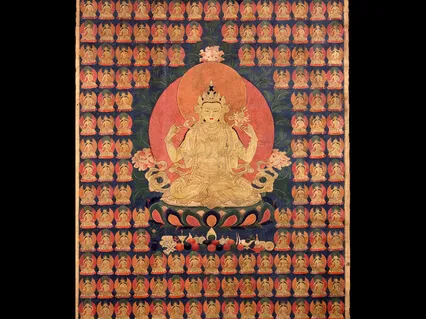
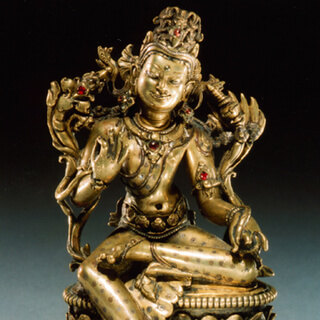
And let's take a look at the artwork that we are viewing today this month wouldn't be complete without including at least a few depictions of this beautiful and meaningful patron deity of Tibet,
Bodhisattva of compassion himself.
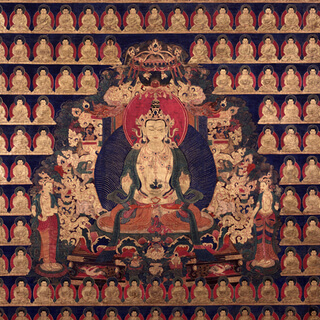
This is Aviloki Teshvara.
This particular tanka is from Tibet and it is from the 1700s.
It is ground mineral pigment and gold line,
Fine gold paint on cotton canvas.
And this is Aviloki Teshvara in this peaceful form,
Traditionally known as white in color here,
He's filled in with gold.
And this central figure is very peaceful,
Very beautiful in his clear gaze forward.
He's seated on a colorful Lotus throne.
And then the depiction of his figure is very simple and elegant here.
We just have this gold color with some fine line work and surrounding him.
We see halos of reddish orange and orange above his crowned head and noticing these bejeweled elements and robes that depict him as the Bodhisattva that he is.
And behind all of this are these kind of lush green leaves and several Lotus blossoms blooming,
Including the three pink ones on either side and above him.
And then one that he's holding in his hand here.
This is Aviloki Teshvara with four hands.
And whenever we think of compassion in this context,
It's Aviloki Teshvara that is this Bodhisattva that is here to offer practitioners an embodiment of compassion and without whom we wouldn't have the ability to really follow or emulate this Bodhisattva ideals that really are all about compassion.
So delighted to have Sharon Salzberg here today.
Sharon is the co-founder of the Insight Meditation Society in Barre,
Massachusetts and has been guiding meditation retreats all over the world.
Her latest book is Real Change Mindfulness to Heal Ourselves in the World.
She's the author of several books,
Including the New York Times bestseller,
Real Happiness and many more.
Please take a look.
She's always has something interesting going on,
Even online.
You can find out about her,
Her writings,
Her activities at SharonSalzberg.
Com.
Sharon,
It's so nice to have you here.
Welcome.
Thank you so much.
It's so nice to be with you all virtually.
I love reading where everyone's tuning in from.
And I think,
Wow,
That's far away.
That's another time zone.
Thank you so much.
Even the people from close by the Rubin,
It's such an interesting way to form community in such an essential way to form community.
So here we all are,
And of course the piece of art is just stunning.
I've just been looking at it and,
Uh,
The topic is really,
Really interesting.
It's like the perennial topic of compassion,
Which I think is actually quite provocative because of all of the assumptions that we tend to make about compassion.
So I think just looking at the notion of a path within the Buddhist framework is very interesting because it's so not linear.
We here in the West,
We tend to think of a path as like I did one on one,
I'm over it.
You know,
I'll never go back there.
I've moved beyond,
But really things within the Buddhist tradition,
They're almost like shaped differently.
It's what,
Uh,
My friend Sylvia Boorstein,
My colleague and describing the eightfold path to liberation said she really felt it should be called the eightfold dot because we kind of go round and round and round or the place you start is a place you return to and it's ever deeper and you return again and again.
And the kind of spirals and movement.
And,
Um,
I sometimes think my perfect depiction of reality is a kaleidoscope.
You know,
It's just these patterns that are,
Are continuously changing.
In fact,
I use that example in a talk and people started sending me kaleidoscopes,
Which was very nice.
So I played sometimes,
Uh,
With my kaleidoscopes and,
Um,
There's something of that sense I have whenever I think about compassion,
Because there's some qualities like compassion,
Which are both an essential part of the path to liberation and an essential expression of liberation.
So as we cultivate and strengthen this power,
And it really is a power of compassion and we develop it and we see more clearly and more honestly how things are,
We see,
Say how interdependent we all are,
How,
How interconnected we all are.
And then that leads to a different way of being in terms of being kinder and more ethical and kinder to ourselves,
Which is all the,
Like the terrain of compassion.
And so as we practice compassion,
We get the chance to see more clearly as we see more clearly,
We get more compassionate in our lives.
And I think it's very much a kind of quality where it's so clear that the inner work and the outer manifestation are as one.
It's so easy for us to take our spiritual life or our life of faith,
Say if that fits or just our meditation practice or our contemplative world and isolated.
It's like,
That's another compartment.
That's what I do Monday,
Wednesday and Friday,
Or that's what I do Monday at one o'clock at the Rubin museum or something like that.
And not have it sort of interwoven with everything we do and everything that we say and,
And yet it really is as one because life is seamless and spirituality in the sense of,
It's an odd word I know for many people,
But it's like the deepest expression of our values,
No matter what the circumstance we find ourselves in our ability to connect to something bigger than the immediate situation or circumstance.
That's something that unites all of our lives,
Every aspect of our lives,
Whether we're alone or with others,
Whether we're at work or at home,
It's really something that permeates everything or,
Or it's not real.
It's not true.
And so compassion can be seen as,
As that kind of a quality that is gotta be alive everywhere.
Otherwise it reminds me of once we brought one of our meditation teachers from India over to the States and this was before we'd established a retreat center.
But still there were communities coming up all over the country where people were meditating together and beginning to explore these different topics,
These different values.
And,
And we said at the end of this tour,
Something kind of proudly to our teacher,
Like,
Isn't it great?
You know,
How many people and,
Uh,
Just really all over the country,
People are interested and,
And doing the practice.
And he said,
I think it is great,
But it's just something about practitioners here that sometimes reminds me of people sitting in a rowboat and with great earnestness and endeavor,
They're rowing and rowing and rowing,
But they refuse to untie the boat from the dock.
And he said,
People here seem to want to practice meditation for great transcendent experiences and alternative states of consciousness,
But they don't necessarily want to think about how they speak to their neighbor,
How they speak to their children,
How they speak to themselves,
Um,
How they are,
Uh,
In an adverse situation commuting or,
Um,
Whatever it might be in,
In really our life as a communal being where we are in fact,
Interdependent with one another.
And that's always stayed with me and made me realize that,
You know,
Something like compassion or kindness,
Um,
It's not just this kind of specialized thing we do in a ritualistic way or a certain meditation that we,
We might practice,
But it's,
It's really about how we live.
And that is both the path to greater understanding and to an expression of our deepest values because the really most precious to me descriptions of an awakened mind or an enlightened mind are the people,
The stories,
You know,
The anecdotes of how people behave.
We don't really know what's going on inside someone's mind,
You know,
That we may,
We may use imagery,
You know,
Or our imagination for this person has a consciousness as vast as,
You know,
A thousand skies or whatever,
But,
Uh,
We see how people behave and we see how we behave.
Um,
And one of the things I've always loved in the Tibetan tradition is when they describe maybe a very learned teacher,
Uh,
Wandering around teaching and there's an attendant accompanying them who's not very learned,
Not very scholarly,
But has a tremendous good heart and really wants to help people and help people have access to,
To teaching and he doesn't get jealous when people seem to be moving ahead or making progress.
He rejoices in other people's happiness.
And then the end of the story is,
Is always,
Well,
The,
The servant got enlightened way before the teacher,
You know,
Because their heart was so pure and they cared so much about others.
It really is a vehicle.
And the other part of that that I love also in the Tibetan tradition is that when people talk about their teacher who,
Uh,
May well played an extremely important mentoring role for them,
Pivotal role,
Uh,
Help them disentangle from some maybe terrible habits and help them see themselves in the world really differently.
And,
Um,
So the kind of standard response when you want to heap the highest praise on your teacher is to hear people say they were very kind to me.
And it always struck me,
You know,
Like they don't say their scholarship was off the charts or,
Uh,
My sense of their enlightenment was just beyond belief.
Um,
They were very kind to me.
And so these qualities like kindness that we tend to demean a little bit here or more than a little bit and say,
Well,
Yeah,
That's nice,
But it's not much.
They're considered really tremendous powers,
Uh,
A vehicle for liberation and a perfect expression of the liberator heart.
So compassion,
I would say rests on an understanding of several things.
One is how interdependent we are,
How interconnected our lives are.
And this is the truth of things.
I recently was teaching remotely into this,
Um,
Company.
And my favorite question to ask is how many other people need to be doing their jobs well for you to be able to do your job well.
And not a lot of people raise their hands,
You know,
Like some did,
But not a whole lot.
And they said kind of sometimes then I expanded it to really close to the original meaning,
Which was what about if you commute outside the home to work and you know,
And then all these other hands went up because we're dependent on that car mechanic.
We're dependent on that train operator.
And then what if you decided to eat today before you went to work and then a whole lot more hands went up because somebody had to grow that food and provide the food.
And you get the sense of like,
Oh,
This is actually reality.
And that's the birth of some compassion.
And the other part of it is realizing how we're all vulnerable in this life,
That life is change.
And that,
I mean,
Look at just what we've been through and you know,
We may not all be in a state of acute suffering or the proportion of joys and sorrows in our lives could be different for every one of us.
But that vulnerability is the same and we can find one another and have a very different relationship based on kindness because of that.
OK,
So let's sit together.
And I'll guide you through it.
See if you can sit comfortably,
You can close your eyes or not.
Just be at ease.
You can start by listening to sound,
Whether it's the sounds of my voice or other sounds.
It's a way of relaxing deep inside.
Allowing our experience to come and go.
It's like the sounds can just wash through you.
And bring your attention to the feeling of your body sitting,
Whatever sensations you discover.
Bring your attention to your hands and see if you can shift from the more conceptual level,
Fingers to the world of direct sensation.
Picking up,
Pulsing,
Throbbing pressure,
Whatever it might be.
You don't have to name these things,
But feel them.
And bring your attention to the feeling of your breath,
Just the normal natural breath.
You don't have to try to make it deeper or different,
Wherever you feel the breath most clearly.
Maybe that's the nostrils or the chest or the abdomen.
You can find that place,
Bring your attention there and just rest.
See if you can feel one breath.
That concern for what's already gone by without leaning forward for even the very next breath.
That's this one.
If you like,
You can use a quiet mental notation like in,
Out or rising,
Falling to help support the awareness of the breath,
But very quiet.
So your attention's really going to feeling the breath one breath at a time.
As images or sounds or sensations or emotions should arise,
They're not very strong.
If you can stay connected to the feeling of the breath,
Just let them flow on by.
You're breathing.
It's just one breath.
They are strong and they pull you away or you get lost in thought,
Spun out in a fantasy or you fall asleep.
Truly,
Don't worry about it.
The most important moment is the next moment after you've been gone,
After you've been lost,
Where we practice letting go and beginning again.
See if you can let go gently,
Whatever's taking you away and just bring your attention back to the feeling of the breath.
It's really the opposite.
It's really the art of learning how to begin again gracefully,
Good spirits with kindness towards yourself again and again.
A little counterfeiting,
It's addressable and easy to just take on,
Which is kind of a high school experience.
It's the same thing.
You you you you you you you you you you you you you you you you