Welcome to the mindfulness meditation podcast presented by the Rubin Museum of Art.
We are a museum in Chelsea,
New York City that connects visitors to the art and ideas of the Himalayas and serves as a space for reflection and personal transformation.
I'm your host,
Dawn Eshelman.
Every Monday we present a meditation session inspired by a different artwork from the Rubin Museum's collection and led by a prominent meditation teacher from the New York area.
This podcast is a recording of our weekly practice currently held virtually.
In the description for each episode,
You will find information about the theme for that week's session,
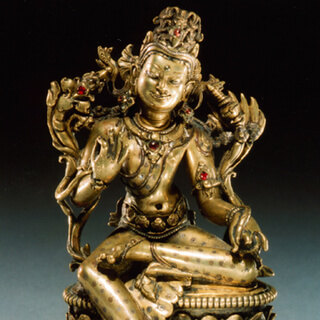
Including an image of the related artwork.
Our mindfulness meditation podcast is presented in partnership with Sharon Salzberg and teachers from the New York Insight Meditation Center,
The Interdependence Project,
And Parabola Magazine.
And now,
Please enjoy your practice.
Tashi Delek,
Tashi Delek and welcome.
Welcome to mindfulness meditation online with Rubin Museum of Art.
So happy to be here with you.
I am Tashi Churdin,
Assistant Manager to Himalayan Cultural Programs and Partnerships here at the Rubin Museum.
We are a museum of Himalayan art and ideas in New York City and so wonderful to have all of you joining us.
This is our weekly practice where we combine art and meditation online.
So nice to see so many familiar names in the chat.
Welcome to those who are joining us for the first time.
For today's session,
Inspired from our collection,
We will take a look at a work of art from our collection.
We will hear a brief talk from our teacher and then we will have a short sit,
About 15 to 20 minutes for the meditation guided by our teacher.
Our theme this month is care.
We continue on this theme and we are often asking ourselves and everyone,
What are you caring about right now?
So now let's take a look at the beautiful art we have chosen for today.
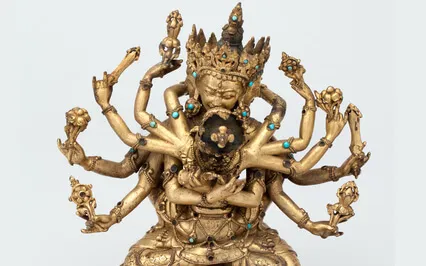
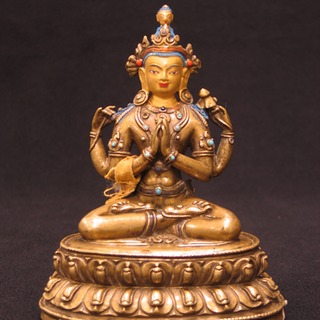
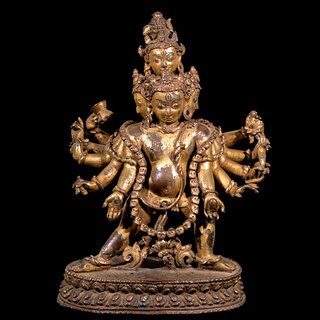
So this beautiful 15th century sculpture gilt copper with inlays of semi-precious stones,
Origin Tibet about eight to seven inches height and width.
This is Guya Samaja Akshobya Vajra.
In Tibetan known as Samva Dupa with concert,
Multiple heads as you see here and multiple hands.
Adorned with semi-precious stones on omelettes,
Holding ritual objects in each of the hands.
The first two hands hold a nine pointed Vajra and bell and the right second holds a white wheel.
In fact,
In the painting,
You can see the white color,
Although this is gold gilded sculpture,
So you only see gold color and so forth.
Each arm has ritual objects that has symbolic meaning behind it and seated in legs in Vajra posture,
Adorned with beautiful major and minor marks.
And the hair in braids is tied on the crown of head,
Adorned with crown,
Earrings,
Necklaces,
Armlets,
Bracelets,
Long necklaces and bells wearing flowy garments.
So this is a Guya Samaja Tantra is one of the most important scripture of tantric Buddhism,
Which is Vajrayana Tibetan Buddhism.
According to one of the tradition,
Guya Samaja Tantra was believed to have been taught for the first time by the Buddha in the form of Vajradhara to King Indrabodhi,
The king of Odhiana.
And Guya Samaja is one of the principal meditational deity of Vajrayana Buddhism.
In fact,
It's known in Tibetan word as Yidam.
So we'll talk more on this after the meditation.
And now let's bring on a teacher for today,
Dr.
Rebecca Lee at Dharma Hair in the lineage of Master Shan Yan,
The founder and guiding teacher of Shan Dharma community.
She started practicing with Master Shan Yan in the 90s and served as his translator.
Until Shan Yan's passing in 2009,
Dr.
Rebecca Lee was translating and later trained and received full Dharma transmission from one of his Dharma hair,
Simon Child.
Currently,
Dr.
Lee teaches meditation and Dharma classes,
Gives public lectures and leads retreats in North America and the UK.
She's a sociology professor at the College of New Jersey,
Where also serves as a faculty director of the Alan Dowdy Center for the Study of Social Justice.
Dr.
Rebecca Lee's new book is Allow Joy into Our Hearts,
Shan Practices in Uncertain Times.
Dr.
Rebecca Lee is leading several in-person residential teachings in upstate New York this year,
And her talks and writings can be found at rebeccalee.
Org.
So thank you so much.
It's my great honor to introduce you.
Thank you.
Thank you.
Thank you,
Tarshi,
For your kind introduction.
And welcome,
Everyone.
It's lovely to be practicing here with you today.
And for the theme of this month,
Care,
What a wonderful theme to be contemplating in our practice.
Care is the expression of loving kindness.
We cultivate loving kindness,
Wishing upon everyone safety,
Health,
Happiness,
And peace.
And as we give rise to this wholesome thought,
That's what propel us into action,
Either in speech,
In what we say,
Or in our bodily action,
In order to bring happiness and health and peace to everyone,
And that includes ourselves.
So let's take a look at how we can engage in this practice of bringing care to everyone.
Our capacity to care is boundless in reality.
And that's why I love the sculpture we have for today,
All those arms holding different magical objects.
And what that really symbolizes is our capacity to bring benefits to care for sentient beings,
Depending on what they need,
We can bring them,
We can offer that to them.
However,
You might realize that that may not be our experience.
We may not experience ourselves as being able to care in a boundless way.
And it has to do with our learned habits,
Unhelpful habits to limit ourselves.
So I'd like to invite you to examine together and see if we notice these habits and so that we can unlearn them so that we can reconnect with our capacity to care in a boundless way.
So one of the habits that we may notice in our effort to extend our care is our attachment to perhaps in our mind,
In our mind,
Our attachment to the form of action that we consider care.
So maybe some of you can relate.
I live 12 time zones away from my elderly parents who are currently living in Hong Kong.
And my dad's fairly elderly and often had some kind of health issues.
So my sister who lives there can find him doctors and bring him medication.
And if I,
Being here 12 time zones away,
Think that that is the only way that I can care for my father,
Then I will be suffering a great deal.
In fact,
I have suffered that way for many,
Many years,
Feeling that I can't care for my father,
Feeling very distraught and kind of go back and forth in this cycle of wanting to avoid the fact that I'm not caring for my father and just avoid him altogether to avoid the discomfort and the shame.
And there's a great deal of suffering.
And of course,
Blocking us,
Blocking me from seeing how I can care for my dad within the current circumstances of my life living so far away from him.
It is when we are stuck in suffering that our mind becomes agitated and lacks clarity to see actually,
Even though I'm so far away,
There is still a lot I can do to care,
To extend my care.
And it is available to all of us,
Wherever we are,
Whatever our circumstances,
We all can extend our care to whoever needs it by bringing our full presence and also our patience.
So for example,
We can listen,
Listen to the person and not be in a hurry to quote unquote solve their problem,
Let me tell you what to do,
This is where you are doing wrong.
Just listen,
Listen and they will,
They tell us maybe valuable information that we can share with others who can be there to help them.
And in fact,
Just being fully heard and understood is very healing.
That person feels cared for just by being fully heard.
And by extending this full presence and patience by really hearing,
Listening to them is also a very important way to build trust.
When this person feels hurt by you,
They trust you and they are more receptive to the information or advice for example,
Seeking care that you may share with them.
And some of us may know this conceptually,
But find it difficult to do.
And patience and full presence can be cultivated in meditative practice that we will be doing a little bit later.
Because what we're doing in this meditation is to allow each emerging present moment to unfold as it is and experienced fully.
So we are practicing and learning to be patient and present with ourselves.
And when we learn and become proficient in doing so,
We can become natural for us to extend this patience and presence for others.
And so with my dad,
I cannot be there in Hong Kong to take him to the doctor.
So if you notice yourself being in a similar situation,
You may want to notice if there is this tendency to label it as the only way or the best way,
An ideal way to care and judge our action,
What we can do as insufficient and lesser than and create suffering for ourselves.
Well,
Really,
We only need one person to take him to the doctor.
And what I do is not lesser,
But it is different.
There are many different aspects of care one needs.
And so there is really no need to feel guilty,
Because these guilty feelings or regrets only blocked our clarity on what we can actually do.
So notice I can call him regularly and listen to him and also encourage him to stay with healthy habits,
Reminding him to drink water,
Because actually one of the most common things that happen with the elderly is that they become dehydrated.
And so reminding him to drink water,
Reminding him to go for his daily walk,
Reminding him to not to forget his medication.
All those things are actually ways to care and also to reassure him that he is in good hands.
The care he is receiving is good.
And so in all that way,
That is providing a sense of safety,
Helping them be healthy and happy and at peace.
And so I have a brother who lives close by and very busy with two toddlers.
He could do even less in terms of talking to them,
But he can't do very much.
He could do is to stop by every week to help them with sorting the medication.
And even though it's not a lot,
It is very important.
The reason why I'm sharing this is that we need to not let our fixed idea of what action qualifies as quote unquote care to stop us from doing what we can.
So even sending a text message once in a while really would touch a person's heart and lift that person's mood.
So we may also want to look at our tendency to be attached to the outcome of our action of extending care.
So as we cultivate total clear awareness in the practice,
It allows us to notice that someone is suffering and needs care.
I was practicing with a student yesterday in a meditation workshop who shared with me how he was walking outside and saw someone who was really not feeling well.
And so we went up and offered this person some water.
What a lovely gesture of care.
And indeed,
It often for us takes some courage to work and to open our hearts to extend this gesture of care.
And in these moments,
Notice our tendency to insist that they accept our offer with an open arm and super happy.
Maybe in our mind,
We're imagining that our gesture will bring about this big smiley face and this person will hug us and thank us for what we're doing and then use that to judge what actually happens and be disappointed.
Because very often when we are suffering,
We get stuck in it and it's not so easy to snap out of it right away and notice that someone is really extending some care for us.
It reminds me of a time many years ago when my nephew was quite little and he was very cranky because he was hungry and he was crying.
And I was saying to him,
That's okay.
I offered him his favorite food,
Banana at that time.
And in the beginning,
He was still cranky and he was like pushing it away.
And he finally realized,
Oh,
It is really a banana.
And he's really here.
So he took a bite while he was still crying for a moment until he tasted the banana and settled down.
And a few moments later,
He was happily eating the banana and forgot all about the suffering.
So if we expect our care to be happily accepted right away,
And when they do not meet our expectation and their response,
We may get agitated and get angry and then maybe start to yell at them,
What's wrong with you?
Why?
And then we may just walk away with a huff and where is the care?
So our intention can turn out in a way that causes suffering for ourselves and others.
So we can practice remembering and understanding that when we are stuck in suffering,
When someone's stuck in suffering,
It's not so easy to step out of it.
And so again,
It takes patience,
The patience that we can cultivate in meditation.
In meditation,
When the mind drifts off from the method,
Maybe our breathing over and over again to be patient with ourselves and this patience can then be applied with someone who is stuck in suffering.
And related to that is notice our attachment to the change we would like to see in someone as a result of our action.
So maybe when we see someone suffering,
We thought,
Well,
Now I am saying something to comfort you.
You should stop being upset now.
And our part,
Our action is only part of the causes and conditions for that person to change.
And so beware of our action,
Turning our action into some kind of pressure to make that person change,
Just to please us and thus causing suffering for them inadvertently.
It is about bringing benefit to them and we need to respect their process.
So when we notice these habitual tendencies arising when we offer loving care to others,
It does not mean that we are bad.
What it means is that we are practicing well to cultivate clear awareness of our unhelpful habits so that we can unlearn them,
Release them and not perpetuate them.
And that way with practice,
We can bring benefits to others without causing harm inadvertently.
So let's set ourselves up in a comfortable posture and we can do some meditation together.
I take us through guided meditation.
Feel the relaxation of the top of the head,
Directly experience the subtle sensations as we allow,
Allow the tension to melt away.
Feel the relaxation spread to the forehead.
Check to see if we're holding tension in this area by habit,
Maybe from worrying.
And allow,
Allow the tension to melt away.
And feel the relaxation spread to the eyeballs and eye muscles.
Directly experience the subtle sensations.
As we allow,
Allow these,
The tension to melt away.
And feel the relaxation spread to the facial muscles.
Check to see if we are holding tension in some part of the face.
Maybe in the jaw or around the ears.
And allow,
Allow the tension to melt away.
And feel the relaxation spread to the entire head.
And feel the relaxation spread to the neck muscles.
And down to the shoulder muscles.
Directly experience the subtle sensations of these muscles softening like melting butter.
As we allow,
Allow the tension to melt away.
And feel the relaxation spread down the arms.
And down to the forearms.
And all the way down to the fingertips.
And feel the relaxation spread to the chest area.
Check to see if we are holding tension in this area by habit.
Maybe from anxiety,
Sadness,
Grief,
Or fear.
Right here,
Right now,
We can give them a rest.
And allow,
Allow the tension to melt away.
And feel the relaxation spread down the torso.
All the way down to the lower abdomen.
Trust that the skeletal structure can hold up the body.
And we can give these muscles a vacation and allow,
Allow the tension to melt away.
And feel the relaxation spread to the upper back.
And down to the lower back.
And all the way down to the buttocks where we feel the sensations of the body on the chair or cushion.
And feel the relaxation spread down to the thigh muscles.
And all the way down to the legs and the toes.
And feel the relaxation of the entire body sitting right here,
Right now,
With this gentle,
Quick-full mind,
Moment after moment.
And as we do so,
We'll notice the subtle changing sensations of the body breathing.
And stay with this subtle changing sensations of the body breathing to anchor us to each emerging present moment.
Allowing the body to breathe on its own.
The body knows how to breathe.
It's been doing so since the moment we were born.
And we may notice the mind drifting off,
Disconnected from the direct experience of the subtle changing sensations of the body breathing.
Not a problem.
We can use that as an opportunity to practice remembering to come back,
To reconnect with the subtle changing sensations of the body breathing.
And if the mind drifts off again,
Not a problem.
Practice remembering to come back.
It doesn't matter how often or how long the mind drifts off.
As long as we find our way back,
We are practicing well.
And when we notice thoughts in the mind,
No need to try to chase them away.
Allow them to be here as part of the present moment.
There's no need to talk back at them.
Allow them to be fully heard and seen and felt.
These thoughts and feelings are part of you in this emerging present moment now.
And they are ready to go.
Allow them to move on.
No need to hurry them.
No need to hold on to them.
Moment after moment.
Allow this body-mind to be here fully experienced in this space.
No need to hurry them.
Allow them to be fully heard and seen and felt.
No need to hurry them.
No need to hurry them.
No need to hurry them.
Maintain this clear awareness.
As we transition from stillness to motion,
Maintaining this clear awareness of the changing sensations as we begin to move our palms,
Our legs,
Our body,
And taking good care of this transition so that we can take the clarity and stability cultivated in sitting meditation.
Into our life,
Lived in motion.
Thank you.
Thank you so much for that beautiful session,
Dr.
Beckley.
That concludes this week's practice.
If you'd like to support the Rubin in this meditation series,
We invite you to become a member.
If you're looking for more inspiring content,
Please check out our new podcast Awaken,
Hosted by Laurie Anderson.
The 10-part series features personal stories that explore the dynamic path to enlightenment and what it means to wake up,
Now available wherever you listen to podcasts.
Thank you for listening,
And thank you for practicing with us.