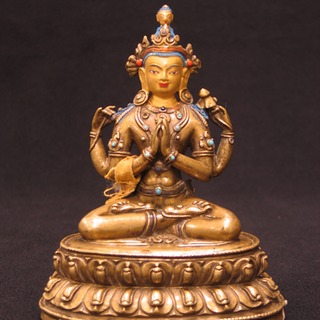
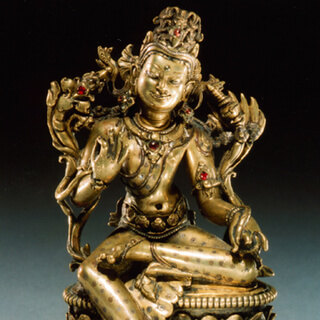
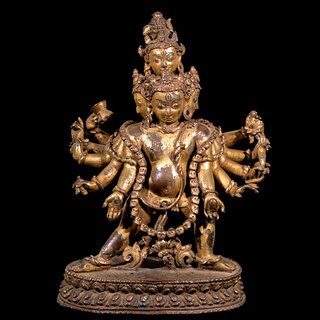
Welcome to the Mindfulness Meditation Podcast presented by the Rubin Museum of Art.
We are a museum in Chelsea,
New York City that connects visitors to the art and ideas of the Himalayas and serves as a space for reflection and personal transformation.
I'm your host,
Tashi Chodron.
Every Thursday,
We present a meditation session inspired by a different artwork from the Rubin Museum's collection and led by a prominent meditation teacher from the New York area.
This podcast is a recording of our weekly in-person practice.
In the description for each episode,
You will find information about the theme for that week's session,
Including an image of the related artwork.
Our Mindfulness Meditation Podcast is presented in partnership with Sharon Salzberg and teachers from the New York Insight Meditation Center,
The Interdependence Project,
And Parabola Magazine,
And supported by the Frederick P.
Lenz Foundation for American Buddhism.
And now,
Please enjoy your practice.
Hello,
Everybody.
Tashi Delek.
Good afternoon.
This is exciting.
So welcome.
Welcome to the Return of Mindfulness Meditation with Rubin Museum of Art.
I am Tashi Chodron,
Himalayan Programs and Communities Ambassador.
I'm so happy to be your host today.
It's a very,
Very special afternoon and so wonderful to see so many familiar faces and many new faces.
I'm kind of curious to know how many of you are members,
If you may raise your hand.
Okay.
And so obviously,
The rest are not members.
Many are not members.
Well,
As a member,
You will get to come to the museum unlimited time all year round.
And to all the meditation,
It is free to the Mindfulness Meditation sessions.
So we are a museum of Himalayan art and ideas in New York City,
And we are so glad to have all of you join us for our weekly program where we combine art and meditation.
Inspired from our collection,
We will take a look at work of art from our collection.
We will hear a brief talk from our teacher,
And we are so fortunate to have our teacher,
Jamgyun Pakcho Rinpoche,
Back to the Rubin Museum.
Rinpoche is on his book tour,
And we are very,
Very fortunate to have Rinpoche.
So then we will have here a brief talk from our teacher,
About 15 to 20 minutes for the meditation guided by Rinpoche.
And now let's look at the art connection for today.
We're continuing on the theme of unity,
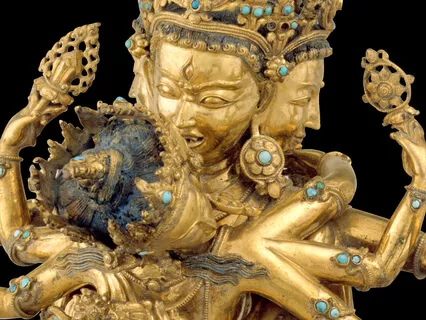
And the art that Rinpoche handpicked is this Guya Samaja.
In Tibetan,
It's known as Sangwa Dupa Iyavyum Guya Samaja with Concert.
So this is from Tibet.
It's a 15th century gilt copper alloy with inlaid semi-precious stones.
It's about 11 and a half to nine and a half inches.
Beautiful sculpture,
And this is up on the gallery in the second floor.
Guya Samaja is one of the main tantric deity,
A yidam,
Meditational deity of esoteric practice,
A manifestation of Buddha Akshobhya,
The unshakable one.
One of the Buddhas of the five families,
The Buddha of the Vajra family,
In fact,
Associated with the east direction,
And it's usually depicted blue in color.
So if you were to look at a thangka,
You would see a blue in color.
According to the blue annals,
It is first taught by Buddha Shakyamuni to King Indrabodhi of Odiana.
Now we'll have a closer look at the sculpture.
As you see the yavyum in union,
Each deity has three heads and six arms.
Their crossed hands are holding a vajra and bell.
Again,
In the colors,
The main face would be dark blue in color,
And the right in white,
And the left in red.
And you see the beautiful ritual emblems that the deities are holding,
The vajra and the bell,
And then the wheel and lotus,
And on the left side,
Second hand is holding the sword.
So all of these are aids to reach the goal,
Which is the awakening or enlightenment,
And the union of wisdom and compassion to reach the awakening,
And sitting on a lotus throne,
Which symbolizes awakening.
And so we normally have a living tradition component,
Where these deities are statues and thangkas that are hundreds of years old.
Even to this day,
It is being revered and prayed to.
But today,
Our living tradition is Rinpoche himself is the living tradition.
So Rinpoche is here for the book tour.
The book is Awakening Dignity,
A Guide to Living a Life of Deep Fulfillment.
And I'd like to introduce Rinpoche now.
Jabja Pakchok Rinpoche is a popular and beloved spiritual teacher who oversees humanitarian projects that include running a free clinic,
Offering education to monastics and providing emergency relief for victims of natural disaster.
Born in 1981 in Kathmandu,
Nepal,
Rinpoche was recognized soon after birth at the early age of one as the seventh Pakchok Rinpoche,
The reincarnation of a great meditation master.
He completed traditional Tibetan Buddhist education at the age of 23,
Completing the Shedra,
Which is equal to PhD,
And has taught Buddhist philosophy,
Theory and practice in centers and universities worldwide.
Thank you so much Rinpoche for your generosity.
Thank you.
Please help me in welcoming Rinpoche.
Welcome all my old friends.
And I'd like to welcome the members of the museum and all of you.
Very nice to see you here.
Today my topic is the beautiful statue.
And of course,
This month's theme is unity.
And I'd like to talk a little bit about what does mean Goya Samajja,
The name.
Goya actually means a secret,
Means all of our nature,
For example,
Your own nature of your body,
Nature of your mind,
Nature of your speech,
Meaning every living being,
No matter how good you are,
No matter how bad you are,
Doesn't matter.
When you have a body and movement,
Speech,
Breathing,
Or mind,
Emotional intelligence,
That living beings nature,
The essence of that is actually inherently pure,
Uncorrupted by our negative actions,
Uncorrupted by external,
Internal,
You know,
Negativities.
So it's completely pure.
And that nature is actually,
When you do something good,
You know,
Like a mindfulness meditation every day,
That inherently quality does not increase.
When you do really bad,
Say you don't do meditation every day and you shout at people,
That nature does not decrease.
It's inherently present,
Uncorrupted,
And uncreated.
That's why we call Goya,
Meaning secret.
Why?
You have it,
But you don't know it.
So imagine that you're living in a really old house,
You know,
Made from 300 years ago,
You know,
Passed by your family members.
And 300 years ago,
Your great-great-great-great-grandma,
You know,
Thought about many generations after,
They need some money needed.
So she kept whole treasure of golds,
Coins,
Hidden in the house for your kids,
Right?
And the people living there,
They're going through trouble,
But they don't know they're living on the treasure.
That is called Goya,
Secret.
You have the treasure within you,
You have the nature is pure within you,
But you don't know it.
That is called secret,
Right?
Now,
Other part of the name is the actually called inclusive.
Goya Samajya,
Samwa Dupa.
Samwa means secret,
Dupa means inclusive,
Meaning everything within.
Now,
How to depict inclusive?
Imagine in art,
When you want to paint something,
Right?
You say it's inclusive.
Now inclusive what?
Right?
This is how you're going to ask.
Mindfulness,
The quality of mindfulness.
Many of in western culture,
You need to achieve mindfulness through meditation,
Isn't it?
Yes or no?
Yes.
In esoteric view,
You don't achieve mindfulness quality through meditation.
You need to recognize the quality of mindfulness within you.
Do you understand now the difference?
Means you don't need empowered.
You already within,
You are empowered already.
You are the empowerment.
Just you need to reconnect it.
That is called inherently,
Meaning inclusive.
Now how to depict the inclusiveness is,
You see,
Is a such a beautiful way of depicting inclusiveness.
For example,
You can see one flower,
You know,
You can see that side of the upper part,
You see the jewel,
The fiery.
This is actually called jewel,
Right?
Jewel meaning like when you wear diamond,
You know,
Nowadays diamond is forever love.
So this showing quality,
What quality they're depicting?
The quality of dignity,
Confident,
Calmness,
Okay?
The quality of,
You know,
When you have aura,
You go out,
You have this very presence aura,
You meet somebody,
You feel you like the person,
And sometimes you meet the person,
You feel a little bit sketchy,
Right?
With,
You know,
Human beings like that,
You know?
So that this shows that inherently we have a fully inclusive quality within in.
We not to achieve the quality,
But we are within is fully quality to depict that.
The Samadhipas holding the male holding jewel in the down there,
The female holding the jewel up there.
Then they both are holding,
You can see the flower,
The here on top the left,
And the man holding the flower.
What does shows the flower?
The flower representing kindness,
Compassion,
A feeling of inclusive to all the beings,
Not just focus on yourself,
But sharing with all beings is representing lotus flower.
It actually means compassion.
So now you think compassion helps you to transform something,
Something,
Compassion,
Right?
But always we think like this,
Compassion,
The quality to achieve something,
That is all of us we think like that.
We need to meditate,
I need to be more compassion,
But we never think that compassion is inherently a nature,
Is a presence within you.
That's why the esoteric Vajrayana tantra says the moral compass,
The ethics,
Moral ethics compass,
You know compass?
To see the right or wrong is not the mind only,
It's actually the nature is the real base of the compass.
And you see the compass,
You have this arrow,
You know,
Have some magnet and the arrow and moving around,
Where's the east and south,
That type of arrow is your intention,
Your mind.
Your mind is that arrow,
But the arrow stays on the compass,
The compass itself is actually the inherently presence,
Compassion,
Inherently presence,
Dignity,
Inherently presence,
The knowledge,
The understanding,
The wisdom is inherent.
So that's why I did not create it,
Your nature or my nature,
Your parents did not create it,
There was no one created,
Buddha did not create it.
He actually said it very clearly,
He Buddha said I did not create your inherent nature because it's a nature.
When it's created it's not nature,
Means you did not receive the nature,
That means you're not going to lose the nature of the dignity,
You understand?
Are you with me?
It's such a powerful,
You can say powerful mantra,
Every morning you wake up you repeat to yourself at least 20 times,
21 times,
Inherently nature is pure,
Sounds very funny,
Very bad,
But actually better than saying I'm very bad,
I'm not worth to anything,
You know what I'm saying?
That is sounds more worse than sounds better than inherently,
You don't need to say I'm better,
That is ego.
My nature is pure because we need to work with ego to reduce our ego,
Increases our dignity,
Reduce judgment,
Increases noticing,
Reduce anger,
Increases compassion,
Is what we practice for.
So just calming the mind,
Have fresh awareness is increasing,
Need to increase.
Confused mind who are distracted all the time need to be reduced,
That's why you need to practice mindfulness,
Right?
But you say I need to do this again,
The answer is no,
You are inherent.
So now you see this beautiful,
You see this husband and wife union,
Now you all picture like this,
Oh it's making love,
That is what actually comes.
Now tell me what is the most easiest to understand unity to you?
When the artist need to draw something about unity,
A feeling of oneness,
What is the best of oneness example?
In the humankind is the husband and wife,
When they're completely fully in a trust,
Love,
You know,
Comfortableness,
When they're oneness in that is the most important inseparable,
That's why in English this is,
That is my half.
Do you understand the expression?
This is my half and this is,
Oh this is my half,
Right?
Now we have one problem to clarify.
The problem is that when you hear a unity,
You look at this,
You can see,
You can have a photo,
Husband and wife holding a hand,
Isn't it?
Why need to be the female,
The leg is crossing and the hand is crossing,
Showing 100% you know togetherness,
Why not just holding a hand?
Because unity means inseparable,
Unity does not mean there are two kinds combining together,
That is not unity,
That is a shake,
Shake,
You know,
Apple shake,
Cocktail,
Mocktail,
You understand?
Mashed potato,
Okay?
So this is something potato and butter and cream and you mix together and it becomes mashed potato and this is mashed potato?
No.
So the unity means quality is inseparable,
It's not separating.
Now again give you one picture,
What they're holding,
You can see the sword,
You see the sword here?
What does it mean holding a sword?
Meaning sword is what is useful for sword,
Cutting things,
Right?
Ripping off,
Meaning opening up.
The sword means what?
Cutting your doubt,
Cutting your own clinging,
Who are completely into it.
We believe ourselves more than our nature,
That's why we struggle so much saying that I'm bad,
But I can say your nature is good.
No,
I don't trust that nature is good,
I am really bad.
You can hear your own voice,
How we are actually deluded into it,
How we create the delusion,
That is how the Goya Samajya tantric,
Esoteric,
To give you depicting of your own nature is inherently pure.
Why they painted gold?
One of the metal,
You know,
Metal,
I'm no scientist but what I know,
The silver,
Copper,
You know,
But the gold when it's pure is the most beautiful metal.
Nothing you can see is completely clean,
Right?
What they show is your inherently nature is like a gold,
It's just very valuable,
It's very clean.
How to show the most beautiful thing that your inherent nature,
We are artists,
This is how they show.
So you think this deity is a kind of somebody's theory?
In Buddha's idea we don't say it's a theory,
We don't say it's a belief,
What we do say is we say it's nature.
When somebody looks at the,
You know,
Painted a forest,
Beautiful forest,
Natural forest,
You know,
Uncorrupted,
Some,
You know,
Designer tried to cut down a tree or make some beautiful French Versailles garden,
It's beautiful French,
You know,
Versailles garden,
It's beautiful,
It's a human made.
You have different,
It's a beauty is there,
But you don't feel the nature.
Where you feel the nature is untouched by human being,
You go there,
You see that the tree is going to make sound,
Vibrations are there,
Animals are alive,
Everything is moving.
It's the nature is more powerful.
That's why in tantric Buddhism says inherently your nature is completely free by creation,
Is inherently nature present,
And that have the quality of cutting your doubt,
Has a quality of compassion,
The quality of dignity is inherently is there,
And mindfulness actually inherently quality.
That's why when you need to work out,
Imagining you already have a million dollar in your house,
You don't need to make it,
How easy that is,
You understand?
You just need to invest it smartly.
Now you don't have million dollar,
You need to work so hard,
You need to work many many years to make million dollar,
Right?
Similarly,
Thinking you inherently nature is pure,
Now you meditate,
Meditation is no need to work so hard,
You just need to presently rest,
Meditation comes easily.
Now you say inherently I'm a bad,
Now you need to meditate means you really need to change 360 degree change.
So that is the big differences of this.
Now I just want to have,
I don't have much time,
But I have two white teary heads,
Right?
Because when you need to understand the nature of all the phenomena,
The Lord our Shakyamuni Buddha mentioned you need to understand three things.
The empty of your self,
Ego,
Empty of ego is number one,
Empty of all the phenomena number two,
And empty of the empty is number three.
How you going to repeat as an artist,
These three things is actually one thing,
But three important qualities to go,
How you going to tell these people?
It shows three heads.
One person by your three heads,
You understand?
Three heads showing empty of ego,
Empty of phenomena,
And empty of empty.
So,
Oh,
All right,
But why need the female need three heads too,
Right?
Why need female just have one head,
One face?
But you see again,
Female have,
In tantric Buddhism the female represent the most important part.
That's why I found out sometimes in America,
They look at certain part of the Buddhist teaching and they say,
Oh,
This Buddhist teachings suppress femaleness or something like that.
I tell them,
Yes,
Certain part,
Yes.
Mahayana part,
Some part,
They are equal,
Same.
They don't care you're a man,
You're a woman,
You're half,
You're gender fluid,
They don't care at all.
They care about mine and you have compassion or not.
But when it comes to tantric Buddhism,
Female goes higher position.
Female holds the key of recognition.
You ever heard about that in Buddhism saying?
Now how you are just looking one part of the Buddhism and judging whole Buddhism,
They're saying you're suppression of female.
I think it's really,
Really,
Sorry to say,
Excuse me,
Is ignorant.
So that's why you can look at here,
The three faces of the female,
Meaning empty of ego,
Empty of phenomena,
Emptiness,
You need recognition,
The wisdom to recognize.
So recognition of selflessness,
The wisdom,
Recognize of all the phenomena is emptiness,
Recognizing.
Phenomena recognizing of emptiness of emptiness,
Meaning yourself not have holding,
Attachment.
Three wisdom needed to realize the three,
You know,
The quality of the emptiness.
That's why the three female have three face,
Telling the student you need to have three wisdom to recognize.
Now you're going to say,
But that means three wisdom separately?
I'm going to say no.
First of all,
All of us,
We went to first class to ten,
Right?
Then we went to what,
Ten to something,
Something,
12,
13,
14,
Right?
You have different name,
I don't know,
I never been to school,
So I don't know.
I don't went to this modern school.
Then we go to college,
Right?
University,
You have three steps.
So you go,
We all went through three steps,
Right?
That means you have three mind?
No.
Person who is rising A,
B,
C,
D,
E,
F,
G person,
After ten years of reading so fast,
Is the same person,
Is a progression.
The same person goes to university,
Oh my,
You become very famous scientist.
The scientist famous one is the same person,
Progress from A,
B,
C,
D,
Singing when the person is six years old,
Isn't it?
It's a progression,
Isn't it?
Exactly.
They give you three face,
Is not separate entity,
Is the progression of understanding.
That's why have a fully inherent equality.
You enlightened,
Mean you can say enlightened,
But enlightened doesn't know what people say,
Oh,
This enlightened means.
Enlightened means uncorrupted,
Uncreated,
Nature,
Always presence,
When you do good,
Does not increases,
When you do bad,
Does not decreases,
You not created,
Meaning nobody can steal from you or rob from you.
And that is inherently dignity,
Inherently nature.
And this Saman Duba statue are showing a unity of understanding and the emptiness itself as inseparable,
But just empty.
And like this nowadays,
Western people says,
Rinpoche,
Meditation,
Mindfulness is blocking the thought.
I said,
Really,
You can block the thought?
I'm really amazed,
You know,
I can't block my thought.
Second,
They say,
Rinpoche,
It's just blank your mind.
Oh,
Wow,
Really?
Blank your mind,
It makes you meditative state,
Means every night when you go to deep sleep for two hours,
Means you're good meditator.
And does it really affect you?
Your body is relaxed,
But your mind is emotional,
Exactly the same.
So why need it?
This just blank your head is okay,
No.
What do you need?
Meditation means you need to have the female,
Three aspect of female,
Recognition,
The awareness.
When you focus your meditation,
You keep the awareness,
In very gentle awareness.
You know,
I remember my grandma,
This is my last one,
Now my time is up.
My grandma,
When she talks to talk to me,
She's a very fierce woman,
You know,
Very tough woman,
I remember,
But she never tough on me,
Because I am the only grandchild,
You know,
So I am the first grandchild,
I'm the luckiest guy.
So she always very gentle to me,
She holds me,
She says my grandchild,
And she gives name,
You know,
My first name,
I'm a born into family who have so many Rinpoches,
Meaning so many spiritual masters.
You know,
My name,
Who give to me the first name is my grandma,
Not the spiritual man who give me the name,
You understand?
That much in our family has so much influence by the female,
But you don't know this,
And everybody read some books,
And judging everybody Buddhist,
This female separation,
I'm sometimes feel my heart pumps goes to 160s,
Because I say,
Please you should know us a little bit,
You know,
One part of the Buddhism we love to praise women,
And women are the most powerful.
In our lineage,
Meaning family line,
When you pray,
Not the man only name is there,
The female name is equally there,
And we chant every day.
And my grandma so fierce,
So strong,
But at the same time,
She's so gentle to me.
So I always remember her as a gentle woman,
Looking at me and teaching me how to chant.
And my first teacher who teach me chanting is my grandma,
And I don't know how to read,
And how I learned,
It's like repeating.
She says,
Om,
I say Om,
Namo,
Namo,
Bhagavati,
Bhagavati,
Aparamita,
I repeat every day like that,
So I learned the long mantra.
That whole long mantra,
I need to breathe it two times,
I learned this from my beautiful grandma,
Right.
So when I look at the statue,
It shows its femaleness,
The recognition is the gentle,
But it's very clear,
And that is the mindfulness,
Quality of mindfulness.
Unity is the most important part,
And inherently quality is the most important part of this,
Our Vajrayana tantric esoteric Buddhism.
And that is the biggest difference from other teachings of the Buddha,
Because this gives you empowerment,
And reminding you don't need empower,
You already inherently,
You are the empowerment.
And this is my unity talk today.
So we do not finish yet,
We need to do mindfulness meditation.
So you can put your hand on your knee,
Like this,
And you can close your eye,
Or you open your eye,
You can choose yourself,
Comfortably,
And first you just be aware,
Your breath,
I think everybody knows,
Then slowly,
Then we just rest.
Just be aware,
Your breath,
Gentle awareness,
Gentle,
Be aware your breath,
Breathe very normally,
Breathe,
Gentle,
Aware,
Gentle,
Aware,
Your breath,
Gentle,
Aware,
To your breath,
Gentle,
Aware,
Your breath.
Thank you.
Thank you so much for that very awakening session,
Rinpoche.
Thank you.