Welcome to the mindfulness meditation podcast presented by the Rubin Museum of Art.
We are a museum in Chelsea,
New York City that connects visitors to the art and ideas of the Himalayas and serves as a space for reflection and personal transformation.
I'm your host,
Dawn Eshelman.
Every Monday we present a meditation session inspired by a different artwork from the Rubin Museum's collection and led by a prominent meditation teacher from the New York area.
This podcast is a recording of our weekly practice currently held virtually.
In the description for each episode,
You will find information about the theme for that week's session,
Including an image of the related artwork.
Our mindfulness meditation podcast is presented in partnership with Sharon Salzberg and teachers from the New York Insight Meditation Center,
The Interdependence Project,
And Parabola Magazine.
And now,
Please enjoy your practice.
Good afternoon,
Everybody.
Welcome.
Welcome to mindfulness meditation online with the Rubin Museum of Art.
My name is Dawn Eshelman.
Great to be here with you on this Monday afternoon.
And for those of you who are new to the Rubin,
We are a museum of Himalayan art and ideas in New York City.
And we're so glad to have you all join us for our weekly program.
This is where we combine art from our collection and meditation online.
I'm so happy to say,
To share that today we have Kate Johnson back with us as our teacher for today.
I will introduce Kate to you in just a moment,
But I wanted to say how happy we are to have her back.
I would love to also just say that the museum is open and our staff is on the ground and taking beautiful care of the folks who come in.
We are really proud of the exhibition Awaken,
A Tibetan Buddhist journey towards enlightenment,
Which explore the steps in the journey of self knowledge,
Transformation from chaos to awakening and everything in between.
So we've really been taking inspiration from that exhibition for what we've been talking about here in this program.
And we pick a theme every month to explore and then select some objects from the exhibition or from our collection to explore together as kind of a framework for going into a meditation together.
Also,
We just last week dropped our final episode for our second podcast,
Which is called Awaken.
And this really takes inspiration from our exhibition about the Tibetan Buddhist journey towards awakening.
That last episode features the fabulous Yungur Minjur Rinpoche,
Who is just really beautiful and incredible on the episode.
So they're all 10 episodes are out now.
You can listen to all of them if you want to binge or just savor them,
Of course.
I hope you will enjoy them.
So let's take a look at the art that we are talking about today.
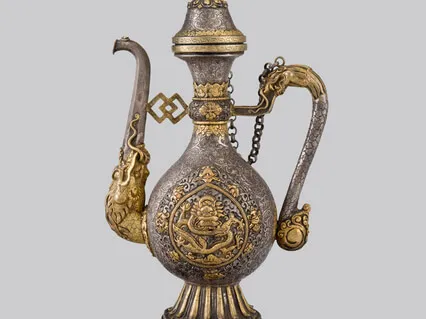
So this beautiful object here is really a ritual object.
And the reason that we are bringing this to you today is because this month we're talking about this idea of offering.
And offerings in the Tibetan Buddhist tradition have a very specific meaning,
Of course.
They're used in ritual by a practitioner to provide many types of offerings.
This is of course a vessel that contains water.
And we saw recently an offering bowl that the water can be poured into.
Today we're looking at this ewer itself.
And this is a ewer that is used to pour liquid during daily offerings,
Also during initiation ceremonies and other rituals.
It could have been part of a monastic setting or a lay household shrine.
It's a great example of this very exquisite silver work here,
Metal work with traditional Tibetan symbols.
And symbolism of course plays a very important part in Buddhist ritual objects and offerings and remind the practitioner of very key teachings.
And here the central kind of decorative motif here in the very center on the belly of the vessel is a dragon surrounded by Buddhism's eight auspicious symbols.
But I also just wanted to point out that the spout emerges from the mouth of a water monster,
Right,
Right here.
And then also up here you see one as well,
The handle.
And of course the etchings are depicting here some lotuses and you also see that kind of lotus base at the very bottom that we often see when we're looking at a sculpture.
Often a figure is seated on a lotus throne or has a lotus base.
And of course the symbolism here is this idea of escaping from the suffering of the world just as the lotus rises up from the mud right at the bottom of a pond.
And the ewer has become associated in China with the Bodhisattva of compassion,
Guanyin,
And it symbolizes purity and healing.
I am delighted to bring on our teacher for today.
Kate Johnson works at the intersections of spiritual practice,
Social action,
And creativity.
She's been a practicing Buddhist and Buddhist meditation in the Western insider Theravada tradition since her early 20s and is empowered to teach through Spirit Rock Meditation Center.
She holds a BFA in dance from the Alvin Ailey School at Fordham University and an MA in performance studies from NYU.
And she's a core faculty member of MIT's Presencing Institute.
She just is about to put out a brand new book called Radical Friendship,
Seven Ways to Love Yourself and Find Your People in an Unjust World.
It comes out August 24th.
You can pre-order it now and you can find out all about it by going to katejohnson.
Com.
Kate,
Welcome.
It's so great to have you.
Hi,
Dawn.
Welcome,
Everybody.
Thanks for taking some time in the middle of your Monday where we are to join us.
And we decided to be talking about both this beautiful ritual object and also this phenomenon,
This activity of offering,
Which is what we'll focus on in our meditation today.
I think of offering as an activity of giving something over to a power greater than ourselves.
Sometimes this is giving over to the natural world.
Sometimes we bring offerings of flowers or other offerings to rivers,
To oceans.
So it can be something like water.
It could be offering to a deity.
Dawn mentioned that the viewer is associated in China with the deity Kuan Yin,
Who's the Bodhisattva of compassion.
Some of you may be familiar with her.
Another name she's known by as she who listens at ease to the sounds of the world.
And sometimes you can see other images of her with her sitting on a rock and with her arm out and her arm resting on her knee.
And there's an ear that is listening.
And it's a way of describing this limitless capacity to be with the reality of our own and others experience and also the readiness to deeply listen before responding.
And the interesting thing about when we offer to,
We're not going to do this specifically in this meditation,
But just thought that I would note that when we are in the practice of offering,
Making offerings to a deity,
Deities like Kuan Yin or other deities,
They actually,
It said that they of course love receiving beautiful objects from us,
Jewels,
Flowers,
Delicious foods.
But that they also love it when we offer them our suffering,
That they actually want to take away the things that are weighing us down.
And so there's when offering in this kind of practice,
There's no shame in offering also something that's been bothering us or something that has been feeling weighty or not ours to carry and asking whether it's the ocean or the sky or the mountain or someone like Kuan Yin to help us hold it.
That's their dream.
That's what they're there for.
So in the meditation practice today,
I would like to play a little bit with the figure of Kuan Yin and engaging that energy of deep listening and wise response,
And also the quality of water that would be filled with this ritual,
Ritual yore,
The water that we would be offering where we were retaking part in a ritual with this object.
And this is also a traditional Buddhist practice,
The practice of meditating on and sitting with the qualities of various elements.
Usually it's earth element,
Air element,
Fire element,
Water element,
And sometimes the element of space as well.
So today we'll be focusing on water and endeavoring to embody the qualities of water as we are with our present moment experience as it's unfolding in a moment to moment way.
And of course,
Water is amazing because it is adaptable,
It is flexible,
It's able to change states.
It's the only element that can change states from a solid to a liquid to a gas.
And so it has this ability to be flexible and to flow and to adapt to whatever container it's in.
Water has this capacity not to hold on to things.
And so there's a lot we can learn actually from water.
So we'll work with that also in our practice today.
So my hope is that this practice will be accessible to you no matter what your normal practice is or if this is one of the first times you're doing a mindfulness practice,
Welcome.
Please feel free to take my instructions and try them on or also adapt it to what feels right for you.
And just remembering at its heart that mindfulness is the experience of attending to what's arising in the present moment and with a quality of love.
And that when we do that,
We start to synchronize our mind and our heart and our body.
It's a natural human capacity.
So don't worry about doing it wrong.
You can't do this wrong.
Let's just say that.
So if you're willing,
Please go ahead and move yourself into a meditation seat that works for you.
I said seat,
But it could also be lying down.
So we want the body to be comfortable and to embody a shape that for us is both alert and relaxed.
So whether you're sitting or standing or lying down,
See if you can first check in with the quality of alertness in the body.
Feel what in the body feels like it's upward moving,
Expanded,
Has energy and attention in it.
I'm sitting right now,
So I'm noticing the length of my spine and the sense of openness in my chest.
And I'm reaching up at the top of my head.
And then also notice what parts of the body feel like they're embodying relaxation,
Softening,
Resting.
I'm noticing it's possible to do both of these at the same time,
Alert and relaxed.
And then before we do any big technique or anything,
Just take a moment to check in with yourself.
How am I in this moment?
How is the body doing right now?
And take a moment to listen to the body.
Never really receive anything that it's telling us in terms of sensation.
And with our attention,
Sending the message to the body that,
Oh,
I care about you.
I care about this body.
And then doing the same thing with the mind,
Checking in how is the mind right now?
What kind of contents are present in the mind,
Textures or moods?
And with our gentle attention,
Carrying the message,
I care about this mind.
And dropping the awareness into the space of the heart,
The seat of our emotion,
What we care about,
What we love,
Sometimes where we are tender.
And as you shine your awareness on the heart,
Checking in with it,
How are you heart today?
Listening with the awareness.
Getting care.
And taking the attitude that this practice can be an offering,
That we're offering to ourselves.
25 minutes to pause in a world that is often going so fast.
And considering what we might be able to offer the world,
Having cultivated some stillness in this way.
So that just as in a ritual,
We're entering into the meditation with some intentionality.
I'll give you some time to practice quietly in a few minutes,
But for now,
Just starting to reflect on the qualities of water by bringing to mind the elements of water that are around you now.
So if you can use your imagination to sense into the water that is flowing through the pipes in whatever building you happen to be in,
If you're inside.
And the different reservoirs of water,
Water pitchers,
Jugs,
Glasses,
Spray bottles,
Toilet basins.
And then expanding your awareness to start to include the bodies of water that may be close by.
Streams,
Creeks,
Rivers,
Ocean,
Lakes,
Ponds,
Puddles.
Bring your awareness to the water vapor that's even in the air that we breathe.
And sensing into the qualities of that water,
Some of it rushing and powerful,
Some of it still and smooth.
With the mind resting on water element,
Water element,
Water element.
And bring your awareness too to the water element as it exists inside the body.
Sensing into the streams and the rivers and the tributaries of our own circulatory system.
Even though we're sitting or laying or standing still,
So much fluid and movement happening on that fluid inside the body,
The heart pumping,
The lymphatic system flowing,
Adapting,
Shifting,
Some rushing powerfully,
Some still and calm.
And start to allow your awareness of the water element outside the body and the water element inside the body to mingle.
Really tapping into the felt sense that this is the same element,
Water element.
And allow yourself to really soak in those qualities of water.
And to embody them so the body starts to feel fluid and flexible to whatever degree that's possible.
And the mind also starts to have a quality of fluidity and flexibility and flow.
And we'll take this quality into relationship with an anchor of your choice.
Some people like to use the breath.
Others prefer to use the sensations of the hands resting.
Others like to use sound.
And see if you can find one anchor in your present moment experience,
A sensory anchor that you can allow the mind to rest in.
And notice that your experience of this anchor includes a coming and going of sensation or vibration.
So as we attend to the anchor today,
I'll ask you to attend to it in terms of its flow.
Whether it's the flowing in and out of breath.
Or the flowing shifting sensations of pressure and temperature and pulsing in the hands.
Or the flow of sound in silence.
Letting your awareness rest.
And allowing the mind to flow with the changing nature of your experience.
.
.
.
.
.
.
.
.
.
.
.
.
.
.
.
.
.
.
.
.
.
.
.
.
.
.
.
.
.
.
Down the river.
Wanting it flow out in the river,
Your experience.
You you you you you you you you you you you you you And as we start to move towards the end of our practice,
Take a moment to reflect on if there's something in your heart,
In your experience that you would like to offer.
Perhaps an expression of your love,
Your gratitude,
Good fortune,
Or it could be an offering of something that feels too heavy to carry now.
Or a big question that you don't know the answer to.
Imagine having this offering in your hands and then see if there is some kind of power that comes to mind that might be capable of holding this.
Or want to receive it.
It could be the earth,
It could be the ocean,
It could be a deity like Kuan Yin,
It could be the power of awareness or love in all human hearts.
Or just imagine yourself as a person of this.
If it's possible to imagine,
See if you can imagine yourself delivering that offering.
Extending whatever is in your hands towards this power or this being.
Seeing them receive it.
Notice how it feels to have offered.
Just resting for a moment in that space.
Taking a few deeper breaths to sort of transition the body,
Bring fresh energy in and letting go of anything that you might not be able to do.
Just sort of to transition the body,
Bring fresh energy in and letting go of anything that is still tense or unneeded.
And in a moment I'll ring the bell to close the practice.
Thank you so much for joining us today.
Thank you.
Thank you so much,
Kate.
Thank you.
That concludes this week's practice.
If you'd like to support the Rubin and this meditation series,
We invite you to become a member.
If you're looking for more inspiring content,
Please check out our new podcast Awaken,
Hosted by Laurie Anderson.
The 10-part series features personal stories that explore the dynamic path to enlightenment and what it means to wake up.
Now available wherever you listen to podcasts.
Thank you for listening and thank you for practicing with us.