Welcome to the Mindfulness Meditation Podcast presented by the Rubin Museum of Art.
We are a museum in Chelsea,
New York City that connects visitors to the art and ideas of the Himalayas and serves as a space for reflection and personal transformation.
I'm your host,
Tashi Chodron.
Every Thursday,
We present a meditation session inspired by a different artwork from the Rubin Museum's collection and led by a prominent meditation teacher from the New York area.
This podcast is a recording of our weekly in-person practice.
In the description for each episode,
You will find information about the theme for that week's session,
Including an image of the related artwork.
Our Mindfulness Meditation Podcast is presented in partnership with Sharon Salzberg and teachers from the New York Insight Meditation Center,
The Interdependence Project and Parabola magazine and supported by the Frederick P.
Lenz Foundation for American Buddhism.
And now,
Please enjoy your practice.
Good afternoon,
Everyone and Tashi Delek.
Welcome to Mindfulness Meditation at the Rubin Museum of Art.
I am Tashi Chodron,
Himalayan Programs and Communities Ambassador,
And I'm so happy to be your host today.
We are a global hub for Himalayan art with a home base in New York City,
And we're so glad to have all of you join us for our weekly program where we combine art and meditation.
Guided by our collection,
We will first take a look at work of art.
We will then hear a brief talk from our teacher,
John Aaron,
And then we will have a short sit,
15 to 20 minutes,
For the meditation guided by him.
Let's take a look at today's theme and artwork.
The theme this month,
We've been exploring on the theme of liberation,
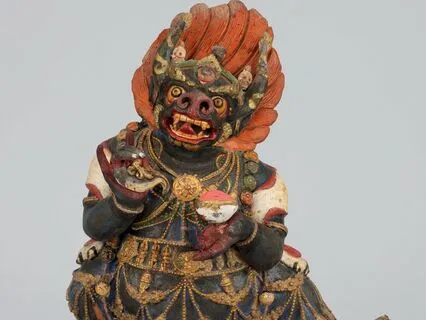
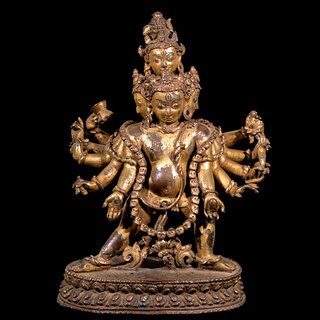
And the art connection for today's session is this beautiful sculpture of Vajra Bhairava,
Known as Dorje Jigye Ma in Tibetan,
Adamant terrifier,
Origin Mongolia,
Dated 19th century,
About 13 x 10 x 7 inches,
Clay and mineral pigment sculpture.
The connection to the theme,
Vajra Bhairava is meditational deity against the force of death who helps us to overcome suffering and leads us on the road to liberation.
Vajra Bhairava is a fierce,
Wrathful form of Manjushri and functions as a yidam,
A meditational deity.
The practice of Vajra Bhairava is common to the three main Serma schools of Tibetan Buddhism,
Sakya,
Gajju,
And Gelug.
He is sometimes called Yamantaka or the defeater of death,
A deity that ends the cycle of rebirth and provides a path to nirvana.
He frightens away egotism and selfishness,
The root of suffering,
And in this true form reveals the awesome and terrifying nature of enlightenment.
Vajra Bhairava is depicted with the head of a buffalo.
This is topped by the head of Manjushri signifying Vajra Bhairava's true nature.
He is in a warrior pose holding a carved knife and this is Vajra Bhairava,
Dorje Jigyema.
Now let's bring on our teacher for today.
Our teacher is John Aaron.
John Aaron is well known as a teacher of Mindfulness-Based Stress Reduction,
MBSR,
As well as a trainer of new teachers of this seminal 8-week curriculum.
Among his primary interests are the use of meditation and somatic work in healing trauma and working with individuals with chronic pain and grief.
When the pandemic hit,
Along with his partner,
He co-founded Space to Meditate,
An online community of meditators that is still going strong six days a week.
John,
Thank you so much for being here.
Please help me in welcoming John Aaron.
I love these wrathful deities and bodhisattvas.
I actually trained much more in the earlier tradition,
So we didn't get to play with them as much,
But they're great.
And I wanted to.
.
.
So this theme of liberation,
This theme of freedom,
This theme of awakening,
Really,
Or extinguishing.
So this word nirvana is really extinguish.
So we are freeing ourselves from greed,
Hatred,
And delusion,
Or we're extinguishing those qualities of greed,
Hatred,
And delusion.
And I wanted to read a sutta from the early tradition,
Or an excerpt from the sutta,
Which is kind of relevant to where we are now in the world,
But also relevant to each of us individually.
And it uses kind of some pretty powerful imagery.
As is often the case,
There are lots of similes and metaphors within the early teachings,
And this one has a few of them.
And the sutta is actually called,
It's the Atta Danda Sutta,
Which is arming oneself.
And I don't really need to say much about it,
But I will read it and then have a few more words and then guide us into practice.
So this is a wonderful translation by Andy Olenski,
A good friend and one of the founding teacher of the Berry Center for Buddhist Studies.
And this is the sutta.
Fear is born from arming oneself.
Just see how many people fight.
I'll tell you about the dreadful fear that caused me to shake all over.
Seeing creatures flopping around like fish in water too shallow,
So hostile to one another.
Seeing this,
I became afraid.
This world completely lacks essence.
It trembles in all directions.
I long to find myself a place unscathed,
But I could not see it.
Seeing people locked in conflict,
I became completely distraught.
But then,
But then,
I discerned here a thorn,
Hard to see,
Lodged deep in the heart.
It's only when pierced by this thorn that one runs in all directions.
So if that thorn is taken out,
One does not run and settles down.
Who here has crossed over desires,
The world's bond,
So hard to get past?
One does not grieve.
One does not mourn.
One's stream is cut.
One is all unbound.
What went before,
Let go of that.
All that's to come,
Have none of it.
Don't hold on to what's in between,
And you'll wander fully in peace.
So that last stanza that I read is really about being in the present moment,
Of course,
Letting go of the future,
Letting go of the past,
Actually letting go of what's in between.
Because the moment is always,
Our experience is continually unfolding,
And our experience is deeply impacted by whatever thorns we have lodged in our hearts.
And so our practice is,
Among other things,
Seeing those thorns and realizing that we can actually remove them.
As we see what those thorns are a result of,
Which is generally greed,
Hatred or delusion on one level or another.
And we certainly see that,
Unfortunately,
On a societal level.
And it starts with us.
So as we bring these practices into our lives,
Every moment we have an opportunity to be free of those thorns.
Which isn't to say they don't come back for most of us,
Right,
Unless we are fully awakened.
But at least for a moment in practice,
In formal practice,
Or even just in our days,
We can recognize when those thorns are removed.
And in those moments that the thorns are removed,
What's left?
What's left is love and compassion.
That's what arises.
And the sense of me and mine falls away.
And that's a moment of liberation,
A moment of freedom.
And so we can discover that in formal practice,
But we can also start to discover it throughout our daily lives.
I forget which teacher said it fairly recently,
I mean,
In the last 50 years,
The statement was,
I mean,
As opposed to 2,
500 years,
The statement was,
Enlightenment,
Awakening is an accident.
Meditation makes you more accident prone.
So we sort of fall into it,
You know,
We have this,
We have this notion that we have to like find it somewhere,
But it's all here.
You know,
Our practice is just to sort of remove the boundaries that are in the way.
So let's practice.
Settling into your seat,
Settling into this body,
Sitting here,
Breathing,
Receiving each breath as the gift that it is,
A gift of life,
A gift of energy and opportunity and a reminder to be fully present just now.
We never know when this last breath will be,
So let's make the most of it.
And just for now,
Just for now,
See if you can put down,
Put down whatever may be weighing you down,
Just put it aside.
Sometimes what we need to put down is just the notion that I need to do,
Or I am this.
If I don't do this,
I won't be that.
So as the teaching was saying,
What went before,
Let go of that.
All that's to come,
Have none of it.
Don't hold on to what's in between.
Simply be with this moment of experience,
Whatever this moment holds,
Arising and fading away,
Giving yourself permission simply to be without needing to become anyone.
Simply when the mind finds itself into habitual thinking,
Which happens,
The moment that's known,
The moment that's known is a moment of clarity,
Is a moment of mindfulness.
And we simply come back to this breath,
To this body,
Sitting here,
These sounds,
These sensations,
These thoughts coming and going.
Each in-breath a reminder to wake up to this moment,
To what's here just now,
What experience is unfolding,
What are you holding on to,
What can be let go of.
With each breath softening the heart that much more on the out-breath,
As we soften the heart,
Those thorns can more easily fall out.
We can turn toward that which is more difficult with an open-hearted,
Kindly curiosity.
Just for the last few minutes of this meditation,
As the mind perhaps has found its way into stillness and the heart has opened,
With each out-breath just imagining love and compassion extending outward,
Radiating outward in all directions,
Embracing yourself and all beings,
Just opening to that potential.
Thank you for your practice.
Thank you so much for that,
John.
That concludes this week's practice.
To support the Rubin and this meditation series,
We invite you to become a member at rubinmuseum.
Org and to stay up to date with the Rubin Museum's virtual and in-person offerings,
Sign up for a monthly newsletter at rubinmuseum.
Org.
I am Tashi Chodron.
Thank you so much for listening.
Have a mindful day.