Welcome to the Mindfulness Meditation Podcast.
I'm your host,
Dawn Eshelman.
Every Wednesday at the Rubin Museum of Art in Chelsea,
We present a meditation session led by a prominent meditation teacher from the New York area.
This podcast is a recording of our Regroup practice.
If you would like to join us in person,
Please visit our website at RubinMuseum.
Org.
We are proud to be partnering with Sharon Salzberg and the teachers from the Nicturin Pundits Project.
In the description for each episode,
You will find information about the theme for that week's session,
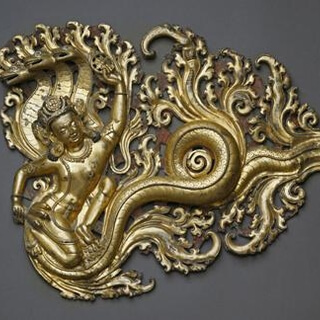
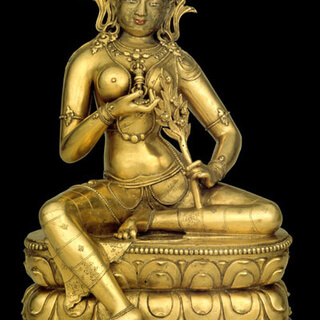
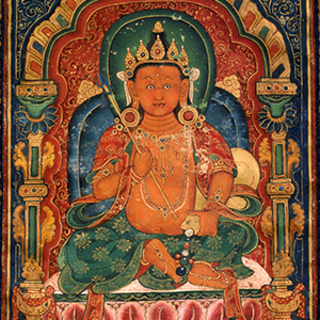
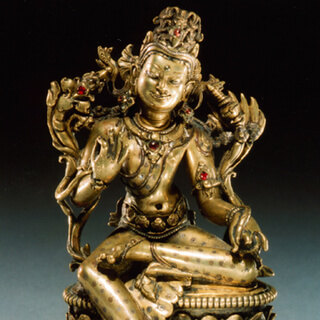
Including an image of a related artwork chosen from the Rubin Museum's permanent collection.
And now,
Please enjoy your practice.
Ethan Nicturin is our teacher today.
He is a senior teacher in the Shambhala Buddhist tradition.
He's taught meditation and also Buddhist psychology classes and workshops for over 14 years.
He founded the Interdependence Project,
Our partner for today,
And that is a nonprofit organization dedicated to secular Buddhist practice and transformational activism in arts.
He is the author of the acclaimed book,
The Road Home,
A contemporary exploration of the Buddhist path,
Which was recently selected as one of Library Journal's best books of 2015 and one of Tech Insider's nine books that define 2015.
Please welcome Ethan Nicturin.
I don't think I've ever seen this many people together to meditate Wednesday at lunchtime.
Thank you all for coming.
I know some of you have been here before.
I was here a couple weeks ago.
Thank you so much,
Dawn.
Great to be back.
So the last time that I was here wandering the galleries,
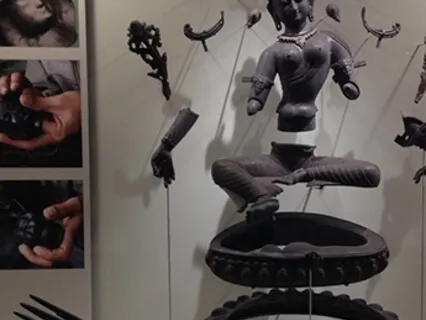
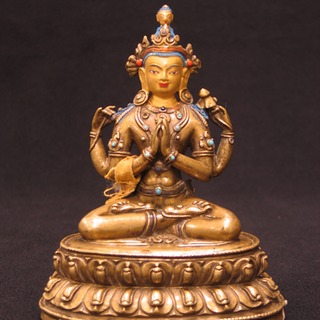
I came upon this process that's illustrated behind that Dawn was talking about of creating a green Tara statue.
And so this sort of crystallized in my mind the idea of talking and then guiding a meditation regarding compassion,
Which is what Tara represents,
Creative process in relationship to compassion and also bringing something to fruition,
Some act that's of benefit in the world,
Which is really from a Buddhist standpoint is what the creative process is all about.
Bringing something into being that's helpful,
That expresses something that actually brings insight or clarity or compassion further into the world.
So a little bit about Tara.
How many of you are familiar with the term Bodhisattva?
So there's two terms that sort of mean different things.
Bodhisattva means awakening being.
It's in a kind of archetype.
In the Tibetan system,
There's also a Tibetan word yidam,
Y-I-D-A-M,
Which often gets translated as deity,
Which is always interesting because Buddhism,
The founder of my tradition,
Insisted that Buddhism is a non theistic tradition.
So I do like to use more of a kind of Jungian language of archetype that Tara is a feminine embodiment of compassion.
That's what Tara represents and Avalokiteshvara is the masculine form of that.
So there's in the tantric or Tibetan or Himalayan system often an archetype will be depicted in different situations,
Embodying different personality energies,
Different emotions.
The two most common practices and manifestations of Tara that one might practice,
There's different colors of light emanating from her body.
So one is often called white Tara,
Which does not mean Caucasian Tara.
It means the kind of the quality of light energy and emotional energy that that represents and green Tara.
And so while white Tara represents healing and nurturing energy,
Green Tara,
As you can see,
Because it looks like she's actually already about to get off of her seat and go do something with her right leg extended,
Represents the aspect of compassion that's actually about to create something or express something or achieve something in the world to get it done,
So to speak.
And green has has this almost archetypal color.
It's the statue is not green.
But if you ever see a Tonka painting,
The colors become much more pronounced.
Green as a as a color has a sense of life growth,
Springtime activity,
Things springing and popping into being rather than just being ideas.
So I'm personally really interested in a Buddhist take on the creative process.
And as a writer,
And as somebody who works a lot and has many friends who are in just living in New York,
It's kind of hard not to have friends who are in one of the formal creative fields.
And also,
I think even if we don't consider ourselves a creative person,
We're always in the process of creating in some entrepreneurial,
You know,
Even if you just made a reservation.
In a sense,
You're still bringing something into being right.
So I think we need to take a really broad sense of what creativity means.
But a lot of times I think creative action in our world doesn't always have a sense of grounding in intention.
Right.
So the intention here.
And this is something that the founder of my tradition,
Chogyam Trungpa said,
He said the purpose of any work of art is compassionate activity.
And I always think about this,
Like how would this transform the New York art world if every artist statement had to start with here is how my piece or here's how this show or here's how this book or here's how this poem or here's how this cake is an expression of compassionate activity.
And one is going to be in a creative process from a Buddhist standpoint,
We need to develop an intention to be both loving and compassionate towards ourselves and also loving and compassionate towards others.
And I think what the archetypes of a bodhisattva represent and why they're so prevalent in so many stories and in a sense,
This is just the ancient Himalayan version of a superhero.
Right.
This is Wonder Woman.
This is Batman.
This is who's who's the new the new Jedi Ray.
We have these same narratives of looking to somebody who embodies the qualities that we are trying to embody in the world in a kind of heroic way.
So I think this is the other part of using an archetype,
Which is sort of an idealized form of what's also talked about in Buddhist thought,
A benefactor.
The idea that your own work in the world has the support of beings who are always there to support you as soon as you can touch into your compassionate intention.
So there's this real sense of Tara as an archetype that we could actually call upon to say,
Please help me fulfill compassionate activity in the world.
And we could call upon other people in our lineage.
We could call upon heroes of any creative process.
I'm just going to ask you before we start meditating people if if you don't feel shy and I hope you don't.
And if you do,
That's fine,
Too.
Just throw out some creative heroes.
Your Tara or Avalokiteshvara of some creative process.
So I mentioned in my book getting my first poetry lesson when I was nine from Allen Ginsberg.
So that's who I'll throw into the Katie Lang.
Thank you.
Frida Kahlo,
Mary Oliver,
Martha Graham.
Awesome.
Rilka.
OK.
Indigo Girls.
Agnes Martin,
Bill T.
Jones.
In the back.
I see a hand.
Alex Caldwell.
OK,
Great.
Awesome.
So these are all kind of the thing about there's one other thing to mention and why sometimes it's good to use our human benefactors and sometimes it's good to use an archetype.
I have a friend,
Dr.
Miles Neal,
And the way he thinks about the archetype or the Bodhisattva is they're meant to map our human heroes sort of best qualities.
And in different compassion and visualization meditations in the Buddhist tradition,
What Tara allows is Tara has never disappointed us because she's not a real person.
Whereas if you met Katie Lang or Mary Oliver,
You might say,
I love your work,
But there's this one part of you.
Or if you spent time with me or even if you met Pema Chodron,
You know,
If you had to spend a week with Pema Chodron.
Right.
You might be like,
Oh,
Pema,
You got annoyed there.
I guarantee that would happen if you spend a week with me.
Ask Kim,
Who's the current director of the Interdependence Projects,
Who's with us today.
So the archetype almost allows this idealized or safe filter to see the best qualities in our human benefactors.
And I think it's really important in the creative process,
One,
As I've said,
To generate compassion and intention,
But also to feel like you are not reinventing the wheel of compassionate intention or of creative inspiration.
It's almost like our consciousness.
It's so quick to go negative that we need a kind of like a pillar to hold up the room and having heroes and archetypes and remembering them and allowing them to support our path in life is super important.
And also having a positive relationship to one's lineage.
Right.
That it would be really hard to be a writer if my belief was every writer who's come before me was an idiot.
Because then whose whose shoulders would I be standing on?
It would be like me against history.
Right.
And this is of the benefactor and the archetypes of Bodhisattvas are a way of feeling like our history actually has our back.
Which is,
I think,
A much more not that it's perfect,
But that it has our back.
And that's a much more confident or empowered way to go into the world and say,
I'm going to actually work on something.
I'm going to achieve something for the benefit of myself and others.
So that's all I wanted to say to lay the framework.
So what we're going to do as our 20 minute guided meditation today is first work with a brief period of mindfulness of body.
And then we're going to do a form of loving kindness or compassion meditation that takes into account this notion of a creative benefactor.
That's giving us the inspiration to gain confidence in our own creativity and then thinking about what our own creative aspiration is.
So please take a comfortable seat.
Some of us when we're doing mindfulness of body meditation like to practice with our eyes open.
Downward cast,
Some with our eyes closed.
I think both can be helpful.
But for now,
Since we only have a short time,
Please do what makes you comfortable,
What allows you to arrive in your own body in this space.
You can take a moment to remind yourself where you are,
Just to really release whatever happened this morning.
And to not be jumping the gun and going forward into whatever you have to do this afternoon,
But to just really be here.
And then we can come into our body sitting comfortably,
Grounded,
Alert,
But relaxed.
Before we go into the loving kindness meditation,
We'll just begin to settle into the body breathing.
Just one moment at a time,
See if you can actually take solace in just feeling your breath.
You don't have to do anything else.
And if your mind wanders,
You certainly don't have to judge that.
You can just come back to all I have to do is feel my body breathing easefully in and out whenever I can connect.
We'll do that for about five minutes in silence,
Working with the breath.
Okay.
Okay.
Okay.
Okay.
Okay.
Okay.
Okay.
Okay.
Okay.
Okay.
Okay.
Okay.
Okay.
Okay.
Okay.
Okay.
Okay.
Okay.
Okay.
Okay.
Okay.
Okay.
Okay.
So we'll transition based on this grounding in our body to the more contemplative or imaginative space of this meditation on creativity and compassion.
So first,
I'd invite you to bring to mind a creative endeavor in your own life,
And it could be something you haven't even started,
Like that raw lump of material.
It could be something that's in the midst of process.
It could be something that's close to the precision of completion.
It could be something you just want to take a lesson in.
Just bring to mind a specific creative endeavor for yourself.
Okay.
And then you have two choices with benefactor.
You either bring to mind a hero who represents your support,
Your pillar in working on this endeavor.
Or if you can't think of someone,
You could use a bodhisattva like Tara,
Loving,
Compassionate,
Fearless in action,
Have an image of her in your mind.
But if you can think of an actual human who represents the benefactor of this creative inspiration,
Please bring them to mind.
And as you get a sense of them in front of you,
If you just imagine that they are wishing you happiness,
Fulfillment,
And if you want a phrase to contemplate,
You could imagine that they are saying to you,
May your aspirations be fulfilled.
And the benefactor is saying to you,
May your aspirations be fulfilled and supporting you in that.
Okay.
And now perhaps with the confidence in the support of your benefactor,
You could start to make this wish for yourself.
May my aspirations be fulfilled.
So the benefactor or Tara is still there.
But you're really generating your own intention now.
May my aspirations be fulfilled.
And perhaps specific next steps come to mind as Tara's right leg is almost stepping forward into action.
You could contemplate after this practice,
Is there a specific simple thing you could do to step into fearless action?
Okay.
Okay.
For a few moments to close,
We can just let this contemplation dissolve,
Come back to your body,
Resettle,
Restabilize in your seat with your breath,
Letting whatever insights or experiences arose just come back to the earth of being right here right now,
Feeling your body breathing.
When we close our meditation,
It's nice to acknowledge the discipline and bravery of making time to work with our own state of mind.
So this just could be a mental moment of self-appreciation,
Appreciation as well for your fellow practitioners and some practitioners to make this acknowledgement a physical gesture,
Close with a bow of appreciation.
So if that feels organic to your practice,
Please feel free when the gong rings,
But otherwise just a moment of appreciating your own effort to be here and appreciating the others who have made similar efforts.
Thank you all.
That concludes this week's practice.
If you'd like to attend in person,
Please check out our website,
Rubinmuseum.
Org slash meditation to learn more.
Sessions are free to Rubin Museum members,
Just one of the many benefits of membership.
Thank you for listening.
Have a mindful day.