Welcome.
Good to be with you.
I find myself mourning the loss of a number of profound spiritual teachers in my life over the last month.
And this week is no different.
I want to take a moment to honor the teaching,
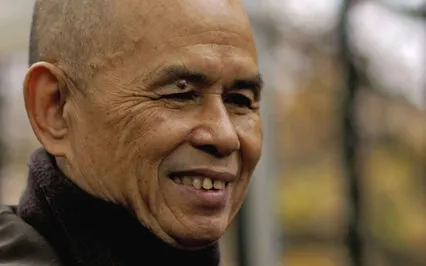
The legacy of Thich Nhat Hanh,
Who passed at the age of 95 yesterday.
Thich Nhat Hanh,
Zen master,
Spiritual leader,
Spiritual activist,
Poet,
Peace warrior.
He was many things.
One of the gifts of his teaching for me is its profound simplicity.
Honoring the Zen tradition of cutting through to the core of the Buddhist teaching.
Thich Nhat Hanh had a way of making spiritual teaching come alive in very few words,
In very simple practices.
One of the quotes I want to reflect on today is the quote,
Sometimes your joy is the source of your smile,
But sometimes your smile can be the source of your joy.
Thich Nhat Hanh's practice was full of happiness,
Joy.
He taught smiling meditation.
He spoke of walking meditation as your feet kissing the earth with every step.
His practice was full of heartfulness,
Presence,
Compassion,
Equanimity,
Joy.
I've sometimes struggled with these things so I've needed teachers to bring me back to the core.
And Thich Nhat Hanh has been one of those teachers.
In a talk that he gave in 2011,
Call Your Cows by Their True Names,
You can find excerpts of it online.
Thich Nhat Hanh is teaching a bit about generating happiness and joy,
Cultivating happiness and joy.
And he offers three things.
One is that mindfulness is a pathway to generating happiness and joy.
That mindfulness,
Calling the mind into the body in the present moment,
Allowing the mind to become present here,
Now,
Connected in this body with this heart,
Is a pathway to joy.
That in the present moment we can experience joy unclouded by the grievances of the past or the worries of the future.
I think particularly when it comes to leadership,
And Thich Nhat Hanh speaks a bit about this in the Dharma talk,
When it comes to leadership in the working world,
We are often reviewing the past and planning for the future.
And so it can keep us trapped outside of the present moment to become overly habituated to those practices and habits of mind,
Reviewing the past,
Planning for the future.
We can get stuck in never enough thinking by getting attached to the future.
What will we make?
What will we succeed in?
What will we get in the future?
We can become stuck in the losses,
The resentments of the past.
Why wasn't it different?
Self pity,
Self condemnation.
So mindfulness being a gateway to joy makes a lot of sense.
That in the present here and now,
Connecting to my senses,
What do I see?
What do I hear?
What do I sense through my body,
Through touch?
Connecting to the senses available to me,
Where can I find joy?
In the present moment,
Unclouded by the ghosts of the past,
Or the phantoms and illusions of the future,
I might be able to practice celebrating the joys of what is here and now.
As I look around my space,
I see the beauty of the color of the wall.
I feel the gift of my body resting in a chair,
That subtle sensation,
Relaxation,
Presence,
Connection to this moment.
These small joys can conjure something that can grow.
If I greet these small joys with mindfulness and a smile,
They expand,
They become generative,
Right?
Wow.
Smiling at the beauty of the color of the wall,
My eyes being able to process it and celebrate it,
That smile is the source of more joy.
So this mindfulness where it meets concentration,
How and where am I placing my attention,
Becomes the gateway to joy.
So mindfulness,
Arriving,
Present,
Mind,
Heart,
Concentration,
Where am I placing my attention?
And then the third piece that Thich Nhat Hanh describes is releasing,
Letting go.
In the releasing,
In the letting go,
What are the obstacles to being present?
What are the obstacles to choosing my attention?
For me,
It might be a thought that this isn't enough.
It might be a habit of wanting or craving more or something different.
It might be stuff,
Right?
Looking at the wall,
Yeah,
That's a beautiful color,
But wow,
The paint is beginning to chip over there and it's imperfect and what should I do about that?
And is my house falling down,
Right?
I can get into a materialistic perfectionism.
So letting go becomes another piece of the practice of generating more joy and happiness.
And that letting go for me is one of the hardest parts.
It's also the surest thing when I cannot let go that will take me out of mindfulness and concentration.
So Thich Nhat Hanh is a great teacher in this regard.
I encourage you to explore his teachings,
To think about how this idea of presence,
This idea of where we place our attention,
This idea of what are the things that we need to let go of so that we may generate more happiness and joy.
How does that apply to your leadership?
How does that actually become essential to your leadership for social change?
And we'll practice a little bit today with a smile meditation.
I encourage you to bring this practice sort of off the cushion outside of this recording into your life in the ways that you can.
I find that it is very simple and often quite profound.
This practice can be done in a number of different ways.
So I encourage you to find a posture or place that works for you to practice today.
Walking meditation may be of interest.
Perhaps even finding yourself a mirror and an ability to look at yourself with this practice can be powerful.
Sometimes that is the next level of this practice if you're just beginning with smile meditation.
So in these few moments I encourage you to find a posture that supports you.
Sitting down,
Lying down,
Standing up,
Walking.
You may choose to close your eyes or you may choose to keep them open,
Particularly if you've found a spot where you can see a reflection of yourself.
Keeping your eyes open may be in service to you today.
Keeping your eyes open to sense into the information that they give you,
The light,
The color,
Or something else.
As we arrive into the practice I encourage you to do what you need to do to settle the body,
To arrive into the present moment.
Maybe breath,
Maybe rooting and feeling the stability of the earth beneath you.
Your body connected through your feet,
Your feet as if they are kissing the earth.
Your body connected through your sit bones or the backside of your body.
This contact being joyful.
And as you settle in more fully,
I invite you to bring your awareness to your face,
Softening any tension that might be felt in the brow,
The cheekbones,
The jaw,
And allowing yourself to smile.
Could be a gentle inward smile or a big bold smile that all can see.
As you smile,
Notice the sensations that that smile offers you.
The physical sensations,
The energy,
The movement,
The release,
Maybe the contraction.
Notice the emotions that come with that smile.
Not needing to fix or control them,
Simply allowing them to come,
Maybe to go,
Maybe to return.
Noticing the varied kinds of emotions that might come with that smile.
It may be hard to maintain a smile.
Maybe you feel your cheeks quivering or sense of stress.
Release the smile and begin again,
Moving in and out of this idea of smiling,
This practice right here,
Right now.
Like we bring our attention to the in-breath and the out-breath.
Perhaps today the meditation brings your attention to the smile and the release,
The smile and the release.
You stay with this practice in the smile,
In the release of noticing the physical sensations,
Noticing the emotions that rise and fall.
Perhaps noticing the thoughts that come and go.
In this noticing,
Remembering that we can simply return back to the practice of the smile and the release.
Remember the smile and the release.
Not moving too quickly,
Allowing yourself to really sense in to a smile.
All of the different qualities of a smile,
The conditions that support smiling,
The states of mind that become obstacles to smiling.
How might you imbue this practice with a gentleness,
Compassion,
Loving kindness?
Not moving into rote muscle movement,
Allowing yourself to offer a smile as a gift to life itself.
The possibility of reverence,
Generative,
Appreciative joy that grows when our smile has the gift of present mind and heart.
When our smile is offered without grasping for control or grasping for results.
It is natural that when we practice with this,
Difficult emotions might arise.
Fear,
Grief,
Longing.
If these emotions are arising for you or thoughts associated with these emotions,
Pay attention to what the body is speaking.
Allow yourself,
If it feels possible,
To meet those emotions with a gentle smile of compassion.
How does your smile become a sincere reflection of your witness to the beauty and joy of life that exists alongside,
Right next to,
Mixed up and in between the difficulty and the suffering that we experience in life?
Inviting yourself to be with this practice slowly,
Gently,
Mindfully aware of how much to stretch and perhaps when to dial back.
As we conclude,
Invite a smile.
A sincere,
Mindful smile.
No matter how subtle or how big,
Bold.
How might you practice the art of smiling as a way of connecting into the physical sensations of the moment,
The emotional realities of the moment,
The thoughts that may become hindrances or supports in the moment?
Sometimes your joy is the source of your smile,
But sometimes your smile can be the source of your joy.
Thank you,
Thich Nhat Hanh,
For being our teacher.
As we conclude,
I encourage you to place your hand on your heart or give yourself a gentle hug,
Being compassionate and aware of any tenderness that has come up in this practice for you.
Remembering mindful presence,
Allowing yourself not to have to fix or change or make meaning too quickly of anything.
Smile,
Breathe,
Breathe,
Smile.
And when the smile feels too difficult,
Breathe.
Allowing yourself to be here.
And if even the breath feels too difficult,
Feel your feet on the ground.
Feel your body kissing the earth.
Walk or simply feel into the contact,
The support of the here and now.
Thank you all for practicing with me.
I appreciate you.
Till next time.