Hello and welcome.
The following is a guided meditation by René Sills,
A somatic movement educator,
Energy worker and astrologer.
This meditation is intended to help support your embodied meditation practice.
If in the recording you are prompted to do something that doesn't feel good for your body,
Please adapt and modify to make it work for you.
Please also note that the content of these meditations sometimes explores deep and subtle states and memories,
And sometimes guided visualizations.
You are encouraged to work with discernment as you practice with them.
If any of the guidance René offers feels too activating or uncomfortable,
Please listen to your body's knowing and pause the recording until a later time if you wish to return to it.
These guided meditations range anywhere from 20 to 40 minutes and do not require any supplementary equipment to participate.
We hope you enjoy.
Hi everyone.
This is René and I'm here to offer a guided meditation.
Today I want to talk a little bit about some of my inspiration for these somatic meditations or these body centered meditations.
Many of you know that I make them in accordance with the new moon and the full moon and I am inspired by astrology.
Astrology is a language.
Yeah,
It's a language.
It is a language that's based on observation of light and the effect of light upon the earth,
Our bodies,
Our moods,
Our mindsets.
It's also a language that is deeply symbolic and intuitive and creative that draws upon mythology and archetype and kind of the essence of our qualities as human beings,
The ways that we can all relate to one another through shared instinct and experience.
The astrological language is not science.
It kind of lives in the in between space,
The intersection between science,
Art and psychology I would say.
It is highly creative.
It is definitely open to interpretation and yet it is an observational practice that over time has been developed and proven over and over again.
I use astrology to inspire these meditations and today I want to talk about Taurus more as an archetypal energy and what this energy is about.
It is about the earth.
It's really the most earthy of all the earth signs but it is the essence of building something,
Of deciding to create.
It follows the first sign of Aries which is the idea of what could be,
The instincts to create and then Taurus builds upon that.
In medical astrology,
Taurus rules the throat,
The neck,
The upper shoulders,
The lower jaw and the tongue.
Taurus is about satiation,
Nourishment,
Satisfaction and the materials which we consume that create our bodies.
And of course,
Again,
This is the earthiest of the earth sign.
It literally represents matter.
The matter of the earth,
The matter of the animals and the plants that we consume,
The matter that is absorbed and assimilated and turned into the tissues that we call our bodies.
And Taurus' opposite sign,
Scorpio,
Rules the rectum and the bladder and it has dominance over the eliminatory functions of the body and compost.
It is death.
So we see in these two an axis of life and death in the material world,
In the material plane that our bodies come into being by consumption or through consumption in order to form material.
And then at some point that material is transformed,
It is released and it becomes something else.
Now we have sewage systems that work to some degree or another depending on where you are,
But in more of a permaculture ideal,
Which some people are certainly living,
When we shit it becomes compost for the food that then we eat.
And that's the cycle of life.
When we die,
Our bodies disintegrate,
They go back into the earth,
They become food for the trees,
Food for the animals,
Et cetera.
So I wanted to just give this context a little bit because what this meditation will really focus on is the symbolic and energetic act of consumption.
I had an eating disorder for a very long time,
Starting when I was quite young,
About eight years old and lasting until my early twenties.
And when people hear eating disorders,
Sometimes they think privileged white girls,
Which in some sense of the word I was,
But often what it's associated to is a body image.
That definitely fit in for me,
But it wasn't actually my primary drive to adopt this kind of disordered eating,
This behavior that was dysfunctional for me.
My primary drive was feeling unworthy of being at all.
And that deep insecurity led me to reject any kind of nourishment.
I didn't really want to exist.
And to some degree or another,
Many,
Many people have an eating disorder.
It doesn't necessarily need to manifest as anorexia or bulimia or overeating,
Compulsive eating or anything like that.
You might have a fairly balanced diet,
But many of us eat on the go.
We're not present with our food.
We eat foods that are not truly nourishing to our bodies.
We eat without gratitude.
We eat without intentionality.
And I would say that on some level,
Just that kind of dissociation from what we're eating is an eating disorder that many of us don't even know when we're hungry or we don't know when we're full or we don't know what is actually going to satisfy us.
And then this manifests in other parts of our lives where we don't necessarily make completely conscious choices about what we're taking in.
Because Taurus rules the throat,
Symbolically,
This is an energy of decision.
This is a gateway in our body,
What we decide to swallow.
You can look at a food,
You can smell it,
You can touch it,
You can taste it.
But once you decide to swallow,
It becomes part of you.
It forms matter,
And that's this energy of this sign.
So that's what I want to work on today.
And you can relate it to food.
I have made that correlation.
It doesn't necessarily need to relate to food.
It could relate to any kind of sensory experience that you choose to consume.
This is media,
This is sex,
This is exercise,
This is anything that you do with your body.
These are the ways in which you fill your eyes,
Your ears,
Your nose,
Your mouth,
Your skin,
Your sense of movement with sensation,
With experience.
So what you choose to consume creates you.
You are what you eat,
But on every level.
So here we go.
This is a long introduction to our meditation.
But my hope is that this meditation is really supportive for all of us to be a little more present with the choices we make as to what we bring into our bodies,
A little more grateful,
And a lot more collaborative with those that we're sharing resource with so that we can really encourage a highly enjoyable life experience for everyone in a sustainable way.
All right.
So with that,
The most ideal body posture that you could take for this meditation is the one in which you are the most comfortable.
So I'm going to give you a second to just make your arrangements and you're free to pause this recording and do whatever you need.
And then as always,
We'll begin with eyes closed and drawing the inhales through the nose,
Feeling the way your inhale spreads into your body,
Into your throat.
And then as you exhale,
Allow your lower jaw to relax,
Let your tongue relax and just sigh out your mouth and feel the softness of your belly recede.
And as you inhale,
Breathe in through your nose and feel the passage of breath move through your sinuses and into your throat.
And notice the moment when your inhale reaches your belly and soften the front wall of your abdomen.
Let your breath move into your sides and into your back.
And as you exhale,
Let the exhale pour out of your body totally naturally,
But with satisfaction.
There's been some studies on the health benefits of sighing.
It's actually shown to calm the vagus nerve,
Which is one of the cranial nerves,
And it's responsible for balancing between your parasympathetic and sympathetic nervous systems.
So when you sigh,
It has a calming effect.
So let's just take a few more breaths like that.
And in these opening breaths,
As we arrive for meditation,
There's just an acknowledgement that sometimes the hardest part of meditating is showing up for it.
So you can breathe in gratitude to your body for being here.
And with a lot of gentleness,
You can set aside anything that's not pressing right now.
So all of your to-dos,
All the things that happened in the past that you might be thinking about,
All the things that might happen in the future that you're planning,
Just all of that putting to the side for the next 20 minutes or so.
So we'll continue this deep breathing.
I'll stop cueing it for now,
But please allow yourself to just breathe in a really satisfying and natural way throughout the rest of this meditation.
And now let your attention rest at the perimeter of your nostrils and really sense the beginning of your inhale.
So the beginning of your inhale before it even reaches your lungs is this movement of breath,
The sucking in of air.
And notice how as you inhale,
The air is cool.
And if you were to exhale through your nose,
Which you can,
The air will be warm.
So just feel that for a couple of breaths,
This coolness on the inhale,
That you're drawing breath from the air around you.
And of course that breath is a gift from our plant friends.
So as you inhale,
You might just want to see them in your mind's eye,
Or maybe if you open your eyes,
You have plants in your home or you're outside and you can just kind of give them a nod,
Like thanks for that breath.
And then feel the way that your body transforms the inhale.
And there are some complex processes for the inhale turning into energy.
But for now,
Just feel the basic transformation of cool to warm.
That you inhale and the breath is cool,
Comes into your body.
It's used and heated and alchemized in your body.
And then as you exhale,
The breath is warm.
Of course,
When you exhale,
The exhale breath feeds the plants.
So you might see your plants again.
And as you inhale,
Be grateful for them.
And as you exhale,
Wish them well in their growth.
And now we'll shift our attention into the lips.
So your lips,
Lick your lips,
Feel the skin of your lips.
And the skin or the tissue of the lips is this interesting kind of tissue that is a tissue in transition from the kind of skin on your face to the kind of skin inside your mouth.
So there's a growing sensitivity and absorbency in the skin.
And I want you to notice how sensitive your lips are.
And lightly rubbing your lips together,
You might just feel how many nerve endings,
Not that you can feel them specifically,
But just a huge amount of sensation that's available in your lips.
And of course,
Taurus is a sensual sign.
It rules the sensate experience.
And the lips are one of the erogenous zones.
They're a sensory zone.
It's easy to feel things.
And in general,
The feeling on the lips is pleasurable.
So if you move your lips together,
Nibble on your lips,
Lick your lips,
And enjoy that feeling.
And then let your lips come apart slightly.
And now let the inhale move through your mouth.
And feel the way that the air of your inhale brings a drying quality into the interior of your mouth.
And then swallow and use your tongue to wet the inside of the mouth.
And just kind of do that a couple of times and feel the two sensations of dry and more moist in your mouth.
And as you pay attention to your mouth,
And you might now use your tongue to feel your teeth,
To feel the inside of your lips,
The inside of your cheeks,
Your upper palate,
Your lower palate,
Underneath your tongue.
So as you bring your attention to your mouth,
Again,
Just thanking it.
It's this amazing place in your body.
And we don't usually think about it that much unless it's in pain or it's,
I don't know,
Experiencing some kind of sensation that's not familiar.
But right now,
Just notice like,
Wow,
You have this cavity in your face that is used to begin the transformation of food.
And feel your teeth.
And think about how many bites you've taken and how much you've chewed.
And as you feel your teeth and move your tongue around,
Feel how your salivary glands are stimulated and you're probably producing more saliva now,
Just moving your tongue around in your mouth.
And then swallow.
And in the swallowing,
Notice the transition.
And can you feel the pathway of your swallowing from your mouth through your throat?
And you might even be able to sense the movement of swallowing down into your belly,
Into your stomach.
And you might even just a moment after swallowing,
Feel a little echo,
A little kind of tingling or drawing upward in your pelvic floor.
And don't worry if you can't feel that.
But if you do feel that,
What you're sensing is the movement of peristalsis.
It's the response of your organs to this swallowing.
It's the basic function of your digestion.
So now we'll let our attention rest in the throat.
And you can breathe through your nose or through your mouth,
However is most comfortable.
And I want you to feel that whatever position you're in,
Your throat is supported and balanced on all sides.
So if you're sitting,
You might just feel that you have support from your pelvis through your spine,
Into your ribs,
And that your head is placed in a nice way over your heart so that there's not increased tension in your neck anywhere.
And if you're lying down,
Just feel that if you have head support underneath you,
That it's allowing a good curve for your neck.
If you're walking or moving,
Bringing attention to this gateway to this space between body and head.
And allowing the tissues of your throat to relax.
And then if it's comfortable for you where you are,
Start to give a vocal sound on your exhale.
So you can breathe in and again just feel the relaxation of your throat as you inhale.
And then as you exhale,
Just letting out a sound like,
Haaa.
And doing that a couple of times and feeling the vibration of sound through your throat.
And what you want to feel is that your throat is open and that the sound that's coming through your throat originates in your belly,
That your throat is just a channel,
So that there's not tension around your throat.
You're not pushing the sound out from the base of your throat,
But the throat is just open to release the sound.
And as you vocalize out,
You might also open your mouth wide,
Stick your tongue out and stretch your jaw.
And as you inhale,
Again,
Just relaxing,
Letting the tissues of your throat receive your breath.
Okay.
So now that we've brought attention into this part of our body,
Let's imagine some different scenarios.
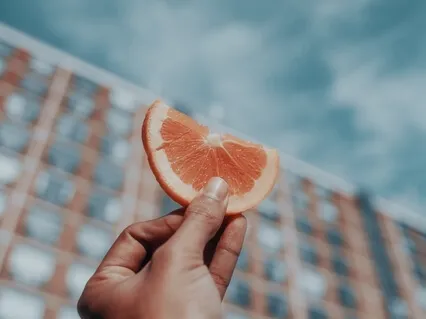
So the first thing I'd love you to imagine is a piece of your favorite fruit.
And if you're not a fruit person,
Maybe it's your favorite vegetable,
But it's some kind of natural whole food,
Plant food that is perfectly ripe,
That is totally delicious and ready to be eaten.
And I want you to imagine it,
To see it,
To remember how it smells.
And then I want you to imagine bringing that food closer and closer to your nose and to your mouth.
And taking a moment before you bite into it,
Of just smelling it,
Of seeing the color,
Feeling the anticipation of taste.
And then imagine the biting into it.
Is it crunchy?
Is it soft?
And then chew it.
So chewing,
And you might even chew,
Though you have nothing in your mouth,
You could just do the movement.
Chewing,
Of course,
Is the first part of your digestive process.
And in releasing from the salivary glands,
Enzymes get released into your mouth and get mixed up with the food that you're chewing and start to break it down from its more material molecular structure so that its nutrients can be released into your body.
So chew and chew,
And chew a little bit more.
And then when you're ready,
When you feel like this bite has been well chewed,
Swallow.
And again,
Trace the pathway of your swallowing and feel how your swallow,
Whatever you swallow,
Travels down your esophagus.
That's your pipe in your throat.
And it lands in your stomach.
And your stomach is just behind your left ribs.
You might be able to feel it,
Your lower left ribs.
And when you have swallowed a bite of food,
That food goes into your stomach and is there for somewhere between a couple of hours and maybe even a couple of days,
Depending on what you've swallowed.
So in your stomach,
Things start to break down.
And your food mixes with stomach acid,
With the bile that your gallbladder produces.
And again,
The material structures and molecular structures get broken down smaller and smaller and smaller and mixed with fluid.
And then eventually that stuff moves from your stomach into your small intestine.
And the small intestine,
If you bring your hands just above your belly button,
Is kind of the top of it is about there.
And it fills the middle front part of your belly,
So behind your belly button and slightly around it.
And in the small intestine,
You assimilate.
So the nutrients that you need from your food in the small intestine are absorbed and they move into your bloodstream so that all of your cells can then eat.
And I forget what the metaphor is,
But you've heard it,
Right?
It's like a human small intestine has the length of a football field or something crazy like that.
So it's turned around and folded around and the food that you're eating is kind of moving through this channel and pathway and it's like a riverbank.
So the riverbank is absorbing whatever is in the water and it's moving into the mud.
And then the fluid from the mud is seeping into denser soil and it's going into the roots of the trees and it's traveling.
So that's basically how your body is working is it's absorbing and assimilating these nutrients that you have consumed and those nutrients are moving through the membranes of tissues into the bloodstream and through the membranes of the blood cells into all the other cells in your body,
The ones that need this nutrition.
And then after your food has gone through your small intestine,
Then it goes into your large intestine and if you bring your hands kind of halfway between your right hip and your belly button and then move downwards towards your feet like an inch or two,
You're roughly at the space where there's what's called the ilial seagull valve and that's where your small intestine and your large intestine meet and there's a valve.
It's also kind of where your appendix is or was.
So when this matter,
This kind of now partially used material passes into your large intestine,
The large intestine's job is to reabsorb all the necessary fluid and to push the material waste out of your body.
So through this kind of squeezing peristaltic movement,
The large intestine absorbs the fluid and then moves it through your body.
And then you poop it out someday.
So your large intestine travels up the right side across underneath your lungs and then down the left side and into your rectum,
Which is just in front of your sacrum and then out your anus.
So this is the pathway of a swallow and when you swallow and when you absorb food,
Your body feeds itself,
Feeds all of its cells.
So now I want you to use the same kind of imagination of what happens when you swallow something,
What happens when you choose something with different kinds of foods and really a lot of yourself to feel what those foods are.
So if you were to take a bite of a donut and even though it might smell delicious,
Kind of notice the greasiness or the sugar and the pastiness of the flour and feel the energy of that food as it moves into your cells.
If you were to take a bite of meat,
You can feel the difference in the energetic quality of the meat.
If it was an animal that lived its life in misery,
Cooped up in a factory,
Abused,
Sick and pumped full of drugs,
That's going to become your cells,
Your cellular structure.
Very different than taking a bite of an animal who lived its life with vitality that was out in the open air in the sun with fresh grasses and a happy life.
So this is a practice to become very attuned to what we swallow,
To what we eat.
And not to be neurotic about it,
But to really consider how what we take in becomes what we are,
Becomes a material of our bodies and the energy of what we eat,
The energetic quality then becomes our attitudes,
Our energetic levels,
Our emotions and our perceptions.
So if we've been absorbing misery and toxicity,
Our perceptions will have that lens,
Which is different than if we've been absorbing freshness or love.
When we choose to consume with intention and with care,
It becomes absolutely essential that we support others around us to consume with intention and with care.
Because of course the environment is an ecology,
It's a living system and you can't separate one thing from the other.
So if you want to eat healthy food,
It's important that you support others to eat healthy food.
And this might mean that you example good choices to your children.
This might mean that you donate money so that schools or senior centers or homeless shelters can have good nutritious food that they serve to the people who are there.
This might mean that you become a policy advocate and start lobbying food corporations to have better ethical practices.
This might mean that you grow your own food and that you teach your neighbors how to do the same.
So there are many ways that you could support vitality and abundance through your own choices of course and recognize that in making your own choices,
You can support the good choices of others that one pretty much depends upon the other.
When we eat and there's a hoarding feeling,
There's dissociation with how much we're eating or how little we're eating.
Hoarding and denying are kind of two sides of the same coin.
There isn't really a recognition of the magic of our bodies or the magic that's around us.
Either way,
It's a little bit of a death wish.
So notice that feeling,
That kind of grasping feeling that can come up.
Selfishness with food,
Especially if you grew up with a lot of siblings,
Might be a familiar sensation and denial might also be a familiar sensation.
So when you feel this come up,
Again,
Noticing your nose and your lips and the way that there's an energetic exchange before something has already begun,
That there's an acknowledgement of the place that something came from,
That there's a decision to bring it into your body,
That there's a process with which your body can receive this.
This is a healing practice for disordered eating,
That you take time to feel what you eat,
That you take time to allow your body to receive what you're eating,
That you take time to feel when you're hungry,
That you take time to enjoy the sensuality of what you bring into your body,
That you recognize when there's satisfaction.
We can't only inhale.
And that when you let go of something,
That there is a trust that there will be more.
Part of the letting go is in knowing that then that allows there to be more.
So I'm going to end this meditation now.
It's been a little bit of a different kind of meditation today.
I hope it's been useful to you.
If you have people in your life that are working on healing their relationship to food,
Please send this meditation to them.
Much love and lots of peace.