Hello sleepy listeners and welcome back,
I'm your host Joanne,
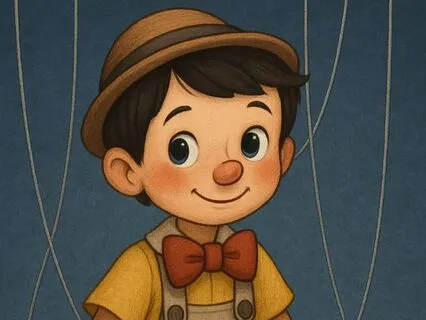
And tonight we continue our journey with the adventures of Pinocchio,
Picking up right where we left off.
In the last episode we began Pinocchio's tale,
His first steps as a mischievous little puppet full of curiosity and trouble.
Now the adventure deepens as we follow him through new twists and turns on his path to becoming a real boy.
But before we begin,
Let's take a few moments to settle in and fully relax.
Find a comfortable position,
Allowing your body to rest just as it wants to.
Take a slow deep breath in,
And as you exhale,
Feel your body beginning to soften.
Let's start by releasing any tension in your forehead,
Smoothing out the space between your eyebrows,
Allowing your eyes to gently relax.
Your jaw loosens,
Your shoulders ease back just a little more,
And with each breath,
Your body feels heavier and heavier,
And more and more at ease.
Feel your arms resting comfortably,
Your hands open and relaxed,
Your chest rises and falls in an easy,
Peaceful rhythm,
Your belly softens,
Your back melts down,
Your legs grow heavier and heavier,
Sinking deeper and deeper into rest.
And as you continue to breathe slowly and deeply,
Each breath out,
Imagine any lingering thoughts or worries drifting away,
Like tiny leaves floating down a quiet stream.
There is nothing you need to do right now,
No place to be,
Just here,
Resting,
Listening,
Allowing sleep to gently find you.
And so,
My friend,
When you're ready,
Let's begin.
Chapter 31 After five months of play,
Pinocchio wakes up one fine morning and finds a great surprise awaiting him.
Finally,
The wagon arrived.
It made no noise,
For its wheels were bound with straw and rags.
It was drawn by twelve pair of donkeys,
All the same size,
But all of different colour.
Some were grey,
Others white,
And still others a mixture of brown and black.
Here and there were a few with large yellow and blue stripes.
The strangest thing of all was that those twenty-four donkeys,
Instead of being iron-shod like any other beast of burden,
Had on their feet laced shoes made of leather,
Just like the ones boys wear.
And the driver of the wagon?
Imagine to yourself a little fat man,
Much whiter than he was long,
Round and shiny as a ball of butter,
With a face beaming like an apple,
A little mouth that always smiled,
And a voice small and weebling,
Like that of a cat begging for food.
No sooner did any boy see him than he fell in love with him,
And nothing satisfied him but to be allowed to ride in his wagon to that lovely place called the Land of Toys.
In fact,
The wagon was so closely packed with boys of all ages that it looked like a box of sardines.
They were uncomfortable.
They were piled one on top of the other,
And they could hardly breathe,
Yet not one word of complaint was heard.
The thought that in a few hours they would reach a country where there were no schools,
No books,
No teachers made these boys so happy that they felt neither hunger nor thirst nor sleep nor discomfort.
No sooner had the wagon stopped than the little fat man turned to Lampwick.
With bows and smiles,
He asked in a weebling tone,
Tell me,
My fine boy,
Do you always want to come to my wonderful country?
Indeed I do.
But I warn you,
My little dear,
There's no more room in the wagon.
It is full.
Never mind,
Answered Lampwick.
If there's no room inside,
I can sit on the top of the coach.
And with one leap,
He perched himself there.
What about you,
My love?
Asked the little man,
Turning politely to Pinocchio.
What are you going to do?
Will you come with us,
Or do you stay here?
I stay here,
Answered Pinocchio.
I want to return home,
As I prefer to study and to succeed in life.
May that bring you luck.
Pinocchio,
Lampwick called out.
Listen to me.
Come with us and we'll always be happy.
No,
No.
Come with us and we'll always be happy,
Cried four other voices from the wagon.
Come with us and we'll always be happy,
Shouted the one hundred and more boys in the wagon all together.
And if I go with you,
What will my good fairy say?
Asked the marionette,
Who was beginning to waver and weaken in his good resolutions.
Don't worry so much.
Only think that we are going to a land where we shall be allowed to make all the racket we like from morning till night.
Pinocchio did not answer,
But sighed deeply once,
Twice,
A third time.
Finally,
He said,
Make room for me.
I want to go,
Too.
The seats are all filled,
Answered the little man.
But to show you how much I think of you,
Take my place as a coachman.
And you?
I'll walk.
No,
Indeed.
I cannot permit such a thing.
I much prefer riding one of these donkeys,
Cried Pinocchio.
No sooner said than done.
He approached the first donkey and tried to mount it.
But the little animal turned suddenly and gave him such a terrible kick in the stomach that Pinocchio was thrown to the ground and fell with his legs in the air.
And this unlooked for entertainment.
The whole company of runaways laughed uproariously.
The little fat man did not laugh.
He went up to the rebellious animal and,
Still smiling,
Bent over him lovingly and bit off half of his right ear.
In the meantime,
Pinocchio lifted himself up from the ground and with one leap landed on the donkey's back.
The leap was so well taken that all the boys shouted,
Hurrah for Pinocchio,
And clapped their hands in hearty applause.
Suddenly,
The little donkey gave a kick with his two hind feet and,
At this unexpected move,
The poor marionette found himself once again sprawling right in the middle of the road.
Again the boys shouted with laughter,
But the little man,
Instead of laughing,
Became so loving toward the little animal that,
With another kiss,
He bit off half of his left ear.
You can mount now,
My boy,
He then said to Pinocchio.
Have no fear.
The donkey was worried about something,
But I have spoken to him and now he seems quiet and reasonable.
Pinocchio mounted and the wagon started on its way.
While the donkeys galloped along the stony road,
The marionette fancied he'd heard a very quiet voice whispering to him.
Poor silly,
You have done as you wished,
But you are going to be a sorry boy before very long.
Pinocchio,
Greatly frightened,
Looked about him to see whence the words had come,
But he saw no one.
The donkeys galloped,
The wagon rolled on smoothly,
The boys slept,
And the little fat driver sang sleepily between his teeth.
After a mile or so,
Pinocchio again heard the same faint voice whispering.
Remember,
Little simpleton,
Boys who stop studying and turn their backs upon books and schools and teachers in order to give all their time to nonsense and pleasure,
Sooner or later come to grief.
Oh,
How well I know this,
How well I can prove it to you.
A day will come when you will weep bitterly,
Even as I am weeping now,
But it will be too late.
At these whispered words,
The marionette grew more and more frightened.
He jumped to the ground,
Ran up to the donkey on whose back he had been riding,
And taking his nose in his hands,
Looked at him.
Think how great was his surprise when he saw that the donkey was weeping,
Weeping just like a boy.
Hey,
Mr.
Driver,
Cried the marionette.
Do you know what strange thing is happening here?
This donkey weeps.
Let him weep.
When he gets married,
He will have time to laugh.
Have you perhaps taught him to speak?
No,
He learned to mumble a few words when he lived for three years with a band of trained dogs.
Poor beast.
Come,
Come,
Said the little man.
Do not lose time over a donkey that can weep.
Mount quickly and let us go.
The night is cool and the road is long.
Pinocchio obeyed without another word.
The wagon started again.
Toward dawn,
The next morning,
They finally reached that much-longed-for country,
The Land of Toys.
This great land was entirely different from any other place in the world.
Its population,
Large though it was,
Was composed wholly of boys.
The oldest were about fourteen years of age.
The youngest,
Eight.
In the street,
There was such a racket,
Such shouting,
Such blowing of trumpets,
That it was deafening.
Everywhere,
Groups of boys were gathered together.
Some played at marbles,
At hopscotch,
At ball.
Others rode on bicycles or on wooden horses.
Some played at blind man's buff,
Other at tag.
Here,
A group played circus.
There,
Another sang and recited.
A few turned somersaults.
Others walked on their hands with their feet in the air.
Generals in full uniform leading regiments of cardboard soldiers passed by.
Laughter,
Shrieks,
Howls,
Catcalls,
Hand clapping followed this parade.
One boy made a noise like a hen,
Another like a rooster,
And a third imitated a lion in his den.
All together,
They created such a pandemonium that it would have been necessary for you to put cotton in your ears.
The squares were filled with small wooden theatres,
Overflowing with boys from morning till night,
And on the walls of the houses,
Written with charcoal,
Were words like these,
As soon as they had set foot in that land,
Pinocchio,
Lampwick and all the other boys who had travelled with them started out on a tour of investigation.
They wandered everywhere.
They looked into every nook and corner,
House and theatre.
They became everybody's friend.
Who could be happier than they?
What with entertainments and parties,
The hours,
The days,
The weeks passed like lightning.
Oh,
What a beautiful life this is,
Said Pinocchio,
Each time that,
By chance,
He met his friend Lampwick.
Was I right or wrong,
Answered Lampwick,
And to think you did not want to come?
To think that even yesterday the idea came into your head to return home to see your fairy and to start studying again?
If today you are free from pencils and books and school,
You owe it to me,
To my advice,
To my care.
Do you admit it?
Only true friends count,
After all.
It's true,
Lampwick,
It's true.
If today I am really a happy boy,
It is all because of you.
And to think that the teacher,
When speaking of you,
Used to say,
Do not go with that Lampwick.
He is a bad companion,
And someday he will lead you astray.
Poor teacher,
Answered the other,
Nodding his head.
Indeed,
I know how much he disliked me and how he enjoyed speaking ill of me.
But I am of a generous nature,
And I gladly forgive him.
Great soul,
Said Pinocchio,
Fondly embracing his friend.
Five months passed,
And the boys continued playing and enjoying themselves from morn till night without ever seeing a book or a desk or a school.
But,
My children,
There came a morning when Pinocchio awoke and found a great surprise awaiting him.
A surprise which made him feel very unhappy,
As you shall see.
Chapter 32 Pinocchio's ears become like those of a donkey.
In a little while,
He changes into a real donkey and begins to bray.
Everyone,
At one time or another,
Has found some surprise awaiting him.
Of the kind which Pinocchio had on that eventful morning of his life,
There are but few.
What was it?
I will tell you,
My little dear readers.
On awakening,
Pinocchio put his hand up to his head,
And there he found,
Guess.
He found that,
During the night,
His ears had grown at least ten full inches.
You must know that the marionette,
Even from his birth,
Had very small ears.
So small,
Indeed,
That to the naked eye they could hardly be seen.
Fancy how he felt when he noticed that,
Overnight,
Those two dainty organs had become as long as shoe brushes.
He went in search of a mirror,
But not finding any.
He just filled a basin with water and looked at himself.
There he saw what he never could have wished to see.
His manly figure was adorned and enriched by a beautiful pair of donkey ears.
I leave you to think of the terrible grief,
The shame,
The despair of the poor marionette.
He began to cry,
To scream,
To knock his head against the wall.
But the more he shrieked,
The longer and the more hairy grew his ears.
At those piercing shrieks,
A doormouse came into the room,
A fat little doormouse who lived upstairs.
Seeing Pinocchio so grief-stricken,
She asked him anxiously,
What is the matter,
Dear little neighbor?
I am sick,
My little doormouse,
Very,
Very sick,
And from an illness which frightens me.
Do you understand how to feel the pulse?
A little.
Feel mine,
Then,
And tell me if I have a fever.
The doormouse took Pinocchio's wrist between her paws and,
After a few minutes,
Looked up at him sorrowfully and said,
My friend,
I'm sorry,
But I must give you some very sad news.
What is it?
You have a very bad fever.
But what fever is it?
The donkey fever.
I don't know anything about that fever,
Answered the marionette,
Beginning to understand even too well what was happening to him.
Then I will tell you all about it,
Said the doormouse.
Know then that,
Within two or three hours,
You will no longer be a marionette,
Nor a boy.
What shall I be?
Within two or three hours,
You will become a real donkey,
Just like the ones that pull the fruit carts to market.
Oh,
What have I done?
What have I done,
Cried Pinocchio,
Grasping his two long ears in his hands and pulling and tugging at them angrily,
Just as if they belonged to another.
My dear boy,
Answered the doormouse to cheer him up a bit.
Why worry now?
What is done cannot be undone,
You know.
Fate has decreed that all these e-boys who come to hate books in schools and teachers and spend all their days with toys and games must sooner or later turn into donkeys.
But is it really so?
Asked the marionette,
Sobbing bitterly.
I am sorry to say it is,
And tears now are useless.
You should have thought of all this before.
But the fault is not mine.
Believe me,
Little doormouse,
The fault is all Lampwick's.
And who is this Lampwick?
A classmate of mine.
I wanted to return home.
I wanted to be obedient.
I wanted to study and to succeed in school.
But Lampwick said to me,
Why do you want to waste your time studying?
Why do you want to go to school?
Come with me to the land of toys.
There we'll never study again.
There we can enjoy ourselves and be happy for more until night.
And why did you follow the advice of that false friend?
Why?
Because,
My dear little doormouse,
I am a heedless marionette.
Heedless and heartless.
Oh,
If I had only a bit of heart,
I should have never abandoned that good fairy who loved me so well and who has been so kind to me.
And by this time,
I should no longer be a marionette.
I should have become a real boy,
Like all these friends of mine.
Oh,
If I meet Lampwick,
I'm going to tell him what I think of him and more,
Too.
After this long speech,
Pinocchio walked to the door of the room.
But when he reached it,
Remembering his donkey ears,
He felt ashamed to show them to the public and turned back.
He took a large cotton bag from a shelf,
Put it on his head,
And pulled it far down to his very nose.
Thus adorned,
He went out.
He looked for Lampwick everywhere,
Along the streets,
In the squares,
Inside the theaters,
Everywhere,
But he was not to be found.
He asked everyone whom he met about him,
But no one had seen him.
In desperation,
He returned home and knocked at the door.
Who is it?
Asked Lampwick from within.
It is I,
Answered the marionette.
Wait a minute.
After a full half hour,
The door opened.
Another surprise awaited Pinocchio.
There in the room stood his friend,
With a large cotton bag on his head,
Pulled far down to his very nose.
At the sight of that bag,
Pinocchio felt slightly happier and thought to himself,
My friend must be suffering from the same sickness that I am.
I wonder if he too has donkey fever.
But pretending he had seen nothing,
He asked with a smile,
How are you,
My dear Lampwick?
Very well,
Like a mouse in a parmesan cheese.
Is that really true?
Why should I lie to you?
I beg your pardon,
My friend,
But why then are you wearing that cotton bag over your ears?
The doctor has ordered it because one of my knees hurt.
And you,
Dear marionette,
Why are you wearing that cotton bag down to your nose?
The doctor has ordered it because I have bruised my foot.
Oh,
My poor Pinocchio!
Oh,
My poor Lampwick!
An embarrassingly long silence followed these words,
During which time the two friends looked at each other in a mocking way.
Finally,
The marionette,
In a voice sweet as honey and soft as a flute,
Said to his companion,
Tell me,
Lampwick,
Dear friend,
Have you ever suffered from an earache?
Never.
And you?
Never.
Still,
Since this morning,
My ear has been torturing me.
So has mine.
Yours too?
And which ear is it?
Both of them.
And yours?
Both of them too.
I wonder if it could be the same sickness.
I'm afraid it is.
Will you do me a favor,
Lampwick?
Gladly,
With my whole heart.
Will you let me see your ears?
Why not?
But before I show you mine,
I want to see yours,
Dear Pinocchio.
No.
You must show yours first.
No,
My dear.
Yours first,
Then mine.
Well then,
Said Marionette,
Let us make a contract.
Let's hear the contract.
Let us take off our caps together.
All right?
All right.
Ready then?
Pinocchio began to count.
One.
Two.
Three.
At the word three,
The two boys pulled off their caps and threw them high in air.
And then a scene took place which is hard to believe,
But it is all too true.
The Marionette and his friend Lampwick,
When they saw each other both stricken by the same misfortune,
Instead of feeling the same sorrowful and ashamed,
Began to poke fun at each other.
And after much nonsense,
They ended by bursting out in hearty laughter.
They laughed and laughed and laughed again,
Laughed till they ached,
Laughed till they cried.
But all of a sudden,
Lampwick stopped laughing.
He tottered and almost fell,
Pale as a ghost.
He turned to Pinocchio and said,
Help,
Help,
Pinocchio.
What is the matter?
Oh,
Help me.
I can no longer stand up.
I can't either,
Cried Pinocchio.
And his laughter turned to tears as he stumbled about helplessly.
They had hardly finished speaking when both of them fell on all fours and began running and jumping around the room.
As they ran,
Their arms turned into legs,
Their faces lengthened into snouts,
And their backs became covered with long gray hairs.
This was humiliation enough,
But the most horrible moment was the one in which the two poor creatures felt their tails appear.
Overcome with shame and grief,
They tried to cry and bemoan their fate.
But what is done instead of moans and cries,
They burst forth into loud donkey brays.
At that moment,
A loud knocking was heard at the door and a voice called to them.
Open.
I am the little man,
The driver of the wagon which brought you here.
Open,
I say,
Or beware.
Chapter 33 Pinocchio,
Having become a donkey,
Is bought by the owner of a circus who wants to teach him to do tricks.
The donkey becomes lame and is sold to a man who wants to use his skin for a drum head.
Very sad and downcast were the two poor little fellows as they stood and looked at each other.
Outside the room,
The little man grew more and finally gave the door such a violent kick that it flew open.
With his usual sweet smile on his lips,
He looked at Pinocchio and Lampwick and said to them,
Fine work,
Boys.
You have brayed well,
So well that I recognized your voices immediately and here I am.
On hearing this,
The two donkeys bowed their heads in shame,
With their heads between their legs.
At first,
The little man petted and caressed them and smoothed down their hairy coats.
Then he took out a curry comb,
Worked over them till they shone like glass.
Satisfied with the looks of the two little animals,
He bridled them and took them to a marketplace far away from the land of toys in the hope of selling them without having to wait very long for an offer.
Lampwick was bought by a farmer whose donkey had died the day before.
Pinocchio went to the owner of a circus who wanted to teach him to do tricks for his audiences.
And now,
Do you understand what the little man's profession was?
This horrid little being whose face shone with kindness to boys who hated books,
Boys who wanted to run away from home,
Boys who were tired of school.
All these were his joy and his fortune.
He took them with him to the land of toys and let them enjoy themselves to their heart's content.
When,
After months of all play and no work,
They became little donkeys,
He sold them on the marketplace.
In a few years,
He sold them all What happened to Lampwick?
My dear children,
I do not know.
Pinocchio,
I can tell you,
Met with great hardships even from the first day.
After putting him in a stable,
His new master filled his manger with straw,
But Pinocchio,
After tasting a mouthful,
Spat it out.
Then the man filled his manger with straw.
I don't like hay either,
He cried angrily.
Wait,
My pretty donkey,
I'll teach you not to be so particular.
Without more ado,
He took a whip and gave the donkey a hearty blow across the legs.
Pinocchio screamed with pain,
And as he screamed,
He brayed,
I can't digest straw.
Then eat the hay,
Hay gives me a headache.
Do you pretend by any chance that I should feed you duck or chicken?
Asked the man again.
Pinocchio became very quiet and said no more.
After that,
The door of the stable was closed and he was left alone.
It was many hours since he had eaten anything,
And he started to yawn from hunger.
As he yawned,
He opened a mouth and swallowed the hay.
Not finding anything else in the manger,
He tasted the hay.
After tasting it,
He chewed it well,
Closed his eyes and swallowed it.
This hay is not bad,
He said to himself,
But how much happier I should be if I had studied.
Just now,
Instead of hay,
Pinocchio looked in the manger for more hay,
But it was all gone.
He had eaten it all during the night.
He tried the straw,
But as he chewed away at it,
He noticed to his great disappointment that it tasted neither like rice nor like macaroni.
Patience,
He repeated as he chewed.
If only my misfortune might serve as a lesson to disobedient boys have patience.
Patience indeed,
Shouted his master just then as he came into the stable.
Do you think,
Perhaps my little donkey,
That I have brought you here only to give you food and drink?
Oh no,
You are to help me earn some fine gold pieces,
Do you hear?
Come along now,
I'm going to teach you to jump and bow,
Do you hear?
Poor Pinocchio,
Whether he liked it or not,
Had to learn all these wonderful things,
But it took him three long months and cost him many,
Many lashings before he was pronounced perfect.
The day came at last when Pinocchio's master was able to announce an extraordinary performance.
The announcements posted all around the town were,
Great spectacle tonight,
Leaps and exercises by the great artists and the famous horses of the company,
First public appearance of the famous donkey called Pinocchio,
The star of the dance.
The theater will be as light as day.
That night,
As you can well imagine,
The theater was filled and not an orchestra chair could be had,
Not a balcony seat,
Nor a gallery seat,
Not even for the weight in gold.
The place swarmed with boys and girls of all ages and sizes,
Wriggling and dancing about in a fever of impatience to see the famous donkey dance.
When the first part of the performance was over,
The owner and manager of the circus,
In leather boots and patent leather boots,
Presented himself to the public in a loud,
Pompous voice,
Made the following announcement.
Most honored friends,
Gentlemen and ladies,
Your humble servant,
The manager of this theater,
Presents himself before you tonight in order to introduce to you the greatest,
The most famous donkey in the world.
A donkey that has had the kings and queens and emperors of all the great courts of Europe.
We thank you for your attention.
This speech was greeted by much laughter and applause,
And the applause grew to a roar when Pinocchio,
The famous donkey,
Appeared in the circus ring.
He was handsomely arrayed.
A new bridle of shining leather with buckles of polished brass was on his back.
Necklaces were tied to his ears.
Ribbons and tassels of red silk adorned his mane,
Which was divided into many curls.
A great sash of gold and silver was fastened around his waist,
And his tail was decorated with ribbons of many brilliant colors.
He was a handsome donkey indeed.
The manager,
When introducing him to the public,
Added these words.
Most honored audience,
I shall not take your time tonight to tell you of the great difficulties which I have encountered while trying to tame this animal since I found him in the wilds of Africa.
Observe,
I beg you,
The savage look of his eye.
All the means used by centuries of civilization in subduing wild beasts failed in this case.
I had finally to resort to the gentle language of the whip in order to bring him to my will.
In all my kindness,
However,
I never succeeded in gaining my donkey's love.
He is still today as savage as the day I found him.
He still fears and hates me,
But I have found in him one great redeeming feature.
Do you see this little bump on his forehead?
It is the bump which gives him his great talent of dancing and using his feet as nimbly as a human being.
Admire him,
And enjoy yourselves.
I let you now be the judges of my success as a teacher of animals.
Before I leave you,
I wish to state that there will be another performance tomorrow night.
If the weather threatens rain,
The great spectacle will take place at eleven o'clock in the morning.
The manager bowed and then turned to Pinocchio and said,
Ready,
Pinocchio?
Before starting your performance,
Salute your audience.
Pinocchio obediently bent his two knees to the ground and remained kneeling until the manager with the crack of the whip cried sharply,
Walk!
The donkey lifted himself on his four feet and walked around the ring.
A few minutes passed Quick step!
And Pinocchio obediently changed his step.
Gallop!
And Pinocchio galloped.
Full speed!
And Pinocchio ran as fast as he could.
As he ran,
The master raised his arm and a pistol shot rang in the air.
At the shot,
The little donkey fell to the ground as if he were really dead.
He looked at the donkey as he rose to his feet.
Cries and shouts and hand clappings were heard on all sides.
At all that noise,
Pinocchio lifted his head and raised his eyes.
There in front of him in a box sat a beautiful woman.
Around her neck she wore a long gold chain from which hung a large medallion.
On the medallion and a fairy in it.
That picture is of me!
That beautiful lady is my fairy!
Said Pinocchio to himself recognizing her.
He felt so happy that he tried his best to cry out.
Oh,
My fairy!
My own fairy!
But instead of words,
A loud braying was heard in the theater.
So loud and so long that especially the children burst out laughing.
Then,
In order to teach the donkey that it was not good manners to bray before the public,
The manager hit him on the nose with the handle of a whip.
The poor little donkey stuck out a long tongue and licked his nose for a long time in an effort to take away the pain.
And what was his grief when on looking up He felt himself fainting,
His eyes filled with tears and he wept bitterly.
No one knew it,
However,
Least of all the manager who,
Cracking his whip,
Cried out,
Bravo,
Pinocchio!
Now show us how gracefully you can jump through the rings!
Pinocchio tried two or three times,
But each time he came near the ring he found it more to his taste to go under it.
The fourth time,
At a look from his master,
He leaped through it.
But as he did so,
His hind legs caught in the ring and he fell to the floor in a heap.
When he got up,
He was lame and could hardly limp as far as the staple.
Pinocchio!
We want Pinocchio!
He cried out to the boys from the orchestra,
Saddened by the accident.
No one saw Pinocchio again that evening.
The next morning,
The animal doctor declared that he would be lame for the rest of his life.
What do I want with a lame donkey?
Said the manager to the staple boy.
Take him to the market and sell him.
When they reached the square,
A buyer was soon found.
How much do you ask for that little lame donkey?
He asked.
Four dollars.
I'll give you four cents.
Don't think I'm buying him for work.
I want only his skin.
It looks very tough and I can use it to make myself a drum head.
I belong to a musical band in my village and I need a drum.
I leave it to you,
My dear children,
To take care of it.
As soon as the buyer had paid the four cents,
The donkey changed hands.
His new owner took him to a high cliff overlooking the sea,
Put a stone around his neck,
Tied a rope to one of his hind feet,
Gave him a push and threw him into the water.
Pinocchio sank immediately and his new master sat on the cliff so as to skin him and make himself a drum head.
Sweet dreams,
My friend.
Sleep well.