Welcome to the Institute for Holiness,
Kehilat Musar,
Our awakening Torah,
Musar mindfulness sitting.
We will begin in one minute.
Allow yourself to become settled.
Welcome.
Welcome to the Institute for Holiness,
Kehilat Musar.
Our weekly Torah,
Musar mindfulness teaching and sitting and community and tehilah and avad and asanga together.
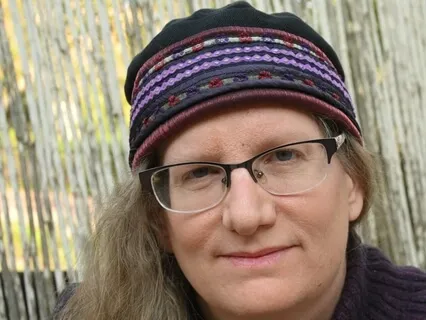
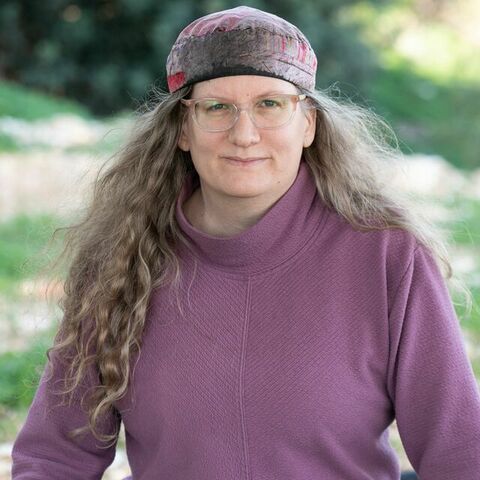
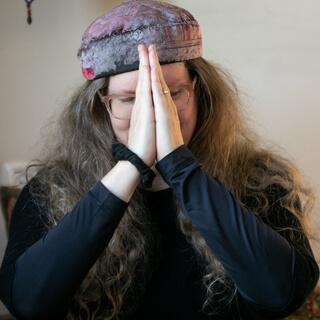
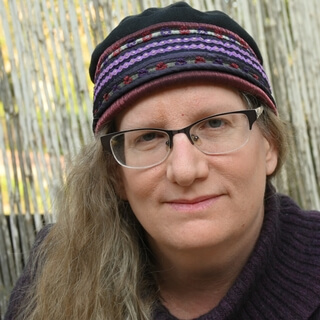
I am Rabbi Hasya Uryer Steinbauer,
The founder and director of the Institute and I'm just delighted to be here with you.
Perhaps you were blessed and privileged enough to sit with us during the 40 days of Elul and I welcome all of you back that we may sit and grow and practice together.
Such an honor.
We always begin with our kavana,
Our intention for our practice.
I'm going to go ahead and share this screen with you.
You'll see before you,
Before doing acts of caring for the self,
We say this is something I'm doing to strengthen my own soul in order to be of benefit to others in the future.
And with that,
We are going to move in to a short teaching and practice and learning together on parashat Noah.
Why are we beginning after the parashah has passed?
We want to give you an opportunity to spend that week and especially on Shabbat,
Really sitting with the parasha,
Learning from it,
Seeing what it has to teach you,
Finding your own reactions to it,
To come and sit with us finally,
To come at it with this lens of mussar mindfulness.
So we are meeting together on Yom Bishon on Sunday in order to really take all that we have taken in to be able to see this with new eyes,
New perspective,
New compassion,
New chesed,
Loving kindness.
So I'm going to begin by sharing some texts with you.
So I'm going to assume that you have read this parasha.
If you haven't,
Please do get in the habit of reading the weekly parasha in whatever language is your native tongue and trying to learn a little bit from the Hebrew so that what I might share will make more sense to you,
But I believe this will be applied to all of us.
So as you know,
We have Noah here who is considered righteous by many of our ancestors.
And then there are those who question how righteous is this person and why is that language even used?
He's described as an ish sadik tamin,
A righteous man and a innocent,
Blemish free and blameless person in his generation,
The dorotav.
Okay.
I'm less concerned with the dorotav as I am about him being called a sadik and a tamin.
Why?
Because later on the Torah itself and Hashem through his communication with Noah understands and sees Noah as an ish sadik.
That the tamin is removed later.
There's a sense of innocence,
Of blamelessness is removed after he has a conversation with Hashem.
Not even conversation.
He informs him,
Tells him that he's about to destroy all that is flesh that has the breath of life in it.
And Noah is silent.
So we have Rabbi Eliyahu Desra.
We have a mistake here.
He says it's Eliyahu.
Eliyahu Desra.
Wonderful Rabbi Sage who wrote in the Strive for Truth,
Volume two,
Page 58.
No one is held responsible for the evil to which he is accustomed from birth.
And as a result of his environment,
Never having learned any better.
In this respect,
He has the halakhic status of a child taken captive and brought up among adulterers.
He will be held responsible only for that which he could and should have learned.
I want you to hold on to this.
Hold that teaching as we also explore other perspectives.
Then in the Talmud,
Bavli Sanhedrin 108a,
We have a wonderful makhlokhet,
A discussion between a fruit,
A couple that learned together,
Resh Lakish and Rabbi Yochanan,
Where he argues that Noah has actually considered Sadiq righteous only in his generation.
That this verse is a verse of praise for Noach and his behavior.
That the Torah is telling us that Noach lived righteously despite living during the time of a widespread wickedness.
So if we're taking Dessler's words,
Noach should have been one as a child who had been kidnapped and brought up by adulterers.
And his children,
His hokhan,
Should in some way have been someone who could not live righteously.
And even though Noah was surrounded by this bad behavior,
Had no support from his neighbors or community,
He still found a way to behave righteously without being influenced by the negativity.
So this is Resh Lakish.
I would like to find a gray,
A gray place,
A place where we might find something where we can honor that he was definitely in this place of wickedness of the surrounding society around them,
But also at the same time honor that he behaved in ways that others didn't.
So we're going to sit with that for a little bit.
So I want to start by saying an encounter with the Torah texts through the lens of Musa mindfulness requires that we practice mindfulness of how we are triggered by the text.
What arises in us from the text?
What are we clinging to?
What are our expectations and desires?
I'm also dealing with the pashat of this text,
Which means this simple,
Plain meaning.
I'm not dealing with our ancestors midrashim,
The stories around the texts.
I would venture to say that many of our midrashim are actually from authors who could not and would not accept the text and the experience of the text as it was.
They had to imagine it differently in order to live with the Torah,
Its demands and God.
So let's look at some midot,
Musa our soul traits of really are embedded in this text and then particularly with Noah.
So he definitely has zerizut.
He has this wonderful enthusiasm.
Where does it come out?
God tells him what to do.
He does it.
He fulfills the command.
Okay.
But hold on to that because that same zerizut,
That same enthusiasm will turn to zerizut real.
Later on,
When he wakes up naked and drunk,
Waking up from that drunkenness and how he will treat his son.
Okay.
There's no space for the space between the match and the fuse.
He will act out.
He will curse his son.
There's no room for teshuva,
Allowing his son to perhaps take responsibility and apologize.
There's no room for that.
So as much as he can be balanced and be an example of wonderful enthusiasm to fulfill God's command,
He at the same time can go completely to the other extreme in his relationship with his son,
Ham.
Okay.
So we're also going to look at the need of responsibility.
Okay.
Which is achara yut.
Okay.
This wonderful lens of was he responsible?
So when we lack responsibility,
We're not seeing the consequences of our behavior.
And then in perkeh ervot,
Our wonderful Mishnah from Rabi Shimon bin Natan El,
He answers,
Who is wise?
One who sees what is born,
What is about to be born.
So it's understanding the consequences of our behavior.
So we're going to ask ourselves,
Is Noah responsible?
Is he responsible the way we want him to be?
So Morris Adler comes at the text quite strongly.
He says,
At no time did we hear a word of concern of anything escaped from Noah's lips.
It was as though he stood apart from the rest of the world.
Noah was a righteous man.
He definitely deserves to be in the circle of the great,
But there's a fatal flaw of Noah.
And so he did not become the father of a new religion,
New faith,
A new community.
He lacked compassion.
And because he lacked compassion,
He far forfeited a far greater place in history that might have been accorded to him.
So he cites this in the Torah on Modern Commentary on page 65.
I want us to try to sit with a gray reading,
Not either or,
But and.
Noah and his son,
Ham,
On one hand were accustomed to great evil during their time and from the time of birth.
And Noah was also considered righteous because he fulfills God's command.
So in our own practice,
We want to give the benefit of the doubt as much as possible.
You have to understand if they're living in that great amount of evilness before the flood,
And then they get this news that something is so overwhelming that the world is about to be destroyed.
So perhaps Noah's silence is more like Aharon's silence when his two sons are taken by God,
Consumed in fire.
Aharon falls completely silent.
And this is the same with Noah.
Perhaps his silence is trauma is,
Oh,
My God,
Really?
So that type of experience of that news,
We could leave room that perhaps this is a silence that he couldn't respond.
He didn't have the skill set.
We're going to give him the benefit of the doubt.
Now,
Of course,
We wanted him to argue,
Right?
We want him to be like Avraham,
Who will come 10 generations later,
Who will argue with God.
God says,
I'm about to destroy Sodom and Gomorrah and visit on them their own evilness in a sense.
And Aharon argues,
No,
Excuse me,
Avraham.
Avraham argues,
Please don't take all the people.
There must be finally after arguing 50,
40,
30,
Down to 10 righteous people.
If you can find 10 righteous people,
Please don't.
Don't take all these people.
So that's what we wanted from Noah.
We wanted him to say,
God,
Don't take everyone.
Don't take all the animals,
All the earth,
All the babies,
All the children.
Don't take everyone because of the unbelievable evilness that's in the land.
But it doesn't happen.
Okay,
We have to sit with that.
That's part of our practice.
That expectation,
That clinging,
That wanting something other than the behavior that is given to us by our ancestors recorded in the Torah.
So the experience of these years of evil from his citizens,
The flood,
The death of humanity,
All the animals except those in the ark,
It finally wears and tears at Noah.
And it comes out,
He checks out,
He drinks wine to the point where he passes out naked in his tent.
And then he acts out his shame and humiliation and wind induce anger at his son who has seen him naked.
So perhaps his son is too also affected by the evil that existed before.
And this could account for this behavior of entering the tent when you're not supposed to,
Seeing your father naked when you're not supposed to,
Telling your brothers that he's naked when you're not supposed to,
Not covering him up,
Not honoring him.
So there's this lack of responsibility from Noah and there's a lack of responsibility from Ham.
So I just think there's this effect of trauma that is really coming in,
Where we find that when that is happening,
It's very hard to act with kavod,
With glory and honor to other and with responsibility.
So how can we act so that we don't cause harm,
That we don't perpetuate harm?
So we can do all we can to make amends,
Right?
And Noah doesn't allow for tushuva when his son does behave in ways that he doesn't agree with,
That he finds abhorrent.
And moreover,
It is morally reprehensible that he is going to,
Noah is going to curse his son and all his descendants into slavery.
That we know that there's morally irreparable.
We can't allow that.
We can't sit with that.
Noah doesn't bear the burden of his son.
He doesn't bear the burden because he can't.
All right.
And at worse,
Noah becomes like Kyan,
The man who tills the land,
Who is not his brother's keeper,
Who is not his son's keeper.
So we long for Noah as a citizen who will protest God's command to destroy all flesh,
All that breathes.
And we also long for the father who will not act with complete being complete judgment.
We long for the father who won't curse grandson,
Great-grandson into slavery.
So we sit with that.
Now were they fairly good people that could have done better?
How about we try to see it from that perspective?
And with that,
We're going to move into a sitting.
I invite you to find a comfortable position.
If you need to stand due to trauma in the back,
Living with chronic pain,
Please do so have a chair next to you to secure you.
And if you need to lie down,
Please do so with your eyes open to stay alert.
For the rest of us,
Root your feet into the Adama,
Into the ground that Hashem created,
God created,
Brought Adam from,
That Noah comes 10 generations from,
That we are here with.
Allow it to hold you and carry you.
Sit upright in a dignified position created in the image of God and allow yourself to settle and arrive.
Close your eyes if you feel safe and comfortable.
If you don't,
Just lower your gaze.
We will sit and practice compassion and chesed toward Noah and his son,
Ham,
Toward our ancestors who long for the text to say something other than what it does toward ourselves and our own encounter with this text.
We will look and recognize what is arising in us,
What is happening.
Are we being triggered by this text?
Recognize and allow whatever your experience is in this moment.
A big part of this practice of engaging in this encounter with God and with the text and with our ancestors is concession,
Is acceptance,
Is disappointment,
Is honoring that and living with it.
Can we carry this burden of our own disappointment with God's behavior,
With Noah's behavior,
And can we recognize and allow and accept?
Allow yourself to sit with that for a few moments of silence,
Always using your breath as your anchor.
The mind will travel as it does from time to time.
Staying for the future,
Thinking about something that happened in the past.
When you wake up from this,
Bring yourself back to your point,
Your anchor,
Which is to reflect on your experience with this text,
To be able to stay with your breath in the present moment.
The breath is a gift from God,
It is what created Adam,
Chava,
And all of our ancestors.
And while we're sitting in the present moment,
We can think of what it's like not to have that breath,
As we foreshadow,
As we think of what is coming next.
But think of Noah for a moment.
Think of Noah being locked in to that Teva,
To that Ark.
It is God who shuts him in.
And even Aviva Zormberg has kindly pointed out to us,
It's like a prison on one end.
He is locked in.
How can he breathe?
How can he breathe as easily as well,
Surrounded by three floors of animals,
Rain,
Flood?
Try to live in his shoes.
Try to live in that experience.
Can we bear the burden of this?
Can we practice compassion?
Allow us to investigate in our sitting now,
Giving everyone the benefit of the doubt.
It is a mitzvah to do so,
A commandment.
Of course,
We can investigate what is it that we expected of them?
What is it that we wanted of them?
And no sooner should we be planning for our own practice of applying what we expect from them.
So much of our own humanity is crying out in need from the pandemic,
From global warming,
From poverty.
And if we want Noah to cry out,
To try to bring about to Shuvah,
To change,
A repentance,
A leaning in,
A taking of responsibility,
Then we need to look at ourselves and what small act can we do towards that,
Towards helping the other,
Towards bearing the burden.
We are not meant to finish the task.
We are meant to contribute.
Allow yourself with gentle,
Loving awareness to do a kind body scan,
Starting with the top of your head.
Notice any tension.
Notice if anything is stuck in your body.
What is the felt sense in this moment?
Can we bring a loving attention to it?
Allow yourself to gently ask yourself,
Can I sit with this?
You may ask God for help.
We will sit the next five or more minutes in silence.
If you are new to meditation,
Just allow yourself to come back to your breath as your anchor,
Should you notice that your thoughts have wandered,
Or if you've gotten caught up in a sensation in the body,
Or perhaps in an emotion that is flowing through.
Perhaps you can create that space between the match and the fuse to notice that this too shall pass.
I will ring the bells when we are meant to come back together.
You can trust that I will keep track of time and we will meet again.
You can trust that I will keep track of time and we will meet again.
You can trust that I will keep track of time and we will meet again.
You can trust that I will keep track of time and we will meet again.
Before we move out of our meditation,
We invite the possibility of a practice of forgiveness.
Do we need to forgive God?
Do we need to forgive Noah and Ham to allow us to move to greater responsibility?
And each evening as we pray,
I hereby forgive anyone who has angered me,
Provoked me,
Sinned against me,
Physically or financially,
Whether in word or deed,
Inadvertently or deliberately,
Willingly or unwillingly,
That no one incurred punishment because of me.
I hereby forgive.
We let go.
We too have to do this practice each year,
Each parasha,
When we're crying out for things to be different than the way they are,
For our ancestors to be different than how they are.
You may gently and slowly open your eyes and meet us back in the shared Zoom live stream space.
Thank you for your practice.
Thank you for joining the Institute for Holiness,
Kehillat Musar.
I'm delighted to be here with you.
It is such an honor.
So as we say every week,
You are welcome to offer what's called dana,
A donation,
Either now or the end of the 52-week cycle.
And of course,
We accept sponsorships in memory and in honor of anyone that is dear to you that you want to dedicate to this teaching.
So may you join us next Sunday at three o'clock Eastern Standard Time,
Where we will discuss,
Of course,
What is coming next.
L'chah.
So as we said before,
Please spend your time during the week in Anshibat studying the parasha so you're all ready,
You know what it says,
You know what the effect that it has on you if you're triggered or not,
So you can come and practice through the lens of Musar mindfulness,
A new way,
A way that we can really grow in our own practice and our own nidot to really learn and engage with the text to see what it has to teach us,
How we can grow into being people in service of others and of God.
And with that,
I thank you again.
God bless you all and I look forward to practicing again next week.
Take care.