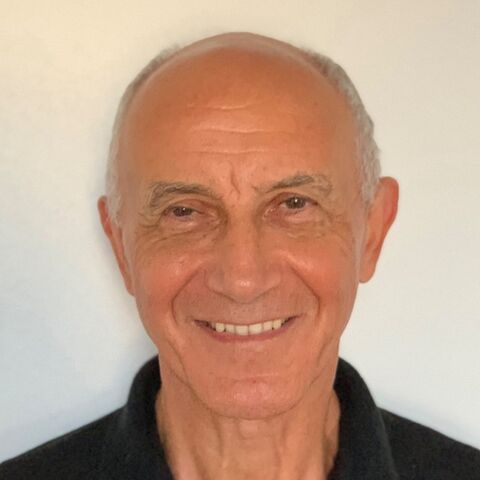
So Rob,
You've paid a lot of attention to listening in your life.
Ah,
I was very,
It goes way,
Way back really.
I became conscious of it.
The first weekend in Chicago during our focusing weekend with Gene Jenglen and lots of other nice people But I asked Gene a question about this.
He was saying it's easy to learn your focusing but then it's hard to learn listening that isn't as natural for people and I said no,
No,
It's the other way around.
It's hard for me to be with myself but there's a big pull in listening,
It's a natural thing to me.
What I want to do,
Not perhaps that I'm good at it but I want to do it.
And then months later I was looking back I realised my dad was always very troubled.
He was a troubled man,
I think now that his upbringing in a very violent and probably abusive school was very damaging and losing his father when he was little was very damaging.
He had trauma that was very unhealed and very obviously unhealed and I always worried about him.
And my mother was very,
Very,
Very private.
Her feeling life was there but it was not on show.
And so there was all,
And my brother was not,
He was not an easy person for me.
He's a good person but he's not an easy person for me.
So there was always this feeling of what's going on in these people.
And then in school I was a bit weird and different and likewise I had the feeling of how do I connect to these people,
How do I find a place in the world.
And so very quickly when I got my degree in music and I went home and thought what am I going to do with my life,
Having no plans worth mentioning.
And people started knocking at the door saying will you teach me the piano and I'm still sitting next to a piano most of the time.
But I found very quickly that I might feel very new and vulnerable and inadequate but some of the people really liked to be around me and it was easy for me to feel yes I'm making a commitment to you,
I want to know who you are and I want to know what's going on in your life.
And I certainly don't feel hey I see you for half an hour and you give me the money and then I forget about you.
It was like,
It's like the people,
People come into your life and you want to know who's there.
And so from the beginning of my adult life listening was a very living and central thing for me.
I read,
I read,
Very early on I read Virginia Axline's Great Dibs book and there was this hugely gifted writer listening to this strange,
Strange little boy with whom I deeply identified,
But I identified with her too in her wish to hear what was going on for this period.
And that passed too into my teaching.
And so there's now more years than I care to count of seeing people,
Often for long periods because some kid comes for piano lessons at five and they leave at 19 you know.
So that's a lot of sessions of seeing people and some of the adults now I've seen for decades trying to live with them in their lives and be friendly to their lives as they change and so listening is,
Listening is the heart of it for me.
That's the most important thing in life to be able to look out at people and say who's there.
So what I'm hearing is a sense of listening is not just something,
An action or something you do,
But is really deeply embedded in the relationship and the choice of,
The choice of relationship,
Of being there,
Of having that curiosity of wanting to be present,
Of wanting to know about the other people.
Yeah,
Absolutely.
I want to avoid pompous and ridiculous words like vocation,
But it's kind of in that territory,
You know.
My dad was a very religious man in trouble in his religion.
It's very deep in me to say how do you make sense of life.
My father lapsed from the Catholic Church and after 50 years he relapsed back into it.
So always with a discomfort,
There was always a secular self saying what am I doing?
But he was much happier once he was back in where he grew up,
Even with that discomfort.
And so the kind of religious stuff that I grew up with came to bits in my teens.
And in a way listening has come into that place that being open to human experience,
Whatever it may be,
Can give a shape and a coherence to living that doesn't close.
You know,
You join some religious community and it has a boundary around it.
It's like there's an us and there's a them outside,
But listening isn't like that.
It doesn't have a boundary to it.
It says hello,
Who are you?
So that's a very powerful context.
You put the listening in the same context as say belonging in a religious community.
But like a religious community,
It has that capacity to give meaning.
But unlike a religious community,
It doesn't constrain you.
That's exactly right.
That's exactly right.
There's a line in something Gene Gendlin wrote,
When Carl Rogers died,
Gene wrote an obituary for him,
A memorial piece.
And he said,
These listeners,
These counselors knew that every client teaches us a new world.
That seems so nice to me,
That you don't go saying,
I know about the unconscious and I know about the id,
And I know about the superego,
And you are a person who,
You have these problems,
But because they're all unconscious,
You can't be responsible and you have to rely on the all wise therapist to show you your hidden doubts.
Instead of that,
You say exactly the opposite.
You say,
I am the listening person,
I don't know,
But tell me what your world is like.
Yeah,
And so listening to.
.
.
How is the world for you?
And of course,
Freud was much better than that description sound.
I don't want to knock those people,
But there is something very dramatic in Carl Rogers,
When he has this great openness to being ignorant and coming up to the other person as an unknown.
It's a great step.
Yeah,
That sense of,
I'm open to this new world that you're going to reveal to me as I listen to you.
Yeah,
I'm not saying I can always do that,
But there's an intention.
It's an intention,
Yeah.
There's an intention.
Yeah.
I spent a lot of time in recent years with Chinese children who come to learn the piano,
But the cultural difference is really fascinating.
They seem just like me and I know who they are,
Then something will happen and there's a gulf.
There's some response that takes me by surprise and what's going on here?
What's the person's world really that I would be missed?
It doesn't quite make sense from my experience and my background.
I've learnt a lot in that space and it's hard to put into words,
Because sometimes it's in the space of things not being said.
Even quite young,
Some of these people will be very polite.
Whereas if they were American,
They would say what was bothering them.
If they don't say what's bothering them,
Then I have to be a little more sensitive,
A little more tuned to catch the undertone.
I like that.
I find it's very nice.
And there's something different in the parents and children.
It's really easy to miss that they really,
Really,
Many of these parents want the children to work very hard,
But they don't lean on them in the way that many of us would in the West.
There's nothing aggressive there.
There's just a very strong expectation and I can get too relaxed there and think we're taking it easy.
We are not taking it easy.
I have to hear what's happening.
It's a different way of conveying what parents want and what children want and what's going on there.
That I can,
Yeah,
Be trusted.
Some would say.
Yeah.
So something about,
As you said earlier,
That listening is not just listening to what is said,
But also to what is unsaid.
And so what you're talking about is listening as that quality of paying attention to the whole context,
To the space,
To something more.
There's many layers that you're in touch with.
There's many layers.
As a foundation,
As a schematic foundation,
There's at least whatever signs you get.
You get the words and you get the tone and you get the body language and so forth.
And then there's what the person's feeling,
Which is invisible to you,
Except through those signs.
But you don't have their feeling,
You have your feeling and their feeling.
My feeling of what somebody is feeling is,
It always has this double thing because it has my sense of what the person is feeling,
But it also has my response in it.
And it can be very slippery to separate what's really my response from what somebody is feeling,
From the felt sense the person has.
And then there's the third thing,
Which is the whole context they're speaking out of.
And that of course goes on and on,
The context can elaborate forever in a way as Gene says in a process model,
It has the whole universe in it.
It's a non-boundary thing.
And quite often,
When somebody's talking,
Say to me,
In a context that is not counseling or psychotherapy,
But is just ordinary human living,
People very often talk about something that isn't the thing that's with them.
People talk about what would be polite or what would be approachable or what doesn't feel too intimidating.
And then there's a delicacy because in a way,
The person very often wants you to hear what's underneath because people need something in their living.
And in another way,
You don't want to intrude.
And so there's a kind of,
There's a frontier around which all the playing happens.
It's where the life is,
It's where the fun is.
And sometimes the words are in a different place from the body and then it's very obvious what kind of thing is going on.
You can feel that somebody's saying,
Perhaps what she feels,
It's appropriate to say,
But the body is saying,
I feel nervous here and I don't feel safe and something's troubling me in my life.
And there's usually a friendly and natural way to receive that.
Yeah,
Yeah.
That doesn't invade the person but still keeps company,
You know?
Yeah,
Yeah.
So something about that friendly way,
An intrusive way to receive that.
Yeah,
Exactly.
Yeah.
So you just wrote a book about these topics.
Do you want to talk a little bit about what you wanted to communicate through this book?
Well,
I think the book wrote me.
I almost never put pen to paper or start typing with an idea that I want to write about this or that.
It's much more that something takes hold of me and I can't concentrate until I give it some form.
And so in many ways,
The book is a series of.
.
.
I hope it comes together as a whole,
But it appeared in a fragmentary way,
As intense moments of what we could call focusing process,
Where something is trying to form.
So that in that way,
I hope the book isn't just about listening,
But it is self-listening,
And there's lots of listening to other people hiding in it too.
It's very often.
.
.
Parts of it are quite raw.
They're my immediate feeling into what I'm experiencing in a situation with some other person.
And I feel quite exposed there because I haven't hidden behind anything.
So there's a piece,
Partly through the book,
That was written the evening that my mother died with the body in the house.
And I do hope people will read that with kindness because it's terribly close,
You know,
And written right in the moment of living through something.
And there are a number of places like that.
There's a little poem that was written in a very painful moment in my life in the middle of our focusing session with Cynthia Coulson,
Whom you know,
And you know.
Listening very beautifully and she listened whilst this poem appeared.
And it really caught that moment of desperately wanting forward movement and not knowing that it would ever come for that.
A person in my life,
Not Cynthia,
Who was keeping me company.
So there's a lot of my own inner life in there.
But I think that's.
.
.
I don't know how to say it.
It's like to.
.
.
There's a place in one of James' talks where he said,
I would be ashamed of myself if I couldn't be at least there as much of the clienting.
And that's really very much how I feel in the book.
I would be.
.
.
If I can't be there,
How can I expect to listen to somebody?
We do this thing,
I have my ping pong paddle.
You cannot get me.
Well,
That to me is not listening if I've got my ping pong paddle and I'm not.
.
.
I just say back what you say and I'm not really there as myself.
I have to be there.
So that's a very,
Very powerful.
.
.
A lot of the book is about me being there.
So listening is about being there.
And therefore in a book about listening,
There's a lot of you there.
Yes,
I was counting pages.
There's really more about being there than there is about anything else.
There's a lot of me there in that raw way of letting being there be seen and not just talked about.
And then eventually the book gets to this long,
Long piece of listening where really when I look at it,
I say astonishingly little.
But the person I'm listening to gradually comes to very deep and tender and beautiful feeling places that can be sat with quietly and thoughtfully and,
As I would say,
Meditatively.
If I'm not quite saying what I want to say or what I mean to say,
Does it make sense so far?
So what I'm hearing is that sense of in that piece,
For instance,
That you're demonstrating that listening has actually a quality of carrying forward so that something can unfold without you having had to express it,
But that your listening presence has helped move the process there.
And so that something about the quality of meditation or contemplation being something that helps achieve something as opposed to simply being,
You know,
Silence or nothing happening.
Yes.
Yes,
Exactly.
It seems to me there's a hugely important difference there which can be said in a number of ways,
But one of the ways to say it.
In contemplative traditions,
Like for example some of the Advaita Vedanta teachers in North India,
There's an aspiration to be meditative in a way that leads to complete inner silence,
That leads to stillness.
But there's also,
We think of it as Western,
Though it really isn't,
For example with the Quakers,
But in many other places you get a kind of inward listening which is not about coming to silence.
It's about coming to a place where something new can come.
There's a lovely example in my book with John Maynard Keynes talking about Eyes of Newton,
And he says,
I was so happy when I found this example,
He says that he thinks the secret of Newton's great discoveries in physics was that he could hold a problem still in his mind for weeks and months until it yielded its secret to him.
He could just hold it steady,
And Keynes,
Who after all is a great,
Great thinker in his own right,
Says for lesser people like us,
We hold something in mind and it starts to slip away rather quickly.
But for Newton it would just stay steady until it opened.
That's a very nice description of focusing.
Yes,
Stay steady until it opens.
So,
Yeah,
I think meditative as it means in my book,
When you use the word meditative what would you like it to mean?
We say T-A-E,
Thinking at the edge.
Meditative in my book means coming to the unknown like I've got stock.
What comes here?
I have the stockness,
But I don't have what comes.
Like you get it,
Jean Jainlin told me to look at the early dialogues of Plato,
Because all of them you get to the stock place and then the conversation stops and the reader is left going,
Where do we go from here?
I can see all the things that don't work and I now have a feeling of the problem,
But I don't yet have the forward movement.
And you get that,
You get similar,
Very different approach,
But a similar inward state in Islam,
In the Salat al-Istikhar,
Where you don't think about your problem.
You sit down and there's a ritual way to sit down and come to a place where you just don't know and you say,
Hello,
I'm stuck here.
I can feel the stock,
But where does it open?
And that is exactly our focusing spot where you come to the,
Not the meditation of stillness,
But the meditation of waiting for a something that will come.
I'm speaking to that place,
I think inevitably,
If the rapport between the two people is flowing,
It must come to that place.
Yeah.
So from that place of listening as a meditation of coming to that place from which movement can come,
It would seem like a natural transition to the idea of listening as having the capacity to heal.
Yes.
I have various edges there,
But yes.
How is it if I can catch two edges?
The less contentious edge here is we don't want to think of listening as only being for a situation where somebody is distressed.
I might be listening to you because you're stuck in your maths problem or you're writing your PhD or,
Hey,
We've just been swimming and how are you doing?
I feel brilliant.
Why would I not listen to I feel brilliant?
It doesn't have to be about a hurting person and a kind of therapeutic context,
Either in professional therapeutic life or just in family life.
It doesn't have to be about healing.
But of course it can be and is and good when it is.
The other thing is that this is more contentious.
As soon as you start talking about healing,
There's an implication that people aren't all right as they are.
And if I may be so crude as to say so,
That sucks.
There's something very bad about starting with an assumption that people are broken.
We have somehow to be.
So I'm wary.
I mean,
I'm grateful for the healing in my life.
There was plenty to heal.
The healing I experienced when the first time that Gene James listened to me was beyond price.
I'm nowhere against healing,
But I'm wary of the assumption that people are somehow cracked.
Wilhelm Reich somewhere has this thing where he says on the surface,
We're all fine.
We can go back in the world and buy a coffee and chat to our friends and do our business and we look OK.
You look under that and all hell breaks loose.
And there's all kinds of broken and cracked stuff and damage in people.
And then you get below that and he says,
This is the thing that Freud never found out.
Below that,
Actually people are fine.
Just fine.
In the East,
They would say people have the Buddha nature.
I don't think we should lose sight of the fine that's behind the stuff where people are up again.
So I am wary of this word,
This word healing.
And all that said,
Yes,
Of course,
Listening is wonderfully healing.
I remember a young man came in to play the piano for me and I said,
How are you doing?
And he said,
Fine.
And I thought,
The hell you are.
I said,
So I'll just go from one to ten.
He said,
Four.
I said,
That's not a fine.
And then we both fell about laughing.
And then I said,
Where are you now?
Well,
He said,
I don't know what happened,
But now it's seven.
So that's listening,
Right?
It lifted,
It lifted from a four to a seven in about a few seconds.
We want that healing,
Both that short term healing,
But also the deep healing that goes way,
Way back into early childhood and everything else,
The stuff that happened to it.
But we don't want,
We don't want healing to put onto people the idea that there's something wrong with them.
Yeah.
Yeah.
Yeah.
Yeah.
Which would be actually very much contrary to the spirit of listening and openness and because there's a quality of judgment in,
You know,
That approach to there's something wrong with you that needs to be fixed.
And by listening,
I'm going to fix you.
So the implicit is actually that there's something wrong with you.
Yeah,
Exactly.
And I'll be provocative.
As Westerners,
We have been far too prone,
Not only to do this to individuals,
But to do it to whole cultures.
We go wading out into the world and say,
Your culture is no good.
You need to have our values.
This must be a bad place to start from.
It would be much more interesting to go wandering out into the world and say,
Hey,
You do things differently here.
Tell us about it.
So that's a kind of under the category of what you call not being missionary,
That listening is a quality that allows you to be open and curious as opposed to preaching what you believe in.
Yes,
That's right.
That's right.
I was gifted,
And this is very sensitive ground,
You know,
But that's exactly right.
If you go out and you say,
I am,
I went to the feet of a master himself and I learned focusing,
Which is what everybody needs.
And now I'm going to teach it to you because we are the people that have the truth and you need to learn it.
This is a terrible place to start from.
And I happily,
I don't think any of our people do that,
But it's kind of vaguely implicit in the project.
Like for instance,
Mary Hendricks,
She would talk about wanting everybody in the world to have felt sense of literacy.
Well,
I got used to it.
I like Mary very much indeed.
And I love Mary.
She is very good to me.
And I came to see it was OK for her to feel like that.
It stopped bothering me.
I could hear where it was coming from.
But it isn't a comfortable way for me to go into the world.
I need to go into the world and say,
Hey,
You're so interesting.
Tell me who you are.
And then,
Of course,
Also when you do that,
You get the same result.
Yeah.
You get to the same place because people telling you who they are and feeling you're open and that you care and that you're curious.
They come to the places where there are things that it's hard to say and they're touching the unknown.
You get to the places where people are waiting at the gates of dawn.
And after a while,
The light comes for both of you,
You know?
But it's a safer project to me.
Yeah.
Yeah.
Yeah.
So that's a more natural way of manifesting a relationship to others.
Yeah.
You know,
That sense of openness and curiosity to others as opposed to,
Hey.
Open and curious and very equal.
Yeah.
I keep coming back to this line of Prince Shōtoku who took Buddhism to Japan in the 6th century or something like that and wrote what's called a constitution,
A rickism really.
And he says,
I'm not wholly wise,
Nor are you wholly foolish.
We are each of us wise and foolish like a ring that has no end.
That's just like a good way to approach people to me.
OK.
Yeah.
Well,
We know where each of us wise and where each of us foolish.
Yeah.
But let's not be on a level.
Let's not be a doctor or a patient.
Let's not be a teacher or a student.
I mean,
We have to be those things to some extent in a social structure.
But in our meeting as human beings,
No,
We have to meet.
We have to meet on a level,
You know?
Yeah.
Yeah.
Yeah.
We have to meet on a level.
I talked to a guy many,
Many years ago.
He was a local taxi driver and very much from the blue-collar end of society.
And he was in hospital.
He'd just come out of hospital from serious and life-threatening heart surgery.
And he said he felt they were all middle-class white-collar people.
And he felt everybody looked at him.
And he had a big chip on his shoulder.
He was really unhappy.
He felt it was a deeply humiliating experience being with these people from another kind of social class.
And he was very ill.
And it clearly had been awful.
Maybe it was all his projections,
But it had been awful.
He said,
And then they said the professor was going to see him.
And he said,
I went,
Oh,
My God,
No.
And then the professor came and he was the only guy I met in my whole time in hospital who just met me like a friend.
I was very moved by that.
It was like the big cheese.
And you have to be just another guy.
Yeah.
I love how you're doing.
Yeah,
I'm frightened.
Yeah,
You'd be frightened to be in the close run.
You know,
Just on a level.
It's such an easy thing to say and it's such a difficult thing to get to.
Or easy and difficult.
You know,
It's right there.
Yeah.
It just.
It's right there and it would be very risky to say you'd achieved being able to be on a level with everybody forever.
It would just be mad.
No,
It's a moment.
It's a moment.
There's a moment where I follow you.
I follow you.
Right across,
Straight across.
So this feels like actually a very powerful way to wrap up what you're saying.
Just want to check whether that notion of moment,
Of being on the level,
Of being there,
Not in a permanent way,
But at a given moment,
Feels right as a way to end this or whether there's something you might want to add.
You say good morning.
Yes,
There's something I want to add.
Good.
I think you've been very successful this afternoon,
Serge,
In doing exactly what I was just talking about.
Let's have that very nice,
That very nice equal to equal person to person feeling,
Just very comfortable and warm and gentle and generous and you really listen and it's been very lovely.
Thank you very much.
Thank you,
Rob.
It feels very nice to share this moment.
Yes.