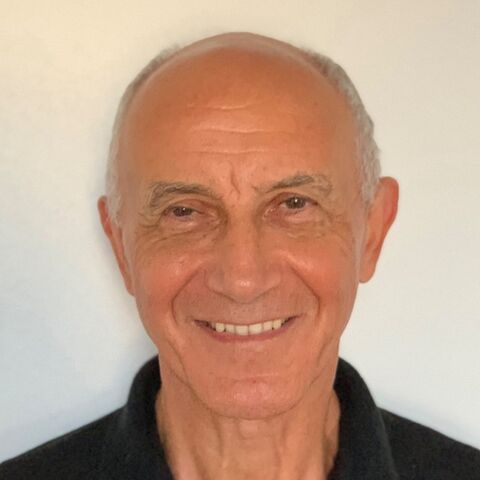
This is a conversation with Gregory Kramer about mindfulness,
About being present.
But it's not just talking about being present.
Our intention was to practice what we preach.
It was to embody the attitude of not knowing as we stay present with what happens moment by moment.
And so,
This conversation is like music.
The meaning is not so much in the details as in the flow.
How do you listen to it?
We invite you to slow down and participate in the process.
Check inside what emerges for you as you share this space with us.
Hi,
Gregory.
Hi.
So,
We're going to talk.
And what we agreed to do is to start this conversation on the basis of not quite knowing what we're doing and where it goes.
Mm-hmm.
Yeah.
And I look at the image of you on this computer screen coming across the internet to me and realize I don't know you,
Right?
Mm-hmm.
And so,
There's a face.
There's a perception of a man.
And you have a slight smile.
And what we're doing is sort of edgy and all of that.
So,
There's that whole kind of the setup of this,
But there's also the kind of inscrutable your mind,
However I conceive of it.
And so,
I don't know what's going to happen,
But I also don't know the experience of you.
Mm-hmm.
Mm-hmm,
Mm-hmm,
Mm-hmm.
And so,
As I listen to you and you mention my smile,
I felt that my smile was expanding and I got connected to more,
To the idea of the pleasure of having this kind of experiment,
The pleasure of the little element of danger in not knowing where it goes,
But with a sense that there is an emerging trust with some degree of carefulness.
Mm-hmm.
And that is a sense of building a bridge.
Mm-hmm.
And that is something I really like,
And it feels very nice to be in the middle of it.
Although,
You know,
The question that arises as you say that,
Sergei,
Is why do we,
Why even talk about it being dangerous?
What's dangerous here,
Actually?
You know,
It's just moment by moment.
Yeah.
You know,
Is it dangerous between us?
Like I might say something cruel or I might,
I guess there's a sense of,
Oh,
People,
He's recording this,
People might watch it.
Maybe you think or I think we'll say something stupid.
You know,
Some sort of self-protective,
You know,
Fear of judgment would be the fear,
I guess,
Or something like that.
What would be the fear,
Right?
So self-protecting fear of judgment sounds right.
And for me,
It's really about the inner judgment,
The sense of maybe having a goal that,
You know,
Doesn't quite happen.
Ah,
Right,
Right.
And so the element of danger is to postulate a goal that might not be reachable.
So failure is possible.
Failure is possible.
And what feels exciting about it is creating a space where the possibility of failure is okay.
Right.
And in that space,
Paradoxically,
Failure is not failure because it's part of the realm of the possibilities.
But the key part is that notion of the possibility of relationality,
Of being enough kindred spirits,
That there is a sense of building a net from which failure,
If you want,
Is like a rupture that can be repaired and is possible to bounce back from something to,
Oh,
It's another opening.
That's where my curiosity and pleasure is.
So I'm looking at you and this word rupture,
Thinking about,
Okay,
So what is this?
What is this relationship or this relational moment?
If it's a thing,
Something that arises between us or within each of us as two separate individuals or it's something that's emergent as like existing between us,
If it exists,
It can be ruptured,
You know?
You can hurt it.
And if it doesn't exist,
Can it be hurt?
And I'm not trying to be philosophical at all.
It's really like there's this constantly unfolding process,
Like each word I speak vanishes.
You hear it,
So there's some registration in your mind.
There's registration in my mind of my own speech,
Right?
I don't know what I'm going to say.
So there's this constant,
Impermanent tumbling forward of not knowing.
And is there something in a tumbling forward of not knowing?
Is there something that could be ruptured here?
So I want to first repeat what you said.
I love that phrase,
The constant,
Impermanent tumbling of not knowing.
And the reason I like it is I think the words themselves convey the process.
So not in a linear way,
But,
You know,
And so in that sense,
When you ask the question,
What is it?
Is it something concrete that could be ruptured or if it's not,
Can it not be?
If it's a process,
You know,
In some way can the process,
So the process could be conceivably broken,
Could be altered,
But really what we're talking about is that constant,
Continuous tumbling of not knowing that's unfolding and the curiosity of being part of this process,
But also not just being totally passive in it,
But finding ways in which it can be modulated.
And it's something that's between us,
Inside me,
Inside you,
And between us.
And we each can modulate it.
And so that's kind of my representation of it.
Yeah,
By representing it,
By speaking it,
By naming it,
Of course,
That also changes it,
That creates it or forms it in some way.
Yeah,
Yeah.
And so my hope in some way is that people who might be watching this have a sense of almost visually connecting the two rectangles in which we each are with some kind of,
You know,
Design that represents this ongoing process.
And so as I'm moving my hands in doing it,
You know,
I am trying to give a visual representation of it.
There's something that's not just you,
That's not just me,
But something happening in the middle as well as encompassing both of us as we talk.
You know,
You speak of the people who may be watching this or a person,
A specific person somewhere watching this,
Right,
In the future.
So there's this weird time shift of you and me and this person that,
You know,
If I were to break frame and say,
Hi,
Person,
You know,
It's an interesting fabrication to hold that.
And that calls up for me,
Something that is just part of how I think or feel or ponder the specific is that this person,
The you that I waved to over there,
Like you on the screen,
You're a little below the camera,
Right?
So there's you and there's me,
Is the shared humanity,
Right?
So I think with some actual tenderness of who might be watching this,
You know,
Some sense of their vulnerability,
Because all humans are vulnerable in a sense,
And mine and yours.
And so with the words that I'm speaking now,
That whoever is watching this person that we now have a sense of,
We've named and they've materialized into this moment,
That we're in relationship with them as well through the construction of the relationship in our minds,
In our hearts,
Right?
And for me,
Part of that construction,
Part of that person that I waved to is knowing that tenderness.
And as I say that,
I'm looking at you now,
The image of you that I have is like a digital image,
Right?
It's just on my computer monitor,
But it's you in that sense.
And I know that you're also human and tender.
And so all of that is now in our shared exploration.
Yeah,
Yeah.
So I feel moved by your saying it.
I very much feel the presence of you out there,
Who at this point,
As we're having the conversation,
Doesn't even know that you're going to be part of it,
Very much part of it.
That's right.
And we,
You know,
But I also then moved by that notion of the tenderness or the vulnerability,
Thinking about how that is an encouragement to show my own vulnerability,
Not hide it.
There's always a tendency to hide vulnerability.
And the showing it almost as a duty to you out there,
Who at some point will be watching it,
And not to present this as,
You know,
This is a conversation that takes place at a space beyond vulnerability.
Oh,
Yeah.
You know?
So that sense of even having to affirm it even more.
Yeah.
Mm-hmm.
Mm-hmm.
You know,
The framework through which I teach is Buddhist.
Mm-hmm.
Since I teach a relational insight meditation.
And so when you said that phrase,
You know,
Beyond vulnerability,
What arises in this mind is,
Okay,
Awakening to the empty fabricated nature of self and the peacefulness that comes with that,
Because you don't have to defend,
You don't have to get,
You don't have to build up yourself.
And so,
You know,
That brings the question to this moment,
To you and I,
You know,
What is my self,
The Gregory self,
Or your self?
We're back to that question of safety.
Do I need,
Do I feel vulnerable?
Do I have something to protect?
And in our moment of relational contact here,
You know,
Is there danger?
Is there love?
Is there emptiness?
Is there something that I need to know about,
That I want to know about?
I don't feel that.
I don't feel like I have to create anything more than just to be with you,
To really be with you,
You know?
Yeah,
Yeah,
Yeah.
So yesterday night,
I saw a wonderful concert that included three people,
And they call themselves the Deuce Trio.
And one of them comes from the Iranian-Persian tradition of music.
Another one comes from a Chinese tradition of music.
And the third one comes from tabla.
So the first two have string instruments,
And the other is an Indian tradition.
And they've been together,
Two of them for 30 years,
And the third one joined them 22 years ago.
They each have separate careers where they're masters recognized at each of their own level.
They do things together,
And the things they do together are based on an inspirational quality of being very much in the moment.
After the concert,
They shared a little bit,
And were talking.
And what came up for them is that loving quality they have about being very much in tune with what each person is doing and responding to it in the moment in such a way that what comes up every night is different.
But it's really both,
You know,
Rooted in their experience,
Their skills,
And their connection.
For sure.
And so what you were saying before reminded me of that.
And so it's in a way a framework that comes together.
As we're having this conversation,
I'm also remembering the connection of these three people and how nice it was to be in that field.
Right.
Right.
Beautiful.
Beautiful.
Yeah.
I've been to musical performances of similar groups,
You know,
Each masters of their instrument,
And they're coming from different traditions.
But meeting in a place that we're going to the edge,
Like we talked about,
It's not just okay.
It's what you have to do in improvised music.
You have to do that or it's not alive.
And I guess right now you and I,
You might say have to do that or it's not alive.
Like I didn't come with preconceptions and so on and so forth.
I didn't even know exactly,
Not exactly what we would do.
I didn't know at all what we would do.
And so here we are.
And,
You know,
Then does this feel alive,
You know?
Yeah.
Yeah.
And it does.
It does.
I feel very,
The mind is very clear and bright.
It's kind of spacious.
I feel steady,
You know,
With you.
Your attention is very steady.
Your eyes are steady.
You're just the way you're paying attention,
You know?
So we have our moment.
We have the edge into which our musical instruments can play.
Yeah.
Yeah.
Yeah.
So I didn't know either what we were going to do.
I had the hope that we might be able to do something that would be authentic,
But I did not know in what way it might materialize.
And the little conversation that we had at the beginning,
The moment of silence and that the beginning of the connection gave me more of the hope of formalizing it this way.
And then as we started proceeding,
In a way,
It took a momentum of its own.
And so I have a sense of very much being driven by the space,
Not in a totally passive way.
I really have a sense of contributing to it,
But a sense of there is something.
So your notion of what is the self,
Not of being a self in my little corner pushing buttons or pushing handles to make something happen,
But both of having something that is beyond me,
That's a process going,
And of,
To some degree,
Having a role in the process.
And very much the sense that there is a co-creation and a great,
Great appreciation for the co-creation,
Which goes with,
It's really nice to find somebody willing to play at this,
To play with me and to play something that I really enjoy.
So there is very much that emotional component to it.
As we go on,
We've been doing this for a while now,
We've been talking for a little while now,
Building our relationship,
Exploring our space.
It reminds me of the early days when I was developing Insight Dialogue,
And one of the values,
If you will,
Was no topic,
No agenda,
No nothing,
Just start.
To tell the story of it very,
Very briefly,
I found when I began to introduce into this fertile space,
This fertile moment,
This dynamic,
Where we're both paying close attention to what's going on,
To drop into that a wisdom seed that said,
Okay,
Yes,
It's still just present moment experience,
But look over here at this aspect of experience.
We started to look at the self,
Or we started to look at vulnerability,
Or whatever.
Roots of that,
Whatever that wisdom seed is,
Being deep enough and strong enough,
I found the dialogues became very,
Well,
Potent.
So what I'm wondering is about this experience now,
It's a question for both of us,
Is how do we feel about the circular,
Ungrounded,
Constant emergence without that kind of seed?
As you're stating this,
It helps me create a narrative for what has happened.
And in a sense,
You talk about three pillars,
And so we have one pillar,
Which is a meditative attitude,
That sense of slowing down,
Of observing,
Of being connected,
Of essentially being mindful.
We have the relational component,
And so the third pillar,
Which is the wisdom it's based on.
And my sense of it is what has been,
If we look at the dialogue in light of what you said,
There has been an emergence of that question,
As to say,
What is it based on?
And so it started with the notion of talking about the self.
And so talking about the self is a way of each having a little bit of the narrative we have around it,
The theory.
And as you said,
You're grounded in the Buddhist tradition of Dhamma.
And I am,
Of course,
Very interested in the Buddhist tradition,
But I'm more grounded in the practice of psychotherapy,
Of experiential psychotherapy,
Of trauma-informed psychotherapy.
And the practice of focusing,
Which is a form of mindful dialogue.
And so,
In a way,
We can have this in the presence of two wisdom traditions or wisdom narratives that have a lot of overlap,
But are not the same.
Right.
Yeah,
Various elements of what you just shared are kind of present and ready to come back up into this now silent moment,
Trauma-informed,
Even psychotherapy.
But something about my sense that what wanted to emerge from the discussion is the sense that,
Yeah,
It's hard to really have a full discussion if there's not also that element of a quest for wisdom and a sense that the conversation is both informed by that wisdom,
But also a way of testing it.
So very much as in my work as a psychotherapist,
Where we have theories,
We have some sense of understanding of people.
And so the process is fueled by it,
But the process is also an inquiry about how the direct experience of the moment might fit or not fit with that theory.
Right.
The question comes up right now of purpose,
Intention.
How are we aimed?
What's the orientation of the heart right now?
Yeah,
Yeah.
So I'm noticing that I'm feeling very grateful that you didn't just say purpose or intention.
You said also orientation of the heart.
And I know that with the question about purpose,
I have a knee-jerk reaction.
You're going into more of either intellect or finding something that makes sense.
And orientation of the heart brought to me more of that sense of it feels good to do it.
Which is a totally different answer.
And one that I'm much happier giving.
And I come alive with it.
And so as I said,
That's why I felt grateful from that possibility,
Because the shaping of the question that way brought a different part of me in relation to it.
And so I feel like there's a step forward in the conversation.
So as we're doing this,
Sergey,
Then this does feel good.
I mean,
It's a pleasant or a happy thing to be engaged in.
And that's enough.
Is that what I'm hearing?
Is that right?
Yes.
And not totally true that it's enough.
There's other probably sense of meaning.
I mean,
I wouldn't have started if I didn't want to share something.
So there's other layers that come back to it.
But what felt nice was just that sense of,
As an answer,
It would be enough.
But I can pile other things to it.
And to say,
I hope that actually what this is,
Is giving,
Sharing with people a sense of possibility.
And demonstrating something that you and I are enthusiastic about in showing it,
As opposed to just talking about it in an abstract way.
So,
You know,
That stuff.
Right.
Yeah.
And what comes up for you?
Hmm.
There's a sense of wanting to learn,
Like whatever I can learn from this situation and from you.
There's a sense of what you just said.
What can this conversation that has no agenda and that has these spaces,
What can this bring to who's ever listening,
Watching?
I would love for anything good to come to anyone.
Whatever is good here,
If it goes into the world,
Good.
So there's that.
And the intrinsic goodness or value of,
I can feel that all of this pausing and investigating,
My mind feels very clear and very bright.
And that has intrinsic value.
Aside from being somewhat pleasant,
It's also,
I think,
Good conditions for a more peaceful,
But also more moral life.
A life without,
You know,
Where the habits of the culture,
The inclinations of the culture around grasping,
Creating more and more excitement,
And really,
You know,
Stimulating stuff is such a,
You know,
There's so much pressure in that direction,
And this is not that.
So I like that quite a lot.
And I feel it in my own mind state right now.
I'm not grasping at anything.
Yeah,
Yeah,
Yeah,
Yeah.
So I definitely relate to the non-grasping.
And,
You know,
Just feeling it in my body,
Like that sense of the body being more open,
As opposed to kind of that closing in,
Where,
You know,
The movement of the hand grasping is replicated by the whole body.
For sure.
So that sense of the grasping being related to fear.
And so a space that is created,
That is safer.
And so you mentioned how it's a welcome respite from a more grasping world.
But so the sense of building an oasis,
Where it is possible to experience that,
As opposed to being caught in that circle.
Right.
Got it.
Got it.
Got it.
Yeah.
So I think,
Again,
Of someone who might be watching this,
Listening to this,
And a wondering,
Comes up.
I guess in its simplest form,
It's something like,
Well,
Is this,
Watching this,
Creating in you a sense of space,
Or wonderment,
Or non-pressure,
Or peacefulness,
Or wholesome curiosity?
Yeah.
Yeah.
Yeah.
And so I love the question.
And I,
In a way,
It brings me into a place of stepping out of the screen and putting myself outside,
As if I'm watching it.
Right.
And though from my own experience of watching things,
I see how it's not necessarily the intrinsic quality of what I'm watching,
But also the space where I'm in at the moment where I watch.
And so what comes up for me is there are some moments where I would be watching something like this,
And it would draw me into that calmer space and that deeper space.
There are moments where not only would it not draw me there,
But I would have tremendous difficulty connecting to it.
Of course.
And because,
And so that's the,
Maybe that's something that is very much part of,
That needs to be said in a way,
That it's not just that,
Say,
What we're doing or representing is something that immediately speaks to people,
But it's an invitation to put yourself,
You out there,
You know,
Who we welcome here,
To put yourself in conditions where you yourself are already a bit in that spirit so that you can connect to it instead of feeling disconnected because you're not on the same rhythm.
If you're in a jagged rhythm and this is a quiet rhythm,
Then it's a disharmony.
Right.
I don't know where this is going,
But I just come back to the image of this musical group that you shared,
And the experience of listening to music as being,
You know,
Some kind of mystery that these changing sounds,
The mind is changed by the changing sounds,
You know,
And some music,
Of course,
Is just to,
You know,
Excite and stimulate,
To entertain.
Some can be very,
Of course,
Contemplative,
And there's so on and so forth,
But the point is what we're doing here and then someone is watching and listening and maybe,
You know,
So our interchange enters their perceptual field.
They hear,
They see,
Enters the mind.
So even as I speak the word mind,
That word enters their mind and something is vibrating.
Something is,
You know,
Maybe it's like,
Oh,
Finish your sentence,
Greg,
You know,
It's like maybe there's some sort of like,
You know,
Jumping out to a judgment of it or maybe it's more like music where the meanings of what we're saying are really just the surface.
What's really going on is the contours,
It's an invitation to present moment experience.
Yes,
Through the senses,
But it's just like music.
It's not just about frequencies and timbres and rhythms.
It's the flow of it that then captures you.
So is there that happening now with our esteemed listener?
So as you do that,
I almost feel like apologizing to the listener and to say if it hadn't been based on not knowing,
If I had known at the beginning where we are now,
I would have told you,
Dear listener,
That first and foremost,
The invitation is for you to find that place where you can slow down,
Have that sense of inner connection,
Curiosity for,
And room and space for somebody else,
And that as you start to develop it,
You hopefully would then be untrained by the rhythm of our conversation to be part of it as well.
And what I want to apologize for is in a way not having prepared somebody for something that is an unusual thing when we listen to a conversation.
Usually we expect that the conversation will guide us places and my hope for this is actually to help people find an inner place that brings them in resonance with us and I wish I had done more to prepare people for that.
So you'll have to come up with a good title and a good description.
Yes.
And so I'm wondering if actually this is maybe as we're talking,
Coming back to the beginning,
A good way to find an ending and should check what comes up for each of us as we contemplate that.
Well,
It feels appropriate to me.
Yeah.
But I've now realized I have this kind of fondness for the listener,
This person we don't know.
I don't have them imagined with a gender or an age or anything like that.
But it's more like a tender attention,
Attentiveness.
If anyone actually sits through this thing,
You know,
There's something kind of beautiful about that to me.
Yeah,
Yeah,
Yeah.
I also have a gratitude,
Almost very selfish,
For the listener.
If it were not for the listener and the idea of doing a conversation,
A podcast conversation like this,
It would never have taken place.
So in a way,
They're instrumental in this happen.
There's a funny switch that happens in my mind when I contemplate that.
And it's something like the actual listener,
The person,
If there's someone watching this,
The person actually seeing and listening to these words now is a real human being.
But what made what you said happen or possible was the imagination of a listener.
Like,
Okay,
We're going to have this conversation because someone's going to listen to it.
But that's not this person who's actually listening to it.
That's just this notion.
It's a construct.
But there's a real person,
We think,
Listening to this.
That's quite a charming little twist,
Isn't it?
Yes,
Absolutely.
From the virtual to the real.
And yeah,
Yeah,
Yeah,
Yeah.
Well,
That could be a good closing line from the virtual to the real.
Yes,
Yes,
Very much so.
So I'll ring a bell.
Thank you.
And while I ring the bell,
I'll put original sound on so that you can actually hear it.