Thanks for joining us here on Pretty Spiritual where we're attempting the unthinkable about how to navigate this messy,
Beautiful,
Imperfect life with spiritual tools,
Principles,
And our own personal stories.
So we're not experts,
We're not religious,
We're definitely silly.
We're honest,
Real,
And willing to share.
So join us as we connect,
Bond,
And grow together.
Hello,
Sweet spiritual friends.
Hi.
Hi.
Welcome everyone.
Thank you so much for joining us today.
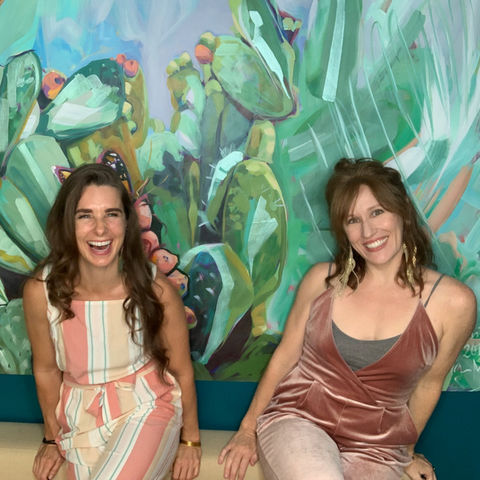
I'm Lindsay Poney and as always to my left is the wonderful Ella.
Hello.
And to my right,
The fantastic Annie.
Hi.
Now,
We've hinted at this topic before and we feel it's about time to define and get into codependency.
Oh,
I have to tell you,
I'm already,
I've been so worried,
Hoping that you will like this just as much as you should.
Please like it.
In true codependent fashion,
We asked you all to look up codependency and today we are going to do it for you.
Just in case you weren't going to do it right.
We know you weren't.
You couldn't do it right and not at the right time.
So let's just get it done for you.
Codependency manifests in large and varying degrees of severity and not all codependence are unhappy while others live in pain or quiet desperation.
Codependency is not something you heal and are forever done with,
But a practice you can start today that can improve yourself,
Your life and your relationships.
Often we think of codependency,
We think of a codependent specific relationship.
Today we're not going to talk partner specific codependency,
But codependency tendencies,
The definition that helped me to suss out what I'm trying to explore is your mood,
Happiness and identity are defined by the other person you're interacting with,
Whether it be your significant other,
Your parents,
Your children,
The barista,
Your boss,
Strangers walking down the street.
Perhaps you are the special codependent that is quite concerned with strangers you pass by.
Are they sad,
Mad,
Unhappy?
Did I do something that caused them this?
The more I investigate codependency,
The more I recognize it in most of the interactions I have on a daily basis.
As social creatures,
Codependency seems to be our natural instincts gone astray.
Can we identify where we go from healthy dependency to codependency?
Here are some signs of codependency,
Difficulty in making decisions,
Difficulty in identifying your feelings,
Difficulty in communicating in a relationship,
Valuing the approval of others more than your own,
Lacking trust in yourself and poor self-esteem.
Jeez,
I wrote late.
Goodtherapy.
Org,
Here's the definition.
Codependency is characterized by sacrificing one's personal needs in order to try and meet the needs of others and is associated with passivity and feelings of shame,
Low self-worth,
Or insecurity.
Today it is more broadly associated with the behaviors of someone whose actions and thoughts revolve around another person or thing.
This can also lead to a loss of our own identities and trying to caretaker people,
Please,
Or guess what other people want.
With this general broad stroke of codependency,
Ella,
Could you start us off?
What does codependency look like in your life today?
Is codependency something you struggle with and what does it feel like?
Actually,
No,
I don't have any experience.
Okay,
Next,
Annie.
Hi,
Go ahead.
I was going to say it's just such a perfect topic.
It's so amazing and so sticky and it was actually really cool in thinking about this to see how far I've come when I'm looking at all of the things you just described as the signs or experience of codependency.
I just want to reiterate what you said,
Which is that my experience is that codependency is this survival instinct that has gone far beyond its proper usefulness.
I want to just encourage all of us not to go to war with the parts of ourselves that we don't like.
And one way that helps me do that is to recognize that there's utility in this experience.
So I'm grateful that we,
As human beings,
Have this instinct that prefers peace over conflict.
And I'm grateful that we have the capacity to wonder about what someone else's experience is like.
I think those are awesome things.
And just when this survival instinct goes on high alert,
That it can cause these really sticky weird situations and relationships.
So let's love the uncomfortable parts of ourselves just as an experiment.
I think we've all tried the other way.
I mean,
You're welcome to keep trying it if you want,
But so far it hasn't worked for me.
So I'm going to try this way.
The way it used to be for me in terms of essentially hurting myself to stay in relationships was probably the clearest in romantic or sexual relationships.
And the first example that came to mind when I was reflecting on this is that in the past,
I dated men who wanted to have open slash polyamorous relationships.
If that's something that works for you,
More power to you.
Like amazing,
Go get it.
For me,
I had all of the information I needed,
Which is that constitutionally that kind of thing wouldn't work for me.
But because I was afraid of losing the relationship or causing someone disappointment or bad feelings,
I kind of pretended that that would work for me.
And so then what would happen is that I would pretend that I didn't have the needs I did and then avoid conflict until all of the pressure from those unmet needs essentially exploded all over the other person.
And then I would end the relationship.
I would get to this breaking point with rage and indignation and unmet needs.
And then it would be like a fiery explosive wreck.
And these days,
It's different.
It manifests in situations where denial and avoidance are the like protection mechanisms that are trying to keep me safe from spiritual growth.
There are kind of two ways that I've been really noticing codependency happen for myself lately.
One is that I focus on what other people are doing so that I don't have to take responsibility for myself or so that I can avoid really seeing my patterns.
Instead of looking at what I need to do to take care of my spiritual or physical needs,
My brain will do this like obsessive focusing on what someone else is doing.
And side note,
It's usually wrong.
And then I'll direct all my kind of energy toward like,
How can I fix it for them?
And oftentimes this happens in the morning when I'm trying to avoid doing my long morning physical therapy,
Spirituality,
Routine stuff.
And then the other way that it happens is where I'm in a direct relationship with someone and there's an unmet need or a boundary that I need to set.
But it's a little bit less conscious and I'm trying to figure out a way to not have to have an uncomfortable conversation.
And then it is opportunity to look at my coping patterns and how I'd prefer to let my needs go unmet and let resentment build inside of me rather than advocating for myself and saying what I need even if it's going to be uncomfortable for someone else to hear.
Yeah,
I've got a lot to say about it apparently and y'all keep talking about tools when we get there.
Yay.
So much to say.
So always so many opinions.
Annie.
Hi.
Oh my gosh,
You're right over there.
I'm just right here.
Oh,
We're so excited.
I love the examples you gave of codependency and you kind of teasingly said with the barista,
But I can totally relate.
I'm not is this person unhappy?
I wasn't teasing.
Yeah.
Okay.
That's real.
It's beyond real.
And how funny that is that when I don't have some space and tools,
I can really get into the story of this barista that I see three times a week,
I'm pretty sure they don't like me and so I'm going to smile extra big when I go in there.
Sparkle,
Sparkle,
Sparkle.
I have read that codependency,
So the use of other people as my source of value and wellbeing is a deeply rooted compulsive behavior and that makes a lot of sense to me because it's happening in my brain,
But I can feel it in my body.
There's this compulsion to behave a certain way and it feels like dangerous to counteract that.
So I've been working on this a lot the last couple of years and have been really confronting,
Noticing when that feeling,
That visceral pull in my body to behave a certain way or to say a certain thing comes up and how uncomfortable it can make me to pause and not react to it or engage with it.
And so I just want to say,
If you're in the middle of it,
It makes a lot of sense.
It felt like it was woven into my DNA,
So to not do it seemed crazy.
For so long,
I didn't even think about my knee-jerk way of avoiding conflict.
It seemed smart.
I was like,
I'm smarter than everyone because everybody loves me.
I'm so nice.
I fix everything.
But I didn't really recognize it as codependency and this needing approval from others.
And what,
Lindsay,
You were mentioning at the beginning,
These two parts were at the heart of it,
Not being able to make decisions for myself and not knowing what I like and if I did,
Not really trusting it.
So underneath the codependency was this part of being really uncertain or not having a solid sense of Annie.
So I was constantly using other people to guide me on what Annie is and how she's okay and to make my choices and decisions within the framework of other people.
As I've been doing this work over the last few years,
I've been really practicing getting to know who I am.
And I don't mean that in a cheesy sense.
Maybe it sounds cheesy,
I don't know.
But like,
Honestly,
What is it that I think about things?
What do I want?
How do I want to be in my life?
Going underneath that sparkle Annie facade to really connect with who I am.
And meditation has been invaluable with that.
Prayer has been invaluable.
Having a spiritual relationship has been invaluable because it's like,
What if there's a source that's not me because sometimes I don't always trust myself,
But it's also not other people that I can draw on.
And it turns out that that spiritual source really is part of me.
And so then as I've been doing this work,
There's this sense of integrity that has been building in me where it's okay to disagree with other people.
As I share on this podcast,
In my life,
I'm not this complete doormat,
But there's just this way I have of navigating the world that is very smoothie ovary.
And it's like,
Suddenly I'm becoming more of like,
And it doesn't even really create conflict in my life to have an opinion or to have this sense of integrity,
But I had been so terrified of it.
So the thing that my somatic therapist,
Shout out,
Always says is you can't predict control or manage how what you do or say will make others think,
Behave or feel.
I'm like,
Oh,
You're definitely wrong.
You're lying to me.
Somebody cross stitch that so I can frame it in my room.
I'm going to repeat it.
I'll say it in the I version.
I can't predict control or manage how what I do or say will make you think,
Behave or feel.
Also shout out to the construction going on next door.
That was just me banging my head against the wall.
I'm sorry,
I'm done now.
I'm feeling very codependent,
Hoping that you all will please forgive us that there is construction next door.
So that's what's happening.
That's amazing.
Thank you so much.
What about you,
Pony?
Look,
I am capable and able.
Yeah,
You are.
Go Pony,
Go.
Go Pones.
Thanks so much for helping shed some light on this very confusing,
All consuming,
What seems to be like parts of me.
Codependency and my experience with that,
What it looks like for me and some examples of my own personal flair for codependency include.
.
.
Pony flavor.
It's quite delicious.
Feeling like a burden,
As though I need to shrink and make myself as small as possible,
To not have any feelings,
Wants or needs because your feelings in life are so much bigger and more important than mine.
I would go before and I would get this chicken.
It's very delicious.
Pony loves little birds.
I haven't.
.
.
Okay,
It's not me to love them.
It's true.
There was this wonderful market where you go there and they say,
Oh,
Would you like me to cut this up for you?
I would always say yes.
Then they would cut it up into fourths.
I learned that they would cut it up into eighths from a customer that was next to me.
He was like,
Oh,
I would like that in eighths.
That's what they said.
They told them.
That means it's like perfect bite-sized little pieces.
Of course,
Obviously I'm going to be eating this.
It's my walking around meat.
Eighths would be perfect.
I was like,
Wow,
But I could never ask for my chicken to be cut up into eighths.
How dare I?
Don't even think about it.
Who do I think I am?
I may have fourths,
But eighths,
That's too much work for them.
Outside the lines.
I can't have them do that for me.
I can't tell you how many years I went knowing I wanted my chicken cut into eighths.
I'm going to cry.
Don't go there as much anymore,
But I did realize what was going on and I started asking for it to be an eighths even though it was incredibly uncomfortable and hard for me.
Guess what?
Not a flinch from the person cutting the chickens.
It's not amazing for years.
Years.
Wow.
Years.
Constantly scanning other people's expressions and dialogue for hidden meanings of their wants and needs.
This is so exhausting.
It's just casual.
It's not a lot of work.
I'll just do it in the background the whole time.
I'm alive.
The whole time.
Trying to read your mind and your feelings to get mine to match up with yours.
If I have the same feelings,
Then I can be safe is this narrative I've noticed underneath all of it because I've gotten really curious.
Instead of just being like,
I've just gotten really curious about the operations of things and underneath it,
I found that there's this narrative that I would be safe if I had the same feelings.
This has just led me to an inauthentic life.
A lost identity and an inauthentic life because I'm just trying to match whoever I think you are.
One time a woman said to me that someone had said to her and we were so much alike in our codependent ways and I'd realized that.
Why are others lives and feelings more important than your own?
I didn't have the answer then,
But it comes from ignoring and negating our own needs growing up.
It's just more of this habitual,
I have no idea what I'm trying to say.
You're doing a great job.
So great.
Codependency is so difficult for me to identify,
Especially in real time life moments and then to try and break this apart with language.
Maybe you're identifying with me in that this is just very difficult.
Just somewhere along the line,
I interpreted that everyone else's feelings and lives were more important than mine.
It feels really sad.
It feels sad too when I see myself doing it in real time.
But the good news is that if I'm able to start identifying this in real time and even being with that grief and what it feels like to have this lost identity or this lost person that I'm trying to get back to,
It's actually the good news because I'm starting to see where I will get to have more of a choice and more agency in maybe being able to listen to myself and I will tell you how I'm exploring how to do that when we get to the tools.
Sweet pony.
I also just want to say in case anyone is having that same experience that when we're little and a caretaker puts more weight on our behavior or attitude than is appropriate,
It can naturally lead us to feel like we're responsible for people and things that we're not actually responsible for.
So I think a lot of people have that experience where they weren't allowed to be children when they were children and as a result,
They've grown up thinking that they have more responsibility than is reasonable.
Yeah,
I do know.
Thank you.
And we love you.
In healthy codependency fashion,
I mean in healthy dependency fashion,
We can share tools to learn and grow from each other.
Let's share our tools for codependency.
Yay.
Yay.
We're going to share.
Ella,
Why don't you start us off?
So great.
I'm really excited that we're talking about this and just sharing all these tools.
So like I was talking about,
I have identified these two types of situations where codependency really comes up for me today.
And the first pattern is where I'm obsessively focused on how someone else is doing because I don't want to,
Because I'm avoiding taking care of myself or taking responsibility for myself and that pattern is characterized by judgment.
So I'm judging how someone else is doing it and I have better ideas than they do,
Of course,
For how to do their life.
I'm like,
If you would only ask me,
Then I could share them with you,
Share my wisdom.
So that's the first pattern.
And the second pattern is this place where I am feeling resentful at someone else or blaming someone else because there is a boundary I need to set that either I'm unaware of it and resentment and blame are just kind of the natural responses or I'm aware of it,
But I'm scared to do it.
And then it's the more kind of like justification and rationalization.
Rationalize a ration of lies.
Oh,
I just dropped that.
I'll give you a moment to give you a moment to scoop your brains off the floor and put them back in your head.
So for me,
I've talked about this on other episodes,
I use the experience of judge judgmental type obsession or of blaming kind of justification resentment as signposts.
So I know that in the morning when I'm focusing obsessively on someone else and how they're doing their life and I'm feeling judgmental about it,
That judgment that kind of feeling tone is the signposts that points me back to myself.
And I can also use the feeling of blame and resentment and justification as a signpost to point me back to my own spiritual work.
So I'm going to talk about what it looks like in each of those situations to like see the signposts.
So to acknowledge the judgmental codependency signpost,
I see what my brain is doing.
Like I have the awareness that I'm having these kind of obsessive judgmental thoughts about how you're doing your life wrong.
And if you would only ask me,
Then I could share all my really valuable opinions with you.
And when I see that,
When I have awareness of that,
I can use it to drop that kind of line of thinking and ask myself questions like,
What is the next right thing I need to do to take responsibility for myself?
And surprise,
Surprise,
I'm often in that kind of like judgment hole when there's some self care thing I need to do that I'd prefer not to most of the time.
That's how I feel about taking care of myself.
It's like,
No,
Thank you.
I notice that a lot in the mornings,
Like I said,
Because there's a lot to do to take care of my body.
And then the other kind of situation where I'm experiencing this kind of like blame or justification when I notice that,
And usually resentment and blame are really strong signposts for me that there's some internal work to do.
I use written inventory to kind of dig around and probe what the dishonest,
Often subconscious broken beliefs or broken core ideals are for me.
Often what those sound like are things like,
It's not okay to have needs.
I'm a burden.
It's not just pony flavor.
It's anyway,
I'm a burden.
I'm a disappointment.
I'm doing it wrong or they're doing it wrong.
Usually both.
Also,
I should know better and they should know better.
So when I can acknowledge this broken thinking around a certain dynamic or relationship,
I can start to see the places where I'm letting codependency dictate my actions.
And what that looked like recently is I needed to set a boundary at work around being paid on time.
And when I got to doing this writing,
I saw that I was essentially giving away all my power to this other person.
And what was happening as a result of that was I felt like my needs weren't valid.
I felt like it wasn't okay for me to have needs or God forbid,
Like ask for them to be met in a clear,
Direct way.
And I was also seeing how basically when I was in that kind of state of fear that I was essentially on my heels,
Like someone was like coming at me,
Force of their impact was pushing me backward,
Causing me to not be able to connect in this like really grounded way.
And so what I started looking at was how can I connect and feel grounded and like I'm safe asking for what I need instead of feeling like I'm on my heels,
Someone's coming at me,
I need to defend myself or my opinion or my need.
Fear has really helped me with that and so has meditation.
And when I started doing that work to look at like what what does Ella look like when she's on her heels and that's like me justifying explaining why I need to be paid on time.
I don't need to justify or explain that it's a statement of need,
I can make the statement and let the other person decide whatever they're going to decide.
So when I'm grounded,
When I'm not in that defensive position,
When my feet are kind of flat down,
I'm not on my heels,
What it feels like is I don't have to be afraid of this person,
I feel safe stating my needs,
Even though they might be really uncomfortable for this person to hear.
I feel when they come at me with like a lot of questions,
Multiple questions in a row,
You know,
Kind of like trying to put me on my heels,
I can say stuff like,
You know,
I'd be happy to talk about that,
But I want to bring us back to the main issue at hand.
This is my need.
This is my bottom line.
And so I can tell the truth in a way that's very kind when I don't have to be afraid of the person I'm talking to.
And actually the miraculous thing that happens when I do this work and I remember that another person isn't God or higher power when I remember that this is just another suffering human being,
Then what that enables me to do is do all of this boundary setting without any rancor or ill will and actually feel safe doing it.
Like I don't have to be,
I don't have to take the bait.
I can just trust that my needs are valid.
I'm allowed to ask for them directly and people are totally allowed to respond or react however they choose to.
Woof,
Woof.
I've got a lot to say today,
You guys.
I just let it all out.
That's right.
Thank goodness.
Annie,
Please let us know if you have any tools for codependency.
It's okay if you don't.
Thank you.
I won't be okay if you don't have tools.
I just want you to know that.
I am relying on you.
We are hitched to whatever's about to come out of your mouth.
So I'm married to a woman who knows her mind immediately and instantly and it is so different than me.
Like just within a second,
She knows,
She's certain,
It's definitive.
And I used to get angry at myself that I wasn't like her.
I'm not good enough.
My brain doesn't work the right way.
And now I've started having compassion for the fact that,
A,
We're just different humans,
Right?
But also that I do have these codependent traits and that there are tools that I can have to work out of that.
So for this,
Specifically in that like need to know,
This is referring to when Lindsay was talking about different signs and traits.
And one that I've really noticed in me is this challenge in making decisions or knowing what I want.
When someone's right next to me and knows exactly what they want and I don't know what I have learned,
I can do is I can pause and say,
I need to think about it.
Like I don't need to know an answer right away.
Whereas before I'd be so angry at myself or I'd pretend I knew what I wanted.
And I can actually say,
I need some time to think about it.
And I can also just internally acknowledge that it takes me a minute to know my mind and that it's not a shortcoming.
And maybe that's just how my creative brain works.
It wants to look at every single color in the rainbow before it chooses one.
You're so creative.
Also with all our tools,
Remember codependency,
Like we said,
Is this deeply ingrained behavior.
So shifting its course is a process.
Lindsay's talked about process in some of our other podcasts,
And it's not just a decision and then it's done.
It takes attention and compassion.
So be gentle and just know that if these tools seem overwhelming,
It's okay.
They don't have to make sense.
Maybe just as we're talking,
Let them seep in and they'll plant some seeds for some time down the road.
Or maybe you already know how to do all this and you're going to teach us some stuff.
Teach us.
Can't wait.
Some other tools I use is investigating where my resentment is.
And so if I'm cranky with someone,
It's usually because a boundary has been crossed or this is the most often the case,
I never made the boundary clear.
What boundary?
What?
I don't have those.
So if I pause and do some spiritual investigation of why I'm upset,
I can usually see I'm not tending to myself because I'm caught up in this cycle of codependency.
So I've just like the pause again,
Pausing for me is really key with this because if it's this compulsive behavior,
It's a knee jerk reaction.
So if I can slow down,
I can,
Instead of being like,
I'm so mad,
My wife always makes all the decisions.
I'm like,
Oh,
Pause.
Can I get underneath of this?
What's actually happening?
The next step is healing from trauma.
Small one.
Just done.
Done.
But I have noticed that when I had this unhealed trauma in my body,
I felt like I was only okay if other people were okay.
And this was really subconscious.
And it was through like professional help and healing acupuncture that the traumas had a chance to move out of my body and really as that has happened is the first time that I started to have some room for my wants and needs and a whole sense of self.
And I don't mean wants and needs like I need some new boots,
But like,
Who am I as a person?
How do I need to navigate this world?
Like what makes me feel good and safe?
And then just the last part of my tools,
Again,
Going back to this element of not knowing what I like and having a hard time making decisions.
So when some areas I love us as humans because we're not all one thing or the other.
So there's some parts of my life where it's really clear and I don't have a hard time making decisions or I know what I like,
But there's a lot of stuff where I'm just like uncertain,
You know,
And it's not,
It seems abnormal.
So a tool that I have been doing is noticing it.
Like Pony was saying,
Like sometimes she doesn't even notice when this stuff's happening.
And so for me,
The first part has just been like,
Am I not even aware of what I want or need right now?
And am I giving credence to somebody else's ideas or experiences over mine?
And it doesn't mean I need to fight,
But it's just like,
Am I even aware of this?
So this is a kind of a fun thing that I've been doing is just exploring it.
And it's been over the last few years,
My wife and I travel a lot and we always,
I love contemporary art and we always go to art museums.
And I realized at the beginning of all this,
I didn't really know what kind of art I liked,
You know,
I couldn't explain it.
Like of course I was drawn to some things,
But if someone said,
That's the one I like,
I would have a hard time saying,
Well,
This is the one I like over here.
And I was like,
I don't know what I like,
You know,
Or I don't think if I do like something,
Cause of course they'd have a poll,
I would think it was wrong.
I'm going to pick the wrong one.
It's going to be obvious that I don't know the stuff.
So I have a fun exercise.
It's specifically around art just cause I think art is so soothing and like can potentially therapeutic,
But go to a museum by yourself and look at the artwork and bring a notebook and walk through and ask yourself,
What do I like without fear judgment of somebody's going to think I'm picking the wrong thing or even you judging yourself and you thinking you're going to pick the wrong thing.
Just kind of let go or notice when you're judging yourself,
Say,
Oh,
What do I like?
And just write about it.
You know,
Do I like bright colors?
Do I like bold patterns,
Watercolors,
Pastels,
Dramatic abstracts,
And keep it in a journal and you can start doing stuff that like even your environments,
Like,
Do I like being in busy coffee shops?
Do I like being in libraries?
Start keeping this journal of the things that like you like and then make you feel good.
And you'll start to build some data on like who you are and kind of start to see like there's those be this case evidence of like you are a person who haven't has an experience and it matters,
You know,
And you can kind of lean on that.
That's all we love you.
That was so great.
Oh,
That's my favorite tool,
Annie.
Thank you so much.
And just my tool is going to really just kind of build on that because it's really like I was talking about losing our own identity as we're so focused and concentrated on what we think others want or need and how that's more important.
So getting to come back to self and really be more in tune with our authentic self.
It's the idea of putting out of our minds entirely what the other person wants,
Like needs,
Whatever we're intuiting,
Imagining,
Constructing,
Putting that completely out of our minds and coming back really deep into self and asking myself,
What do I want?
Like,
In this moment,
What do I want?
And it's okay if my habitual knee jerk reaction is,
You know,
If you're significant other,
Your friends are like,
Well,
Where do you want to eat?
Well,
Where do you want to eat?
If you even- What are you in the mood for?
Oh my God,
I hate that question so much.
Whatever you're in the mood for.
That's always a really good indicator right there to pause and take that moment and really,
What do I like to eat?
What is the food that I would choose to eat right now if I wasn't concerned with you wanting it or liking it or it being- Will you be happy with my response?
The amount of time and energy that this takes up.
And really,
That's just my tool right now is just to even self-awareness.
That is what is in my prayers all the time.
This is very personal.
I love this.
I really see the greatest potential power is being self-awareness.
And every day that is what I pray for.
Please just,
You know,
Obviously guide me towards your will.
Sure.
Fine.
Okay.
But if we can,
I'm pretty sure I know what I need.
Okay.
And it is definitely more self-awareness.
And it's okay that this is just my spirituality.
So I understand it's broken and flawed.
Okay.
It's fine,
But it's real and it's here.
It's human.
It is.
And I just,
When it comes to tools and focus,
Willingness and self-awareness without these pieces,
I'm lost.
And if I can't see where it's so more important to me,
Your wants and needs,
I'm lost.
You know,
I am lost if I can't recognize that.
And then go in a different direction.
And it's perfectly okay if the first thing I say,
Because a lot of this for me is that what I feel like Ella taught me,
Which is the backwards step,
Which is where I make even the wrong first move and I say,
Oh,
Well,
Whatever you want.
And then I catch myself and then I come back.
I put out of my mind whatever I think I'm going to get if I answer correctly what you want.
And I put that out of my mind.
I really come back into self.
And this is really difficult.
All of this has been what?
How many decades?
What if today is the first day that I'm like,
Oh,
You can,
You really can get your chicken cut how you want.
You really can stumble over your drink order and figure out what it is that you want at the barista.
You can fully show up however clunky or messy,
Whatever it looks like as you are today and really honor that.
That's what I'm doing right now.
And one of the tools that I learned in researching,
Because honestly,
I have such extreme codependency challenges.
I'm in the grieving process before I can turn towards real growth,
I think,
Just seeing that there's a lot of change and a lot of help that is needed and a lot of tools.
And one of the tools that was suggested is date yourself.
Date yourself.
Make an active attempt at dating yourself.
And I had to do this one time for faith building for some kind of higher power because I believe I'm agnostic and perhaps maybe even atheist.
Oh,
Can I keep that in there?
Unknown.
And so you can be whatever you are.
So in dating a higher power,
That really helped me to see what that would look like.
And so now the idea for me that I'm trying to do and going to practice,
Cultivate,
Implement is to date myself and to find that real.
.
.
You know when you first start dating someone and you're really curious about what they like and you really want to know the music that they like and you're just so interested in everything about them.
I am going to turn that energy on myself in a way that I never have before.
Yes.
Sounds so great.
Oh yeah.
Has any like,
Wow,
I'm just so moved because I don't feel like I've ever done that.
I just wrote down in my notes,
Picture the world really wanting to know what is going on for you internally.
Imagine that if you really showed up authentically and expressed your wants and needs and all of that,
Then other people could really line up with you and get in sync with you.
Imagine what would happen if you did that.
It just seems like totally different.
Then we could all grow together in such a different way.
Well,
This was all about me,
So I don't have to worry about if you got anything from it right now.
Pony,
I am so love hearing about your journey and I am honored to witness it.
I feel like maybe you do this more than you know of letting us in and seeing who you are and it's so special.
I agree.
What a treat that we can all be here together.
Also thank you guys for listening because this is just us hanging out as best friends and talking about what's going on and trying to love the uncomfortable parts.
Thanks for being on this journey with us and helping us grow.
Hopefully we have helped in the beginning processes of detaching from our codependent tendencies.
This is a continual practice,
Not a destination.
The goal is balanced to recognize we are already safe,
Independent,
Autonomous,
And strong.
It could be true.
Yeah,
We want to hear from you.
Visit our website at prettyspiritualpodcast.
Com.
You can get on our email list.
You can listen to previous episodes.
Ella has made it so pretty.
We're on all the socials at Pretty Spiritual Podcast.
We love you.