Welcome,
Awake and Creative,
To this Insight Timer talk about the playful mind,
Breaking patterns and finding your creative flow.
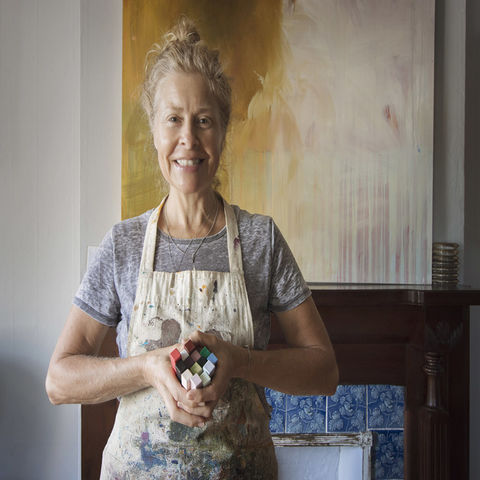
I'm Patricia Baldwin Sagerbrook,
And I invite you to sit back,
Relax,
And open your mind to possibility.
I'm delighted to share this space with you.
It's been a joy to begin expressing my truths,
My values with all of you here.
It has helped me refine and define what I do over the blank canvas.
The dance has been so enjoyable,
And I hope the benefit I feel is something that you too have been able to reap rewards from.
Thank you for considering yourself an Awake and Creative with me.
Today,
We're diving deep into the heart of creativity,
Guided by the words of a truly remarkable mind.
Gianni Rudari is an Italian writer,
Journalist,
And educator whose insights into imagination are profoundly relevant to us as artists and creators.
He gifted us with a beautiful definition of creativity that I want to share with you,
And that will be our compass for this time here.
He said,
Creativity is thinking that is capable of continuously breaking the patterns of experience.
A creative mind is one that is always on the move,
Always asking questions,
Always discovering problems where others find satisfactory answers,
Completely comfortable in fluid situations where others sense danger.
This creativity is capable of making autonomous and independent judgments,
One that rejects everything that is codified,
Preferring to reshape objects and concepts without itself to be hindered and inhibited by conformism.
All of these qualities manifest themselves in the creative process.
And this process,
Listen up,
Listen up,
Always has a playful character,
Even if we are dealing with strict mathematics.
Okay,
That's a mouthful.
I get it.
But within his words lies an incredible roadmap for fostering a truly vibrant and dynamic creative life.
Throughout this talk,
I'm going to unpack these ideas,
Reflect on creative habits,
And discover how we can cultivate this playful mind in our artistic practice.
Let's get started.
Rodari begins by saying creativity is thinking that is capable of continuously breaking the patterns of experience.
What does this mean for us?
Think about your art,
Your personal creative process.
Do you ever find yourself falling into comfortable habits?
Do you use the same color palette,
The same compositions,
The same themes?
Our brains are wired for this efficiency to create these patterns.
This is great for daily life,
But sometimes it can stifle our creative flow.
Breaking patterns isn't about rejecting what works,
But about being open to new ways,
New combinations,
And new interpretations.
Take a reflective moment,
Perhaps with a journal.
Answer some questions for yourself.
What are some of the patterns of experience you notice in your own creative work or your daily life?
Are there specific materials,
Subjects,
Or approaches you consistently gravitate towards?
Just list them,
Observe them.
This isn't about judgment.
Rodari continues,
A creative mind is one that is always on the move,
Always asking questions,
Always discovering problems where others find satisfactory answers.
This speaks of curiosity,
About a healthy dissatisfaction with the status quo.
It's not about negativity,
But about seeing potential where others may see completion.
It's about the what if,
The why not,
And how could this be different?
Take this as an opportunity in your practice today,
And maybe every day,
To introduce a small,
Deliberate change to your creative process.
Shift a constraint.
If you use bright colors,
Try monochromatics.
If you paint in silence,
Try with music.
Break one small pattern,
And see how it changes or reframes your composition.
Next Rodari speaks of a creative mind being completely comfortable in fluid situations,
Where others would tend to sense danger.
This is a powerful concept,
Something to sit with for a little while.
The creative process is inherently fluid,
It's messy,
Uncertain,
Over and over,
Not just at each blank canvas,
But at each step in the process upon this canvas.
Creativity often means letting go of control,
Fully embracing the unexpected,
And allowing your work to take you places you hadn't planned.
Many of us as artists can relate to that feeling of danger when a piece isn't going as planned.
We've deliberately put ourselves in this circumstance.
When we face a blank canvas,
The same danger signals can trigger.
But Rodari is inviting us to see this fluidity not as a threat,
But as a fertile ground for discovery.
It's in this unpredictable moment that true originality emerges.
Consider the medium of encaustic,
For example,
My personal passion.
It's inherently fluid.
The wax must melt and blend in order to be sculpted,
Scraped,
And layered.
Encaustic encourages a responsiveness rather than rigidly planned approach.
It demands a comfort with flux,
A willingness to let materials guide rather than idea.
Take out that journal again.
When have you felt that danger in your creative process?
Is there a consistent touch point in your system and rhythm?
Or is it an arbitrary showing up?
Identify it.
And then,
How do you respond?
Can you recall a time when you leaned into the fluidity?
And what was the outcome?
Rodari then says the creative mind is capable of making autonomous and independent judgments.
This is about finding your authentic voice.
It's about trusting your gut,
Your intuition,
Your unique perspective.
Even if it's going against trends,
Expectations,
Families of origin.
This independence is crucial as a creative.
It's inherent in the title definition of creative.
As artists,
We're constantly bombarded with images,
Opinions,
And market trends.
To truly be creative,
We must filter all of that through our own unique lenses.
Making decisions that are true to our vision,
Not someone else's or a prescribed design.
Rodari pushes us further,
Suggesting a creative mind rejects everything that is codified.
Preferring to reshape objects and concepts,
Without allowing itself to be hindered and inhibited by conformism.
This is about challenging norms,
Questioning established rules,
And seeing potential for transformation everywhere.
But this isn't rebellion for rebellion's sake.
It's about seeing the underlying structure and asking,
How can I play with this?
How can I reimagine this?
Think about Picasso reshaping the human form,
And Duchamp placing a urinal in a gallery.
They were rejecting the codified ways of seeing and creating,
And revealing new ways,
New possibilities.
In your creative practice,
Or your daily life,
Where do you encounter codified ways of doing things?
How might you playfully reshape or reimagine just one of these?
And finally,
Rodari's genius.
A return to the childlike wonder with,
Listen up,
Listen up.
The creative process always has a playful character,
Even if we are dealing with strict mathematics.
Play.
We forget that it's not just for children.
Play is how we experiment,
How we learn without fear of failure,
How we discover new combinations.
When we bring a playful attitude to our creative work,
We unlock incredible potential.
It removes the pressure,
The self-criticism,
And it allows for genuine exploration.
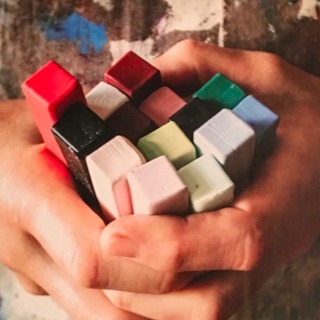
Think about the child building with blocks.
They're not worried about perfection.
They're exploring possibilities,
Seeing what fits,
What balances,
What new structures can emerge.
This is the mindset we want to bring to our canvases,
Our instruments,
Our words,
Even our spreadsheets.
So think about it.
Cultivating that playfulness,
And having a pattern-breaking mindset.
As a creative,
How do you cultivate these qualities?
Or perhaps,
How can you introduce these qualities?
If you've become constrained by the mathematics,
That is,
The rules,
Of artistic practice.
How can you become more comfortable with fluidity,
More autonomous in your judgment,
And more inclined to play and break patterns?
Curiosity is your partner.
The why and what if.
Look at your studio.
Your everyday objects.
Wonder over them.
How could they be different?
And how would this then change the world around you to a fresh gaze?
And I personally find that giving specific limitations,
Constraints,
Choosing these can then force me to think outside of a usual box.
For instance,
I often take three new colors and let a piece become from just these three.
This can often spark incredible creative flow and force,
If you will,
New pathways to open in my creative exploration.
And this is one that I struggle with.
Prioritizing play over perfection.
So often I can come to the studio thinking it's a job,
Which makes it a chore.
Rather than a beautiful place of exploration.
Your studio is a laboratory.
A place of trial and error.
A place of building blocks to see how they balance.
Not a seeking of perfectionism.
So before you begin each day,
Ask yourself what feels good?
What could be surprising?
Seek out these questions and answers.
And surround yourself in your studio,
In your home in your thinking mind with different ideas different perspectives read outside of your usual genre listen to music that's not typical to your ear and try engaging in conversations with people of different backgrounds.
This helps break old patterns of thinking and creating and open pathways to new and beautiful concepts outside of your usual range.
This speaks to community.
This speaks to places you might not entertain when you're in your studio being your authentic,
Unique self and yet are so necessary to foraging and fostering that deepest authentic self.
Events like art retreats,
Online forums they're that vital second pull that helps you delve and splunker your true self.
Ritari gives us much to think about in that one complex statement.
As artists,
As creators it can sometimes be hard to think outside of our developed mind and the creative process that has become successful to us.
Yet I have found in my three decades as an artist that successful only happens in a moment.
If I stay in it if I try to constrain myself to that one expression or evidencing that gave me that success that one moment,
That one time I am lost.
It is lost.
Only through seeking novelty,
Curiosity the what if,
The stretching the boundaries from comfort the stretching of my boundaries my comfort zone is where that next success evidences.
Only I get to decide,
And you decide what that success looks like or feels like but it happens again and again and again because you're flexible you're open you're what if-ing your way into the next.
Hold yourself true hold yourself real but remember those come because you hold yourself to your own creative practice and the influences and intrigues that meld and make it real.
Awaken creative today.