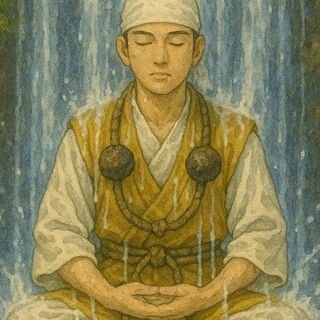
Just the right amount of ego.
For millennia meditation has been tied to the concept of ego death and of becoming selfless.
The idea is that if we release the ego and achieve oneness with the universe we will live in a state of perpetual peace.
That however might not actually be true.
While there are inherent disadvantages of being egotistical there are also disadvantages of being literally selfless.
As someone who suffers from a mental health condition that literally causes me to have no self I can assure you it's not all roses.
So what is ego?
Ego is the part of ourselves that creates the sense of self.
Which is comprised of the id,
Which is the part of animalistic desires and the superego,
The social ego.
Or at least that's what Freud would tell you.
Buddhists,
Many Buddhists I should correct myself,
Would tell you that there is in fact no self and that the perception of such is a mere delusion.
I say some Buddhists because there are different interpretations of Buddhist words.
Interestingly neuroscience can't prove either way whether there is a self or not.
Either way,
Whether the ego is real or whether it's a delusion of the mind it dominates our lives.
We humans naturally view things in an egocentric way in so far as we see the world as it relates to us as individuals.
And some people also stray into egotism whereby they view themselves as more important than everyone else.
As a whole it seems that society tends to reward the egotist who will do anything for their own success and prosperity.
And I imagine we can all name quite a few famous wealthy people who are incredibly egotistical.
Yet while society seems to reward the egotist,
Spiritualties tell us that the spiritual rewards go to those with no self because that is the path of complete inner peace.
So who is right?
Is ego a bad thing?
Let's set one thing right off the bat.
There is nothing inherently bad about the ego.
In fact many people,
Myself included,
Would argue that the ego is absolutely essential.
Problems do occur,
However,
When we become egotistical and when we hold too rigid a sense of ourselves.
And the reason for that is that life doesn't always conform to our sense of ourselves.
A few examples.
Let's say you're egotistical about your intelligence.
You always consider yourself to be the most intelligent person in the room.
But uh oh,
Here comes someone with a PhD in astrophysics who works at NASA and in comparison to them we don't feel very intelligent at all and suddenly we challenge our view of ourselves and we feel quite irked about this other person.
Or maybe we're sexy and we know it,
But then there's this one dude who just doesn't even seem to notice us.
What is wrong with this dude?
Is he blind?
Stupid?
Is he just being a jerk?
Maybe we've always been spoiled and we've grown the mindset that we are entitled to everything and any time we're told that we can't have something it drives us around the bend.
These rigid views of ourselves lead us to suffer.
The more rigidly we hold on to our ego the more we will suffer as time and again the world will refuse to conform to our view of ourselves.
So if rigidly holding on to the sense of self causes suffering surely ego death must be a good thing,
Right?
What does ego death mean?
Ego death is the dissolution of the boundary between the self and the world.
When ego death occurs it's a moment when we achieve oneness with the universe.
And if you ask most spiritualists it is the moment of awakening.
Indeed many famous thought leaders have discussed ego death such as Carl Jung who called it a fundamental transformation of the psyche and Joseph Campbell who wrote about it in The Hero's Journey.
Eckhart Tolle meanwhile describes the ego as an accumulation of thoughts and feelings that create an illusion of separation from the outside world and ego death is the relinquishing of that.
Similar notions can be found in Buddhism,
Taoism and indeed many philosophies and spiritualities.
Ultimately ego death is supposed to be a beautiful moment that leads to profound inner peace.
And yet in my experience I hate to say it but that is simply not true.
Indeed I myself have an absolute lack of self caused by the fact that I have Borderline Personality Disorder.
Yes a huge part of my mental health condition that I've struggled with these past twenty years is that I do not have a self and I can absolutely guarantee you that being literally without self is a very very bad thing.
The problem is that the mind demands a self.
It demands that we cling to something and if we don't provide that for ourselves the mind will find it elsewhere.
As someone with no self I've spent years literally becoming the people I'm around.
Anytime there's somebody with a really strong personality it's like I sink into them and become them.
And I can assure you there is nothing that is peaceful about that.
Now I do recognise that there is an elephant in this room and that elephant is the Buddhist Sangha.
The Buddhist community.
Buddhist Sanghas are full of monks who have achieved no self and who are happy,
Peaceful and healthy.
So how do we explain that?
Well here's the thing,
Buddhists do not genuinely have no self,
Rather they have a sense of self that identifies with Buddha and with the Sangha,
With the community.
When Buddhists talk about ego death what they really mean is letting go of the individual self to become a part of the bigger Buddhist self.
Think about it like water,
Let's say there is a puddle of water.
That puddle is comprised of billions of individual molecules of water.
Those molecules exist individually each being its own unique molecule but we would never say there's a billion individual molecules of water here.
Rather we'd say there's a puddle.
Buddhists choose to identify as the puddle.
But of course the individual molecules,
The individual monks still exist as an individual thing and that is crucial because to literally be selfless,
To literally not even recognise the existence of the molecule in the puddle would be a really bad thing.
Is it good to be selfless?
We usually say that it is a good thing to be selfless and indeed it can be a noble quality to put ourselves ahead of others.
However when we say selfless in this way we don't really mean not having a self we mean being kind and compassionate.
If you ask the new age spiritualist if it is good to literally have no self they will likely say yes,
That is the pathway to peace and enlightenment as Buddha taught.
Yet I myself as someone with as I say a condition that literally causes no self will tell you that it's horrible to not have a self and that it puts you at the whim of the elements because if we have no identifiable self then our ego moulds itself to whatever situation we happen to be in and whomsoever we happen to be around.
So what does all of this leave us with?
We can say for certainty that being very egotistical is a bad thing.
We know that people with blown up egos,
Very egotistical people,
Narcissistic people are not happy,
Are not at peace and do struggle to get along in the world.
Even though they might be outwardly successful but inwardly they're in a lot of pain and so having too strong a sense of ego is not ideal.
Then again having no self is also not ideal and so as with so many things in the world what it comes down to is that we need the right amount of self.
The right amount of self is when we do have a good sense of who we are,
We have a good sense of our core values and of our personality traits.
We know the type of person we are but we are flexible in this view.
For instance maybe we do consider ourselves intelligent but not to the degree that one incorrect answer in trivial pursuit causes a panic attack.
Maybe we do consider ourselves a good person but not so much that one small transgression causes self loathing.
The right amount of ego is a keen and positive sense of oneself but one that is set in play dough not set in concrete.
One way that we can accomplish that is with meditation.
Through my experience both from meditating myself and from teaching meditation I've seen that meditation can balance out the ego.
It can make egotists more flexible in their sense of self and for people who suffer from identity diffusion like myself it can give us a more solid sense of identity.
We achieve those two things in different ways.
If what you want to do is reduce the ego then I recommend that you practice vipassana and self inquiry.
Vipassana is a method in which we observe and label our thoughts and feelings which makes them have less of an effect on us.
And self inquiry is all about observing the empty silence at our core.
In my experience these two methods can loosen up a stubborn ego.
For overcoming identity diffusion and lack of self we want to meditate on our idea of ourselves.
We want to bring to mind the core values that we have and also memories of times in our lives when we have enacted when we've lived in accordance with those values and that will help us to have a better sense of ourselves.
So by using that combination of meditation techniques,
Vipassana,
Self inquiry and also meditating on our core values and our memories we can have a balanced ego.
That is we can have a good sense of who we are but without being so rigidly fixed on ourselves that we time and again hurt when reality fails to conform to the view of who we are.
And that is our episode on the ego.
In closing thoughts,
Ego is a tricky thing.
Too much ego and we become attached to a false view of ourselves,
A view that can lead us to suffer.
Too little ego and we lose our sense of being,
Struggle to relate to the world around us and become at the mercy of outside influences.
Thankfully we can use meditations and the three that I've suggested that we use are vipassana,
Self inquiry and a guided meditation based on our core values and our memories.
By using those techniques we can get a balanced sense of ourselves.