Hello and welcome back.
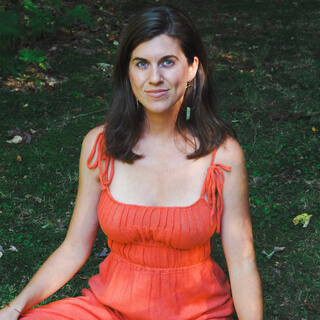
My name is Olivia Roberson and today we're going to be talking about Brahmarī Pranayama or bee breathing.
So for this practice I encourage you to set yourself up in a comfortable seat.
I'm seated on a meditation cushion.
You might choose to sit on a pillow or a block,
A blanket.
It's nice to have your hips slightly higher than your knees.
Another option is to sit back on your heels like this or a great option if you're pregnant or otherwise.
You can just be comfortable for anyone is to sit like this in Baddha Konasana or butterfly pose.
This can be really nice during pregnancy.
Anyways,
I'm going to sit back up on my meditation cushion and I'll explain a bit about Brahmarī or bee breathing.
This is a great practice for those struggling with addiction,
For those struggling with depression and anxiety,
And just really for anyone.
It's a very calming,
Soothing practice for the nervous system.
I'm going to offer a few variations since each of us is different and it's going to look different for each of us.
So the traditional way to practice is to take your thumbs and you're going to put them in your ears.
You're going to use this little piece of part of your ear and kind of plug your ear just very softly but don't do it just yet so you can hear the rest of this video.
So you'll be plugging your ears just slightly,
Light pressure,
And then you're going to take your pinky,
Ring,
And middle finger and you're going to gently cover your eyes.
Again,
Just really soft,
Light touch,
Nothing too hard.
And then you're going to take your pointer fingers and put them on your kind of like your temple space.
And the rest of your body is just going to be fully relaxed.
So I'll show this posture again.
The traditional,
This would be how you would practice it most traditional,
Traditionally,
But for those of us who for whatever reason might not feel comfortable closing our eyes,
Another variation is to just do the ears,
Closing the ears,
Or maybe for some reason we don't feel comfortable closing the ears,
It's okay,
You don't even have to do the hands.
That's just a nice way to like bring all your energy inwards so that you're not distracted by outside noises and things but due to our various different histories,
We might not feel safe for some reason to plug our ears or close our eyes and if that's where we're at then it's fine to do it without the hands,
Okay?
Okay,
So for the breathing exercise,
The other aspect of it is that we're going to slightly constrict the back of the throat,
Sort of like as if you were to do an ujjayi breath if you're familiar with that.
And if you're not familiar with that,
The way that we constrict the back of the throat,
You can think about if you were to be fogging up your glasses to like rub your glasses off and you go,
You kind of like do this slight constriction in the back of your throat.
And we're going to be doing that in this practice,
Although instead of doing it out loud like,
We're going to actually have our tongue against the roof of our mouth just gently and then we're going to make a buzzing sound.
It might sound like a bee,
That's why we call it bee breath.
And I'll do an example of the sound.
I've read in one of my reference books that I was reading about this practice,
The author described it as like a high pitched buzzing sound.
So it might sound like that or it might just sound more like another practitioner described it as it's like as if you're doing an om,
But internally.
So whichever of those,
Either the om internally or like that high pitched buzzing,
See which one is more accessible to you and practice that one.
So I'm just going to practice it with,
I guess I'll do the traditional one.
So again,
Thumbs go over your ears,
And then three fingers softly covering the eyes,
Pointer fingers on the temples.
And I'm going to make a buzzing sound.
I'll breathe in first.
And my tongue is going to go to the roof of my mouth just gently,
And I'm slightly constricting the back of my throat.
And now three fingers.
Gently bring the hands away from the face,
Let them rest by the body.
Hands can be faced up for receiving.
Take a couple breaths for integration,
Just slowly in and out.
And again,
As you're practicing pranayama or breathing exercises,
You want to really see if you can relax through the whole body.
This is designed to be a soothing practice,
But it might just be in our nature to kind of be tense or to go hard at things.
So if that's the case,
Just remind yourself that this is gentle and soothing.
So invite more of that soothing,
Gentle energy into the practice.
And just another note,
When you do this practice,
It's normal sometimes for you to have an emotional reaction to it.
So if you feel a flood of emotion coming up,
Maybe you feel like crying,
And this might not necessarily happen,
But if it does,
Just know that it's very normal and just take care of yourself as you practice.
So in the demonstration,
I did three exhalations,
So three full breaths.
And we're really focusing on the exhale here.
And you can practice this for 10 to 20 breaths if you'd like,
Or just start slow with just three breaths.
If you have any questions,
Please feel free to reach out to me and I'd be happy to answer.
I hope this practice serves you.
Thank you so much for sharing your practice with me.
Namaste.