Welcome.
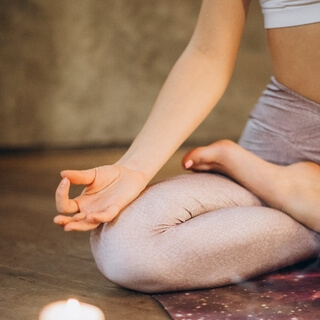
Find your way into a comfortable cross-legged seat for this part of your practice.
In Sutra 2.
3 Patanjali lays out the kleshas which are basically described as obstacles that when in our life create tendencies that then create more karma or samskaras which are these deep mental grooves that keep us from knowing our truth.
There are five kleshas Avidya,
Asmita,
Raga,
Dvesha and Abhinavesha.
When we come into this world as souls entering into a physical body we have no veils,
None of these kleshas.
These things are learned,
These veils eventually through experiences and things that were taught and told by adults and parents.
They grow over our light,
They grow over our spark.
We grow up and become attached to the world outside of us and this begins to block us from knowing our truth.
I love the analogy of a kerosene lamp.
You turn it on and it burns brilliantly.
It illuminates an entire room initially but with time the chimney begins to collect some soot and over time if you don't clean it that soot can eventually obscure the light within.
This is an example of what happens to us.
We start to layer on our beliefs,
We start to become overly attached to the world and reach outside of ourselves for identities and this eventually blocks our true light.
And so the goal here is to dissolve our kleshas and I'm going to explain to you what those five kleshas are.
A vidya is ignorance but not ignorance in a bad or evil sense.
It's spiritual ignorance.
You just don't know any better.
The word vidya means to see and the A in front of it negates it.
So it translates as not seeing or simply not being aware and it said that if you were able to eliminate this klesha,
This first one,
You would solve all the rest of them.
Ignorance of our divine nature is another way of saying a vidya,
Forgetting who we truly are and what we're made of.
The next klesha is asmita and asmita is attachment to the ego.
So the veils are the colorings that cover our true self.
We begin to attach to them and these are limited identities but we overly attach to them and forget our source,
Our true self.
And meditation is the tool that helps us to detach from all of those layers of ego.
Raga is the third.
Raga means chasing desire all the time.
So you're always chasing after material things,
Chasing the highs,
Chasing the pleasurable experiences and in translation somewhere it reads excessive fondness of fleeting pleasures,
Always seeking out those epic experiences.
The opposite is dvesha,
The fourth klesha.
Dvesha means excessive avoidance of discomfort or unpleasant experiences.
So always running away from things that don't bring us pleasure or bring us discomfort.
And so think about that.
Do we spend our lives always running after the highs and running away from the lows?
It's explained in another book I have that life is like a swinging pendulum for most.
It's good to bad,
Good to bad,
Or pain to pleasure,
Pain to pleasure,
Light and dark,
Light and dark.
And we tend to go towards those extremes but through the practice of yoga and meditation the pendulum slows down and we're able to find more of a middle ground where we can experience more balance and peace.
The last one is abhinivesha and this is not acknowledging that everything in our life in our world is impermanent,
Pretending that it's always going to be this way,
Pretending that there is no end to the job we have,
The health we have,
The body we have,
The feeling we have,
The people in our life,
The life itself,
The breath in our lungs,
And recognizing the truth that everything changes is how we dissolve abhinivesha.
This is an obstacle that has us in a space of not recognizing how grateful we should be every single day that we're alive because someday the breath will not come into our lungs like it does today.
So the spiritual practice of yoga and meditation prepares us for recognizing impermanence and recognizing that what we have today might not be tomorrow.
The busier we get the less we realize impermanence in our lives.
I feel like as yogis we regularly are aware of the changes happening within not only our physical body but our emotional body,
Our energy body day to day.
So it's a little easier when you practice yoga and meditation daily to be reminded to feel grateful and to recognize what you have.
And lastly,
People diagnosed with life-threatening diseases are studied to have a keener sense of the present moment because they're face to face with reality of life being fleeting.
So maybe it doesn't have to take a life-threatening disease for us as yogis to be reminded how grateful we should be and how fleeting this experience is and to enjoy the moment.
So adjust your seat and take a comfortable position that feels welcoming for your meditation practice.
Close your eyes and sit up a little bit taller with your chin neutral lifting the crown of the head towards the sky.
At the same time release your shoulders,
Soften your belly.
Breathe slowly,
Patiently and evenly in and out through your nose.
Let the length of each exhale breath be at least as long as the length of your previous inhale.
And just settle in on a breath that's quiet and comfortable and easy.
As you sit here watching and noticing the breath,
Just also noticing how the mind is always at play.
Thoughts continually coming and going,
Maybe even emotions arising.
But as they come,
As they will,
They'll also dissipate and fade away if you let them.
And another thought may take its place or better yet maybe there's just spaciousness between the next thought that you can become aware of.
Start to recognize that space between the thoughts.
The moments where it's just you sitting here watching the breath.
As you sit here present with the breath there's still movement in the mind.
When you recognize a thought or the process of thinking,
Watch that thought as if you're watching it from a distance.
Notice how there's the part of you that's thinking but also there's the part of you that's watching,
Witnessing,
And noticing.
Can you sense that there's a separation between those thoughts and you,
The thinker?
And further back behind all of that there's the you that is just simple awareness itself.
Now bring your attention back to your breathing and back to this moment having perhaps had a moment of just experiencing the separation between your awareness and the thinking.
Recognizing that you are not the thoughts,
That you are something else.
And let this journey be a journey of pondering what that something else is.
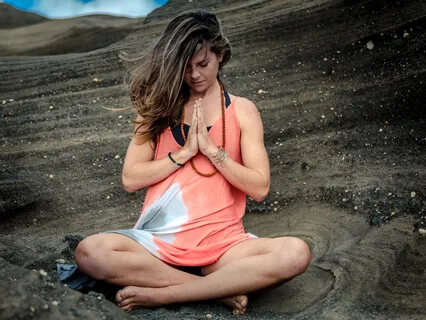
Bring your palms together in front of your heart.
Thank yourself for taking time for this practice and namaste.