Hi there,
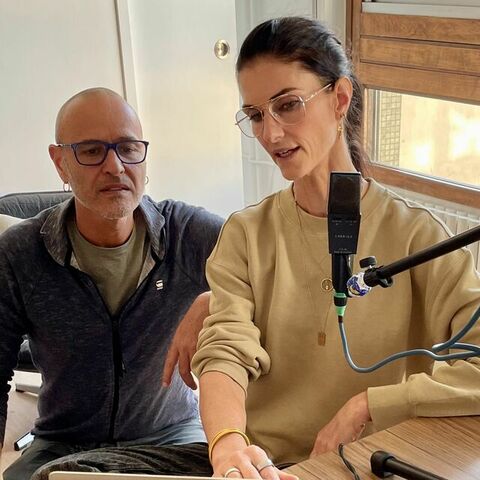
I'm Kianna Ademir from Mysore Yoga Paris.
These droplets designed to support you in your practice are a collaboration between myself and sound artist Jotham Agam.
They're best experienced listening with headphones.
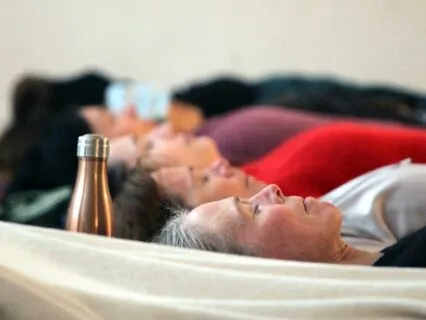
Just lying down in a neutral Shavasana.
So let the feet fall naturally on your mat,
Your arms beside you.
And for this part of your practice,
Try not to use any supports,
But lying directly on the floor.
So this part is more like a research than a relaxing Shavasana,
So to speak.
It's an invitation to get to know the language of the body.
And it's an invitation to know where we begin.
So listening to our body,
Your vehicle for this precious human birth.
Just begin by asking yourself,
How are you feeling this morning?
How are you feeling?
We establish this simplified space so that we can experience sensation.
If we don't begin our practice by inquiring into what is already here,
Our practice is very likely to be rout,
Habituated or mechanical.
So we begin by quite methodically scanning through our physical structure.
So begin by looking up towards your feet and being interested in knowing how they fell on your yoga mat.
And notice also if one foot is falling out more than the other,
Or if one is turned out a little bit more than the other,
Away from the midline.
Where is the weight on your heel?
And is the weight different on the heel on one foot compared to the other?
It's very rare that we are symmetrical.
Most of us are quite asymmetrical.
So notice how that image of your feet might translate into a felt sensation in your knee joint,
In your hip joint.
And notice where the weight rests on your pelvis.
If it's on the base of the pelvis,
The center or the upper pelvis.
If you have more weight on one side than the other.
And we're not only interested in the places that meet the earth,
But also the hollow spaces.
So take your both hands now and feel into your lumbar curve and get a felt sense for the quality of that curve,
Whether it feels sharp,
Abrupt,
Flat,
Smooth.
See if you can find some vocabulary for that felt sense of your lumbar curve,
Building literacy and language around your body.
And moving up towards the rib cage now,
Where is your weight on your ribs?
And where does your breath move?
Do you feel you have more breath space in the front or in the back?
On one side more than the other?
And what about your shoulder joints?
Are they falling forward or are they falling back?
You might take a hand and feel between the neck and the shoulder.
As if one shoulder tends to hike a little bit more than the other.
And while your hands are in this area,
You can slide them underneath your neck and take a note of the curve of your neck.
And if the curve is sharp,
It might be a corresponding action of the weight on your skull being higher up,
So the chin falls away from the chest.
If there's less space for your neck,
Then maybe your chin is falling more in.
Perhaps your head feels tilted to one side.
So this is noted as incredibly valuable messaging from your body,
Allowing you to be self-guiding in your practice,
Allowing you to attune to the shifting conditions that is part of all of our lives,
The subtle or sometimes big changes that happens in the body from day to day,
Even from hour to hour.
So give yourself now a baseline reading,
A number between 1 and 10.
Where are you now?
Reading our body in a neutral position is so important so that we know where we begin and can assess when we come back to this position at the end of our practice,
We can notice any shifts or changes.
We can become aware of which direction our practice is moving us,
And if necessary,
We might choose to course correct.
It is also hugely motivational to see the changes before the practice compared to after and asking ourselves if our practice is moving us in a direction that is serving us.
And perhaps at this moment also reminding ourselves of our agreement that we made with our body to not move into any sort of pain in our practice and to allow that to be a guiding principle,
Reminding ourselves of our motivation for practice as a pathway to healing,
Wholeness,
Inner and outer peace.
When you feel complete,
Offer yourself a nice wide stretch.
So bringing both hands onto your belly now.
Notice what it might feel like to move from this place of connection and take your noble seat fully aware of everything that you have welcomed onto your yoga mat.