Welcome to mindfulness for writers.
My name is Heather Demetrius.
So today we're going to be doing a 20 minute mindfulness meditation with a focus on working with emotion.
And we're going to be using a tried and true mindfulness technique called RAIN.
This technique has been a complete game changer for me and I hope that it's as helpful to you as it has been for me and many other people.
So we're gonna get right into the meditation.
I'll just quickly explain what RAIN is and then we'll just have at it.
And then when I'm done with the meditation,
I'll talk a little bit at the end.
There's also going to be a podcast episode about this as well as a blog post.
Okay,
So RAIN,
R-A-I-N,
This is a process that you would use when a difficult emotion arises.
And the mindfulness technique here is that it's helping us sort of recognize what's happening in the moment and dealing with that in a way that is constructive for us as opposed to falling into just blind emotion,
You know,
Getting really angry and yelling at somebody or devolving into story patterns that we have for ourselves.
For example,
If you think that you are invisible and you get a rejection letter from an agent or editor and you feel upset about that and then you immediately go into this story of I'm invisible,
I knew I was invisible,
Which isn't helpful at all.
So when an emotion arises and we're going to be working with this in the meditation,
You would use RAIN.
So R,
Recognize what's going on.
So let's use this example.
You get a rejection from somebody.
What you would do is just stop for a minute and realize what you're feeling.
Actually articulate it to yourself.
I'm upset right now.
I'm angry or I'm really sad.
A,
Allow the experience to be there just as it is.
So instead of trying to push the emotion away or self-medicate with,
You know,
Chocolate or alcohol or whatever your go-to is,
You would just allow yourself to feel that emotion,
To really feel what's going on inside you.
And the best way to do that is to get in your body,
To physically pinpoint where this emotion rests inside you.
So for me,
My strong emotions of stress,
Anger,
Sadness,
They tend to arise and kind of live in my chest area and move up into my throat.
If I'm extremely nervous or I feel uncertainty about something,
That is usually in my stomach.
And so what I'll do is just stop,
Okay,
Recognize I'm angry,
Allow the experience.
Okay,
Where do I feel this anger?
I feel it in my chest.
My hands are shaking.
I'm sweating,
Whatever is going on,
Just allowing it to be there,
Seeing what that's like.
I is investigate with kindness.
So this isn't psychoanalyzing yourself.
And it's also,
Again,
Not devolving into that story of I'm invisible and nobody loves me and therefore I should just quit writing,
Right?
Investigating with kindness is being kind to yourself,
Gentle to yourself,
Not getting upset at yourself for feeling an emotion,
Whether you associate that with weakness or something like that,
But just kind of looking at what it is and why it has arisen.
So you're just really thinking,
Okay,
I'm angry.
Well,
Why am I angry?
And just kind of go through it.
The end,
The last part of brain is awareness,
Natural awareness,
Which comes from not identifying with the experience.
So you can think of N as not identifying.
And what this means is that you are not your emotion.
And that emotion doesn't get to control your day or the choices that you make regarding whatever caused that emotion to arise.
And so let's say you're angry again about a rejection.
So the natural awareness there after you've investigated with kindness about why you're angry might be simply saying,
Okay,
I'm angry because I've been writing for 10 years and I'm not any closer to getting published than I was,
Or I feel like I'm not any closer to getting published than I was 10 years ago.
And then you let it go.
So what that looks like is just truly,
You've gone through this process,
You accept this feeling,
And now you're letting it go.
You're not allowing it to linger.
You're not obsessing over this anger or this sadness.
The gift of rain is that often by the time you're at the end of this process,
That the strength of that emotion is often much lower and much more easily handled.
It might even have dissipated those physical sensations that you are experiencing.
Okay,
So again,
I'll talk a little bit more about this in the podcast,
But that's what rain is.
And it's something you would do on the spot.
So in today's meditation,
We're going to start out using our breath as the focus of our meditation.
And as we go through the 20 minutes,
I will jump in occasionally to have a check in with your emotions.
And we'll go through the rain process once and then you'll kind of have an idea of what that looks like in action.
We'll be working with this in the meditation,
But this is something you could do literally in a matter of minutes,
Seconds even,
Really on your own once you get used to it.
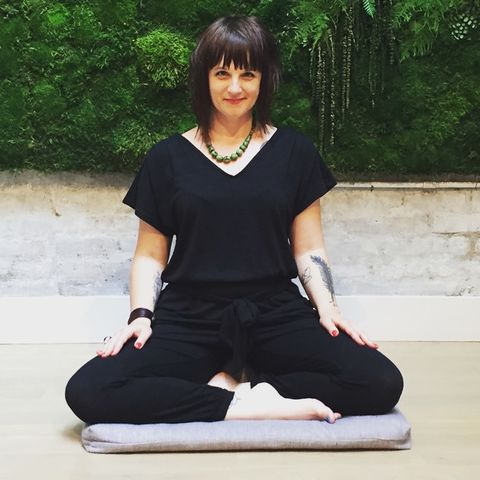
So finding a comfortable seat,
Whether you're on a chair or a cushion,
Just making sure that the spine is nice and straight,
Upright,
But not uptight.
Rolling the shoulders back,
Resting your hands,
Palms down on your thighs.
You want your head to be gently tucked so that the chin gently tucked and a general feeling as though somebody had a string attached to the crown of your head and they're gently pulling up so you can feel your spine kind of stacking there.
So first,
Notice any sounds that are going on around you.
This is a great way to begin a meditation to settle your body,
Settle your mind.
Focusing on sound lets us be mindful and very present of our environment,
Where we're at,
What's going on,
Really grounding ourselves in this space that we've shown up.
And now you'll want to begin letting that sound meditation go and focus in on your breath,
Basic mindfulness meditation,
Focusing on the breath.
So you're inhaling and exhaling through your nose.
These aren't necessarily deep breaths,
It's just natural breathing,
Watching your breath.
If you feel a lot of tension inside right now,
You might want to take a couple of nice deep breaths,
Filling your belly,
Exhaling audibly,
Just to let some of that tension go.
It can be a helpful way to ease into the breath.
If your mind is racing,
It's totally normal.
The mind thinks that's what it does.
You are the observer,
You are watching your mind.
You're getting curious,
How does this mind work?
What does it think about?
Noticing where your breath lands.
What is the anchor for your breath?
Is it your chest?
Are you breathing into your chest?
Is it your belly?
Or do you notice that your breath is more at your nostrils?
So choose one of those three places to be kind of home base for you as we work through this meditation.
So you are breathing in,
Seeing where that breath flows into and out of.
So you are breathing in,
Seeing where that breath flows into and out of.
So you are breathing in,
Seeing where that breath flows into and out of.
So you are breathing in,
Seeing where that breath flows into and out of.
So you are breathing in,
Seeing where that breath flows into and out of.
So you are breathing in,
Seeing where that breath flows into and out of.
So you are breathing in,
Seeing where that breath flows into and out of.
So you are breathing in,
Seeing where that breath flows into and out of.
So you are breathing in,
Seeing where that breath flows into and out of.
So you are breathing in,
Seeing where that breath flows into and out of.
So you are breathing in,
Seeing where that breath flows into and out of.
So you are breathing in,
Seeing where that breath flows into and out of.
So you are breathing in,
Seeing where that breath flows into and out of.
So you are breathing in,
Seeing where that breath flows into and out of.
So you are breathing in,
Seeing where that breath flows into and out of.
And you go up to 10,
10 breaths and then go back to one.
So it's an extra way just to kind of focus the mind a little bit.
Again,
The point of meditation is not to stop thinking or to relax.
The most effective moment in meditation is that moment when you realize you're not focusing on the breath anymore.
That's mindfulness.
And then you gently bring yourself back to the breath,
Remembering the anchor of your nostrils,
Your chest or your belly.
Again,
If your mind has wandered off,
Just gently bring it back to the breath.
If there are noises around you,
Just note them.
You can think sound and then go back to the breath.
You can also use noting for thoughts.
So when you catch yourself wandering into thoughts,
As opposed to focusing on the breath,
You can just note it simply by saying to yourself,
Thinking and then go back to the breath.
It can be helpful to think of thoughts as clouds.
Passing through the sky.
They don't stop,
Linger.
They keep moving.
Or a leaf in water flowing downstream.
There's nothing wrong with thoughts.
When you notice yourself staying with them,
You might note that with thinking and then let it go.
So the technique isn't about stopping thought at all.
It's letting thought be a passing stream.
As opposed to something you hold on to and go down the rabbit hole with.
So we're going to start working with rain.
Choose an emotion to work with.
Something that you are experiencing right now.
How are you feeling right now?
You angry,
Sad,
Bored,
Frustrated,
Feeling like you're doing meditation wrong.
Maybe you feel happy and at peace.
For the purposes of this exercise,
If you aren't feeling any kind of emotion,
Maybe recall something that brought up an emotion in you.
Perhaps with your writing,
Writing career.
So just take a minute to gently inquire.
What are you feeling and articulate that I'm angry,
Sad and stressed and tired.
So that's the first part are recognized,
Right?
You're recognizing the emotion.
Name it.
Now you're just going to allow the experience to be there just as it is a second step of rain.
So you're locating where you physically feel this emotion.
When this emotion arises,
Where does it live in your body?
Maybe your chest,
Your belly,
Your throat,
Your head.
Maybe your hands are tingling and sweating.
Can help as you sit here to really become aware of your body.
How it feels to be sitting on the cushion where your legs connect with the chair you're sitting on.
If your feet are flat on the floor,
Really feel them there on the floor.
However you're sitting,
Really get grounded in your body and then locate that emotion.
And when you've located it,
It takes a couple minutes just to sit with it.
You're not trying to change it.
You're not trying to push it away.
You're not trying to fix anything.
You're not even thinking about it.
You're just feeling it and allowing yourself to tune in to how your body reacts to emotion.
And now we're going to move on to the second step.
And now we're going to move on to the third step of RAIN,
The I,
Which is investigate.
But with kindness and gentleness,
This is not the time to beat yourself up about something.
This is not the time to overly analyze.
You're simply investigating why you might be feeling this way.
What happened to make you feel this way?
Is this a pattern?
So this step is really about curiosity.
You're just curious what's going on here.
How did this happen?
Okay.
Now we're on to the last step and this is the part N where you not identify with this emotion,
This experience.
You can also think of it as a letting go.
So you've held this emotion,
You've felt it,
You've investigated it,
You've acknowledged it and now you're going to let it go.
And what this means is that you're not going to hold on to this emotion and feed it and support it,
Sponsor it.
You recognize that you are not this anger,
You are not this stress,
You are not this sadness and that it is a valid emotion but it's not you and it doesn't have any power except whatever you give it.
It's just a feeling.
And so this letting go can just be a thought that you say,
Okay,
I release you.
It could be a nice deep breath.
So take a minute to let that go,
Whatever it is.
Don't give it a story.
Don't let it be one more thing that you add to the list.
Don't let it be a way of keeping score.
These last moments of the meditation,
Congratulate yourself,
Thank yourself for sitting today,
For giving yourself the time to do this important inner work.
Thank yourself for the gentleness that you showed yourself and the bravery for working with difficult emotion when you could have been checking your email or watching Netflix but you chose to do this today.
So let's take a nice deep breath through the nose,
Filling the belly and then you're going to let go with an audible sigh.
And slowly when you're ready,
Transition back into the non-meditative part of your day.
You can stretch,
Pat yourself on the back.
Try to notice if you can as the day goes on how this meditation affected you.
Don't expect there to be,
You know,
A huge transformation that takes time but be conscious,
Be mindful and see if you can work with rain throughout the day when difficult emotions arise.
Make sure to check out the blog and the podcast for more on this technique.
Thank you so much guys.
Have a good one.