Welcome to this deep relaxation breathwork and meditation.
As you get settled in I will let you know what you can expect in today's meditation.
The main rules to follow in this practice is comfort.
As you follow the instructions and do the breathwork you do that as long as it feels comfortable to you.
For example this can mean that you are going to shorten the length of the inhale or retention or exhale so that the pranayama remains comfortable for you.
Let's slowly begin.
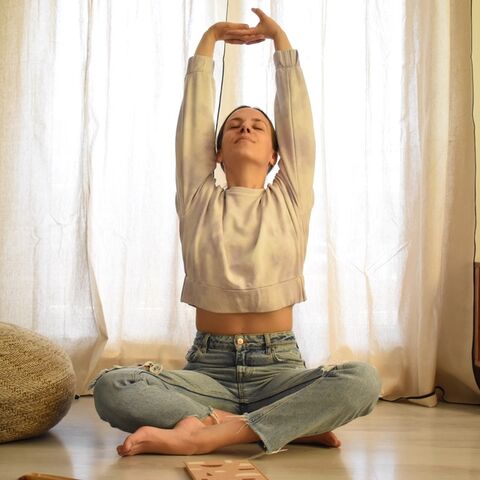
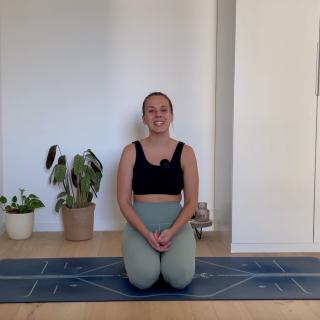
If you haven't already find a comfortable seated position keeping your eyes closed or if that is not accessible keeping a soft gaze at something neutral like the floor or the wall and with the next inhale see if you can stretch up the spine just a little bit more,
Open up the chest and relax the shoulders away from the ears.
Take a moment here to check in with yourself and notice how you feel.
Notice the body,
The sensations,
Notice the posture you're in.
Observe without assigning any meaning or judgment.
Simply notice,
Note and move on.
Let's start with a pranayama called Nadi Shodhana using kumbhaka or alternate nostril breathing with a pause after the inhale.
This pranayama balances out our nervous system and has a calming relaxing effect on both the body and mind.
Left hand can be gently placed on your thigh,
Palm facing up.
If you like you can position this hand in Gyan Mudra bringing the tip of the thumb and index finger together forming a circle.
Keep the remaining three fingers extended straight and relaxed.
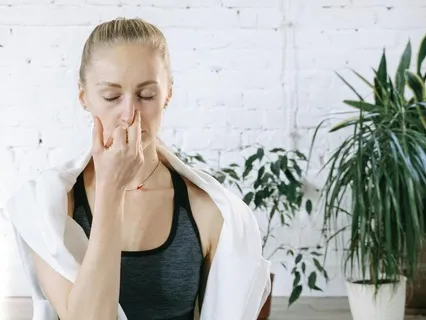
Right hand can be raised up to your face in Vishnu Mudra meaning the index and middle finger are curled in toward the palm so that the tips are touching the base while other three fingers remain extended and relaxed.
You will use your thumb to close your right nostril and the ring and pinky finger to close the left one.
Now that you have your hands in position let's slowly transition to Nadi Shodhana.
First begin by taking a full breath in and out using both nostrils and exhaling completely.
After the exhale you can close your right nostril with your thumb and inhale deeply through your left nostril.
Hold here for a moment closing both nostrils left closed with the ring and pinky finger and open the right nostril exhaling slowly with control until all the air is out of the lungs.
Stay here and deep inhale through the right nostril.
Hold closing both nostrils and open left and exhale.
Again inhaling through the left and as you do so visualize inhaling from the base of your spine all the way up to the top of your head.
Stay here and hold the breath closing both nostrils and open right exhale from the top of your head all the way down to the base of your spine.
Continuing with this visualization through your spine inhale through your right nostril from the base of your spine all the way up to the top of your head.
Stay here hold the breath and open left nostril and exhale from the top of your head all the way down to the base of your spine and continue like this on your own for a couple of rounds in your own rhythm.
Wherever you are continue with alternate nostrils until your exhale on the left happens and after that allow the breath to flow naturally relaxing both hands on your thighs and again check in with yourself and notice how you feel.
Notice the effect of this pranayama on your body on your mind.
Notice the sensations,
The posture.
Notice if anything's different from the beginning.
Let's slowly move to our next and last pranayama Samavritti also known as box breathing.
For this pranayama imagine a square in front of you or between your eyebrows where your third eye is.
As you do this pranayama you move along the sides of the square as you breathe like this.
You start at the bottom left corner and as you inhale you move slowly upwards to the left upper corner.
As you hold your breath you move from the upper left all the way to the upper right corner of the square.
Next as you exhale you move downwards from the upper right to the lower right corner and lastly as you hold your breath after the exhale you move from the lower right back to the lower left corner.
This completes one cycle of Samavritti breathing.
All components of the breath,
The inhale,
Holding,
Exhale and holding again last equally.
We will start with four seconds meaning that you inhale for four,
Hold for four,
Exhale for four and then hold again for four.
If needed you can shorten the length of the hold keeping in mind that the pranayama has to feel comfortable the entire time.
Let's first again begin by taking a full breath in and out without any retention and start with the lower left corner of your square and as you inhale for four move upwards.
Hold for four moving from left to right upper side and exhale for four moving downwards to the lower right side.
Hold again for four moving from right to lower left and the new cycle begins inhaling moving from lower left to upper left corner for four,
Hold upper left to right,
Exhale moving down,
Hold back to the lower left moving through the square inhaling again for four,
Hold for four,
Exhale for four and hold for four.
And now I invite you to continue on your own for a couple of rounds of breath either shortening the hold keeping it the same or if there is space extending each component of the cycle to maybe five seconds.
You're finding your own rhythm,
Finding where you're at at this moment and after your next exhale without holding it afterwards simply allow the breath to flow naturally.
Again check in with yourself and notice how you feel,
Notice your body,
The sensations,
Notice the posture,
Notice your mind,
Thoughts,
Again noticing what's changed if anything changed.
Coming again back to your breath,
Once more breathing deeply into your body,
Maybe starting to move your fingers,
Your toes,
Perhaps stretching in any way that feels comfortable.
Reminding yourself that you can always check in with your breath and use this grounding pranayamas anytime you feel the need.
Their benefits are countless and it doesn't take long to notice the effects.
In the next couple of breaths you can slowly blink your eyes open and come back to the room that you're in.
I hope you have a wonderful rest of your day.
Until our next meditation,
Namaste.