Compassion powerfully and directly relates to the question of ethics.
And the question at the heart of ethics is how do I treat the fellow human being in front of me?
And compassion basically says,
Recognize the other human being just like yourself.
Just as I do not wish to suffer,
Just as I wish to be happy,
The other person too wishes to be free from suffering and wishes to be happy.
So then honor that person's wish,
If you take seriously your own wish for happiness and wish to be free from suffering,
Then you need to honor your fellow human beings' aspirations as well.
That is the central message of compassion.
Welcome to Mind and Life.
I'm Wendy Hasenkamp.
Thanks for checking out our podcast.
We're really looking forward to sharing it.
Before we jump into the first episode,
I just want to say a few things about the show.
Our aim here is to explore the field of contemplative science.
And for those of you who are new to this area,
I'll just share a few points that might help with orientation.
Contemplative science is primarily focused on deepening our understanding of the human mind.
And at first that might seem like a purely academic pursuit,
But actually it's incredibly relevant for our daily lives.
Our minds are the foundation of our every experience.
How we perceive the world and act in it,
All of our thoughts and emotions,
How we conceive of ourselves and how we treat others.
So it's really critical to examine and understand our minds,
Especially because a lot of the ways they work are often outside of our conscious awareness.
It's important to note too that understanding the mind goes far beyond brain science.
Understanding the brain is definitely an integral part of this work,
But it's just one part.
When we speak about the mind,
We also include the body along with our day-to-day lived experience of the world.
So this begs the question,
What is a mind?
And you'll see as this show unfolds,
There are a lot of ways to start to answer that question.
Contemplative science touches on many fields,
Including psychology and neuroscience,
But also anthropology,
Religion,
Philosophy,
And clinical science,
Just to name a few.
The essential element here and the common ground is the use of contemplative practice to inform what we're learning in these different areas of study about the mind.
Contemplative practices such as meditation,
Mindfulness,
Yoga,
Tai chi,
And other forms of inquiry can give us unique lenses that allow for fresh insights into our personal and shared experiences.
This bridging of science and what we often refer to as contemplative wisdom sits at the very heart of what we'll be digging into with this podcast.
I won't try to lay out all this here in detail because I think it will unfold organically through the course of these conversations.
These ideas really can't be summed up in a single explanation.
That's the idea behind this show is to give a lot of different perspectives on how we investigate the mind and how we might integrate contemplative wisdom to improve our lives and create a more connected society.
I'll also just add that the Mind & Life Institute,
Who produces this show and where I serve as science director,
Has been involved in this work for decades,
Funding research and bringing people together to share insights around these topics.
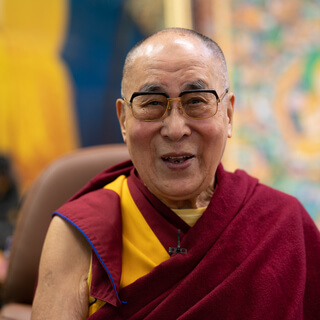
It began with a series of dialogues between the Dalai Lama and Western scientists and philosophers.
And you'll actually hear a bit more about that in this initial episode.
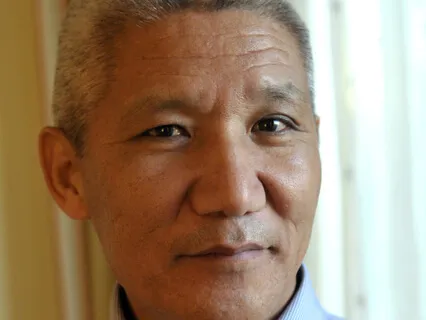
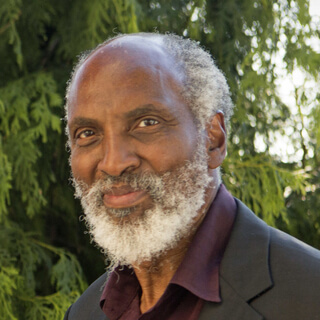
Our guest today is Tupton Jimpa.
Jimpa is a Buddhist scholar,
Author,
And the longtime English translator for the Dalai Lama.
His life and his career represent a true bridging of Eastern and Western ideas.
Jimpa was born in Tibet and was just one year old in 1959 when his family fled to India with so many others in the wake of the Dalai Lama's escape from Chinese-occupied Tibet.
He grew up as a refugee in India,
Where he eventually trained as a Buddhist monk and received the equivalent of a PhD from that Tibetan tradition.
And he went on to study philosophy and get a PhD in religious studies at Cambridge University in England.
And he now lives in Canada.
His work with the Dalai Lama has put him at the forefront of the conversation between science and Buddhism.
And he's really been involved in contemplative science since the beginning,
Which he reflects on in this episode.
I should also note that Jimpa is currently chair of the board at the Mind and Life Institute,
So he has a deep knowledge of our organization's work.
But we actually would have been interviewing him anyway,
Given his long history with contemplative science and his contributions to the field.
Our conversation covers many topics,
Including his early interest in the mind and monastic training,
How he met and started working with the Dalai Lama,
And some insights from 35 years of translating for him,
The relationship of language and mind,
Tips on stage fright and how to deal with self-consciousness,
The development of the dialogue between Buddhism and science,
And first and third person ways of investigating our minds.
Jimpa has also done a great deal of work in the area of compassion.
And we discuss the relevance of compassion for our well-being.
And he also describes a program that he developed to cultivate compassion with colleagues at Stanford University.
And at the end of the episode,
Jimpa shares his insights about the value of mental training and compassion in the time of COVID.
I think this conversation will give you a good sense of the breadth and variety of topics within contemplative science.
And it's a great way to set the stage for this podcast.
So with that,
I'm very happy to bring you Tupton Jimpa.
I hope you enjoy this conversation as much as I did.
Jimpa,
Welcome,
And thank you so much for joining us today.
Thank you,
Wendy.
Thank you for inviting me to this podcast.
I'm very excited.
So you've had really a front row seat to the whole evolution of the dialogue between science and Buddhism,
As well as the development of contemplative science as a field.
So I'm really looking forward to digging into that with you.
But before we start that,
I'd love to hear a little about your personal story.
You have such a unique and interesting story.
And I know you've been trained in both Eastern and Western forms of scholarship.
I know you were a Tibetan refugee growing up in India.
So you became a Buddhist monk in the Tibetan system.
Can you share a little about how that unfolded for you and what motivated you to take that path?
Well,
Thank you for the question.
The uniqueness of my background is purely a consequence of my circumstances that I happen to be born in.
I was born in Tibet just before my parents left in 1959.
And then I was part of that first generation of children who grew up in India as refugee children.
And one of the most fond memories from my early childhood where we were put to boarding school was the presence of two monks at the school.
And they were among all the teachers,
They were the ones that I felt most attracted to.
They even physically look radiant.
And they always had this very assuring smile on their face.
There was a kind of a level of serenity and presence in those two teachers that I could not find in any other adults around me,
Which really left a powerful impression.
And then later when I was in grade school,
In grade four,
We had a group of monks who came to teach at our school as part of their training,
It turns out.
And the teacher who was assigned to my class taught us elementary debate,
Which is very central to fundamental to Tibetan monastic education.
And I was fascinated because my memory of early childhood school years is that of just boredom.
I was looking back,
Probably I wasn't that intellectually challenged in the classroom.
So when these monks taught something that was completely new and really training that muscles of the brain as it were,
I was just fascinated and I just wanted to become a monk.
So to cut a long story short,
I became a monk at the age of 11,
Against my own father's advice and pleading.
And so I had a monastic background and I was fortunate to be able to eventually join an academic monastery at Ganden and go through the entire Kishi training.
Even tragedy always have silver lining.
So one of the silver linings of my early childhood was in Dharamsala where the monastery that I joined first was based.
There were a lot of enlightenment seeking hippies around and I had the good fortune to be able to sort of hang out with some of them,
Meet them on regular basis and really try to acquire a working knowledge of speaking of English,
So command of English.
So by the time I was at Ganden doing my Kishi studies,
I had a reasonably good command of English.
So that's how my combination of East and West kind of began.
You've obviously devoted so much of your life to language and translation.
Did you always have this love of language?
Is that why you were drawn to learning English?
No,
Initially I think it was more of a joy because for me,
English opened a whole new world that was not available to me as a Tibetan,
Speaking Tibetan.
So I think that was probably initially,
It was just curiosity and joy.
And as I remember,
Once I began to have a reasonably good command of comprehension,
I started reading some of those Second World War comics.
And that is an entire world that was not available to my other colleague,
Students,
Monastics.
So I think initially it was not so much any grand plan that I had.
It was just one of those things that you happened to do as a kid that you enjoy.
But then as my command of English got better,
And also I took formal training in Tibetan grammar and linguistics.
By then around age 18,
19,
Then I started really taking interest in Tibetan and English as different languages and began to appreciate how languages in a way represent different way of carving out the world.
And it's almost like a kind of a cognitive systems in their own.
And that cross comparison of Tibetan and English and expressibility,
Particularly of English.
Which is a very practical language and I really began to appreciate and the way in which there are a lot of things that you can do in English,
Particularly in the form of writing that you can't do in Tibetan.
Oh,
Can you give an example?
For example,
Like in English,
You can have flowing sentence strung together with colons and semicolons and dashes,
As well as you can use the relative clause using relative pronoun.
I'm the one who said this kind of thing.
And those relative pronoun usages are very specific to Indo-European language and Tibetan handles that kind of usage in a different way.
So being able to start noticing those differences in the strengths and weaknesses.
I mean,
Each language has a strength and weakness.
So Tibetan is really good in very specific areas,
Is very contextual,
And it's very good at capturing the more subtle nuances of philosophical thinking.
And particularly that has to do with psychological mental map.
Whereas in English,
It's a bit more complicated because the systematic articulation of the mental map is much later in terms of historical evolution.
So though you begin to see these differences.
That's so interesting how looking at language is like almost a reflection of our minds,
Right?
And language shapes our minds and then becomes a reflection of it.
So your facility in English also played a role in your meeting the Dalai Lama,
Right?
Yes.
You know,
As a Tibetan,
You know,
Growing up in India,
Of course,
His Holiness is,
You know,
A presence in our life is always very,
Very pronounced.
We think of him every day.
We have photographs of him in everybody's room.
And especially as a monastic scholar,
You know,
He would visit the monasteries almost on an annual basis.
And he'll keep an eye on the emerging young scholars.
And whenever he visited the major monasteries,
He would have debate sessions that he would attend and observe.
So he knew me by sight.
But then of course,
I was one among hundreds of young scholars,
You know.
But the first time when I had an opportunity to interpret for him was 1985.
This was in Dharamsala and a group,
A Buddhist group in Los Angeles had arranged for a specific set of teachings from His Holiness.
And turns out that the official translator that they have arranged was not going to be able to make it on the first day.
So the teaching was scheduled and they were looking for someone to stand in for that person.
So this was in October 85.
And I happened to be in Dharamsala to visit my sister who was at the time a student.
And I,
Of course,
It was a happy coincidence,
Wanted to attend the teachings.
But then,
You know,
They were looking for someone to stand in,
What got around it.
There is this young monk who has a reasonably good command of English.
One thing led to another.
I was plugged from where I was sitting,
You know,
It was on an outside veranda of the temple,
You know,
To be brought in.
And it was a very scary kind of moment,
Too.
But fortunately,
The translation was being done simultaneously through FM.
So there was no silence.
It was a continuous teaching,
Which is much less nerve-wracking because if you have the speaker like His Holiness speaking and then stopping and then the interpretation comes,
Then there's an absolute silence where you are now speaking.
So it was a simultaneous one.
Wow.
Can I ask about that because I've been struck sometimes I've heard those simultaneous translations.
So that actually means that the person you're translating for is speaking and as they're speaking you're translating,
But you're also listening to what they're saying.
So I've always just been amazed.
How can you,
How does that work?
Well,
It is actually,
It's an interesting kind of attention exercise because you have to split your attention.
And so,
I mean,
One thing in simultaneous translation or even in subsequent translation,
The biggest stumbling block is the problem of self-consciousness.
If you are able to somehow prevent the arising of self-consciousness,
Then you're in a kind of a flow and then it goes smoothly.
So in simultaneous translation,
It's less nerve-wracking because there is no silence on the stage.
So therefore there's less chance for being self-conscious because self-consciousness arises when you think you're being viewed by looked at by others or heard by others.
Whereas in simultaneous,
The challenge really is in being able to maintain the continuous attention and at the same time speaking so that your own speech does not interrupt your attention or listening to whoever is speaking.
So that is a big challenge and it takes a little while,
But after a while you get into that state because it's a skill that you can acquire.
That's intriguing what you said about the problem of self-consciousness and then needing to kind of bring that offline.
Do you have any tips that you developed over the years?
Because I'm thinking it's also relevant,
Right,
For Buddhist theory at large about the self and reducing the self.
I mean the same thing.
And it's a general problem for stage fright.
And the stage fright is often a function of self-consciousness.
And the problem with self-consciousness is that it's a very weird experience.
I mean there is a beautiful essay written by Jean-Paul Sartre about the problem of self-consciousness where he says that the demon is the other.
So there is this idea of,
And there's even a painting of you being seen by someone else.
So self-consciousness is a function where you have a consciousness of yourself looked at from outside.
And that's what makes it sort of very disrupting.
There's a big difference between self-awareness and self-consciousness.
Self-awareness is a function of mindfulness and attention.
And there where you don't have that second loop.
Where self-consciousness is an awareness of you as viewed from as if you're looking into a mirror and seeing yourself.
And that's why it makes it disruptive.
So where I found to deal with that,
And partly probably it's because of my monastic background.
One thing,
I set an intention at the beginning and once you're on the stage,
And especially when I'm interpreting for his souliness,
Fortunately there's always an introductory preliminary kind of part.
Like either there is a chanting or his souliness is speaking.
And during that moment I take a deep breath and then I just remember I'm here purely as a mouthpiece.
I'm a medium.
And my role here is just to be the medium.
And that kind of intention really kind of relaxes me.
And the other thing is with his souliness,
Because his command of English is really good.
So I know that I cannot go wrong too badly because he's going to catch me.
So there is that safety net as well.
So the combination of these really make me relaxed.
And once you're relaxed,
Then you forget yourself.
When you forget yourself,
Then things flow smoothly.
So I think the self-consciousness is where I think you need to somehow find a way to relax yourself,
Create a space,
And probably doing some intentional work.
So you began working with the Dalai Lama then in this way the first time you were just describing,
But then it continued.
Yes.
It's been a real joy and honor for now over 30 something years.
You know,
It's going to be 35 years this October.
And it's been for me,
I mean,
As a Tibetan Buddhist,
As a former monk,
As a student of his souliness,
For me also,
I began to appreciate that how this ability to offer a service to him was also a powerful opportunity for me to really put into practice the Buddhist sattva ideal of trying to bring about others' welfare because in my own capacity,
In my own right,
My ability to reach other people is very limited.
Whereas by serving him,
By being his medium,
I have assisted in his souliness as a message,
You know,
Reaching across many more people and bringing some solace and comfort and peace of mind in their lives.
And particularly one of the things that his souliness has been very powerful and effective is in really advocating a more universal human centric understanding of the place of compassion in our self definition of who we are as human beings.
And the fact that any serious ethical system,
Moral system must be ultimately grounded in compassion as a foundation.
And that teaching has really been very powerful to me in my own personal life.
And also I can see the power of that teaching in offering something,
A very fundamental,
Robust basis for people from all walks of life,
All kinds of cultural and religious,
Different diverse religious backgrounds and ethnicity to really come together,
To appreciate each other as human beings,
You know,
Human conditions sharing the same,
Exactly the same condition.
So for me,
Looking back,
Of course,
Initially when I began,
There was a huge amount of excitement.
There was a high level of anxiety and nervousness because for us,
The Tibetans,
You know,
Serving his souliness is like serving God,
You know,
I mean like,
And initially it was also quite tough because,
You know,
I have a friend who was a professional interpreter at the UN in Geneva.
And when I began interpreting for his souliness early on,
I asked for some tips.
And one of the tips she gave me was that whenever his souliness is speaking about himself,
You as the interpreter should use first person language.
And if he's talking about his childhood,
Then the translator should say,
I when I was a kid,
And for me as a Tibetan,
Initially,
That was really tough,
Because I know it's not me and I'm pretending to be his souliness and using to describe the word I took a little while but once I got on over these,
You know,
Sort of hesitances and stuff,
It's been a real joy.
And for me,
When I leave this world,
You know,
One thing that I will take probably the greatest pride in and rejoicing is my self's desoliveness.
So part of your work as a translator for the Dalai Lama has put you in the middle of this conversation between Buddhism and science.
What were your first experiences like of that dialogue?
Do you remember some of the first meetings?
Yes,
Actually,
I do.
The main one came in 87,
Which was the first Mind & Light Dialogue in Tarim Salah.
Francisco Varela was one of the coordinators of this.
Actually he was the scientific coordinator.
And at that time,
Of course,
You know,
I did not know that this was going to be an ongoing,
You know,
Engagement on his holiness's part that this was going to lead to a whole movement and,
You know,
Global work and all of this.
I was very curious.
I was quite excited.
But until that point,
My interest with Western thought really has been more in philosophy than in science,
Partly because I left school from grade,
You know,
After finishing grade four,
I did not even finish grade five.
So my level of math competency is very low.
And whenever I look at scientific kind of,
You know,
Publications,
There's always these numbers and graphs.
And so I sort of gave up on science fairly early,
Whereas philosophy,
You can play with intellect.
It's more about concepts.
But that 1987 dialogue was really an eye-opening experience for me.
And one thing that I particularly remember is the presentation given by Jeremy Hayward,
Who gave a history and philosophy of science kind of presentation.
And for the first time,
His holiness,
As well as myself,
Were introduced to the idea of Kuhnen paradigm shifts.
And this was for me a revolution.
I don't know whether it was a revolutionary solanist,
But for me,
Because I had a naive understanding or attitude of how,
You know,
The status of scientific knowledge as if scientific descriptions really mirror what is out there in the real world.
Yeah.
Can you describe that concept of a paradigm shift?
Well,
The paradigm shift basically questions the naive assumption that the scientific truths are truths in a truly objective sense,
That scientific descriptions of reality are somehow mirroring what is out there in the actual,
You know,
Facts of the world.
And whereas the paradigm shift was suggesting that it's actually,
That is not accurate.
Scientific,
You know,
Status of scientific truths should be more understood in a kind of a more pragmatic terms of how at that point,
Given the understanding and information people have,
That is the best description that one has.
And those descriptions should always be taken with a kind of a caveat that it could be revised,
It could be changed.
And when new information come in and the real test of the scientific theory should be its ability to predict its power predictability.
And then in koinin paradigm shifts,
They're examples of how major paradigm shifts occur in science,
When they are counter examples,
Which stressed the explanatory power of existing theory.
And then this is how scientific revolutions happen.
And new,
You know,
Discoveries are made,
Which then opens up a whole new airway of understanding things.
And that for me was a real revelation.
So as these dialogues evolved,
You were a part of these dialogues as translator for the Dalai Lama.
So these were dialogues between the Dalai Lama and Western scientists,
Philosophers.
This was kind of the beginning of the field of contemplative science.
Can you describe the original impetus to bring these two viewpoints together?
I think he's all in his has been interested in science for a long,
Long time.
I think he tells the story of his kind of interest in science from his childhood,
Beginning with the fascination with mechanical objects.
And he had a telescope that he was able to use from the rooftop of the Patala Palace.
And he was fascinated by the whole ideology,
If I can use the word,
That led to the development of these kinds of technology.
And that of course is science.
And so when he became refugee,
Came to India,
And once initial kind of activity of trying to settle down the Tibetans and find some livelihood for them sort of settled,
Then I think his solidness was able to take advantage of meeting with people from different background.
And so his interest in science goes quite far.
And initially,
I think he says in his book that it was really more out of curiosity about a different worldview there.
And then he also began to realize the pervasive nature of the influence of science in the modern world and began to also understand like the Darwinian evolutionary theory has a whole account of how life on earth came into being and propagation of life from this simple to the more complex forms,
All of which are very powerful.
And initially he was also fascinated by quantum physics.
So I think initially it was more of a curiosity,
But then he also began to realize that actually there is something that the Buddhist philosophy could learn from science because there's a kind of a pseudo science in classical Buddhist thought.
For example,
Many of the early,
Very,
Very early Indian versions of atomic theories were developed by Buddhist thinkers,
Going back to the beginning of the common era in the Abhidhamma in a text.
There was a lot of debate on whether there was a space between the individual particles that make up together into a unit of an atom.
So there was that kind of debate.
And then how do you account for the integrity of the macroscopic level objects,
All of which are composed by the same kind of stuff,
But there is a boundedness beyond a particular object.
So those are questions that were there.
And there was also in Buddhist writings,
A lot of speculations on the origin of the cosmos.
How does different world systems come into being?
So clearly these are scientific inquiries,
Although the actual science may not have happened in a modern sense because there were no instruments and equipment and measurement.
So I think his own is then began to realize actually there will be a lot of benefits for Buddhist thinkers engaging with science so that at least the physical,
The material theory could be updated.
Because the ones that are in the text are fairly old.
And now with many modern physics and discoveries of modern physics and biology and all of this,
There could be a lot of updating that could be done.
So I think that initially the motivation was not so much the Buddhist could offer to the world,
But more what the Buddhist thinkers and philosophy and thought could learn in terms of updating the more scientific aspects of the Buddhist tradition.
Yeah.
And that's making me think of something that I've so appreciated about the Dalai Lama's view.
I remember,
I think it was 2005 when I first heard him speak at a meeting in Washington,
DC,
I think.
And he said,
You know,
If there are things in the Buddhist view or philosophy that science proves otherwise,
Then we should change,
Change the religion basically.
And I think for many Westerners,
That's just a mind blowing openness.
This is really important because at least in principle,
You know,
I mean,
I don't know how,
Whether it translates into practices is another matter,
But at least in theory,
In Buddhist philosophy,
Particularly the version that the Tibetans uphold,
You know,
They are recognized three sources of knowledge.
One is direct experience and perception,
Which includes our perceptions,
The evidence of the senses if you want.
The second is inference,
You know,
Inferential knowledge.
And the third is testimony.
So within these three sources of knowledge,
For many religion,
The authority of the testimony of the scriptures is the highest.
In Buddhism,
It's completely turned upside down.
So that the authority of the testimony of the scriptures really comes last.
It has the least value in terms of authority as a sources for knowledge.
So among the three,
The highest authority is really the evidence of the senses,
Which is empiricism,
You know,
Empirical evidence.
The second is the inference that we draw based on our empirical evidence.
And then finally on matters where you cannot use these two sources of knowledge,
Then testimony comes in.
So testimony is totally irrelevant when it comes to trying to understand the nature of the world,
Because that then understanding the nature of the world can be accessed through the first two forms of sources of knowledge,
Which is the empirical evidence and the inference.
So in Buddhism,
It's really upside down.
So His Holiness is absolutely right when he says that,
As a result of engagement with science,
If there are aspects of Buddhist thought that needs to be revised or,
You know,
Or discarded,
We should do it.
And he's right.
What you were just describing,
Too,
I think,
Reflects,
You know,
An alignment in approach between science and Buddhism in some ways about this emphasis on experience of the senses and what we can learn about the world.
So how do you feel like the dialogues and the conversation between science and Buddhism then evolved into really,
This joint way of investigating the mind and understanding the mind?
I think,
As scientists began to sit down and,
You know,
With His Holiness,
One of the amazing things about His Holiness is that he's got a very inquisitive and,
You know,
Fast mind.
And he anticipates often what could be the next question that needs to be asked in the process of research.
So many of the scientists who have had,
You know,
The opportunity to sit down with him have really also found a way to ask new questions,
Take a new angle in their research.
And the thing is that in science,
The systematic description of our mental life is a fairly recent phenomenon.
And of course,
Science being science,
It has access to these powerful tools and has the ability to measure.
That's one thing that is powerful about science is that when science takes on a topic,
It has to operationalize the constructs and find a way to measure them.
Because if science cannot measure something,
Then it has no handle on it.
And that's what brings science,
Brings a very practical approach to exploring whatever that topic is.
Now Buddhism,
On the other hand,
Brings a powerful long history of using sustained attention in a way where we can take seriously the first person perspective.
And also because Buddhism has in some sense been in the game for much longer,
At least by a thousand years,
There's a lot more content to the conceptual side of things about teasing our mental life in the fine distinction between aspects of attention and focus and,
You know,
Mindfulness and,
You know,
Meta awareness.
And one of the amazing things about Buddhism is because Buddhist monks were not simply they're interested in finding a passive description of reality.
They were also interested,
Ultimately they were motivated by what can we do to train our mind.
So there was always a practical agenda,
Just as the scientist,
But for the Buddhist,
The practical agenda is to transform their mind.
So along with this,
You know,
Sophisticated and complex description of the mental life also comes development of techniques on that can be applied by the individual.
So for example,
There's a whole training which involves a very refined application of,
You know,
Attention and also regulation of,
You know,
Meta awareness through monitoring,
You know,
What's happening inside one's mind.
So Buddhism has really developed these mental training techniques and also appreciation of what are the key faculties that are involved in specific types of mental training exercise.
So I think this,
As the dialogues proceeded,
I think both sides began to really recognize there's a lot that can happen through this dialogue.
And the beautiful thing about mind and life dialogues is mind and life has been really singularly successful,
And I would say actually a pioneer in creating a dialogical method and approach and process where a space is created where no one side is,
You know,
Has the impulse to,
You know,
Reduce the other side into its own paradigm.
So in some sense,
Offering equal footing of the two voices so that there is a kind of always a striving for a common language,
Common ground.
And you know,
And what can we learn through this synthetic process and what can come up from this synthetic process and also having the patience because sometimes you have these series of dialogues,
Which it's not so obvious what the immediate practical applications of those things could be.
But in a mind and life has been able to create that space,
The patience to really allow for these conversations to proceed and increasingly expand the horizons of this discourse that even the scientist can venture beyond their comfort zone and really start thinking,
Looking at issues from a different angle.
And for the Buddhist too,
To really bring in the role of brain because Buddhist texts don't describe at all.
You know,
I mean,
If you look at the Buddhist texts,
Despite all their sophistication,
There's no brain.
And the most important human organ is the role is not there because the whole approach is from the mind side of the story.
So I think this is what has led to this really powerful dialogue and engagement.
Can you say a little bit more about,
You spoke about the first person and,
You know,
Juxtaposing that with the third person,
Quote unquote,
Third person views of science.
Can you explain a little bit more about that for our listeners,
Those two viewpoints?
The third person viewpoint is the standard perspective of science because the science is always seeking a kind of an objective description or at least objective evaluation or analysis or whatever the phenomenon is.
Like looking from the outside?
Yeah,
From the outside.
Yeah.
And it's important because for many scientific findings,
Repeatability of that finding is crucial because if you did a research and you found something and you describe what the process was,
What your hypothesis was and what you found,
You publish it.
And then if another group of researchers replicate it exactly the same way and they find the same kind of findings,
Then it is taken more seriously.
So for scientific knowledge,
One very crucial factor is the repeatability that it has to be quantifiable and it has to be repeatable.
So which means that the very conception of the scientific knowledge has built in this third person view,
You know,
Looking at a phenomenon from outside and,
You know,
Measured in an objective sense.
Whereas the Buddhist approach is primarily first person,
Is really from the perspective of the person who is living that experience,
How he or she experiences it and how he or she views it and observes it.
And where richness of the Buddhist tradition and Buddhist thought emerges is really in the domain of philosophy of mind and cognitive science and what is today part of the neuroscience and clinical applications of this.
And this is where a meditator is able to,
First of all,
Consciously settle the mind.
Then once you are in a restful state of mind and then learn to observe it in a sustained way,
Apply attention,
Maintain it and then observe what comes and goes.
And what you discover through this process is really a first person,
You know,
Approach because it's from the perspective of the living individual who describes it and understands it as it is experienced.
So I sometimes describe the two kind of as one is the mind side of the story and the other one is the brain side of the story.
So the scientific explanations are really powerfully more from the brain side of the story.
There's a peripheral biology that comes in,
But it's mostly from the brain side of the story.
Whereas the contemplative,
The Buddhist description is really from the mind side of the story.
And individuals ourselves,
When we experience something,
Particularly at the mental level,
Although their body has a role to play in it,
But most of us really experience more at the cognitive,
Emotional level.
And you know,
And of course,
Body and brain,
You know,
The brain processes,
We don't have access to them.
You know,
To the actual physical brain processes and the chemical processes,
We don't have access to them.
It's just maybe if you are a yogi who has a very advanced mental state,
Maybe it is possible,
But they are completely beyond the subconscious level of the individual human being.
But as individual human beings,
We do have access to the mental side of the story.
You know,
When we are focused,
For example,
When we are beginning to get worried,
We can catch ourselves.
When we are beginning to get frustrated,
We can catch ourselves.
When we are beginning to get,
You know,
Tired,
We can catch ourselves.
That's the mind side of the story.
And there's a very strong experiential dimension to them.
And this is where I think,
Mental training and mindfulness,
You begin to notice them,
Bring more awareness to them.
So but that is the mind side of the story.
And at least in principle,
There is a beautiful promise of the integration of the two.
And that is the promise of contemplative science.
I think what you were just saying was making me also think of when you can become aware of different emotions arising or mental experiences,
A lot of times that signal that you can become aware of is coming from your body.
And so I think that's just one example of how work in this field has expanded our understanding of mind well beyond the brain.
I think,
You know,
You were just describing as important,
Obviously central parts in the brain,
But the role of the entire body is also fully integrated into mind and then even beyond into,
You know,
Our social environment,
Our physical environment,
Culture,
Things like that.
So then the field starts to bring in anthropology and all sorts of other domains.
So I think it's just been really striking for me how much the concept of the mind and what the mind is,
Keeps expanding and expanding.
It is.
That's one of the beautiful things about our time,
Because the sort of conceptual tools to analyze is becoming a lot more sophisticated.
And also we are beginning to also understand the role of the social relationship in this context because many of the emotions and other things that we experience are very relational.
And although it is the individual who may be experiencing it,
But the individual experiences within a context and that context has a very strong social dimension.
And until recently,
Those things were difficult to analyze for scientists because there was no real conceptual tool and there was also technical tools as well.
But now there are different ways of capturing it and experience sampling type kind of approaches.
There's a more qualitative and quantitative kind of approaches that can capture those social dimensions.
And also we're beginning to also understand how our own identity of who we are as individuals and human beings are also shaped powerfully by the culture we participate in.
And many of the influences are coming from sort of subconscious processes where we have been conditioned in a particular way.
And this is one area where I think humanities and anthropology and others can really shed more light on understanding the mind.
So you spoke very beautifully before about how His Holiness has inspired you about the role of compassion and you've done a lot of that work in your own right now,
Both developing compassion interventions at Stanford and you have a book called A Fearless Heart,
Which outlines the importance of compassion and how we can cultivate it.
So can you say first just a bit about why you feel that compassion is such a central aspect of human life and why it's a key to our happiness?
Thank you for that question.
One of the things that I noticed as I said earlier when I began working for His Holiness,
Serving him and traveling extensively with him is that I noticed that there's certain things that are constant in the message that he's bringing to the world.
In those days,
It was during the Cold War before the Berlin Wall fell.
So there was a lot of fear in Europe.
So there was a world peace was a major theme in his talk.
But along with it was also a very strong emphasis on promoting a particular approach to understanding compassion,
Which was he would call it secular ethics approach,
Sort of way of talking about compassion and understanding it by using primarily common sense,
Shared human experience and science.
In the early days,
There was not that much from the science.
The science of compassion hasn't really kicked in yet,
But he was beginning to draw on scientific information.
And one thing that I noticed that he was also making a powerful case is a more of an ideological case,
Which is he was making the point that because of the popular interpretation of the Darwinian evolutionary theory,
There is this widespread belief that the fundamental drive for human behavior,
Fundamental explanation for human behavior is the pursuit of self-interest.
And he of course admits it.
That's one of them.
But one of the things that he has tried to argue is that it's only one side of the story.
There's a whole dimension of human nature,
Which has to do with nurturing,
Kindness,
Connection that has been overlooked by science.
And that needs to be brought into the very conception of our human nature.
And without this,
You cannot explain the emergence of large scale,
You know,
Cooperation and,
You know,
Altruistic behavior.
I think now of course,
Science has moved on.
It's now a different story.
But one of the things that I realized is that actually his wholeness has really made the way,
But in order for that message to really take root in a way that would change the world,
We need to create practical programs that can actually make that real.
And that was the inspiration for me to develop the Compassion Cultivation Training at Stanford.
And I was inspired by the success of,
You know,
John Carpeton's BSR,
Standardization of that and the eight week kind of,
You know,
Framework.
And I looked at that structure and I thought I could do the same thing with compassion.
And mindfulness has really shown a way to the,
You know,
Secular world.
There are techniques from the Buddhist tradition that could be universalized and applied in a way that can be really helpful to us as individuals,
You know,
Not just in the clinical setting.
I mean,
The one thing that I'm particularly enthusiastic about compassion is that compassion,
Unlike mindfulness,
Directly relates to the question of ethics.
This is where mindfulness and compassion are different.
Mindfulness is neutral when it comes to ethics.
Compassion you cannot avoid ethics.
And at the heart of ethics,
The question at the heart of ethics is how do I treat the fellow human being in front of me?
That in a way is the fundamental question of ethics.
And compassion,
Principle of compassion basically says,
Recognize the other human being just like yourself,
Just as I do not wish to suffer,
Just as I wish to be happy.
The other person too wishes to be free from suffering and wishes to be happy.
So then honor that person's wish.
If you take seriously your own wish for happiness and wish to be free from suffering,
Then you need to honor your fellow human beings aspirations as well.
That is the central message of compassion.
And one of the things about formal training of compassion is that it also teaches us how to consciously shape our intention because motivations are powerfully shaped by emotions.
Motivations you cannot get to them directly.
You know,
Emotions are powerful when they arise,
They arise,
You cannot do much.
But intentions are conscious thoughts,
Intentions are goal directed.
So in compassion training,
One of the powerful techniques that we use is setting your intention so that you consciously bring compassion into your everyday intention.
And that I think is another powerful technique which can be done by anybody regardless of whether they are Buddhist or not.
And another thing in compassion is that because compassion is completely relational,
You know,
It has a way of opening our heart because there's a lot more effective content to compassion training compared to mindfulness.
Mindfulness is primarily a cognitive approach.
Compassion has a lot more wetness to it and it allows us to open our heart.
And once we experience opening of the heart,
We feel expansive,
There's a power to it.
So compassion offers a lot more richness and also compassion training allows us to bring closer alignment between values that we cherish deeply and the actual reality of our everyday life.
So because of these,
I developed this training program and Emory has also developed at that time a six week training.
So there was a movement and then by that time,
You know,
Sharon Salzberg has already written in that book on,
You know,
Loving kindness,
Which is drawn primarily from the Theravada Buddhism.
And there was some research that was done by Barbara Fredrickton.
So there was,
The time was perfectly ripe to develop a kind of a systematic approach to training compassion.
So I began that when I had the opportunity at Stanford,
Yeah.
And can you describe some of the steps or kinds of practices what someone would do to cultivate compassion?
Well,
In the CCT training,
It has six steps.
The first step is really a basic mindfulness type practice where the aim is to learn some skills on learning to self quiet in your mind,
Learning to focus by consciously like breath counting or,
You know,
Noticing the breath.
So it's learning to apply your mind on a task.
And then a third aspect of that practice is applying meta awareness.
So they're observing without any particular focus happening,
What's happening in your body,
What's happening in your mind.
So it's a basic skills of applying your mind and settling your mind.
And then the larger background to the old six steps and eight week is really the intention setting.
So every,
You know,
It's a two hour once a week class over a period of eight weeks.
So every session begins with an intention setting.
In the first session,
There's a sort of more didactic explanation of the role of intention setting.
But from that point onwards,
We just do the intention setting.
The second step is then loving kindness for a loved one.
And this was an important revelation for me because in the traditional format,
We begin with self compassion,
And then to a loved one to others.
But that was the first protocol I developed at Stanford.
But we tried it twice among Stanford undergraduates and self compassion was just too tough.
Hmm.
Can you say why you think that is?
Probably there's something in the culture.
And I don't think it's East versus West.
I think it's more to do with highly competitive nature of our society in the affluent world where we are so used to being evaluated early on,
Where our sense of self worth is really heavily contingent on how we perform,
You know,
On a criteria set externally.
But whatever may be the reason,
I was surprised to find out that even for some students,
There was a kind of a aversive reaction to even silently wishing themselves the phrase,
May I be free from suffering?
May I be happy?
There's even this phrase,
May I be happy seem to be,
They seem to be an almost a kind of an aversive reaction to it.
So it was just turned out to be just too much to ask.
So we switched the sequence.
And so the second step is loving kindness for a loved one.
And in our training,
We really focus more on the somatic experience,
You know,
To conjure an image of a loved one,
An easy target,
Not not a complicated,
You know,
Person in your life,
But someone like an infant child or a pet or,
You know,
A loving grandparent.
And then the aim of this step is to really bring awareness to what it feels like when you truly care for someone unconditionally.
What does it feel like in your body?
What does it feel like,
You know,
In your around your heart,
You know,
Where does the softness comes in?
Can you notice the tenderness?
Can you notice this your instinctive tendency to sort of lean in?
We bring a lot of yoga type,
You know,
Aspect to this to see really bring up the role of the body and sensation.
And then the third step is self compassion,
But the self compassion was split into two weeks because it's such a challenge.
And in our protocol,
The self compassion as a construct is much simpler,
Basically the same compassion that we have.
Now we're directing it ourselves.
And the idea here is that in the loving kindness step for a loved one,
We notice that we can do this naturally for someone we care.
Now it's simply a matter of shifting the object,
Shifting the focus.
Of course,
It's easier said than done.
But the conceptually it's easy.
It's simply a turning.
So there so that third step is self compassion.
So it's spread into two weeks.
And then the fourth step is common humanity.
So where now we are moving out from self to others,
The neutral person and all,
You know,
And there,
We take common humanity as a primary foundation of recognizing the shared human condition and vulnerability and,
You know,
Susceptible to fear and,
And all the rest hopes and fears.
And then the fifth step is to really kind of,
You know,
Extend compassion to all.
And then the final is a more integrated step where we go through the whole thing and then bring in the active compassion.
So now we are trying to prime ourselves.
So imagining scenarios of helping others and sending,
You know,
Strength and courage in others.
So those are the six steps.
And where CCT particularly is an interesting approach is the method that we use is a kind of a synthetic approach where we rely,
Of course,
Heavily on contemplative approach drawn from the Buddhist practices.
But we also use quite a lot of interactive exercises that are performed in the context of two people.
Because if you look at the traditional meditation,
Many of the meditations involve imagining scenarios and evoking your natural response.
So in those types of situations,
It's sometimes more effective if you actually do a role play,
You know,
And then the interactive exercises,
Which are often in the form of a dyad is also very powerful where you simply sit in front of the person and you have to be,
It has to be a little contrived,
It's a discipline so that you don't immediately give commentary or interrupt.
So we see each person has two minutes,
Two people,
You know,
Partners facing each other.
And then one of the exercises is that,
You know,
Ask the other person,
Tell me something about yourself that you really appreciate.
And then the other person has no commentary,
But full attention for two minutes and listens and at the end says,
Thank you for sharing this.
It's a powerful experience because you have the full attention of someone for two minutes uninterrupted,
Just attending to you.
So those kinds of relational exercises are really powerful.
And also we use from the learning theory,
The need to reinforce through journaling.
And the overall approach is a combination of contemplative practice and techniques that are drawn from more contemporary approaches.
And then we also ask individuals,
Participants to do homework on a daily basis,
Which involve recorded kind of your MP3 guided meditation practice,
You know,
Starting from 10 to 15 minutes up to half an hour towards the end.
And we also ask what we call informal practices.
So if you happen to be,
If that week's theme is loving kindness for a loved one,
Then in your everyday action,
Seize the moment when you notice that feeling evoking in you,
Then just instead of just moving on,
Dwell on it and,
You know,
Observe it and stay with it and so that so we encourage people to do informal practices.
So if you're doing common humanity practice,
Then if you are taking a subway,
Then just simply,
You know,
Sort of softly gaze at someone,
Total stranger,
And then just close your eyes and imagine what it must be like,
You know,
Have the same kind of hope,
Same kind of fear,
Same kind of aspiration for their family members.
And so we do this combination.
So that's why I think CCT is turned out to be quite effective.
So we're recording this interview about three or so weeks into the global pandemic of coronavirus.
And it strikes me what you were just saying about emphasis on the common humanity and extending compassion feels particularly relevant right now and something that actually might be coming more naturally to some people.
What do you think about applying these practices or the role of compassion in this current moment?
I think when the crisis began and as it became obvious that North America was not going to be spared,
I immediately approached the Compassion Institute and one of the actually senior staff also suggested that we offer some free,
You know,
Online classes.
So we are now doing weekly drop-in classes that anybody can attend.
And it's a way of kind of sharing time together to learn to relax ourselves,
You know,
Acknowledge the anxiety that we're all feeling and then recognizing the common humanity.
Because you know,
One of the things that we forget when we are going ourselves going through great anxiety and difficulties that there are a lot more people who are in a worst situation than us.
And I'm trying to forget that because you know,
When we experience our own pain,
They are so real,
They are so close and there seems to be an element of eternity to them which rules which kind of prevents any space or time to think about others.
But I think in those moments thinking about others in some ways is a very powerful way of calming ourselves because you know,
To recognize that we are all in the same boat,
It really makes us powerfully connect with others.
And one of the things about these kind of diseases,
They're real equalizers.
You know,
No one is an exception.
So of course,
The poorer people are more vulnerable,
Partly because they don't have in the poor part of the world,
Healthcare systems are very poor.
More people simply don't have basic sanitation facilities.
Then if it strikes their ability to cope and you know,
Kind of in a curb,
The spread is much worse.
But as far as the susceptibility and vulnerability is concerned,
We're all the same.
So I think thinking about these is really helpful.
And with compassion training,
You know,
One of the things that I've been very keen is to really adapt the training for specific population.
So we have quite a big project through the Compassion Institute focused on law enforcement in Northern California.
We're at the moment,
You know,
Confining ourselves to California State because I believe that you need to start small and try it out in one area where there's less variability.
You know,
There's a kind of a shared culture.
And we also have an adaptation of the program for dealing with burnout among physicians through collaboration with University of California San Diego.
And we also have collaboration with Colorado University,
Particularly the Renee Brown Wellness Center collaboration on developing,
Bringing compassion education to the teacher training of school teachers.
So I think there's a real chance to adapt it.
And for the situation,
I think one thing that would be really helpful is that people in the mindfulness and compassion world can really share with others,
Not in the form of proselytizing,
But allow,
You know,
Offering people some basic skills to learn,
To calm their mind down,
To pay attention when anxiety arises and also catch yourselves before you start getting suspicious of others.
Like,
You know,
I know for example,
Like,
You know,
Right now I'm an Asian,
You know,
Even though I've been living here,
My wife is,
You know,
French Canadian,
But when I go out to do shopping,
I'm conscious of the fact that because there is an element of racism towards the Asians because of the origin of this.
And I'm completely aware of this.
And I understand where some of these suspicions and fear may be coming from,
But it is important that on our part,
We don't allow these to take over.
So I think here learning some skills to pay attention to your mind because the mind plays tricks.
And especially when we are confined,
Asked to be self-quarantined,
Then we are asked to be alone with our mind for long periods of time.
And unless you're a monastic,
You're not used to being along with your mind for such a long time.
So I think in those kinds of situations,
I think some skills from,
You know,
Paying attention to your mind,
You know,
Checking your intention and learning not to forget common humanity.
I think these are really,
You know,
Powerful ways to keep ourselves sane and also keep ourselves more available for others in our life.
So for example,
Like many of us,
You know,
Have our relatives and family members living in different parts of the world and different parts of the country.
In these days,
I think we now need to use the virtual capacity to show our face to Zoom or FaceTime and assure each other.
So I think when we come out of this pandemic,
There will be an end.
It may feel like eternal right now,
But there will be an end.
I hope we as human beings and we as nations and societies will learn something about common humanity from this experience.
And also my hope is that as we come out of this,
Because of the isolation,
Social isolation and the forced time to be with ourselves for a long period of time,
I hope more and more people will appreciate the importance of developing some mental skills to be able to pay attention,
To be able to bring awareness,
To be able to bring compassion into their intention.
Let's hope that we learn something when we come out of this very,
Very difficult experience.
Well,
Jimpa,
Thank you so much for joining us today and sharing your wisdom with us.
It's been wonderful to talk with you.
Thank you very much,
Wendy,
For giving me this opportunity.
And you know,
I'm very excited by this new series,
You know,
Being able to bring to the much broader world the value of contemplative science and its potential contribution to the well-being of entire humanity.
This episode was edited and produced by me and Phil Walker.
Music on the show is from Blue Dot Sessions and Universal.
This episode was supported in part by the Lens Foundation.
Show notes and resources for this and other episodes can be found at podcast.
Mindandlife.
Org.
If you enjoyed this episode,
Please rate and review us on iTunes and share it with a friend.
If something in this conversation sparked insight for you,
We'd love to know about it.
You can send an email or voice memo to podcast at mindandlife.
Org.
Mind and Life is a production of the Mind and Life Institute.
Visit us at mindandlife.
Org,
Where you can learn more about how we bridge science and contemplative wisdom to foster insight and inspire action.
There you can also support our work,
Including this podcast.