Welcome to Guided Mindfulness Meditations.
Track 1.
Guidelines for setting up a meditation practice.
There are four points.
Point 1.
Space and where to meditate.
Point 2.
Posture,
How to sit in meditation.
Point 3.
Instructions for mindfulness meditation.
Point 4.
When and how much to meditate.
Point 1.
Space and where to practice meditation.
Choose a quiet space in your home or in a safe environment.
Create some privacy.
Close the door and ask others to give you some alone time.
Turn off any cell phones or other electronic devices.
Clean and tidy the space as this will help put the mind at ease.
Make the space pleasing to the senses,
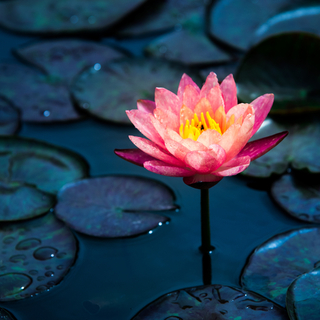
Meaningful or sacred by arranging flowers,
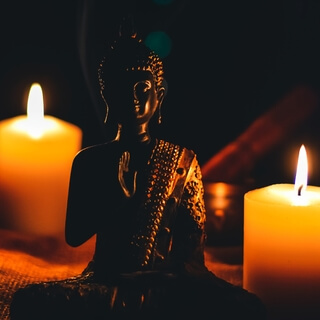
Lighting candles or incense,
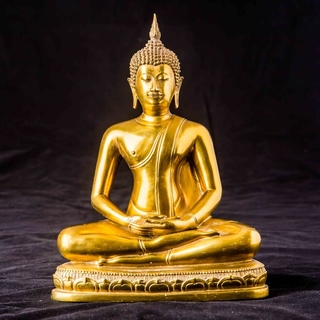
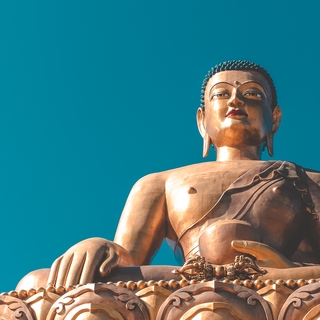
Setting up pictures or statues of inspiring people or places,
Or making offerings and gestures of gratitude.
This helps to designate the meditation space from ordinary space.
Point 2.
Posture,
According to the traditional Tibetan seven-point Viruchana posture.
In the beginning,
Comfort is more important than form.
If seated on the floor,
Place your legs in full or half lotus position or just cross them in front of you.
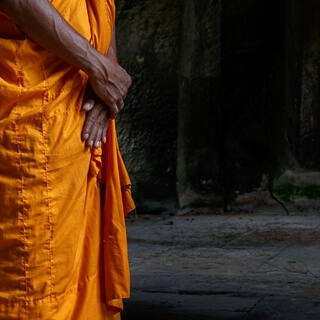
The right hand is placed in the left hand,
Palms facing upwards,
With the tips of the thumbs gently touching.
If seated in a chair,
Place your feet flat on the ground and hands folded in your lap.
Eyes are half open,
Gazing softly at the space in front of you.
This will help prevent you from falling asleep.
If you're feeling restless,
Try closing the eyes completely to help the mind begin to relax.
Keep your spine erect like a stack of coins,
Upright but not rigid.
This will help you stay alert.
Position your meditation cushion beneath your rear to raise the spine and tilt forward the pelvis.
If in a chair,
Come forward slightly,
With your back away from the back of the chair and your rear at the front half of the seat.
Shoulders are even and relaxed,
Being mindful that you're not slouching.
Dip your chin down slightly.
Keep a relaxed space between lips and teeth.
Do not clench the jaw.
Rest your tongue softly on the roof of your palate.
Point three,
Instructions for mindfulness meditation.
We define mindfulness meditation as present-centered awareness with an attitude of discipline and care.
Begin with reflecting on your spiritual aspiration for your life in general and clarifying your intention to meditate in particular.
There are typically three types of aspirations.
The simple aspiration to achieve peace and happiness,
The medium aspiration to achieve complete freedom from suffering,
And the great aspiration to achieve complete freedom in order to benefit all living beings.
Select the object upon which you will focus your awareness.
The breath,
Sensations,
Emotions,
Sounds,
Consciousness,
A specific theme,
A visual object.
Breathe diaphragmatically in order to trigger the relaxation response.
After a short period,
You can allow the breath to settle into a natural rhythm.
Once you realize you've been distracted from the meditation object,
Return your awareness back to the focus with an attitude of discipline and non-judgmental care.
Finally,
Seal your meditation with a dedication,
Recommitting your energies towards your initial aspiration.
Point four,
When and how much to meditate.
In general,
It is advised to meditate first thing in the morning when the mind is fresh and well rested.
Practically speaking,
However,
Consider when your own energy level is optimal and when you have the time in your schedule.
In the beginning,
Commit to slightly less meditation than you think you should do.
Once you've decided on the length of time,
Follow through without exception.
Quality,
Consistency,
And follow through are more important than duration.
Ideally,
You should end your meditation while still enjoying it so that you desire to return to practice the next day.
This is called developing a taste for the practice.
Try starting with five or ten minute intervals,
Working up towards 25-30 minute periods.
Consistency is important.
Better to do a little meditation every day than to do long stretches once or twice a week.
Remember that meditation alone does not constitute the entire contemplative path.
Balance your meditation practice with readings,
Attending lectures,
And meditation with others,
And reflecting on the significance of spiritual themes in your own life.