Welcome.
If you've found your way here,
There's likely something you're carrying.
Perhaps you're in the thick of it right now.
Grief,
Uncertainty,
Fear,
Loneliness,
Or a sensation that doesn't yet have a name.
Maybe you've been moving so quickly that you haven't had a chance to feel what's actually happening inside you.
You're not alone in this,
And you don't need to have it figured out to be here.
Our nervous systems are ancient,
Remarkable instruments.
They're designed to keep us alive,
To help us flee danger,
To numb when pain becomes too much,
To armor us when the world feels unsafe.
But sometimes,
In protecting us from feeling too much,
They also prevent us from healing.
We become skilled at moving around our suffering rather than through it or with it.
Our most basic truth is that suffering is a part of life.
It's woven into the fabric of what it means to be human.
It's part of our contract with the universe to be here.
Life's beauty is inseparable from its fragility,
The difficulty,
The loss,
The impermanence of it all.
Mindfulness is the experience of observing and existing in reality as it is.
In practicing mindfulness,
We must meet reality and embrace universal suffering as part of the experience.
When we try to bypass our pain,
When we look away from what's hard,
We separate from ourselves and from each other.
The part of you that numbs,
Distracts,
Or pushes away feeling is the part of you programmed to keep you functional and productive.
Thank it.
Then for the next few moments together,
We'll gently invite our nervous system to practice a different state,
Knowing that you are safe right now.
There are many ways to deepen our capacity to hold what's difficult.
All of them require the same first step,
Permission to slow down.
So I'm inviting you now to sit with your own suffering.
As you do,
I want to remind you that you don't have to solve it,
Understand it,
Or make it mean something.
Sometimes the most healing thing is to simply acknowledge.
This is hard.
This hurts.
I'm here with it.
And that's enough.
Part 2.
Grounding when you need it.
Before we enter this practice together,
Some compassionate heart-keeping.
I'm offering you a guided audio meditation and somatic practice,
Which means I can't see you,
Can't sense where you are,
Can't know the particular shape your suffering takes today.
I hold this limitation with care,
And I want you to hold yourself with even more.
If you are in the midst of acute or extreme trauma right now,
If you are in immediate crisis,
Experiencing active harm,
Or in a situation where your safety is compromised,
This practice may not be right for you in this moment.
Please reach out to in-person support if you have access to it.
A therapist,
A crisis line,
A trusted person who could be with you in this moment.
Recorded meditations cannot replace the presence and responsiveness of another human being when you need it most.
Working with what's difficult can be tender,
Activating work.
There's a crucial difference between feeling and flooding,
And knowing this difference might be the most important thing you learn here.
Feeling looks like this.
My chest is tight.
My eyes are tearing.
My throat feels closed.
I feel sadness in my heart.
Flooding looks like this.
I can't breathe.
Nothing will ever be okay.
This always happens to me.
I can't think.
I need to get out of my body.
If you find yourself flooding,
If your thoughts are racing and catastrophic,
If you've lost your sense of time and place,
Or if you feel desperate or like disappearing,
You've gone too far.
It's information from the nervous system and the body,
And that's okay,
But I urge you to be gentle with yourself.
I would encourage you not to push through this experience.
Instead,
Consider turning off this meditation and ground yourself using one of the following techniques.
Try gentle movement.
Stand up,
Stretch,
Shake your hands,
Walk into another room,
Go for a walk outside.
Movement tells your body that you have agency and that you're not trapped in your current state.
You might also ground yourself by pressing your feet into the floor,
Feel the chair or cushion beneath you,
Or place your hands on your thighs or even wrap your arms around yourself.
My personal favorite is to simply lay down on the floor.
Solid ground to ground yourself.
And finally,
You could try changing your temperature.
Hold ice in your hands,
Splash cold water on your face,
Or wrap yourself in something warm.
Changing temperature is one of the fastest ways to bring your nervous system back online and your awareness back into the present moment.
This is you building capacity gradually,
Learning to touch the edges of pain without being consumed by it.
Healing happens in the space between too much and too little,
And only you can feel where your boundary is.
You're allowed to pause,
You're allowed to stop,
You're allowed to come back another day.
Your willingness to even try is already enough.
When you're ready,
Let's begin.
Part Three.
The Practice.
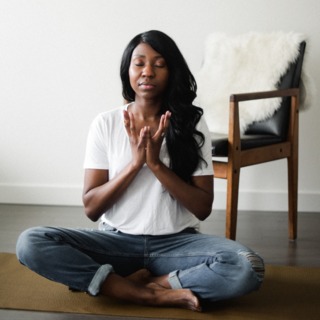
Find a comfortable place to settle.
This might be sitting,
Lying down,
Or standing.
Whatever allows your body to feel supported right now.
Keep your eyes open or closed,
Whatever feels safer.
This is a practice to help you learn how to touch the edges of what's difficult without being consumed by it.
We'll move slowly,
With intention,
Undulating between constriction or difficulty,
And relaxation or safety.
Before we turn inward toward anything difficult,
We need to establish a state of awareness.
Establish an anchor,
Something that feels neutral,
Steady,
Or even pleasant in this moment.
Take a look around the room you're currently in and find something that catches your attention in a positive way.
Maybe it's a color that stands out to you,
A plant,
A photograph,
The way the light falls through a window.
Take a moment and let your eyes rest there.
Now bring your attention back to your body.
Find one place in your body that feels relatively comfortable or neutral right now.
Perhaps it's the palms of your hands,
Resting on your leg,
Or turned towards the sky.
Maybe it's your feet against the floor.
Maybe it's your back against a chair,
Or on the surface upon which you are currently laying.
Throughout this practice,
This is your anchor.
This is where you can return whenever you need to.
If it feels right for you,
Touch this place with your hand.
Feel the sensation beneath palm and fingertip.
Notice the temperature,
The texture,
The weight of this anchor point.
Notice the flow of your own breath without needing to change or transform it in any way.
Allow this awareness to build a bridge between the anchor point in your physical body and the anchor for your attention on the flow of your breathing.
You can come back here anytime to the anchor of your body or the anchor of your breath.
Now that we've established your anchors,
I'm going to invite you to think about what you're carrying.
A moment or memory of suffering that travels around with you like heavy baggage,
Just for a moment.
No need to ruminate on the whole story.
No need to dive into the deepest part.
Just the edge of it.
Maybe it's a word,
A feeling,
An image,
Or sensation in your body.
Let yourself notice it for just 10 more seconds,
That's all.
10,
9,
8,
7,
6,
5,
4,
3,
2,
1.
Notice your next inhale or intentionally take a deep breath in through the nose if you can.
Then let it go,
Extending your exhale breath for about 6 to 8 seconds.
Now bring your attention back to your anchor.
Back to that neutral or comfortable place in your body,
An object in the room that feels steady,
Or the flow of your breath.
Notice you touched something difficult,
Sat in a moment of suffering,
And then you came back.
You have control over where your attention goes.
Let's try again,
This time for a little longer.
Picking up your attention from wherever it may currently lie,
Bring it back to what's difficult.
What do you notice in your body when you think about it?
Where do you feel it?
What qualities does this sensation have?
Is it hot or cold?
Tight or relaxed?
Moving or still?
Just notice.
Don't try to change it.
No need to fix anything.
15 more seconds.
15,
10,
5,
4,
3,
2,
1.
Pick up your attention and awareness from wherever it may currently be.
Can you notice your next inhale or intentionally take a deep breath through the nose if you can?
Then exhale,
Letting it go by extending the out breath for 6 to 8 seconds.
Again,
Come back to your anchor.
Notice that spot on your body,
That steady object in your room,
The movement of your breath.
You're learning that feelings have edges.
They have beginnings and endings.
They don't last forever.
Emotions are constantly in motion.
Now let's try something.
Instead of pulling away from what's difficult,
We're going to notice what your body does naturally.
Bring your awareness back to the suffering.
To the ache of what hurts.
Notice what happens in your body as you bring it to your mind's eye.
Does it tighten?
Heat up?
Does your breath change?
Do you feel pressure anywhere?
Just track these sensations.
Watch them like you're watching clouds pass through the sky.
As you take time and intention to observe these sensations,
Without forcing anything,
See if you notice any shifts,
Even tiny ones.
Does the intensity plateau?
Or maybe even dissolve away slightly?
Does it start to soften,
Even by 1%?
Does your breath start to slow or deepen slightly?
Do your muscles start to unclench?
This is the natural rhythm of activation and settling.
A cycle that your nervous system naturally desires,
But has perhaps forgotten.
As a result,
It creates tension patterns of holding and gripping and ruminating.
As we slow down,
We interact with our body.
We invite our nervous system,
Our bodies,
To return to this cycle.
To soften.
To settle.
If the intensity is rising too much,
Or perhaps you haven't noticed any subtle transformation or shifts,
Come back to your anchor.
We're working on building capacity gradually.
So remember,
We're trying to connect to our feelings without being flooded by them.
Once again,
Notice your next inhale,
Or intentionally take a deep breath in through the nose,
If you can.
And let it go through the mouth,
Extending your exhale breath.
For about six to eight seconds.
Let's move a little deeper now,
But only with this sensation.
Not the narrative of your story,
The why,
Or the how,
Are not important for these next few moments.
Bring your attention back to what's difficult.
Sit with your suffering once again.
This time,
Instead of thinking about what happened,
Or what it means,
Just describe the sensation quietly to yourself that is happening within your body.
Where is it?
Your chest,
Your throat,
Your stomach,
Your shoulders.
What does it feel like?
Is it hot or cold?
Tight or spacious?
Heavy or fluttering?
Does it have a color,
A texture,
Or a shape?
You might say to yourself,
There is tightness in my chest.
It's hot,
Feels red,
It's about the size of my fist.
Stay with the sensation,
Not the story.
Notice,
When you describe it this way,
You create a little bit of space between you and it.
Your higher self and the experience of your suffering.
You are not the suffering.
You are the one noticing the suffering.
You're the witness.
You're the witness working with your body and not fighting against it.
Notice your next inhale,
Or intentionally take a deep breath in through the nose if you can.
Then let it go,
Extending your exhale for about six to eight seconds.
Breathe.
We'll repeat this together for a few more cycles.
Through the nose,
Inhale for 1,
2,
3,
4.
Exhale 8,
7,
6,
5,
4,
3,
2,
1.
Through the nose,
Inhale 2,
3,
4.
Exhale 8,
7,
6,
5,
4,
3,
2,
1.
Through the nose,
Inhale.
Exhale.
Inhale.
Exhale.
Inhale.
Exhale.
Exhale.
One more time,
Take a deep inhale through the nose.
Make it your biggest inhale yet,
Filling the belly,
The chest,
Back of the throat.
Breathe into the top of your head,
And with a gentle sigh,
Exhale.
Let the breath go fully.
Settle here for a moment and just notice how you feel.
Your body may want to do something right now.
You might want to shake,
Or sigh,
Or cry,
Or yawn,
Or stretch.
This is discharging.
This is how our nervous system completes the stress cycle,
How it releases what's been held.
If something wants to happen,
Let it.
You don't have to understand it.
You don't have to make it make sense.
Shake your hands if they want to shake.
Let your shoulders drop.
Sigh as big as you need.
Cry if tears come.
Trust that your body knows what it's doing,
And if none of these experiences arises for you,
Know that that is okay too.
As you allow more space and more presence for your suffering,
Your inner protector may come to rescue you.
You may notice yourself pulling away,
Going numb,
Wanting to distract yourself,
And that's okay.
That's a part of you that's been keeping you safe.
You might even say to that part,
Thank you for protecting me.
I see you.
I know you've been working so hard.
And then gently,
Let it know I am safe right now.
I invite it to relax just a little bit.
Can I let this be just for now?
As natural as the cycle of our nervous system,
So too is the protector.
We're not fighting against protection.
We're building relationship with it.
We're befriending it.
What it desires for us most is a sense of safety and grounding.
So in the times when it arises,
Place your hand on your heart if that feels right.
Feel your own warmth,
Your own care.
Say to yourself,
Silently or out loud,
I see this suffering.
I don't have to fix it right now.
I am safe,
And I am here with it.
There is room within my nervous system for this experience.
Suffering moves through us when we stop racing against it.
That movement allows for a flow of deep and meaningful change.
With time and presence,
This practice helps us build not only more compassion,
More capacity for our own suffering,
But it helps cultivate an empathetic and compassionate heart towards the universal experience of suffering for all.
Now,
Gently bring your full awareness to the heart.
Back to the room.
Back to your anchor and perhaps to your breath.
Take a moment to feel your feet on the ground.
Look around you.
Notice where you are.
Take a deep breath in and a deep breath out.
You sat with your suffering,
And you're still here.
You navigated the edge and came back.
You welcomed the tides of your suffering without being capsized by the ocean's waves.
This is how we build capacity.
Not by forcing ourselves into the deep end,
But by learning that you can touch the water and return to shore.
Return to this practice again whenever you need to.
As with any practice,
Consistency yields greater results.
Let your body move what it needs to move and witness the experience without needing to.
To fix or change.
Little by little,
Your capacity grows.
Thank you for having the courage to sit with yourself.
When you're ready,
Return to your day with gentleness.